COUN 6001, Professional Dispositions and New Student Orientation, is a 1-credit entry course in Walden's School of Counseling. One choice decides most of the grade: describe a disposition in the abstract, or show yourself practicing it. Reflection rubrics are built to reward the second, and writing the first is the commonest way students lose marks here.
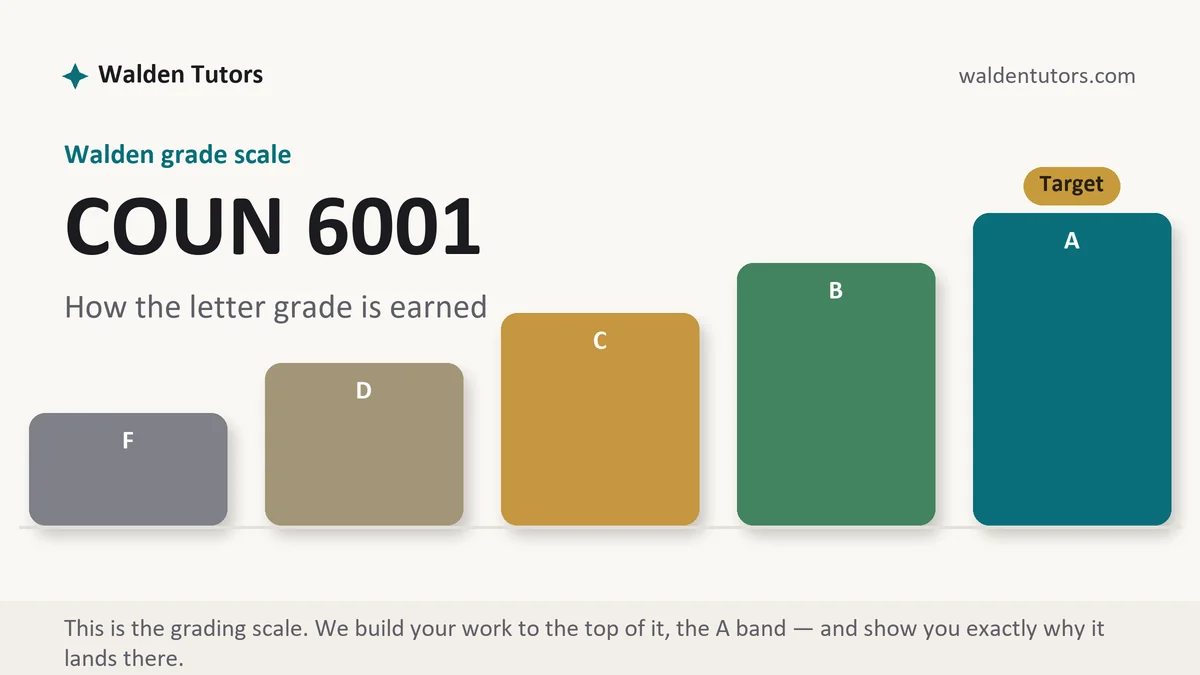
What COUN 6001 actually grades
Short reflective writing measured against a published set of professional dispositions, confirmation that you worked through the program orientation materials, and discussion participation where the scoring looks for self-application rather than definition. At 1 credit the reading load is small, which fools people into treating the writing as a formality. The vocabulary you meet here follows you: the same disposition language reappears in practicum and internship evaluations, where somebody rates you against it.
Results arrive as letter grades assembled from rubric rows, the same as every other Course-Based item in the sequence. Counseling terms run on a quarter or a semester calendar depending on which program admitted you, so treat your student portal as the authority on dates rather than anything a tutoring site tells you. Walden wants more than a silent login in the opening week: a discussion post or a submitted assignment has to appear, and this is frequently the course where students first meet that rule.
How we help in this course
Tutoring reviews your student-authored reflection for specific first-person incidents and annotates where each paragraph answers a rubric row. You choose every revision, preserve your own voice, and submit only work you can explain and defend.
Everything else matches the standard terms across this site: delivery inside 24 to 48 hours, an A target on each deliverable, two separate quality passes before anything reaches you, and revisions at no cost until that target lands.
Weekly manuals for this course
COUN 6001 manuals go up week by week, each released only once the deliverable behind it has been confirmed inside a running classroom. Walden does not open its syllabi to the public, so a grid assembled from guesswork would be worse than no page at all. Where the item in front of you has no manual yet, bring the prompt to chat and the drafting desk works from that instead.
Sitting in COUN 6001 right now?
Paste the prompt plus whatever rubric came attached to it. There is no charge for the first premium sample, and it reaches you in 24 to 48 hours.
Why disposition writing is harder than it looks
A disposition is not a skill and not a body of knowledge. It is a habitual way of showing up: openness to feedback, tolerance for ambiguity, cultural humility, willingness to be supervised. Because those words are abstract, the instinct is to define them, and definition is precisely what the rubric declines to pay for. A grader working through forty of these can tell inside two sentences whether you are describing the concept or describing yourself.
The second difficulty is that candid self-assessment feels risky. Students worry that naming a weakness will be remembered by a faculty member who later signs off on their readiness to practice. In this course the opposite holds. A reflection claiming every disposition is already strong reads as thin self-awareness, and thin self-awareness is itself a disposition problem. Naming one genuine growth area and attaching a plan to it is both the safer paper and the higher-scoring one.
How to actually write COUN 6001: where to begin
Start from the disposition list your program published, not from a general article about counselor characteristics. Walden's School of Counseling names the dispositions it expects, and the assignments are written against that named list. Print it out. Beside each item write two lines: a moment when you demonstrated it, and a moment when you did not. Those notes become raw material for everything the course asks you to submit, and collecting them costs half an hour that saves several.
Next, open the rubric and turn every row into a heading in an empty file. Read the point value beside the row and give it proportional space. Reflection assignments hide their weight in the rows about application and planning, while students spend their words on background narrative. If the row asking what you will do next carries a quarter of the marks, one closing sentence about growth will not fill it.
Build each paragraph on a simple spine: name the disposition, give one concrete incident, say what it revealed, then state the specific change you are making. Incidents work best when they are small and dated. A disagreement with a supervisor last spring. A client interaction from a previous job. A group project where you went quiet. A piece of feedback you argued with before you accepted it. Gesturing at years of experience in healthcare proves nothing, and no grader can award a row for an event you never described.
Watch the scholar-practitioner framing, because Walden uses it deliberately. It means connecting your own practice to published thinking rather than writing pure memoir. One or two sources per reflection, used to interpret your incident instead of decorating it, is usually the right density. The social change element is not decoration either. Say who benefits when this disposition of yours gets stronger, and be concrete about the population you intend to serve.
| Section | What it does | Common failure |
|---|---|---|
| Opening frame | Names the disposition you are addressing and why you selected it. | A general paragraph about the counseling profession that never identifies the disposition under discussion. |
| The incident | One specific, dated situation described closely enough that a reader can picture it. | A blend of several vague situations, so nothing can be examined and nothing can be scored. |
| Self-assessment | An honest read on how you handled it and what that handling revealed about you. | Self-congratulation, or a confession with no analysis attached to it. |
| Scholarly link | A source interpreting the incident or defining the professional expectation you fell short of. | A citation dropped into the final line to satisfy a requirement, connected to nothing. |
| Growth plan | The particular behavior you will change, and how you will know it changed. | A promise to keep improving, which names no action and sets no marker. |
| Orientation confirmation | Evidence you worked through the program materials the course asks you to verify. | Skipping the verification step because the essay felt like the only graded part. |
Discussion-post craft in an orientation course
Discussion carries its own rubric here, and these early threads set a tone faculty remember. An initial post that works usually does three things: takes a position, grounds it in something that genuinely happened to you, and cites once. Walden's grading policy asks for participation that is substantive, consistent and on time, and suggests spreading contributions over a minimum of two to four days rather than dropping the lot in one sitting. A thread where every post is stamped on the last evening reads as compliance, not engagement.
Replies are where orientation courses separate people. Agreement adds nothing. A reply that earns its row takes a classmate's example and does something with it: offers a different reading of the same incident, names the disposition they described without labeling, or asks the question their story leaves hanging. Keep it warm. This cohort sits in your classes for two years and some of them will read your work in group supervision. Check your own classroom for how many replies count and which day they close, since Walden states outright that what a thread demands is not identical from one section to the next, or even inside a single course.
Citations and APA 7 in reflective writing
First person is permitted in reflective assignments and expected in this one, so drop the habit of writing "this author" to sound formal. What does not relax is mechanics: the title page Walden expects, heading levels applied by the rules rather than by eye, and a list of references in which nothing appears that the text never cited and nothing cited has gone missing. Set that template up once now and reuse it for the next two years.
Search inside the Walden Library instead of the open web. The counseling databases your later courses take for granted are indexed there, and a general search engine will hand you commentary where a rubric wanted research. For a dispositions paper the productive shelf holds work on counselor development, reflective practice and supervision, while the ACA Code of Ethics stands as a citable document in its own right whenever you write about professional expectations. Give every source one job you could state aloud in a few words, then set the attribution within the claim itself, so a reader meets the evidence at the same moment as the assertion.
The mistakes that cost points in COUN 6001
- Treating a 1-credit course as ungraded, then finding the letter sits on the transcript like any other.
- Defining each disposition from a textbook or a dictionary instead of evidencing it from your own conduct.
- Claiming even strength across every disposition, which a counselor educator reads as absent insight.
- Growth plans built from intentions rather than actions, leaving nobody able to tell whether the change happened.
- Missing the orientation verification tasks, which are quietly scored even though no writing is involved.
- Submitting after the cutoff, which falls at 10:59 p.m. Central time and shows as 11:59 p.m. on an Eastern clock.
COUN 6001 questions students actually ask
Does a 1-credit course really matter to my GPA?
Yes, though the arithmetic is gentler than you fear. A 1-credit course carries less weight in a grade average than a 5-credit one, so a single result here shifts your standing less than a result in a full course would. Treat that as permission to relax about the workload, not permission to skip it. The bigger stake is not numerical. This is where faculty form their first read on your professional conduct, and the qualities you write about are the ones you get rated on when you reach practicum.
How honest should I be about a weakness?
Honest about something real, and specific about what you are doing with it. The safe zone is a growth area you have already begun working on, described plainly, with an action attached: a habit of filling silences, discomfort with critical feedback, impatience when a process moves slowly. Outside that zone sits anything that is a live, unmanaged risk to a client, which belongs in a conversation with your advisor rather than a graded reflection. Counselor educators read self-awareness as a strength and defensiveness as a warning, so the paper claiming nothing needs work is the one that raises eyebrows.
Can I reuse this writing later in the program?
Reuse the material, never the document. Your incidents, your growth areas and your notes against the disposition list are worth keeping in one running file, because they resurface in practicum applications, site evaluations and interviews. Handing in the same paper twice for credit counts as self-plagiarism under Walden policy and it does get caught. What you can do freely is revisit the same incident two years later with training behind you and write something better about it, which is roughly what the course was setting up.