A premium sample is a complete original model of your exact Walden deliverable, your course, your week or competency, your rubric, delivered with notes that map each section to the rubric row it satisfies. It exists so you can see what top-of-scale work on your precise assignment looks like before you write your own version. Discussions, APA papers, Tempo Work Products, capstone chapters: same promise, first one free.
What arrives in your inbox
| Component | What it is |
|---|---|
| The model | Full-length, written to your rubric in your program's register, current APA throughout. |
| Rubric map | Notes tying every section to the row it satisfies, and where the top-level move lives. |
| Reference list | Current scholarly sources, every one actually used, verified by the APA QA pass. |
| The outline we used | How the rubric became structure before it became prose, the transferable part. |
Sample types, matched to Walden's real deliverables
Discussion samples show the compound-prompt structure and what a substantive reply actually reads like. Assignment and paper samples model the APA-heavy weekly work that fills course-based terms. Tempo samples are drafted to the Exceeds Expectations rows, because Mastered is a row-counting game and the sample should show the count. And the long-form samples, DNP project sections, DBA doctoral study chapters, dissertation pieces, arrive as staged excerpts with the architecture visible, since the architecture is what doctoral students most need to see.
Using a sample well
Read the rubric map first
Ten minutes with the notes teaches more than an hour with the prose, because the notes show why the piece is shaped the way it is.
Rebuild the outline in your own words
Take the structure, restate each section's job, and slot in your own practice examples, your unit, your classroom, your organization.
Write your version and keep the moves
Answer-first openings, evidence attached to claims, the named top-level extra per row. The moves transfer; the sentences are yours.
Self-score, then submit your own work
Check your draft against the rubric like our QA does, and submit from your own account. Your school's integrity policy governs use of study materials, and this workflow is built to respect it.
The free first sample
Tell us your class, the week or competency, and the rubric, and the first complete premium sample is free, no card required. It is the audition: judge the bench on your own assignment, not our marketing. One per student, standard 24 to 48 hour delivery, and if your deadline is closer than that, say so and the desk will answer honestly.
Claim the free sample
Email, phone, and the assignment details. The team starts today.
What a sample paper is, and what it is not
A premium sample is a complete document written against your prompt and your scoring guide, delivered to you as a model to study. It is not a submission, and nothing about the way it arrives pretends otherwise: it comes as a file to your inbox, not into a classroom, and the account that uploads your assignment is always yours. Walden's academic integrity policy is the text that decides what a student may do with study material, and reading it once yourself beats trusting any vendor's summary of it, including ours.
What a sample is not is a paper pulled from a shelf. Every one is drafted for the request, which is why the turnaround is 24 to 48 hours rather than instant. A recycled file would be faster and worthless, because it would answer a prompt that was not yours and would already have been read by every similarity database your grader has access to. The value sits in the fit: your week, your rubric rows, your program's register, and the notes explaining why the document is shaped the way it is.
Reading the rubric map, the part that transfers
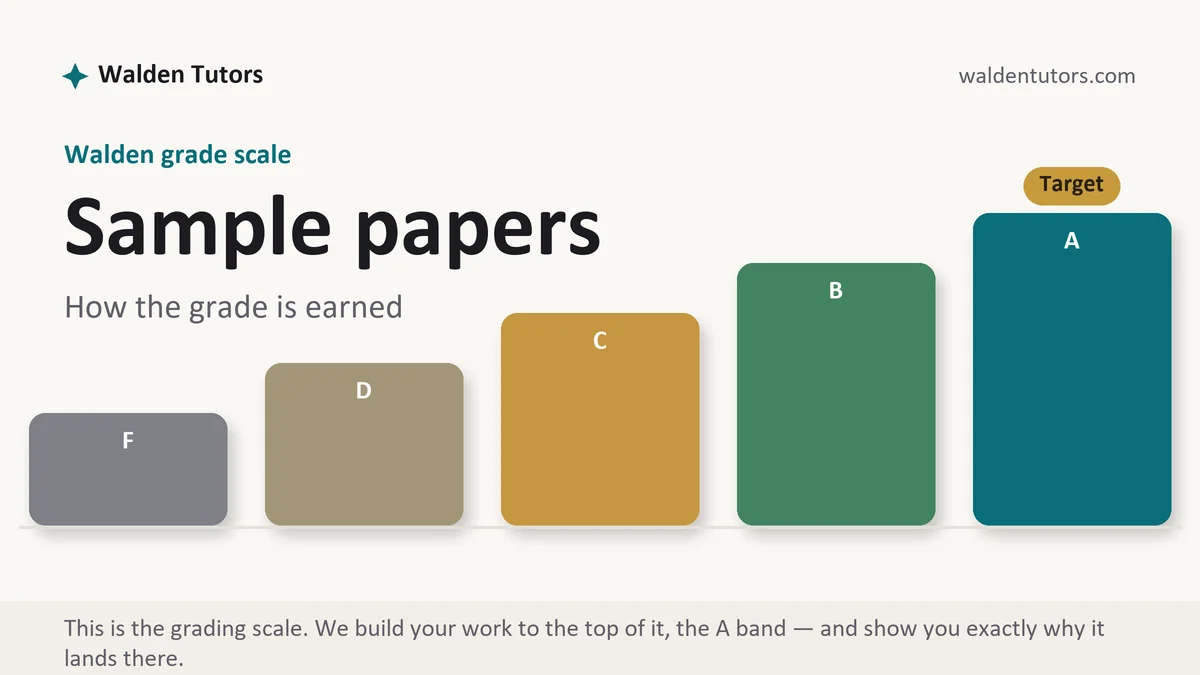
Walden grades course-based work as a letter built from a rubric with point-weighted rows. That sentence contains the whole method. Each row is a question your grader has committed in advance to asking, and the points beside it say how much that question matters. A sample that scores well is not better written in some general way. It is proportioned to those weights, and the rubric map that ships with it makes the proportions visible.
So read the map before the prose. It tells you which paragraph exists to satisfy which row, where the top-band move sits in each section, and which sentences are doing structural work rather than decorative work. Then do the exercise that actually teaches: rebuild the outline from the map alone, without looking at the document, and see whether you can state each section's job in one line. If you can, you have the method. If you cannot, you have found the row you were about to underfeed. Students who want the underlying theory before the model arrives can read the rubrics guide first, then use the sample as the worked example.
Timing a sample against your own term clock
How much room you have depends on which calendar your program follows, since Walden keeps two. Quarter programs, with nursing's online MSN and DNP as the verified instance, hold a term to 11 weeks, a figure that comes out of published dates rather than folklore: the cycle we checked began August 25 and finished November 9, exactly 77 days, with the following start 13 weeks along because a two-week break sits between them. Semester programs are longer, roughly sixteen weeks, the MBA being the one this site prices by the semester term. Set your sample request against whichever calendar your portal shows and the timing question answers itself.
Here is the arithmetic. Standard delivery is 24 to 48 hours. Ask on the Monday of a week whose assignment closes Sunday and the model reaches you Tuesday or Wednesday, leaving four or five days to write your own version without hurrying. Ask on Saturday and you are gambling on the fast end of a range that was never promised. The bigger number is the one about which week you choose. A sample requested in week 2 of an 11-week quarter informs the nine weekly deliverables that follow it. The same sample requested in week 10 informs one. Walden also wants something graded posted in your opening week, so nothing about the start of a term is a warm-up, and the cheapest week to learn the method is always earlier than it feels.
Manual, sample, or full drafting: choosing between them
| The free manuals | A premium sample | Full drafting support | |
|---|---|---|---|
| What you get | The method written out, no document attached | One complete model of your exact deliverable, with the rubric map | Drafts for the deliverables you nominate, week after week |
| What it costs | Nothing but reading time | Nothing for the first one, then per document | Per deliverable, quoted before anything starts |
| Time it saves you | None directly. It saves you from redoing work | A few hours, and the false starts | The writing hours themselves |
| Best when | You write comfortably and just want the scoring logic | You have never seen the format and want a target to aim at | The calendar, not the ability, is what broke |
| The catch | Generic by nature; it cannot know your rubric | One document teaches one format, not the whole term | The writing reps go to somebody else that week |
The tradeoff deserves stating in both directions. A sample shortens the learning curve on a format you have never attempted, and it does nothing for a student who already writes well and is simply out of hours. Full drafting returns the hours and costs you the practice, which is a fair trade in a bad month and a poor one as a habit, because the capstone assumes reflexes built earlier in the sequence. If you are honestly unsure which you need, take the free sample and find out on evidence.
Walden sample paper questions students actually ask
Can I submit the sample paper as my own work?
That is not what it is built for, and we will say so plainly rather than wink at it. A sample is a model: you read it, rebuild its structure in your own words, and submit a document you wrote from your own account. Walden's academic integrity policy is the text that decides what may be done with study material, and it is worth reading once yourself rather than taking any vendor's word for it. The rubric map exists precisely so the transferable part is the method, not the sentences.
Is the sample reused for other students?
No. Each one is written from your rubric, your prompt, and your course, which is also why turnaround is 24 to 48 hours instead of instant. A file pulled from a bank of past papers would be faster and would be worth nothing, because it would answer a prompt that is not yours and would have been read by a database before it reached your grader. Ask for a sample on a course code such as NURS 6512, or NURS6512 as students often type it, and what comes back was drafted for that request.
How long is a sample paper, and does it match my word count?
It matches whatever your assignment specifies, because length is usually a rubric constraint rather than a suggestion. Send the page or word limit with the request. If your prompt gives a range, the sample is built near the top of it, since the extra room almost always goes into the analysis rows rather than the summary. If your prompt gives no limit at all, the sample is sized from the point weights, with the heaviest rows carrying the most text.