Group Counseling in the Schools carries 5 quarter credits and sits in the school counseling side of Walden's COUN sequence. Its catalog description names the destination clearly: you study group theory, process and dynamics, and then you prove you understood them by building a small group plan for an actual school setting. That plan, and the writing that defends it, is what gets graded.
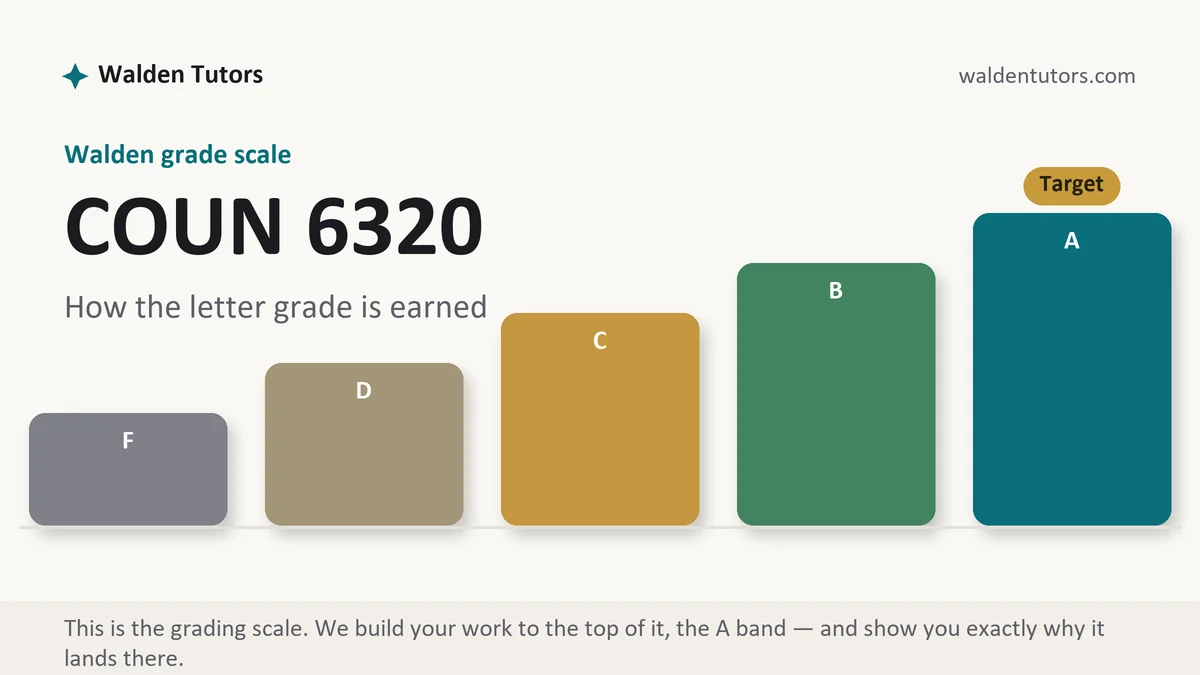
What COUN 6320 actually grades
The centrepiece is a designed group, written up so another counselor could run it. That means a rationale grounded in a need somebody could point to, membership decided rather than assumed, a session sequence with a purpose per meeting, and an evaluation method that would produce evidence at the end. Around the plan sit shorter graded pieces on leadership, on group stages, and on the ethical territory that opens up when the members are minors sitting in the same building all day.
One structural point worth knowing before you plan your quarter. In Walden's published plans of study this course does not travel alone: it is listed beside GRPL 6100, the zero credit Counseling Group Lab, and in the clinical mental health sequence COUN 6250 Group Process and Dynamics appears as the alternative to it. So the group work you do here is deliberately split between a course that grades your writing and a lab that grades your participation. Students sometimes assume the lab will carry the applied part and the written plan can stay theoretical. The rubric does not work that way, and the plan is where the applied marks live.
What the rows keep testing is whether theory is doing any work. Anybody can name the stages a group moves through. The scored question is what you would actually do in the second meeting when nobody talks, or when one member fills every silence, and which part of the theory told you to do that. Walden's description also puts group work in service of social change, so expect at least one deliverable asking what your group is meant to shift in the building, not only in the six students inside the room.
How we help in this course
Group plans are a drafting problem before they are a counseling problem, because the content is only worth points once it is organized the way the scoring guide reads. We take your instructions, your rubric and your school context, then write the plan as a document a principal could be handed: rationale, screening, sessions, leadership, ethics, evaluation, each part carrying the reasoning that justifies it.
Standard terms apply. Work is returned within 24 to 48 hours, drafted at the top band of every row, checked by a rubric reviewer and then by a separate APA and originality reviewer before it reaches you, with revisions included until it lands. If your program expects a particular school counseling framework or a specific ethical code, name it in the order and the draft will be built on that footing.
Weekly manuals for this course
Individual week manuals for this course go up as each is confirmed, and until one exists this page says nothing about it. There is no public syllabus for a Walden course, so any site printing a confident week-by-week list for 6320 has guessed. Two calendars operate at this university, a quarter and a semester, and your admission decided which of them your terms follow. The course code has no say in it. That is a further reason the schedule belongs to your student portal and not to us. Bring your week to chat and the desk will tell you what is already written.
Small group plan due?
Send the instructions, the scoring guide and a line about your school setting. The first sample is free.
How to actually write COUN 6320: build the building before you build the group
Underneath every row in this assignment sits one question: could a counselor run this in a real school on a real Tuesday? So describe the building before you design anything inside it. The grade band and roughly how many students. The bell schedule, and what a member gives up by attending during it. Whether there is a room where six people cannot be overheard through a door. How consent travels home and comes back, and in which languages it has to travel. Who else must know the group exists, and what you would tell an administrator who asks. That paragraph decides most of the feasibility marks, and a plan written in the abstract forfeits them without ever seeing what happened.
With the setting fixed, lay your scoring guide beside it and take your section headings from its rows, in its order and its words, with the weight noted next to each so the sections that pay are the ones that get length. A group plan runs long, and a long document is where rows go missing quietly.
Choose the need next, and choose one a school would recognize. Attendance, transition into a new building, friendship difficulties in the middle grades, grief, academic organization, anxiety around testing. Then say how you would know that need exists in your setting, because a rationale supported by referral patterns, attendance data or a staff survey is an argument, while a rationale supported by the sentence many students struggle with this is a wish. Rows about needs assessment are looking for the source of your claim.
Design the sessions in a sequence, and make the sequence visible. Session one belongs to safety, rules, confidentiality and what leaving the group would mean. The middle sessions carry the work, and each should list its goal, the activity, the processing questions and the expected difficulty. The final session belongs to consolidation and to ending properly, which in a school is not a formality since these young people will pass each other in a corridor tomorrow. When you write the activities, write what you would say to introduce them. Rows measuring group leadership are hard to satisfy with descriptions of what will happen and easy to satisfy with the words that would make it happen.
Finish with evaluation, which is where good plans get careless. Say what you would measure, when you would measure it, and what result would tell you the group worked. Pre and post ratings from members, teacher observations, attendance or discipline records, whatever the goal implies. Then use your sources to synthesize rather than to summarize: bring two studies together on the same claim, note where they disagree about which age benefits most from group work of this type, and say what that disagreement means for your design. One paragraph per claim, with the literature arriving to support the claim, always beats one paragraph per article.
Citations and APA the way Walden grades them
This course wants sources in three places especially: the need you claim, the group format you chose, and the outcomes you expect. Each of those is an empirical claim and each should carry evidence drawn through the Walden Library, where the school counseling and group work journals live. Where the literature was built with a different age group or a different setting than yours, say so in the sentence rather than hoping nobody checks, because acknowledging the gap is scored as judgment.
Ethics gets cited too. Group work in a school raises confidentiality problems that individual work does not, since you can bind yourself but not five thirteen year olds, and that reality has to be handled with the standards your program uses named directly. On formatting, follow APA 7 through the Walden title page, consistent heading levels for a long document, and a reference list that matches the text exactly in both directions. Long plans lose easy marks in the reference list because a source cited in session four never got added. Check that at the end, every time.
| Section | What goes in it | Where it goes wrong |
|---|---|---|
| Need and rationale | The concern you are addressing and the evidence from your setting that it exists. | A general statement about student struggles, with no data, referral pattern or staff input behind it. |
| Group type and membership | Purpose, size, age or grade band, open or closed membership, and the reason for each choice. | Numbers chosen without justification, so nothing explains why six members rather than twelve. |
| Screening and consent | How members are identified, how you screen for fit, and how guardians are informed and asked. | Screening skipped entirely, which also removes any chance to address who is wrong for this group. |
| Session sequence | Each meeting with its goal, activity, processing questions and the words you would use to open it. | A list of games with no processing, so the plan reads as activities rather than as counseling. |
| Leadership and process | Your style, how you would handle silence, dominance, conflict and a member who wants out. | Stage theory recited in the abstract, with no moment in your own sessions where it changes what you do. |
| Ethics, culture and context | Confidentiality limits among minors, school constraints, family communication, cultural fit of the design. | Confidentiality promised to the group as though you could enforce it on every member. |
| Evaluation | Measures, timing, and what a result would have to look like for you to call the group effective. | Success defined as members enjoying it, which no rubric row on outcomes can award points for. |
Discussion posts in a group work course
Threads here often ask what a leader should do in a described moment, and the honest answer usually has a fork in it. Say what you would do, say which principle of group process sent you there, and then say what you would do instead if the room reacted badly. That second half is what marks a post as clinical thinking rather than a preference. Cite something, even briefly, since a scored row asking for application of theory is asking you to show whose theory.
Walden's own guidance on participation asks for contributions that are regular, substantive and submitted on time, and it points students toward spreading their posting across two to four days of the week rather than arriving all at once. A group work classroom rewards that more than most, because a thread is itself a group and it develops in stages. The university also expects a login and a first post or submission during the opening week of the term, so nothing about week one is optional.
Good replies test the plan in front of them. Ask what happens to a colleague's activity when one member refuses to participate. Point out the confidentiality problem hiding inside a design that pulls students from the same homeroom. Offer the processing question their activity is missing. Your classroom sets the number of replies and the day they close, and Walden says outright that these requirements vary by course and by week, so read this week's instructions rather than assuming. Submissions close at 10:59 p.m. Central, equivalent to 11:59 p.m. Eastern.
The mistakes that cost points in COUN 6320
- Activities listed with no processing questions attached, which turns a counseling group into a series of exercises.
- A rationale asserting a need without a single indicator from the school that the need is really there.
- Confidentiality described as though the counselor could guarantee it on behalf of every member in the room.
- Group stages named in a theory section and then contradicted by a session plan that expects deep disclosure in meeting one.
- A design that ignores the timetable, so students would miss the same class every week with nothing said about it.
- Evaluation reduced to a satisfaction question, leaving the outcome rows with nothing measurable to score.
COUN 6320 questions students actually ask
How many sessions should my small group plan cover?
Your assignment sets that number and nothing on the open web can tell you what it is, so read the instructions before you design anything. What you can rely on is the internal logic: whatever the count, the first session builds safety and sets the rules, the closing session consolidates and says goodbye properly, and the sessions between them move from lighter disclosure toward the real work. If the count is left to you, pick one a school day can actually accommodate and justify the choice in writing. A plan built around a schedule no counselor could timetable loses points for feasibility even when the content is good.
Do I need a real group of students, or can the group be hypothetical?
Most versions of this deliverable are designed on paper, and the rows reward a plan that could be run rather than proof that you ran it. Ground it in a real school context anyway, since a plan floating free of any actual building is the easiest kind to write and the hardest to defend. Name the grade level, the size and setting of the school, the referral route, and the constraints that shape it, including bell schedules and the fact that pulling students from class costs them instruction. When you do describe a real school or real students, remove anything identifying before the document reaches a classroom.
What actually counts as evidence that a group is culturally responsive?
Decisions, not adjectives. A responsive plan shows the community it serves shaping specific choices: how families were informed and in which languages, which activities were replaced because they assumed resources or family structures not everyone has, how you handle a student whose culture treats open disclosure among peers as inappropriate, and who else in the building you consulted before designing anything. Rows asking about culture and context are asking what you changed and why. A paragraph asserting respect for diversity, with an identical plan sitting underneath it, is the version that reliably scores low.