What sinks most COUN 6730 submissions is a decision made at the outline stage: writing an essay about addiction instead of a clinical document about one person who has one. This 5-credit required course covers substance-related and behavioral addictions together, taking in the history and current direction of treatment, biological and environmental causes, assessment and diagnosis from individual, group and systemic angles, developmental and cultural factors, and the pull of public policy and advocacy on all of it. Clinical mental health, school counseling and dual-degree students all take it under this code. The rows reward a screening decision, a diagnostic judgment and a plan with a level of care attached, not a well-argued opinion about why addiction happens.
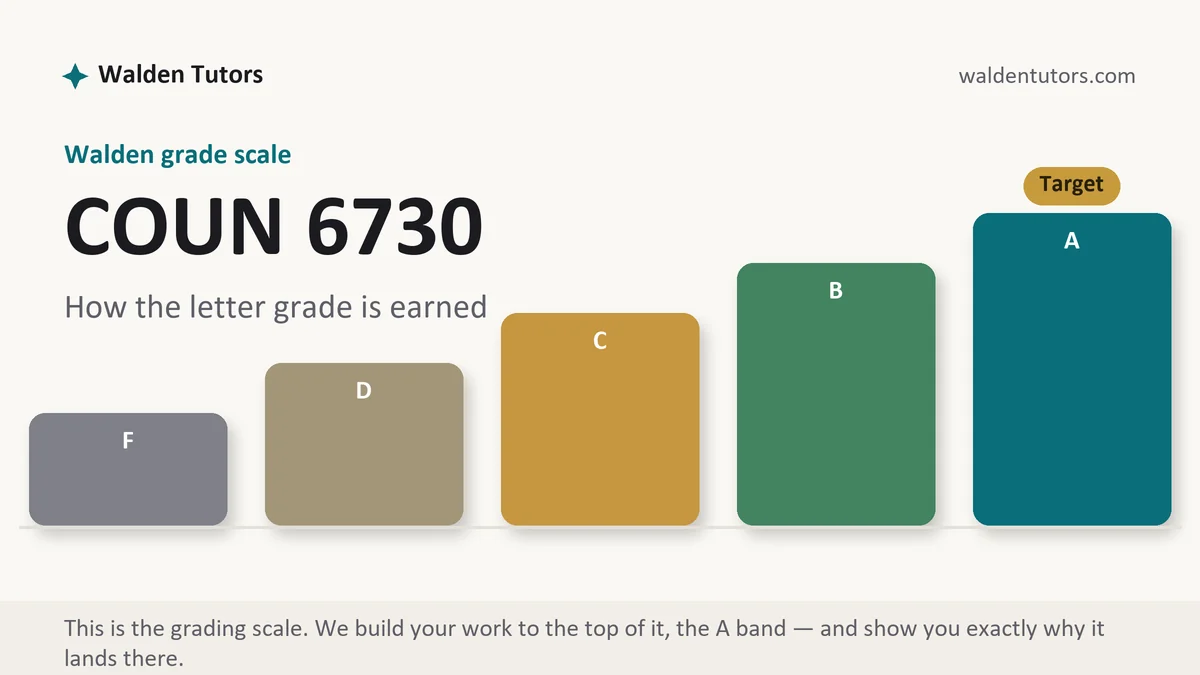
What COUN 6730 actually grades
Clinical judgment under uncertainty. Deliverables in this course tend to be biopsychosocial assessments, diagnostic write-ups, treatment and relapse prevention plans, dissects of a policy or trend, and discussion threads about cases nobody feels neutral about. Each of them scores on whether you moved from information to a decision, and then justified the decision with something checkable. Walden gates this course behind earlier clinical coursework, and the gate itself was rewritten with the catalog year opening 29 May 2023, so the relevant question is not whether yours has a prerequisite but which list yours falls under. Admitted from that date into clinical mental health counseling, you clear COUN 6726, COUN 6250 or COUN 6320 plus the CPLB 602L lab. Admitted earlier, a different set applies. The school counseling route runs through SPLB 672L. Under any of them the addictions course lands after the group or family sequence rather than near the start, and the scoring guides are written for a reader who already has that background.
How we help in this course
Tutoring reviews student-authored work as clinical documents. Feedback checks whether the assessment gathers the relevant de-identified evidence, diagnostic sections match evidence to criteria without rounding up, and plans specify recognizable goals, a justified level of care, and case-specific relapse prevention. You make every clinical judgment and remain the author.
Terms do not change for this course: two days or less to delivery, an A targeted on the rows you provide, one review for score and a separate one for format and originality, and revisions you never pay for.
Weekly manuals for this course
The individual COUN 6730 week manuals publish as each deliverable is verified, one at a time, because Walden does not release its syllabi outside the classroom and a schedule copied from a neighboring course would be a guess dressed as guidance. Anything not yet listed can go into chat and gets drafted immediately. Some students here follow a quarter calendar and others a semester one, so let the dates inside your student portal decide, never a page like this one.
Assessment or treatment plan due?
Send the case, the prompt and the rubric attached to it. The opening sample is free, covers one deliverable, and lands in about two days.
The essay trap
Addiction is a subject people already have views about, and that is exactly the hazard. Given a case, many students write two pages on whether addiction is a disease or a choice, add a paragraph on the reward pathway, mention that stigma is harmful, and finish with a recommendation for treatment that no evidence in the paper produced. The document reads as thoughtful and scores as unfinished, because assessment rows, diagnostic rows and planning rows all went unfed while the etiology row received three times the words it was worth. Turn the order around. Decide first what you would conclude about this client, then write only the background that supports the conclusion. Etiology belongs in the paper as an explanation of why this particular person developed this particular pattern, tied to their history and their environment, not as a survey of models. Register matters as much as structure. Write about a person with a substance use disorder rather than an addict, keep moral vocabulary out of clinical sections, and describe use in quantities, frequencies and consequences rather than adjectives. The cutoff sits at 10:59 p.m. Central every time, and 11:59 p.m. for anybody living on Eastern, after which the letter grade forms row by row around the decisions you were willing to make.
What we need in the order
The case or vignette, the prompt, the scoring guide, and any assessment template or form the classroom supplied. Tell us which screening instruments or placement criteria your course has covered, since programs differ on which tools they teach and a paper that uses an unfamiliar one invites questions you do not want. If the week involves a policy or advocacy element, name the jurisdiction you care about, because state rules on treatment access, licensing and confidentiality of substance use records are not uniform and a paper written to the wrong one is wrong twice.
How to actually write COUN 6730: from information to decision
Begin with the pattern, described in numbers. What substance or behavior, how much, how often, since when, by what route, and in what context. Then the consequences, sorted by domain: health, work or school, money, relationships, legal exposure, and the person's own sense of themselves. Then the history of change attempts, including what worked briefly, what ended it, and how long the longest period of reduced use lasted. This is unglamorous writing and it is the foundation the whole document rests on, because every later judgment has to point back to something recorded here. A plan that recommends intensive treatment while the assessment above it describes weekend use with no consequences will lose the planning row regardless of how well it is written.
Screening and assessment come next, and the distinction is worth stating in the paper. A screen asks whether a problem may exist and takes minutes. A full assessment establishes what the problem is, how severe, and what else is happening alongside it. Name the instrument you would use, say why it suits this client's age, substance and setting, and note what its result does and does not tell you. Add collateral where it would be reasonable to seek it, and say whose permission you would need first. Co-occurring conditions belong here rather than in a footnote: depression, trauma histories, anxiety and chronic pain all travel with substance problems often enough that a paper ignoring them looks incurious, and the sequencing question of what gets treated when is a genuine clinical decision your reader wants to see you make.
Diagnosis is where the rows separate. Work criterion by criterion using the manual your program teaches, quoting the client's own reported behavior as the evidence for each one, and count honestly toward the severity level rather than announcing it. Where evidence is missing, say what you would ask to settle it instead of assuming the answer. Distinguish intoxication, withdrawal and use disorder if the case touches more than one, and consider whether a medical condition or another substance explains what you are seeing. For behavioral presentations, note which have formal criteria and which are discussed in the literature without them, and describe the functional pattern in behavioral terms when no diagnosis is available.
Then plan, and let readiness set the shape. Goals written for a client who is not yet convinced there is a problem will fail, so state where this person appears to sit and choose an approach that meets them there: building discrepancy and exploring ambivalence early, structured skills work when commitment exists, maintenance and monitoring later. Recommend a level of care and justify it against the placement criteria your course uses, covering withdrawal risk, medical and psychiatric stability, living environment and readiness. Say what role medication might play and who would prescribe it, since counselors do not, and name the mutual-help or community supports you would offer while acknowledging that fit varies and that a client who dislikes one format may accept another. Finish with relapse prevention built from this client's own high-risk situations, each with a coping response the client could actually perform, and treat a return to use as clinical information rather than as failure.
Two sections carry weight in this course that they do not carry elsewhere. The first is the systemic and cultural view: who else is affected, what role each family member has taken up around the use, what recovery would cost them, and how culture, developmental stage and community shape both the pattern and the help that is acceptable. The second is policy, where the course explicitly asks about public policy and advocacy. Tie it to your client rather than to the country: the funding rule that decides whether a bed exists, the confidentiality protections attached to substance use records, the licensing requirement that puts a job at risk, the transport gap between a rural address and the nearest program. For sources, use the Walden Library and prefer primary studies and current federal or professional guidance to a textbook's summary, since treatment recommendations in this field move. Synthesis means putting two findings side by side and saying what their difference means for your client, and APA 7 mechanics should come from the Writing Center rather than from memory.
| Section | What goes in it | Common failure |
|---|---|---|
| Use pattern | Substance or behavior, amount, frequency, route, duration, and the situations it happens in. | Adjectives standing in for quantities, so nobody can judge severity from the page. |
| Consequences and history | Effects across health, work, money, relationships and law, plus every previous attempt at change. | Consequences asserted in general terms with no dates, no losses and no prior attempts recorded. |
| Screening and assessment | The instrument chosen, why it fits this client, collateral sources, and co-occurring conditions. | A tool named without a reason, or mental health treated as a separate matter entirely. |
| Diagnostic reasoning | Criteria worked one at a time against reported behavior, with severity counted rather than declared. | A diagnosis announced up front and then illustrated, which reverses the reasoning the row wants. |
| Etiology for this client | Biological and environmental influences as they apply to this person's history. | A general debate about causes of addiction that never reaches the client at all. |
| Plan and level of care | Goals matched to readiness, a placement justified against criteria, medication and support roles named. | An intensity recommended with no criteria cited and no link to anything in the assessment. |
| Family, culture and policy | Roles around the use, cultural and developmental factors, and the specific policy barrier in play. | Three respectful paragraphs that leave the treatment recommendation exactly as it was. |
Discussion posts in an addictions course
These threads attract opinion faster than any other in the program, which is why the scoring guide usually rewards restraint. Answer with a clinical move: the question you would ask next, the screen you would run, the criterion you think is met and the evidence for it, and one citation. Where the prompt raises something contested, such as mandated treatment, drug policy, or whether a client can set a goal other than abstinence, state a position and give the reasoning that could change it. That is what separates a professional judgment from a personal view, and rubrics in this subject are written to find the difference.
In replies, add a case fact rather than a compliment. Point out a co-occurring condition their assessment did not pursue, ask what their plan does if the client declines the level of care recommended, or raise the family member who would be most affected by the change they proposed. Walden expects participation that is substantive, steady and delivered on schedule, and its guidance points to a spread of two to four days as the floor. Because the same guidance says the requirement varies by course and by week, the count that governs you is the one printed in your own classroom.
Where COUN 6730 papers lose points
- A debate about disease and choice that consumes the word budget the assessment rows were paying for.
- Language that judges rather than describes, including labels the field has moved away from using.
- A severity level stated as a conclusion with no criterion-by-criterion evidence supporting it.
- Treatment intensity recommended without placement criteria, so the level of care rests on instinct.
- Co-occurring mental health conditions mentioned once and then left out of the plan entirely.
- Relapse prevention assembled from a generic list instead of from this client's own risky situations.
- Policy discussed at national scale when the barrier that matters sits in the client's own state.
COUN 6730 questions students actually ask
Can I write about my own experience with addiction?
Only where the prompt asks for reflection, and even then keep the clinical purpose in front. Lived experience is an asset in this field and a liability in a paper when it replaces evidence, because a rubric row cannot score a memory. If a reflection section exists, use your experience the way you would use any other source of insight: name what it taught you, then name what it might make you assume about a client whose situation is not yours. Keep it brief, keep it examined, and let the assessment and planning sections stand on the literature.
Do I have to take a side between abstinence and harm reduction?
You have to take a position for this client, which is not the same as declaring an allegiance. Write the goal the client is actually willing to work toward right now, state what makes that goal appropriate given severity, risk and readiness, and describe what would move the plan if the picture changed. A paper that argues abstinence is always correct, or that harm reduction is always kinder, is arguing about the field rather than treating a person. Graders in this course are looking for a defensible match between the client in front of you and the goal on the page.
How do I write about behavioral addictions when the manual covers so few?
Say that plainly and work from it. The diagnostic manual your program uses recognizes far fewer behavioral addictions than the research literature discusses, so a paper on gambling, gaming or compulsive spending should note which of them carry formal criteria and which are described in the literature without them. Then assess with the criteria that do exist, use validated screening tools where they have been developed, and describe the functional pattern in behavioral terms rather than borrowing a diagnosis that has not been written. Naming the gap is a scored strength, and pretending it does not exist is the error.