COUN 6743 is Psychopharmacology, a five-credit core course in the clinical mental health counseling sequence and an elective for school counselors. Its catalog entry frames counselors as client advocates who need working knowledge of the psychotropic medications prescribed for mental, behavioral and addictive disorders, and it names classification, drug interaction and side effects as the territory. Open any graded paper in it and a reader can tell within half a minute whether the writer is speaking as a counselor or impersonating a prescriber. That one choice of register moves more rubric rows than any amount of extra pharmacology.
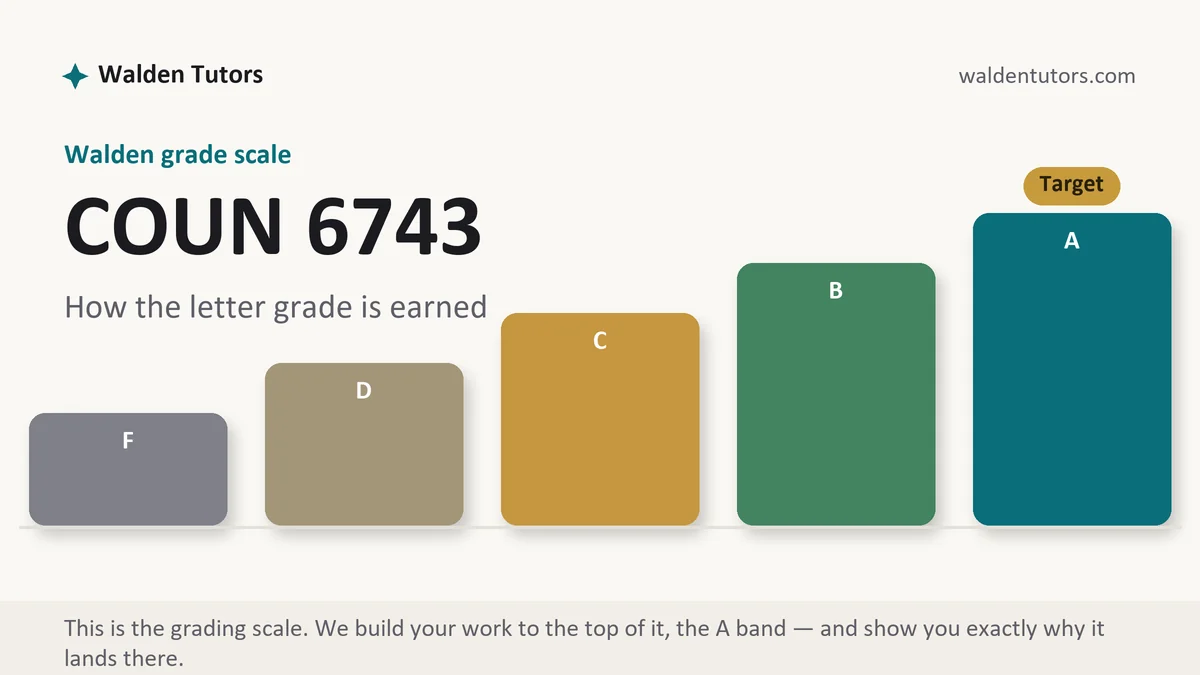
What COUN 6743 actually grades
Four shapes of work recur. Medication class papers, where you account for how a family of psychotropics is thought to act, what it treats and what it costs the person taking it. Case analyses, where a presenting picture arrives and you reason about a regimen already in place or one a prescriber is likely to consider. Interaction and adverse effect work, tracing what happens when two agents meet, or when a pattern of substance use meets a prescription. And collaboration pieces, where the graded question is how you would speak to a prescriber, a client or a family about a decision that is not yours to make.
Underneath all four, the rows reward a counselor who is pharmacologically literate and professionally located. Literate means generic names, class before brand, mechanism explained only to the depth your source supports, and a clear line drawn from the pharmacology to what the client notices on a Tuesday afternoon. Located means you never cross into prescribing. This course sits in the sequence because counselors advocate for clients inside a treatment team, and the grading follows that purpose: observe, educate, monitor, refer, document. A paper that proposes a starting dose has answered a question nobody asked it.
The course also runs a thread through addiction, which is where the reasoning gets harder and the points get easier to win. Assignments ask you to separate a medical picture from a psychopathological one that looks similar, or to consider what changes when a psychiatric condition and a substance use disorder occupy the same person. Writing that treats those as two unrelated problems on one chart tends to score in the middle. Writing that examines the overlap, and says what it means for medication and for counseling, does not.
How we help in this course
Hand over the prompt, the scoring guide and any case material that came with it. The draft comes back written the way the course wants it heard: generic names leading, mechanism pitched at the level the evidence carries, adverse effects sorted into what a client would report against what a clinician would monitor, and every clinical statement attributed to something a grader can open.
Criterion-mapped feedback can return in 24 to 48 hours. One pass checks your draft against the live rubric; another checks APA, source use, and originality. You remain the author, choose each revision, and submit only work you can defend. No grade is promised.
Weekly manuals for this course
There are no per-week manuals for COUN 6743 on this site yet. Walden keeps its syllabi behind the classroom login, so a week is written up here only once somebody has seen what it actually contains. If the deadline in front of you arrives sooner than that, put the assignment into chat and a scope comes back the same day.
Medication case due and the drug names blurring?
Send the case and the scoring guide together. Your first sample carries no charge.
What a grader sees in the first thirty seconds
Before anybody reads your argument, they have taken in the title page, the headings, the opening paragraph and the shape of the reference list. In this course that glance is unusually informative. Generic drug names in the headings say the writer learned classes. Brand names throughout say the writer learned advertisements. An opening that names a person and a question says the paper is going somewhere. An opening about the history of psychiatric medicine says it is not.
The reference list gets read the same way, from a distance. A grader can see whether the sources are professional drug references and peer-reviewed studies or a consumer health page and two summaries, and whether the years cluster anywhere near the present. None of that is the grading itself, but it sets an expectation, and expectations are difficult to shift once a rubric is being filled in. Twenty minutes spent making the first page look like the paper you actually wrote is twenty minutes well spent.
Terms, deadlines and the reading load
Term length here is a property of your degree, not of this course code, because Walden runs a quarter calendar and a semester calendar in parallel and enrolls different programs onto each. Only the academic calendar inside your own student portal carries dates that actually bind you, so plan against that and nothing else. Submissions close at 10:59 p.m. Central; add an hour if you keep an Eastern clock and you have your own cutoff. The opening week also has to carry something real from you, a discussion contribution or an assignment, since Walden settles the attendance question on that first piece of work.
Plan the reading differently from your other counseling courses. Theory and technique courses reward one careful pass; this one rewards several short ones. Drug information does not stay in memory after a single reading, and a paper written from notes taken a week earlier is usually a paper full of half-remembered mechanisms. Read the class, write your own two-line summary of it in plain language, and keep those summaries in one file. By the end of the term that file is worth more than any set of highlighted PDFs, and it is what you will still be able to use in practicum.
How to actually write COUN 6743: where to begin
Begin with the rubric rather than the reading list. Copy each row into an empty document, write the weight beside it, and use the row itself as a heading so your finished paper arrives in the order it gets scored. The rows in this course tend to split description from application, and description is the easy half. Where a row mentions the counselor role, implications for practice, or ethical and cultural considerations, that is where the distance between grades lives, and it deserves length in proportion rather than a closing paragraph tacked on at midnight.
Decide what the paper is about before you open a source. A medication paper with nobody in it drifts into encyclopedia writing inside two pages. Anchor it to a person: an age, a presentation, a regimen either in place or being considered, and a reason the question is live now. Every later section then has something to be relevant to. When the assignment supplies its own case, use the details it gives you instead of generalizing away from them, since those details were chosen deliberately and the rubric usually rewards noticing them.
Build the body in the order a treatment team thinks. What is the presentation, which class addresses it and on what grounds, how is that class understood to work, what does the person experience while taking it, what could go wrong and who would catch it, and what does the counselor do at each of those moments. That sequence also makes your citations obvious, because every move in it is a claim somebody has already published evidence about.
A thesis here is not a slogan. It is a position about this client and this class that somebody could argue with, stated in one sentence. Something along the lines of: for this client, the sedation and weight burden of the current regimen threatens adherence more than the symptoms it is controlling, which puts monitoring and prescriber communication at the center of the counselor's role. Written that way, the thesis tells the grader what is coming and makes half your paragraphs easier to draft.
Synthesis in this subject means putting sources into conversation about the same drug question instead of stacking them. Two studies of one class often disagree because they enrolled different people, ran for different lengths of time, or measured different outcomes. Say so, and say which of those explains the gap. A paragraph that names a disagreement and accounts for it proves you read; a paragraph that hangs three citations off one uncontroversial sentence proves nothing. Where the evidence is genuinely thin, which is common for combinations and for populations that trials exclude, write that plainly. Marking the limits of what is known is graduate behavior rather than weakness.
| Section | What it does | Where it usually fails |
|---|---|---|
| Opening frame | States the client picture or medication question the paper answers and names the class in play. | A general paragraph about mental illness that would sit on top of any paper in the program. |
| Classification and mechanism | Places the agent in its family and explains, at the depth the source supports, how it is thought to act. | Mechanism copied from labeling in wording the writer could not restate if asked. |
| Indications and evidence | Says what the medication is used for and what the literature reports about how well it does it. | Indications listed with no source, or effectiveness claimed with no population attached to it. |
| Adverse effects and monitoring | Separates what the client feels from what a clinician watches, and names who does the watching. | An unranked side effect list with nothing about what would trigger a call to the prescriber. |
| Interactions and substance use | Traces what changes when another agent, prescribed or otherwise, enters the picture. | An interaction named as a risk with no mechanism and no consequence the client would notice. |
| Counselor role | Sets out what you would observe, document, teach and refer, and where your scope stops. | Guidance that reads as a prescribing decision, or a role section written purely as a disclaimer. |
| Culture, ethics and access | Handles beliefs about medication, adherence, cost and informed consent in this client's real circumstances. | A diversity paragraph that names no barrier and changes nothing about the plan that follows. |
Threads about medication that earn their row
Discussion prompts in this course usually hand you a case and ask what you would do with it as a counselor. Take a position and show the reasoning behind it: what you noticed, what it suggests, what you would communicate and to whom, and what you would keep watching over the next month. Cite inside the post even when it is brief, because a confident claim about a drug with nothing attached reads as recall rather than evidence.
The university's posted expectation is participation with real substance behind it, arriving steadily and on time, with a stated floor of two to four separate days of activity instead of one marathon at the keyboard. The same policy states outright that posting requirements are not uniform, differing between courses and sometimes between weeks of the same course, so take the count and the closing day from your own classroom instead of importing the rhythm of whatever course you finished last term. When you reply to classmates, hand them something usable: the interaction they did not check, the adverse effect that would explain the behavior they described, or the question they should be putting to the prescriber instead of the client.
Sources and APA 7 when you are writing about drugs
Two habits separate a clean paper from a messy one. Name drugs the way the literature does, generic in lower case with the brand capitalised and used sparingly, and give the generic at first mention so the reader knows which molecule is under discussion. Then attach clinical claims to the sentence making them rather than to the end of the paragraph, because a citation parked at a paragraph break leaves the grader guessing how far back it reaches.
Run the searching through the Walden Library instead of an open web engine. Regulatory labeling and the professional drug references answer questions about indications, warnings and interactions; peer-reviewed studies answer questions about how well something works and in whom. Every source should be doing one identifiable job, and if you cannot name the job, cut the source. Pull headings, tables and reference entries straight from the templates the Walden Writing Center publishes. Borrowing their formatting costs a few minutes, and defending your own version to somebody holding a rubric costs marks.
The mistakes that cost points in COUN 6743
- Brand names used throughout with the generic never supplied, so nobody can tell whether the class was understood.
- Side effect lists lifted from a patient-facing website and reproduced without ranking, frequency or clinical meaning.
- Dose recommendations, titration schedules, or a stated preference between two agents, all of which belong to the prescriber.
- Mechanism sentences carrying far more certainty than the pharmacology supports, usually because a simplified summary was read as settled fact.
- Silence on adherence, which is the part of medication management a counselor is genuinely positioned to affect.
- Addiction content written as though the substance concern and the psychiatric one can be handled separately, when examining their overlap is part of why the course exists.
COUN 6743 questions students actually ask
Do I need a pharmacology background to pass this course?
No, and most people arrive without one. What the course asks for is organized reading rather than prior training: learn the classes before the individual agents, hold on to the handful of neurotransmitter systems those classes act on, and accept that you are building a counselor's working knowledge rather than a prescriber's. Students who struggle are usually the ones memorising drugs one at a time in isolation. Learn a class, learn two or three representative agents inside it, learn what the class costs the people who take it, and unfamiliar drug names stop being unfamiliar.
Can I say a client should be on a particular medication?
No, and a rubric row will catch it if you do. Counselors do not prescribe, and this course is built around what a counselor can do instead: recognize a presentation that warrants referral, describe what the client is reporting in language a prescriber can act on, support adherence, watch for effects that need reporting, and advocate when a regimen is not serving the person taking it. Write the referral rather than the prescription. When an assignment appears to be asking you to pick an agent, it is nearly always asking what you would communicate to whoever picks.
Which sources count as current enough for drug information?
Current enough that no revision has landed since. Pharmacology texts age unevenly, because the physiology sections keep well and the treatment recommendations do not. Take prescribing and safety information from regulatory labeling or the professional drug references your library carries, take effectiveness claims from peer-reviewed studies found through the Walden Library, and check the publication year on anything discussing a newer agent. Consumer health websites are written for patients and are not what a graduate rubric means by evidence. Where your syllabus sets its own recency window, that number settles the question.