Business Essentials is DDBA 4990, the foundation seat sitting at the front of Walden's DBA. The catalog gives it a credit line of zero, so nothing here moves your credit total, and it still decides how steep the first graded business course feels when you reach it.
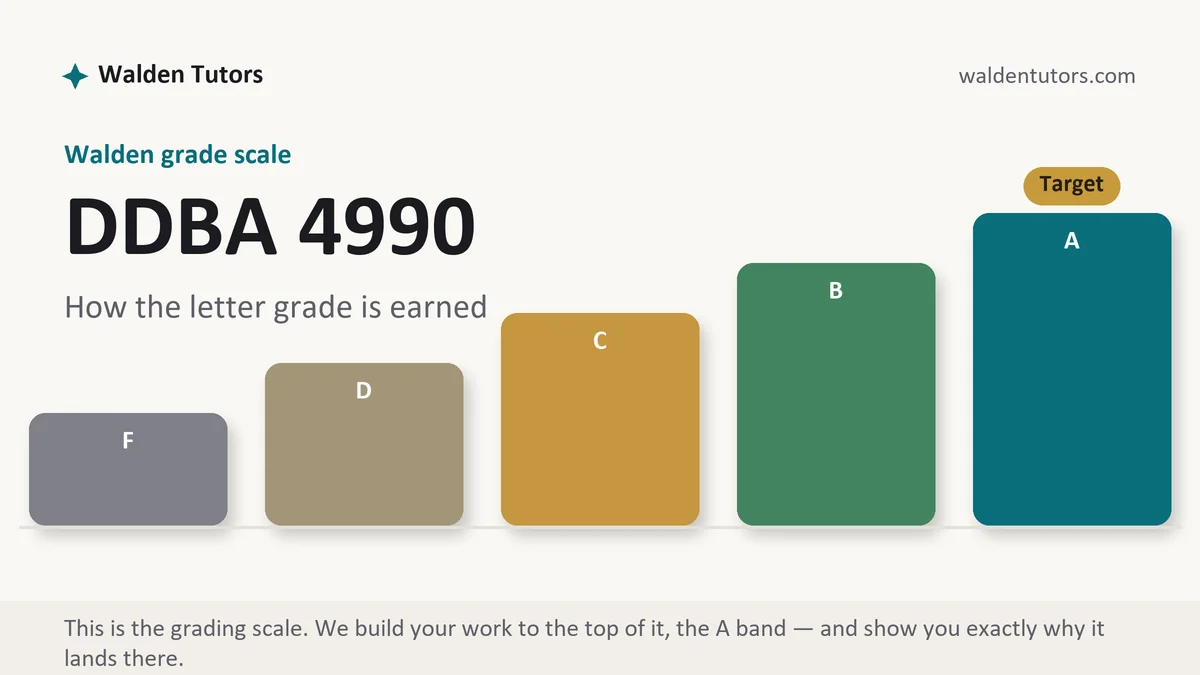
What DDBA 4990 actually grades
Walden's catalog entry for 4990 lists subjects rather than deliverables, and the credit line reads zero. Read that pairing literally. The seat exists so you arrive at doctoral business coursework already fluent in the functional areas that later rubric rows quietly assume: leadership and management, business ethics, the legal environment of business, accounting, finance, economics, quantitative methods and statistics, information systems management, global business, marketing, and strategic management. Eleven areas, one foundation seat, no credit at the end of it.
Whether your section posts a score or simply records completion is settled inside your classroom. Walden does not publish course syllabi to the open web, so the week's own item is the only thing worth trusting on that question, and guessing from what a colleague told you about their term is how people end up submitting the wrong artifact.
How we help in this course
We treat 4990 as the cheapest place in the whole doctorate to repair a weak spot, because nothing you get wrong here costs you a grade point. Tell us which of the eleven areas you have never worked in professionally and the drafts and walkthroughs weight that area hard. Accountants come in strong on the finance block and thin on the legal one. Operations people arrive fluent in systems and rusty on marketing. Nobody is even across all eleven, and the ones who pretend otherwise are the ones who get surprised two courses later.
Terms are the same as everywhere on this site: original work back inside 24 to 48 hours, written against whatever rubric your classroom posts, two separate QA reads before anything reaches you, and revisions at no charge until the target holds.
Weekly manuals for this course
No week grid appears on this page, and none is going to be invented for it. Start by reading the prefix on your own registration, because Walden runs this doctorate in two versions and the catalog separates them by course code. The semester-calendar program carries the DDBA numbering used throughout this page and prices the seat at zero semester credits. The quarter-calendar program lists the same foundation subject as DBAX 4990 instead, inside a sequence counted in quarter credits. If the code in your classroom opens with DBAX, the quarter route is the one governing you and the numbering here will not line up. Opening and closing dates for your own session sit in your student portal, and that record is the one that settles them. Per-week manuals for DDBA 4990 publish as each one verifies. If yours is not up yet, drop the assignment into chat and the drafting work starts anyway.
In DDBA 4990 right now?
Send the item and whatever your classroom posted alongside it. The first premium sample costs nothing and comes back within 48 hours.
The gap between what the prompt asks and what gets handed in
Almost every point lost in a foundation course disappears into the distance between the instruction and the document. A prompt says analyze the financing decision and receives a description of the financing decision. A prompt says compare two regulatory approaches and receives two paragraphs, one per approach, with nothing in between doing any comparing. The verb in the instruction is the assignment, and in 4990 those verbs are deliberately undramatic: identify, explain, apply, compare.
Students who have run departments for fifteen years read explain as an invitation to give a view, and the view is frequently correct and still scores in the middle, because correctness was never the thing being measured. Underline every verb in the prompt before you write a word. At the end, check that the finished document performs each one somewhere a reader could put a finger on. That single pass closes most of the gap.
What one 4990 order carries
Send the item, the rubric if your section posts one, and a line about your working background. That last piece does more than it sounds like it should, because the quickest way to make foundation work read as genuinely yours is to keep the examples inside industries you already understand. Turnaround runs 24 to 48 hours. What comes back is annotated: where the prompt's verb is being performed, which functional area each claim draws on, and where a stronger example would slot in if you want to swap your own into place. Spending the free first sample here rather than later is the better trade, since one 4990 document shows you the register before the graded doctoral courses start charging you for the same lesson.
How to actually write DDBA 4990: where to begin
Find out what your section is assessing before anything else, because a zero-credit course can be run several ways and the classroom decides which. If a rubric is attached, do the ordinary thing and convert its rows into headings before you draft. If no rubric appears, the prompt becomes the rubric: split it at every verb and every question mark, then treat each fragment as a row you owe an answer to. Foundation work is judged loosely at the top and strictly at the bottom, meaning the gap between adequate and good is narrow while the gap between complete and incomplete is total. Coverage first. Polish second.
Then pick your examples from a business you can describe from the inside. Business Essentials crosses eleven functional areas in one foundation seat, and the people who get through it comfortably stop treating each area as a fresh subject and start treating it as a fresh question about the same organization. Take one firm, ideally your employer or a former one, and run it through the areas as they arrive: who holds the decision rights, where the money comes from and where it leaks out, which regulator constrains the thing you want to do, what the market data would need to say before the strategy makes any sense. One organization examined eleven ways builds far more usable understanding than eleven textbook cases skimmed once each.
Write the short pieces short. Foundation prompts usually want a page or two, and length in a course like this reads as padding rather than effort. Open with the direct answer to the question asked, put the reasoning in the middle, and close by naming the limit of what you have just claimed. That closing habit is the one that transfers furthest. Doctoral rows later in the DBA pay real marks for stated limits, and building the reflex now costs you nothing, because nothing here lands on your transcript in credit terms.
The quantitative methods and statistics block is where confident students most often stumble, and it happens for a specific reason: the arithmetic is easy and the interpretation is not. Reporting a mean is not analysis. Saying what the mean implies for a decision, and what it cannot tell you given how the data was collected, is analysis. Show your working inside the document, name the assumption sitting behind any figure you use, and never leave a number in a sentence without a clause explaining why a reader should care about it.
| Section | What it does | The common failure |
|---|---|---|
| Direct answer | States the answer to the question the prompt asked, inside the first two sentences. | A warm-up paragraph on why the topic matters, arriving before any position does. |
| Organizational context | Names the firm, its size, its market and the specific decision under discussion. | A company sketched so lightly that the analysis would fit any company at all. |
| Functional analysis | Applies the week's area, whether finance, ethics, law or marketing, to that decision. | The area explained in general terms and never actually pointed at the organization. |
| Evidence and figures | Brings the numbers, source documents or regulation that hold the claim up. | Figures quoted with no origin and no statement of what they are unable to show. |
| Limit and next step | Says what the analysis cannot settle, and what evidence would settle it. | A confident close that treats a two-page exercise as a finished business case. |
Discussion posts that actually earn the points
Where 4990 runs a discussion board, it tends to reward a plain answer over a decorated one. Post the position, one reason, one piece of support, and a question you actually want answered. Foundation threads suffer a particular failure mode: everybody agrees, because the material is settled and nobody wants to look uncertain in front of a new doctoral cohort. Universal agreement produces a dead thread and thin marks for everyone in it.
The university's stated expectation for graded threads covers three things at once: substance, consistency and timing. Its guidance steers students toward spreading contributions across a minimum of two to four separate days each week, rather than parking the entire obligation in one sitting. Treat that as a calendar instruction. Five posts landing together on a Sunday evening read as compliance and get scored accordingly. How many replies your own section wants, and the day they close, sits with your classroom, and the university is explicit that these requirements differ from one course to the next and even between weeks inside the same course.
Getting APA right while it is still free
APA 7 applies here even where the credit does not, and installing the habit during a term that costs you nothing is the best trade available anywhere in the DBA. Set up your title page, your heading hierarchy and your reference list correctly on one occasion, save the result as a template, and stop rebuilding the same scaffolding every week. Every in-text citation needs a matching reference and every reference needs a matching citation, and that reconciliation is mechanical, which makes it free marks for anyone willing to spend four minutes on it.
Run your searching inside the Walden Library instead of the open web, since what those databases return carries dates and peer review status you can stand behind if a reviewer presses. In a functional-areas course the useful citation is often not a journal article at all: a regulator's own publication, a company's filed report, or an industry body's data release will hold up a factual claim better than a paper written about that claim second-hand. Say which kind of source you are using and why it is the right kind. The Walden Writing Center keeps the current templates and will review a paper before submission, and that appointment is far easier to book early in a term than late in one.
The mistakes that cost points in DDBA 4990
- Treating a zero-credit course as optional, then arriving at the first graded one missing vocabulary everybody else already has.
- Answering the prompt's topic instead of its verb, so a comparison question collects two unconnected descriptions.
- Examples pulled from famous companies nobody in the thread can question, when your own workplace would be more interesting and easier to defend.
- Numbers reported with no units, no origin and no sentence explaining which decision they ought to change.
- Work submitted in a format that ignores APA because the course does not count, converting a free rehearsal into a wasted one.
DDBA 4990 questions students actually ask
Does DDBA 4990 affect my GPA?
Walden's catalog lists the course at zero semester credits, which is the part you can verify from outside the classroom. What that credit line does to your transcript, and whether your section posts a letter grade at all, is a registrar question rather than a writing question, and your student portal or your enrollment advisor will answer it in one message. Treat the course as consequential regardless. The habits you build in a term nobody is scoring are the habits you carry into the terms where the scoring is severe.
I have twenty years in business. Can I skip the reading?
You can skim the areas you work in daily and you should not skip the areas you do not. Experience covers a company's practice, while coursework asks about the models underneath it, and those are graded differently. A controller who has closed two hundred month-ends may still lack the vocabulary a rubric row wants for the same activity. The efficient move is honest triage: rank the eleven areas by how much of each you have genuinely done, spend your reading hours from the bottom of that list upward, and let the top of it coast.
What time is work due?
Course-Based work is due at 10:59 p.m. Central, the same moment as 11:59 p.m. Eastern. The clock that decides lateness is the classroom's, not the one on your kitchen wall. Build a personal cutoff a full day earlier. Foundation weeks are the easiest ones to leave late because the stakes feel low, and a habit formed here follows you into the research methods sequence, where it will not be survivable. Your own section can set a stricter local rule, so read the week's item rather than assuming the standard applies everywhere.