DDBA 8303 carries the catalog title Qualitative and Case Study Methodology for Business Analysis Research and runs at 4 semester credits. It narrows the DBA methods sequence down to three designs the catalog description singles out for emphasis: case study, pragmatic inquiry and program evaluation. It also asks you to think the way a consultant thinks, and it puts your prospectus through rounds of peer and instructor feedback while you do.
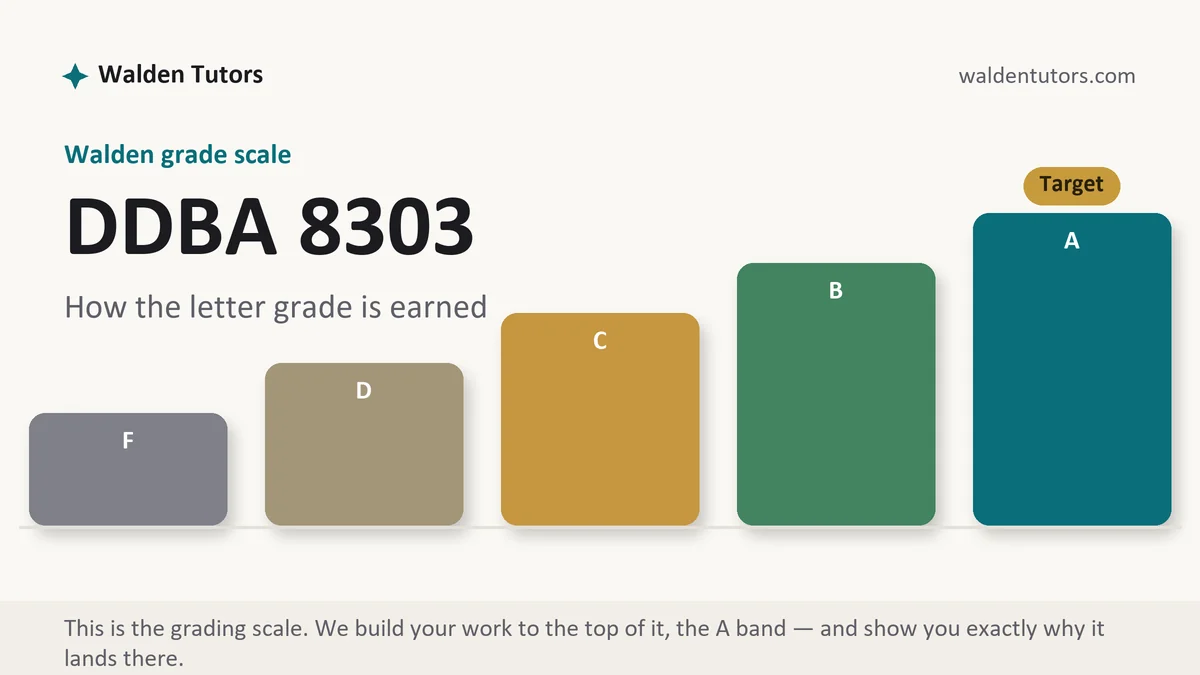
What DDBA 8303 actually grades
Three strands, graded together. One is design craft: bounding a case, choosing between a single site and several, deciding what counts as evidence and how you will corroborate it. Another is the consultant reflex the course is built to develop, meaning analysis that ends in something a business could act on rather than in a set of findings left on the table. The third is the prospectus itself, which comes back to you marked up by classmates and by your instructor, again, on purpose.
That last strand is where the course feels different from the ones before it. Revision is not a penalty here, it is the assignment. Rows reward a draft that visibly absorbed the previous round of comments, and they punish a draft that answered the surface of a comment while leaving the underlying problem untouched. Scholars who treat feedback as editing rather than as diagnosis end up submitting the same document four times.
How we help in this course
Two kinds of work land on our desk from 8303 students. The first is the ordinary weekly deliverable, a design paper or a methodological critique, drafted to the scoring guide with a note showing where each row is satisfied. The second is prospectus support, where the useful thing is usually not more prose but a structural read: which of the reviewer's comments is the real one, what has to move, and in what order.
Either way the terms hold. Drafts land within 24 to 48 hours, they are written at the level a course-based rubric calls an A, two different reviewers check the work before it reaches you, and revision costs nothing until the piece does its job. Send a marked-up prospectus with your order and we will work from the actual comments rather than from a guess about them.
Weekly manuals for this course
A manual covering one week of 8303 goes up only after that week has been verified, never in advance. Walden publishes its syllabi to enrolled students inside the classroom, which means no outside site can honestly print the deliverable list for this course, and we would rather say so than fill the gap with invention.
Scheduling starts from the code you registered under, and DDBA is the semester build of the DBA while DBAX carries the quarter build of the same curriculum, so let the student portal tell you when this term opens and closes instead of trusting a figure from a page like this. Whatever the term length, the nightly cutoff is 10:59 p.m. Central, or 11:59 p.m. for anyone on Eastern time. If your week has no manual yet, bring it to chat and you will get scope and pricing today.
Working on an 8303 design paper or prospectus?
Attach the brief, the rubric and any reviewer comments. First premium draft free, returned within two days.
How to actually write DDBA 8303: let the scoring rows dictate the shape
Before you write a sentence, take the rubric apart. Every row becomes a heading in an empty file, and next to every heading goes the share of the marks it controls. That file is your outline, and it has an advantage no self-made outline has: it was written by the person who will grade you. Then read the headings in order and ask whether the paper they describe is the paper you were planning to write. Where those two differ, the rubric wins, because the rubric is the document that gets filled in.
Bound the case next, and be ruthless about it. A case is not a company; it is a company, doing a particular thing, in a particular window of time. Write the boundary as a single sentence naming the organization, the activity, the period and the unit you are treating as the case, then treat everything outside that sentence as context rather than data. Unbounded cases are the most common reason these papers sprawl: without a fence, every interesting fact about the firm seems to belong, and the analysis section turns into a company profile with quotations in it.
Build the argument for your design by comparison, not by assertion. Say what a program evaluation would deliver that a case study would not, and where a pragmatic inquiry would sit between them. Program evaluation asks whether an intervention did what it promised and is bound to a set of stated objectives. A case study asks how and why something happened in a setting you cannot separate from the outcome. Pragmatic inquiry starts from the practical problem and takes whatever evidence answers it. Name the two you are turning down, say what each would have given you, and state the trade you are making. That paragraph is worth more to a reviewer than three pages of definition.
Then make the evidence plan concrete. Qualitative rigor is demonstrated by procedure, so say who you would talk to and why those people, what documents you would pull, what you would observe, and how many sources would have to agree before you believed something. Corroborating across interview, document and observation is what turns an anecdote into a finding. Describe your coding sequence in enough detail that a stranger could repeat it: first pass, second pass, how codes become categories, how categories become themes, and what you would do with an account that refuses to fit. Use the right vocabulary while you do it. Credibility, dependability, transferability and confirmability are the terms this tradition uses, and reaching for validity and reliability instead signals that the concepts have not landed.
Finally, write like a scholar who has run something. The course wants action-oriented analysis, which in practice means every theme you report should be followed by the sentence that says what a manager could do about it and what it would cost. Get your sources through the Walden Library, where the qualitative methods texts and the business databases both live, and give each citation one job: this author defines the design, this one supplies the coding procedure, this one is the published case whose approach you are borrowing. Under APA 7 the author and year belong in the clause where the claim is made, heading levels have to stay consistent from the first page to the last, and no entry may sit in your references without a citation somewhere in the text pointing at it. Book time with the Writing Center early rather than after a paper comes back, since the formatting rows are the cheapest marks in any doctoral course.
| Section | What it does | Common failure |
|---|---|---|
| Case and its boundary | Fixes the organization, the activity, the time window and the unit under study. | A whole firm named as the case, so every fact about it seems to qualify as data. |
| Design justification | Argues for case study, evaluation or pragmatic inquiry against the alternatives you rejected. | The chosen design defined at length while the rejected ones are never seriously weighed. |
| Conceptual framework | Supplies the lens that decides which observations count and what they might mean. | A framework named in the opening pages and then absent from the analysis entirely. |
| Data sources and corroboration | Lists participants, documents and observations, and says how they check one another. | Interviews alone, with corroboration mentioned as a principle but never operationalized. |
| Analysis procedure | Walks through coding from first pass to themes so another researcher could repeat it. | Themes that appear fully formed, with no account of how the data produced them. |
| Trustworthiness and application | Establishes rigor in qualitative terms and states what a business should do with the findings. | Rigor claimed in a paragraph of borrowed terminology, and no recommendation anyone could act on. |
Posting inside a workshop thread
This course runs its threads as workshops more than as debates, because much of what you post concerns work your classmates are also trying to build. That changes what a good post looks like. Bring a decision you actually made about your own design, show the reasoning behind it, and name the part you are least sure of. Certainty is cheap in a methods thread. A well-argued doubt gives everyone something to work with.
Walden expects participation that is substantive, steady and on time, and its grading policy recommends spreading contributions over at least two to four separate days instead of compressing them into one evening. Walden is also explicit that requirements shift between courses and between weeks, which means the brief inside your own classroom outranks any habit you carried in from a previous term. When you respond to someone, aim at their design rather than their prose. Ask where their case boundary sits, ask what their second data source is, ask what finding would change their mind. Those three questions have rescued more prospectuses than any amount of encouragement.
The mistakes that cost points in DDBA 8303
- Treating an entire organization as the case, which leaves the study with no edge and no focus.
- Choosing case study by habit and never showing what evaluation or pragmatic inquiry would have offered instead.
- Reporting themes without ever describing the coding steps that produced them.
- Using validity and reliability where a qualitative design calls for credibility, dependability and confirmability.
- Answering a reviewer's comment locally when the fault it points at lives two sections away.
- Ending on findings with nothing said about what a business should do differently on Monday.
DDBA 8303 questions students actually ask
What makes a business problem suit a case study rather than a survey?
Boundaries and context. A case study earns its keep when the thing you want to understand cannot be lifted out of the setting it happens in, and when the interesting part is the mechanism rather than the frequency. If your question is how a mid-sized distributor kept its people through a merger, the answer lives in that distributor's decisions, sequence and culture, and a questionnaire sent to two hundred firms would flatten exactly what you came for. If your question is what percentage of distributors kept their people, a survey is the honest tool.
How many cases does a doctoral case study need?
One is legitimate when the case is unusual, revealing, or the only site you can reach, and multiple cases are legitimate when you want to see whether a pattern survives a change of setting. What matters far more than the count is what each case is doing for your argument. Two cases chosen because they were convenient add nothing except work. Two cases chosen because one succeeded and one did not, at otherwise similar firms, give you a contrast the analysis can actually use. Say which logic you are following and your reviewer will follow it too.
My prospectus draft came back with the same comment again. What now?
Assume the comment is about a structural fault rather than the sentence it landed on. When a reviewer keeps flagging the problem statement, the usual cause is that the purpose or the research question further down has quietly changed shape, so the opening no longer matches what the document ends up proposing. Rebuild the spine on one page, reconcile the pieces, then rewrite the flagged paragraph last. Answering the comment where it appeared is what produces a fourth round of the same note.