Walden lists DDBA 8522 as Seminar in Sustainability at 3 semester credits within the DBA. Expect the pressure to arrive earlier here than in most seminars. The reading is weighted toward recent journal articles rather than a settled textbook, so the term front-loads a search problem, and the crunch lands when a broad interest in the environment has to become one defensible question about one material, one product or one operation. Doing that narrowing in the first two weeks is the whole trick. Leave it late and you will be reading and arguing at the same time.
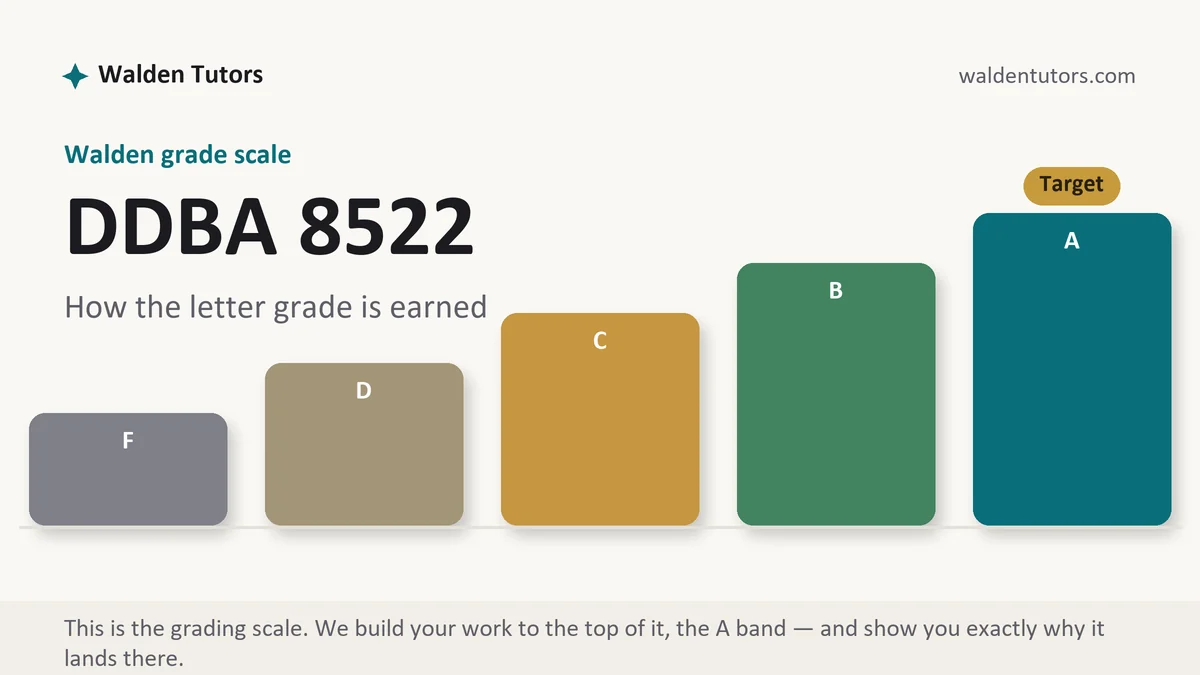
What DDBA 8522 actually grades
Scope discipline comes first. The catalog frames this seminar around resource use, materials processing, waste disposal and the effects a product carries with it, which is a far more specific brief than the word sustainability suggests on its own. Papers that stay at the level of the planet score badly. Papers that follow one input through an operation and out the other side score well, because everything after that has something to hold on to.
Second is the link between natural systems and commercial decisions. You are being asked to connect an ecological constraint to a business consequence and to hold both in view at once, over a longer horizon than a normal strategy paper uses. Third is source quality. The description leans on recent scholarly articles alongside the foundational work, and there is a reason for that emphasis: reporting rules, technologies and the evidence base in this field all move quickly, so a paper built on decade-old figures is describing a world that has already changed. Last, as in every seminar at this level, you formulate your own research topic and take it to your peers, so the argument has to be portable enough for someone outside your industry to interrogate.
How we help in this course
The 8522 orders we see cluster around a handful of deliverables: the topic proposal that has to survive its first critique, the analytical paper tracing a resource or waste stream through a firm, the critique of a corporate disclosure, and the piece that has to build a defensible business case out of environmental evidence. Each one comes back written to the scoring guide, with a note showing where the rows are answered.
Our terms do not shift by course. Work is returned in 24 to 48 hours, written to reach an A under a course-based rubric, checked by two reviewers who do not talk to each other before the draft leaves, and revised at no cost until it lands. Send any disclosure documents, plant data or reports you are working from and we will build the analysis on your evidence rather than on a generic firm.
Weekly manuals for this course
Manuals for individual 8522 weeks appear only after that week has been confirmed. Syllabi at Walden live inside the classroom rather than on the open web, which means nobody outside your section can honestly publish the deliverable list, and an invented schedule would waste your time more than a missing one does.
Term length needs no such restraint. Two calendars operate at Walden, a quarter cycle and a semester cycle, and this seminar sits on the semester one, since DBAX numbers belong to the quarter edition of the doctorate and DDBA numbers to the semester edition. Your student portal holds the dates that govern you. What does not change is the nightly cutoff at 10:59 p.m. Central, which is 11:59 p.m. if you keep Eastern time. If the week in front of you has no manual, ask in chat and we will scope it today.
Stuck narrowing an 8522 topic?
Send the prompt, the rubric and the firm or sector you have in mind. First premium draft free, returned within two days.
How to actually write DDBA 8522: pick a flow, not a theme
Open by choosing something physical. Not sustainability, not climate, not corporate responsibility, but a thing that moves: the packaging on one product line, the water a plant draws and returns, the offcuts a fabrication shop pays to have hauled away, the electricity a distribution center buys at peak. A flow gives you quantities, prices, owners and a place where a decision could be taken, and those four things are what turn an essay into an analysis. Write the flow into a single sentence naming what enters, what leaves and where it goes, then keep that sentence at the top of your draft as a fence.
Draw the boundary next and say out loud where it stops. Are you examining the firm's own operations, or the supply chain behind them, or the product's behavior after a customer takes it home. Each answer produces a different paper and a different evidence problem, and reviewers penalise a study that quietly changes boundary halfway through far more heavily than one that picks a narrow boundary and stays inside it. If you are using emissions categories, name which ones you are counting and which you are leaving out, and give the reason rather than the definition.
Then select a lens and let it earn its place. The triple bottom line organizes reporting but decides very little on its own. A resource-based reading asks whether an environmental capability is rare and hard to copy, which turns the discussion into one about competitive position. Circular economy thinking reframes waste as a mis-priced input and points at redesign rather than disposal. Stakeholder and institutional accounts explain why firms in the same sector converge on similar programs even when the economics differ, which is often the most honest explanation for what your own organization has done. Choose the lens that predicts something in your case, then show it predicting.
Handle evidence like an auditor, because most sustainability data is self-reported. A corporate report is a claim, not a measurement, and the useful questions are which boundary the company drew, what it chose to count, what it left uncounted, and whether an outside party checked any of it. Set voluntary disclosures against regulatory filings, sector studies and the firm's own earlier numbers, and write about the disagreement when you find one. Where a claim is marketing rather than measurement, say so in plain terms and show what evidence would have been needed to support it. That paragraph, done well, is often the strongest passage in a doctoral sustainability paper.
Build the recommendation as a trade, never as a virtue. Say what the change costs in capital and disruption, what it saves in materials, energy, disposal fees or compliance exposure, over what period the balance turns, and what has to be true for that to hold. Name the risk of doing nothing over the same horizon, because in this field the counterfactual is rarely stable. Then attach measurement: what gets tracked, from which system, against what baseline, reviewed by whom. A recommendation with no measurement plan reads as an opinion no matter how much evidence sits above it.
For the literature, work by construct rather than by article. Group your sources under the questions you actually need answered, what drives adoption, what the measured effect on performance has been, where the reported benefits fail to replicate, and write each paragraph as a claim of your own supported by studies placed against one another. Blend the foundational pieces with current empirical work and check publication years deliberately, since standards and regulation in this area have been rewritten more than once. The Walden Library is where the journals and the industry databases both sit, and it beats open search for anything you intend to defend. Under APA 7, remember that a standard, a corporate report or an agency dataset is cited by its organizational author with the year and the retrieval details, that in-text citations belong in the clause carrying the claim, and that heading levels stay consistent throughout. The Writing Center holds the templates Walden marks against, and using theirs is faster than correcting yours.
| Section | What it does | Common failure |
|---|---|---|
| Flow and setting | Names the material, energy or waste stream under study and the operation it passes through. | A theme rather than a flow, so nothing in the paper can be counted or priced. |
| Boundary statement | Fixes whether you are examining operations, supply chain or product use, and says what is excluded. | A boundary that drifts, letting supply chain figures answer questions about the firm's own site. |
| Theoretical lens | Chooses the reading that explains behavior in your case and applies it to the evidence. | Three frameworks defined in sequence, none of them used once the data arrives. |
| Evidence and its quality | Weighs self-reported disclosure against filings, sector studies and prior-year figures. | Company claims accepted at face value and repeated as findings. |
| Trade-off analysis | Sets cost and disruption against savings, exposure and the risk of inaction over a stated horizon. | Benefits listed with no capital cost, no timeline and no conditions attached. |
| Measurement and limits | Says what will be tracked, from which system, against what baseline, and what the study cannot show. | A closing promise of monitoring with no indicator, no owner and no admitted limitation. |
Posting in a thread where everyone already agrees
Sustainability threads have a particular failure mode: total consensus and no argument. Everyone posts that the topic matters, everyone agrees with the previous reply, and the whole exchange produces nothing anyone can use. Break it by bringing a number and a constraint. Say what the change would cost the firm you have chosen, name the department that would carry that cost, and state which part of your own reasoning is weakest. A post with a figure in it earns replies. A post with a sentiment in it earns agreement.
Walden expects contributions to be substantive, regular and posted on time, and the grading policy suggests spreading them over two to four separate days rather than compressing everything into a single sitting. Walden also makes clear that requirements differ from course to course and from week to week, so read the brief in your own classroom instead of importing a pattern from a previous seminar. When replying, go after the evidence: ask where a colleague's figure came from, ask whether the boundary they used matches the claim they are making, ask what their firm would give up to fund the proposal. Those questions move a thread from encouragement to critique, which is what the rows reward.
The mistakes that cost points in DDBA 8522
- Writing about sustainability in general, so no quantity, price or owner ever appears in the paper.
- Quoting a glossy corporate report as though it were an independent measurement.
- Switching between operational, supply chain and product-use evidence without ever saying the boundary moved.
- Building an argument on figures old enough that the reporting rules behind them have since been replaced.
- Advocacy in place of analysis, where the recommendation carries moral weight but no capital cost.
- Defining several frameworks in the opening pages, then analyzing the evidence without any of them.
- Ending on a call to monitor progress while naming neither the indicator nor the person responsible.
DDBA 8522 questions students actually ask
Can I write about my employer if they have no sustainability program?
Yes, and the absence is often the better paper. A firm with a polished report gives you material that has already been shaped for an audience, while a firm with nothing gives you an unexamined material flow and a real decision to argue about. Start from what physically enters and leaves the operation, since every business consumes something and discards something even when no policy exists. Then ask why nothing has been done: whether the cost sits with a department that gets no credit for saving it, whether nobody has ever measured the waste stream, or whether the customer has never asked. Each of those is a doctoral-grade explanation, and each points to a different recommendation.
How do I use a company sustainability report without just repeating it?
Treat it as evidence about the company rather than evidence about the world. A voluntary report tells you what an organization chose to count, which boundary it drew, and what it left outside that boundary, and all three of those choices are findings you can analyze. Compare the figures against regulatory filings, against sector studies in the peer-reviewed literature, and against the same firm's numbers from earlier years, then write about the gaps. Where the reporting is thin, say what a reader cannot tell from it. That sentence is analysis. Reproducing the highlights in your own words is not.
Is it acceptable to argue that a sustainability initiative is not worth doing?
It is acceptable, and a well-argued negative usually reads as more rigorous than a predictable endorsement, because it means you tested rather than assumed. The requirement is that the case be built on evidence rather than on discomfort with the idea. Show the resource savings you can document, the capital and disruption the change would demand, the regulatory direction the sector is moving in, and the risk of doing nothing over the horizon your paper claims to cover. If the arithmetic and the evidence still say no, say no, then say what conditions would flip the answer. That final sentence is what keeps a negative finding useful.