Walden carries this seat as Seminar in International Finance, code DDBA 8540, priced at 3 semester credits inside a specialization block worth nine. Its real function is preparatory. The habit it drills, reading a body of finance literature and coming out the far side with a defended position rather than a reading list, is the habit the seminar after it simply assumes you own. Worth knowing before you plan anything: the catalog currently shows the DBA and its finance specialization closed to new applicants, so nearly everyone sitting here is completing a program begun some time ago.
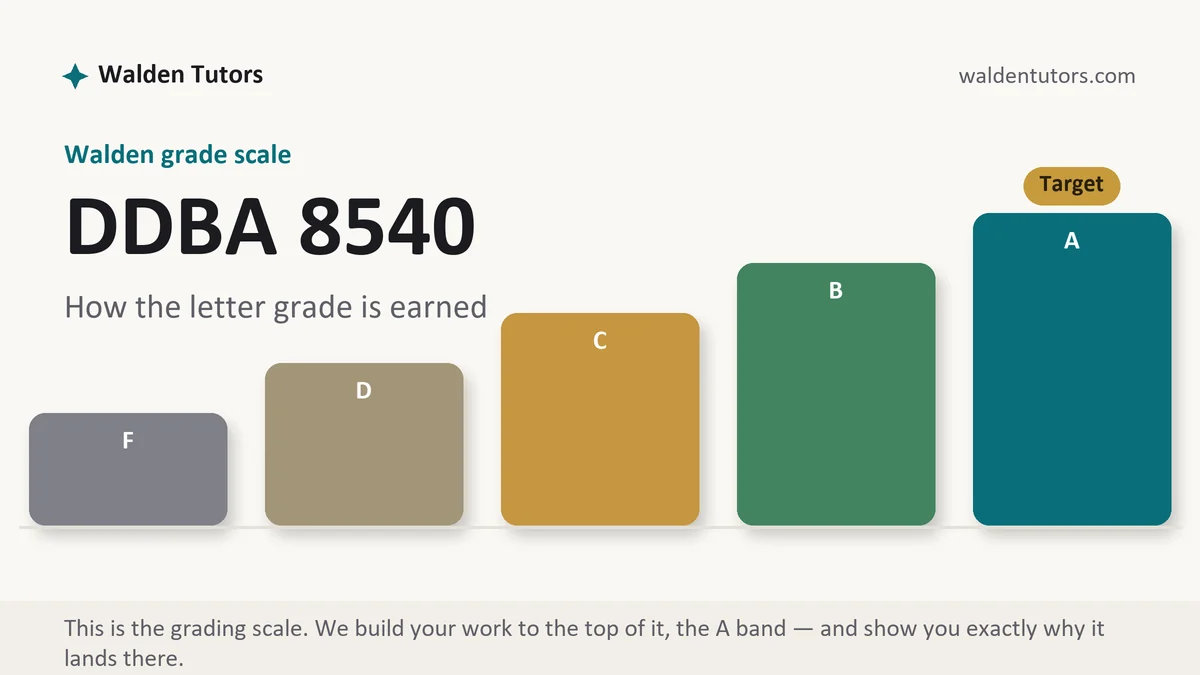
What DDBA 8540 actually grades
The catalog description sets out a route rather than a syllabus. You start with the historical setting in which capital began moving across borders at scale, work through what that movement gives to firms, to markets and to the societies hosting them, then turn to how risk is managed once money is exposed to more than one economy, and to the barriers that keep capital from flowing as freely as the models predict. The seat closes on a research topic you choose yourself, written up with the findings pulled together into one account of the field.
Three things get marked underneath that route. The first is whether you can handle the established models with confidence, meaning you can say what each one assumes and where it stops working, not merely what it predicts. The second is judgment about exposure. Anyone can name currency risk; the graded question is whether you can tell a translation problem from a genuine economic one and argue about which deserves a firm's attention. The third is the synthesis at the end, which is where most of the difference between bands appears.
One warning about the opening section, because it catches people every term. An instruction to set out the historical context reads like an invitation to write history, and history is easy to write at length. A grader reading a chronology of trade liberalisation is reading a paper that has spent its word budget before the argument started. Compress the background into whatever is needed to make your question sensible, then get to the question.
How we help in this course
Most orders from this seminar arrive in one of two shapes. Some are the weekly written pieces, a critique of a model or an analysis of some cross-border exposure, and those get drafted straight against whatever scoring guide your classroom posted, with a short note showing which paragraph answers which row. The others are the end-of-seminar research paper, and there the useful work happens before any prose exists: cutting a topic down to a size that a doctoral paper can actually finish, and building the map of literature it will stand on.
Send the prompt, the scoring guide, and if you have one, the topic you are circling. Turnaround sits at 24 to 48 hours. Writing is aimed at the top band of a course-based rubric, two different reviewers read every file before it reaches you, one scoring it the way your instructor would and one checking citations and originality, and revision costs nothing until the piece does its job. Attach something you wrote in an earlier seminar and the register comes back close enough to yours that making it your own is an evening.
Weekly manuals for this course
No deliverable grid appears on this page. Walden releases its syllabi to enrolled students inside the classroom and nowhere else, which means any site printing a confident week-by-week table for a DBA finance seminar assembled it out of nothing. We would rather leave the space empty and say why.
On dates, the build you were admitted into is legible from the code itself, since DDBA seminars are the semester build of the doctorate and DBAX seminars are the quarter build. Treat your student portal as the record that settles when this session opens and closes. Whichever calendar applies, the nightly cutoff for Course-Based work is 10:59 p.m. Central, which reads as 11:59 p.m. on an Eastern clock. Individual week manuals publish as each is verified. If yours has not appeared, bring the assignment into chat and you will have scope and pricing the same day.
Sitting on an 8540 paper?
Upload the prompt, the scoring guide and your topic if you have one. First premium draft free, returned within two days.
How to actually write DDBA 8540: start from the question, not the region
The single most useful move available to you in this seminar is to refuse the country-report instinct. Given a topic in international finance, almost everyone begins by choosing a place: Brazil, the eurozone, Southeast Asia. Then the paper becomes about the place, and the finance turns into background. Choose a mechanism instead. Exchange rate pass-through, sovereign risk premia, capital controls, cross-listing, remittance flows, the cost of hedging for a mid-sized exporter. A mechanism gives you something that can be argued about; a country only gives you something to describe.
Once you have a mechanism, write the question as a single sentence with the boundaries built in. Name the type of firm or market, the period, the setting, and the outcome you care about. That sentence becomes the thing every later section has to serve, and it is the fastest way to spot padding, because any paragraph that does not help answer it has no defense.
Then build the literature map before you write prose. Take a blank page and put your question in the middle. Around it, place the three or four established strands that speak to it, and under each strand write the seminal work that opened it and the more recent studies that tested it. A doctoral seminar expects you to reach the origin of an idea rather than to cite whoever restated it most recently, and this map is what stops a reference list from turning into whatever the database returned first. Where two strands disagree, mark the disagreement. Those marks are where your contribution will come from.
Handle the models with their assumptions attached. Parity relationships, asset pricing extended across borders, and the standard accounts of why capital does not flow smoothly from rich economies to poor ones are all built on conditions that hold imperfectly in the real world. A paper that states a parity condition and then observes that markets do not obey it has not said anything. A paper that names the frictions responsible, transaction costs, controls on capital, political risk pricing, thin markets in the relevant currency, and then asks which of those dominates in the setting you chose, is doing doctoral work. If your seminar has assigned a particular framework, use it, and use it as an instrument rather than as decoration.
Distinguish your exposures explicitly. Translation exposure sits in the consolidated statements and moves with the reporting rate. Transaction exposure lives in contracted cash flows already agreed in another currency. Economic exposure is the one that changes what the business is worth because competitive position shifts when rates move, and it is the one practitioners under-manage and papers under-discuss. Say which you are analyzing, say why the other two are not your subject, and the risk management section stops being generic immediately.
For evidence, go through the Walden Library rather than an open search. The business and economics databases available there carry the peer-reviewed work the rubric assumes, and they also carry the country and market data series you will want for context. Give every source one job you could state in a short phrase: this one defines the model, this one supplies the contrary finding, this one is the empirical study whose method you are borrowing. Under APA 7 the author and year belong inside the sentence carrying the claim, heading levels have to stay consistent from first page to last, and nothing sits in the reference list without a citation pointing at it from the text.
Finish the way a scholar-practitioner is expected to finish. International finance is a field with consequences, and the seminar asks for organizational, market and societal effects, not only firm-level ones. Say what a treasurer should do differently, then say what the same finding implies for the market and for the people living in the economy on the other end of the flow. Three short paragraphs doing that honestly are worth more than a page of restated conclusions.
| Section | What it does | Common failure |
|---|---|---|
| Question and boundary | States the mechanism, the setting, the period and the outcome in one sentence. | A region named instead of a mechanism, so the paper reports on a country rather than arguing about finance. |
| Context | Supplies only the background needed to make the question intelligible. | A chronology of globalization that consumes a third of the word count before anything is argued. |
| Model and assumptions | Sets out the established relationship you are using and the conditions it depends on. | A model stated as fact, with the gap between prediction and reality noted but never explained. |
| Evidence | Brings peer-reviewed studies and market data to bear on the specific question. | Sources listed in sequence, each summarized, none of them placed in conversation with the others. |
| Risk analysis | Identifies which exposure is at stake and weighs the instruments available against it. | Hedging discussed in general terms without naming the exposure type or costing the hedge. |
| Synthesis and implications | Resolves the disagreements you found and says what follows for firms, markets and societies. | A closing paragraph reporting that findings are mixed and further research is needed. |
Posting in a doctoral finance thread
Threads in this seminar reward specificity more than confidence. Bring a claim with a number or a mechanism attached to it, and say where you got the number. A post arguing that emerging market firms carry higher funding costs is unremarkable; a post naming a spread, a period and a plausible reason for it gives the room something to push on. Cite inside the post itself, because a row asking for evidence cannot see the reading you did off the page.
Walden asks for participation that is substantive, regular and delivered on time, and its grading policy suggests spreading your contributions across at least two to four separate days rather than compressing them into one late evening. The university also states plainly that posting requirements differ between courses and between weeks, so the brief inside your own classroom beats any pattern you carried in from an earlier seminar. When you reply to someone, aim at the reasoning: ask what would have to be true for their conclusion to hold, or name the frictions their model quietly assumed away. Those replies are the ones instructors quote back to the room.
The mistakes that cost points in DDBA 8540
- Writing a country profile with finance vocabulary sprinkled over it, rather than an argument about a mechanism.
- Citing news coverage and consultancy reports where the rubric expects peer-reviewed work and primary data series.
- Naming currency risk generically without ever saying whether the exposure is translation, transaction or economic.
- Reaching for the most recent restatement of an idea instead of the seminal work that established it.
- Reporting that studies disagree and treating that report as if it were the synthesis the rubric asked for.
- Letting the historical background swell until the original research question arrives on page four.
- Stopping at firm-level implications when the description explicitly asks about market and societal effects too.
DDBA 8540 questions students actually ask
Do I need a finance background to survive this seminar?
No, but you do need to be honest with yourself about which vocabulary you are missing, and you need to fix it in the first two weeks rather than the last. Scholars arriving from operations or human resources tend to stall on the same handful of ideas: what a forward contract is for, why an interest rate differential and an expected currency movement are supposed to be two sides of one coin, and what people mean when they separate a firm's accounting exposure from its economic exposure. Those are afternoons of reading, not semesters. What cannot be repaired late is a paper written by someone who never worked out what the terms meant and hoped the citations would carry it.
How do I pick an original research topic that will not collapse?
Pick a question narrow enough that you can name, in advance, what evidence would settle it. Whether emerging market firms should hedge currency exposure is not a question, it is a subject area, and it will swallow every page you give it. Whether firms in one industry, in one country, changed their hedging disclosure after one specific regulatory shift is a question, because you can see immediately where you would look and what would count as an answer. Narrow topics also protect you at the synthesis stage, since a tight question makes it obvious which of two disagreeing studies is actually relevant to you.
What counts as synthesis when every source says something different?
Disagreement is the raw material of synthesis, not an obstacle to it. When two studies reach opposite conclusions, your job is to explain the difference rather than to average it away or to quietly cite only the one you prefer. Look at the sample, the period, the country and the measure each study used, and you will usually find the conflict is really a boundary condition nobody stated. Writing that boundary condition down in your own sentence is synthesis. Reporting that the literature is mixed and moving on is the summary the rubric is trying to weed out.