DDBA 8550 is titled Seminar in Managerial Accounting in Walden's catalog and carries 3 semester credits. It is the first of three accounting seminars, and its job is to give you the vocabulary of internal decision numbers so that the seminar directly after it, which is about performance evaluation systems, can ask the harder question of what those numbers do to the people being measured by them. Get comfortable here with what a cost figure assumes, and that next course becomes an argument you can join rather than a language you are still learning. Walden's catalog currently shows the DBA and its accounting specialization closed to new applicants.
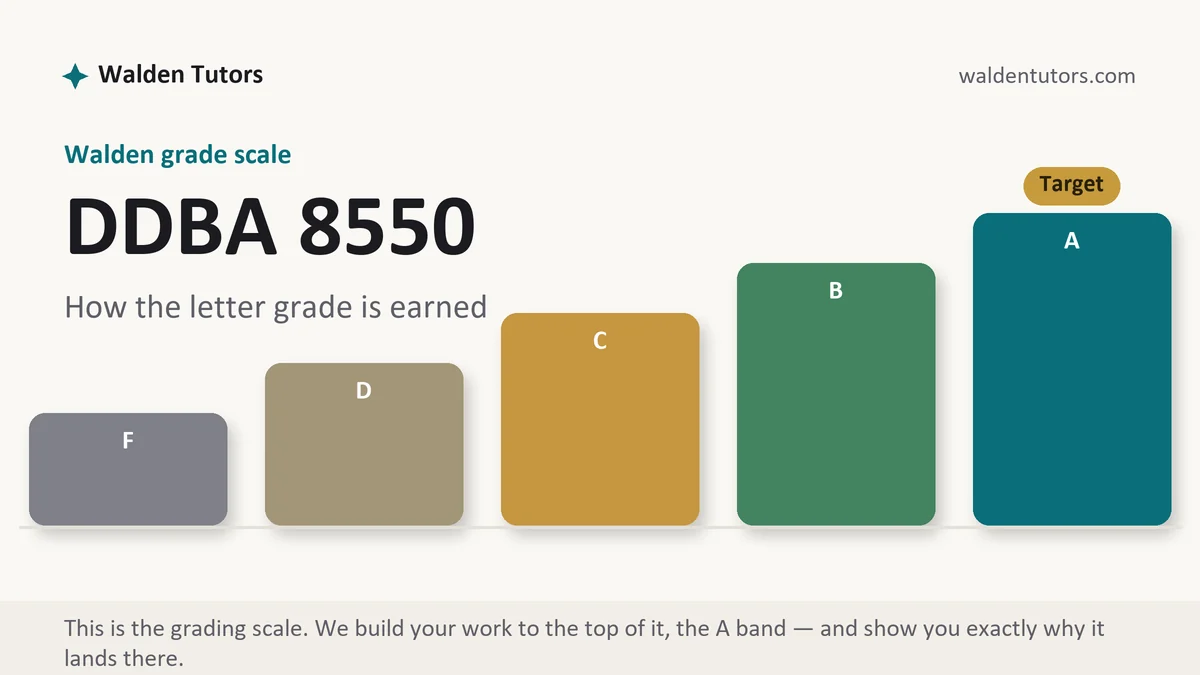
What DDBA 8550 actually grades
The catalog is unusually specific about content here. You work through forecasting revenue and predicting cost behavior, break-even and cost-volume-profit analysis, variance analysis on performance, relevant cost analysis for decisions, project valuation, expected rates of return and discounted cash flow. Then you look at how those methods might be improved, and at how applied research methods bear on designing decision systems that behave rationally.
Read the first phrase of that description carefully, because it changes everything about how you should write. The seminar takes a theoretical approach. It is not asking you to produce correct answers to costing problems; it is asking you to treat each method as an object of study. What does contribution margin analysis assume about how costs behave, and over what range does that assumption hold? What has to be true for a variance to mean what a manager thinks it means? Where does discounting quietly encode a judgment about risk?
That is why the strongest and the weakest papers in this seat can contain identical arithmetic. Two scholars compute the same break-even point; one moves on to the next section and the other stops to say that the figure depends on a fixed cost classification which will not survive a change in volume large enough to require another shift. The second paper is the one that gets the top band, and no extra calculation was involved in earning it.
The applied research strand is the piece people underestimate. Asking how you would investigate whether a decision method actually improves decisions is a research design question, and answering it seriously means naming what you would measure, over what period, against what comparison. If your assignment includes that element, it usually carries more of the marks than its word count suggests.
How we help in this course
Send the prompt, the scoring guide, and any data set or case the assignment attaches. The draft that comes back carries the calculation where it belongs and the reasoning around it in full: what the method assumes, what the inputs are and where they came from, what the result does and does not license anyone to conclude. Tables are formatted for a doctoral paper rather than exported from a spreadsheet, and a short note maps each row of the guide to the passage that answers it.
Delivery runs 24 to 48 hours. Work is written to the top of a course-based rubric, read independently by two reviewers before release, one checking it against the rows and one auditing sources and originality, and revised at no charge until it does what you needed. If the assignment includes a sensitivity element, the draft shows the range rather than a single figure, because a lone number is the easiest thing in this seminar for a grader to push back on.
Weekly manuals for this course
There is no deliverable table on this page and there will not be one until each week has been checked. Walden keeps its syllabi inside the classroom where enrolled scholars can see them, which means the week-by-week lists floating around the open web for doctoral accounting seminars are guesses, and we are not adding another.
The DBA does run under two calendars, but the codes keep them apart: DDBA is semester, DBAX is quarter, and this seminar is a DDBA course. Only your student portal can confirm the dates your enrollment sits between. Whichever it is, Course-Based work is due by 10:59 p.m. Central, the same moment as 11:59 p.m. for anyone keeping Eastern time. Manuals publish week by week as verification allows. Missing yours is not a reason to wait: open chat with the assignment and you will have scope and a price today.
Stuck on an 8550 costing analysis?
Send the prompt, the scoring guide and any attached data. The first premium draft is free and lands inside two days.
How to actually write DDBA 8550: audit the assumption before you run the number
Begin every piece of work in this seminar by writing down the decision. Not the method, not the data, the decision. Whether to accept a one-off order below normal price, whether to make a component or buy it in, whether to close a division that shows a loss on the allocated statements, whether to fund a project competing with two others for the same capital. Naming the decision first is what tells you which method belongs in the paper, and it prevents the most common structural failure, which is a paper that performs an analysis nobody asked for because that analysis was in the reading.
With the decision fixed, sort the costs before touching a calculator. A cost is relevant only if it lies in the future and differs between the alternatives on the table. That test disposes of sunk costs immediately, and it disposes of allocated overhead unless the total pool genuinely changes with the choice. It also brings in the item most submissions forget, which is opportunity cost. The capacity used by the special order is capacity denied to something else, and a relevant cost analysis that ignores the forgone contribution is arithmetically tidy and substantively wrong.
When you use cost-volume-profit or contribution margin analysis, state the relevant range out loud. The whole apparatus rests on costs behaving linearly and the sales mix holding steady, and both of those are true only within a band. Say what that band is for your case, say what breaks when you leave it, and you have converted a routine calculation into the kind of qualified claim a doctoral rubric is built to reward. The same discipline applies to cost prediction: if you are separating fixed from variable behavior, say how, and say what the method you used would miss.
For variance analysis, remember that a variance is a question, not a verdict. An unfavorable materials variance can mean a poor purchase, a change in supplier quality, a badly set standard, a production problem downstream, or a genuine shift in market prices that nobody controlled. Doctoral writing on variance is expected to reach for the explanation and to acknowledge that the standard itself is a managerial choice with behavioral consequences. That last point is your bridge into the seminar that follows this one.
On valuation, the number is only ever as defensible as the inputs. Lay out the cash flow assumptions explicitly, state the horizon and justify it, name where the discount rate came from and what risk it is meant to represent, then run the case at more than one rate. Expected rates of return deserve the same treatment: an expectation is a probability-weighted figure, so say what the probabilities are and where you got them, and do not present a single-point outcome as though the distribution around it did not exist. One clearly labeled sensitivity table does more for your credibility than three pages of precision.
Then write the section the seminar's description points at and most papers skip. How would you improve the method you just used, and how would anyone find out whether the improvement worked? That is a research design question, so answer it like one: what would you measure, in which organization, over what period, compared against what. Give it real content and you are doing exactly what a seminar built on applied research methods asks for.
Sources come from the Walden Library, where the accounting and management journals hold the empirical work on whether these techniques actually change decisions in practice. Cite the origin of a method rather than a textbook summary of it, cite the evidence when you claim a method works or fails, and cite the provenance of every input you use. Under APA 7 the citation sits in the clause carrying the claim, headings hold their levels throughout, tables carry proper numbers and titles, and no reference entry may sit unmatched by an in-text mention.
| Section | What it does | Common failure |
|---|---|---|
| The decision | States what is being chosen between, for which organization, over what horizon. | Opening with a method rather than a choice, so the analysis has nothing to serve. |
| Method selection | Says which technique fits this decision and why the alternatives were set aside. | Running whatever technique the week covered, whether or not it answers the question asked. |
| Assumption audit | Names the relevant range, the cost behavior claim, the horizon and the risk judgment. | Assumptions used silently, leaving the result looking more certain than the inputs allow. |
| Computation | Shows the inputs, the arithmetic and the result in a table a reader can follow. | A figure produced with no visible working, so nobody can tell where it came from. |
| Sensitivity | Re-runs the decision under plausible alternative inputs and reports where it flips. | One point estimate presented as the answer, with no indication of how fragile it is. |
| System implication | Says how the method could be improved and how you would test whether it was. | Ending at the number, leaving the applied research element of the seminar unaddressed. |
Threads about numbers, argued properly
Accounting threads go wrong in a specific way: people post the answer. Someone computes a break-even volume, posts it, and the room agrees. Nothing has happened. Post the assumption instead. Say which cost you treated as fixed and why, or name the input you were least comfortable with, and the thread suddenly has somewhere to go. In a seminar built on a theoretical approach, the disagreement is the content.
Walden expects participation that is substantive and reasonably spread out, and its grading policy recommends contributing on at least two to four separate days rather than in a single session. The university also states that requirements differ between courses and even between weeks, so the brief inside your own classroom is the one that binds. When you respond to a classmate, take one of their inputs and ask what happens if it moves. Ask what their analysis would say at twice the volume, or whether the overhead they allocated actually changes with the decision. Those replies teach the room something, which is what the row is paying for.
The mistakes that cost points in DDBA 8550
- Including sunk costs in a relevant cost analysis because they appear on the statement in front of you.
- Forgetting opportunity cost when scarce capacity is being reassigned by the decision under study.
- Applying cost-volume-profit outside the range where the linearity it depends on could plausibly hold.
- Reporting a variance as a verdict on someone's performance rather than as a prompt for investigation.
- Choosing a discount rate without saying where it came from or what risk it is standing in for.
- Presenting a single-point valuation with no sensitivity work, then arguing a decision on top of it.
- Skipping the improvement and research design element, which is where a large share of the marks often sits.
DDBA 8550 questions students actually ask
Is this seminar going to be spreadsheets or writing?
Writing, with arithmetic inside it. The catalog says the seminar takes a theoretical approach to the methods it covers, which is the signal that matters. You will still compute break-even points and discounted values, but the computation is evidence in an argument rather than the answer to a question. Scholars who arrive from accounting roles tend to find the numbers easy and the framing hard, because nobody in practice ever asked them to say what a method assumes or where it stops being valid. Budget your effort accordingly: an hour on the calculation, several on what the calculation is allowed to prove.
How do I choose a discount rate I can defend?
Say where it came from and what it is standing in for, then test it. A rate is a claim about the risk of the cash flows you are discounting, so a project riskier than the firm's usual work should not be valued at the firm's usual cost of capital, and saying so in one sentence earns more than any amount of precision in the number itself. Take a published estimate from a source you can cite, adjust it if your case warrants and explain the adjustment, then run the valuation at a rate above and below your choice. If the decision holds across that band, the rate was never the fragile part. If it flips, you have just found the sentence your paper needed to say.
Do I need to cite sources when the paper is mostly calculation?
Yes, and the citations should be doing something. Three places always need them. Where you define a method, cite the work that established it rather than a textbook restatement. Where you state an assumption, cite whoever demonstrated that the assumption holds or fails under particular conditions, since that is the literature the seminar is built to examine. Where you use an input, cite its source, because a number without provenance is an assertion. What does not need a citation is your own arithmetic. A paper full of well-cited definitions and an uncited set of inputs has the reference load in exactly the wrong place.