The single decision that sinks a DDBA 8552 paper is usually made in the first hour, when a scholar picks a country pair because it sounds interesting and only later finds that the filings, tax schedules or price indices the argument needs were never published anywhere citable. Walden's catalog carries the course as Seminar in International Aspects of Managerial Accounting at 3 semester credits. Graded work is written: analytical papers and doctoral threads about managerial decision making, risk and budgeting once currency, tax regimes and cross-border control systems enter the picture.
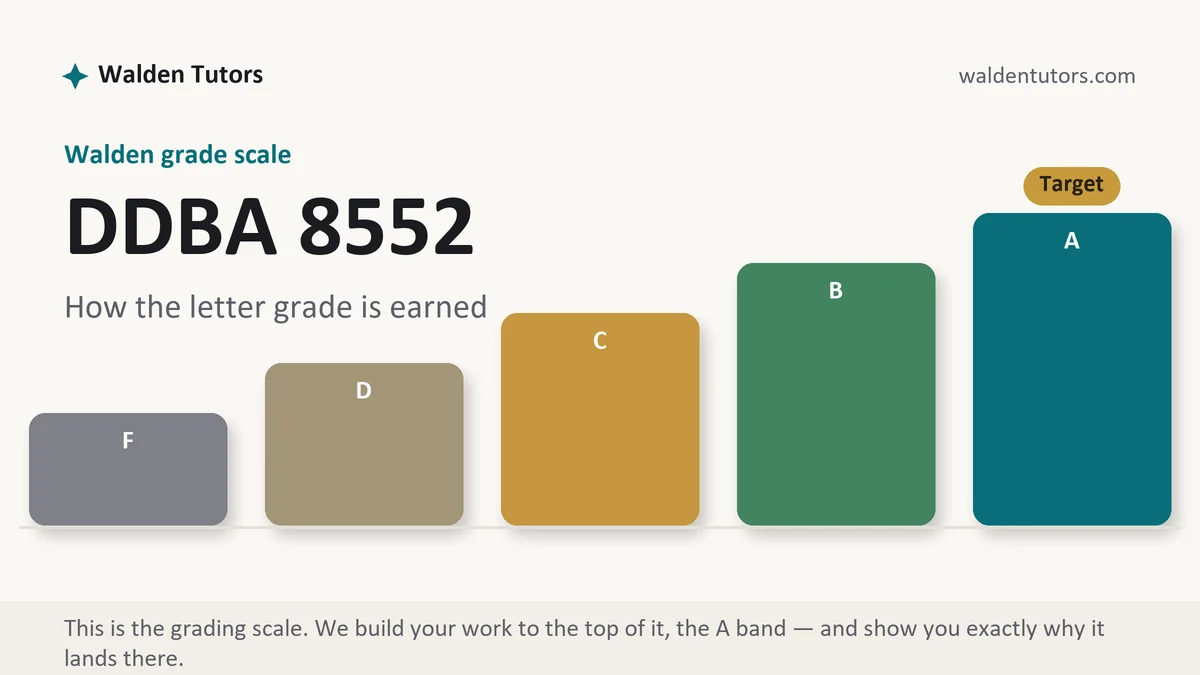
What DDBA 8552 actually grades
Walden's own description marks out the territory. You take theories of managerial decision making, risk management and budgeting and run them through a global, cross-cultural setting, then apply research methods to problems such as import and export exposure, foreign exchange movement, controlled economies, social responsibility reporting, inflation accounting and international taxation. Every graded item arrives with a scoring guide, and because those rows are set assignment by assignment, read yours before assuming anything about weighting.
The rows keep circling one demand. A grader wants an accounting mechanism identified by name, applied to a specific entity operating across a specific border, with figures or documented policy underneath it. Work that stays at the level of multinational firms face currency risk collects a middling band however clean the prose is. The band above belongs to a paper that says which exposure, measured how, on whose balance sheet, translated under which method, and what a manager should therefore decide.
How we help in this course
Upload two things, the task itself and whatever scoring guide came attached to it. What returns is original writing arranged so every row on that guide has a paragraph aimed at it, together with a short map saying which paragraph does which job. On 8552 the map matters more than usual, since method and evidence are the rows doctoral writers most often satisfy by luck instead of by design.
Criterion-mapped feedback on your student-authored draft can return inside 24 to 48 hours. One pass checks doctoral reasoning against the live scoring guide; another checks APA 7, source use, and originality. You choose each revision, preserve your own voice, and submit only work you can defend. No grade is promised.
Weekly manuals for this course
A manual for a given week goes up here only after that week has been checked against Walden material. Syllabi for DBA seminars are not posted publicly, so a site handing you a confident list of what 8552 grades in week four built that list out of nothing.
Two scheduling points are worth pinning down. The calendar attached to your term is a semester one, because Walden files the quarter build of this doctorate under DBAX and the semester build under DDBA, and your student portal is still the authority on start and end dates, which makes this page subordinate to it. For Course-Based classrooms the cutoff never moves: 10:59 p.m. by the Central clock, 11:59 p.m. by the Eastern one. Week not covered here yet? Ask in chat and the scope comes back to you before the day closes.
Working on an 8552 paper this week?
Send the prompt and the scoring guide attached to it. The first premium sample costs you nothing and lands within two days.
How to actually write DDBA 8552: choose the border before you choose the theory
Begin with the scoring guide, not the prompt. Copy every row into an empty document, turn each row into a heading, and write its point value beside it. You now hold a skeleton that cannot omit anything and a word budget telling you where the marks live. The commonest proportion error in this seminar is a long, careful explanation of a theory followed by a short, hurried application of it, which inverts nearly every weighting a DBA guide actually uses.
Pick the entity and the border next, and pick them for evidence rather than for interest. A workable subject has three parts: a parent company whose financial statements you can read, an operation in a second country whose reporting environment is documented, and a mechanism visibly connecting the two. Transfer pricing between the units, translation of the subsidiary's results into the parent's reporting currency, a tax treaty position, or a price index that makes historical cost figures misleading are all mechanisms. Doing business in emerging markets is not one. Before committing, spend twenty minutes confirming that the filings, the tax authority guidance and the exchange rate series you will need are obtainable, because the version of this paper that fails is generally the one where the writer could not get the numbers and quietly switched to description.
Now write the thesis as a claim a reader could argue with. Something on the order of this: the reported margin in the firm's second market is an artifact of the translation method rather than of operating performance, and a manager reading the consolidated statements would misallocate capital as a result. That sentence hands you sections to write and hands the grader rows to fill. Set it beside international accounting presents challenges for managers, which commits to nothing and therefore cannot be checked against anything.
Synthesis is where doctoral rows part company with master's-level ones. Three summaries in three paragraphs is not synthesis even when each summary is accurate. Put the sources into contact instead. Management control scholarship will tell you budgets travel badly across cultures because the assumptions inside them are local; international accounting scholarship will tell you the same budget travels badly because the currency underneath it moves. Run both explanations at your case and one will fit the evidence better. Say which, say where the other falls short, and you have produced a paragraph nobody could write without having read both.
Do your searching inside the Walden Library. Its accounting and business collections carry peer reviewed material with provenance you can defend under questioning, and twenty minutes spent with a subject librarian will beat an afternoon of guessing at keywords. Standards and statutes belong in a different class: go to the standard-setter or the tax authority for the rule itself, then let scholarship supply the interpretation of it. On APA 7, hold author and year inside the clause making the claim instead of parking them at a paragraph's end, keep heading levels stable, and reconcile each reference with the text citing it before the file leaves your machine.
| Section | What it does | Common failure |
|---|---|---|
| Problem statement | Names the entity, the two jurisdictions and the accounting decision under examination. | A general essay about globalization that never identifies whose books are affected. |
| Theory and method | States which decision-making, risk or budgeting theory applies and how you intend to test it. | A literature tour where four theories are introduced politely and none is chosen. |
| Evidence | Statements, tax positions, rate series or index data, laid out so a reader can follow the calculation. | Figures quoted with no source, no period and no currency, so nothing can be verified. |
| Analysis | Applies the mechanism to the evidence and shows what changes once it is applied. | The theory's categories restated as headings with a generic sentence beneath each. |
| Managerial recommendation | Says what the manager should do differently once the accounting distortion is visible. | Advice about improving communication that would suit any company in any country. |
| Limitations and conclusion | Admits what the data cannot show and states the confidence the evidence supports. | A recap of the sections in place of a verdict on the argument. |
Discussion posts that hold up in an accounting seminar
Threads carry rows of their own here, and brevity is what they pay for. Put the position in your opening line. Back it with a single study you have genuinely evaluated, not a handful you have merely named. Add the remark that only somebody who has closed a set of books could make. Then stop, because a doctoral post is an argument and not an essay, and the stopping is itself being marked.
Three qualities appear in the grading policy: substance, regularity, and posting on time. The recommended floor puts your contributions on two to four separate days, which rules out the single late session that clears an entire week at once. Walden is candid, too, that no fixed posting requirement runs across the catalog or even across the weeks of one course, so whatever your classroom brief specifies beats whatever the last seminar trained you to do. Replying is scored on its own row, meaning an agreeable comment banks nothing. Supply the exchange rate series your colleague lacked. Move their control argument into a country running capital controls and watch it break. Or isolate the assumption propping their position up and ask what a devaluation would do to it.
The mistakes that cost points in DDBA 8552
- Writing about currency risk in the abstract when the rows ask for one exposure, on one entity, over a stated period.
- Mixing translation exposure and transaction exposure as if they were a single problem, which tells a grader the mechanism was never understood.
- Reporting figures with no currency, no reporting date and no source, so not one number can be checked.
- Treating consulting summaries and news commentary as evidence on rows that plainly ask for scholarship or primary standards.
- Explaining a cross-cultural difference by naming a culture dimension and stopping, with no link to a budget, a control or a reported figure.
- Closing on advice any multinational could adopt, which proves the analysis did not drive it.
DDBA 8552 questions students actually ask
Do I need to be an accountant to pass this seminar?
No, but you do need to be comfortable reading a financial statement and following a calculation. The rows reward precision about mechanisms rather than technical virtuosity. If you can locate a subsidiary's results inside a consolidated report, tell a translation adjustment apart from an operating result, and explain what a tax position does to reported profit, you have enough. Where a concept is unfamiliar, learn it from the standard or the textbook first and the journal article second, because the article assumes you already know it.
Can I use my own employer as the case?
Often yes, and it usually improves the paper, because you can explain why a policy exists instead of guessing at it. Two cautions. Anything confidential stays out, meaning no internal figures you would not be free to publish, and where the argument needs numbers you should point at material already in the public record. Check the assignment too, since some weeks tie the analysis to a named case or to a listed company so faculty can follow your evidence.
How current do my sources have to be?
Recent enough that nothing has replaced them. Theory about budgeting behavior and management control ages slowly, and older seminal work is often the right citation. Anything touching tax rules, reporting standards or exchange regimes moves quickly, so take that from the current standard, current authority guidance or recent scholarship, and check the date before building on it. If your scoring guide states a recency window, that number governs whatever some other paper did.