DDBA 9000 belongs to the previous DBA curriculum. Walden superseded the code in its Summer 2026 curriculum update and the capstone now carries the number DDBA 9001, for which no page exists on this site yet, so nothing is linked here. Chairs, committees and section gates behave much as they did, which is why the guidance stays up; even so, the study you are actually enrolled in, and the chair reading it, set the requirements that count.
In the DBA path as it was numbered before Summer 2026, DDBA 9000, Doctoral Study Completion, The DBA capstone, is where this page points its help. Everything under this line describes the capstone as it was numbered, plus the help still attached to it.
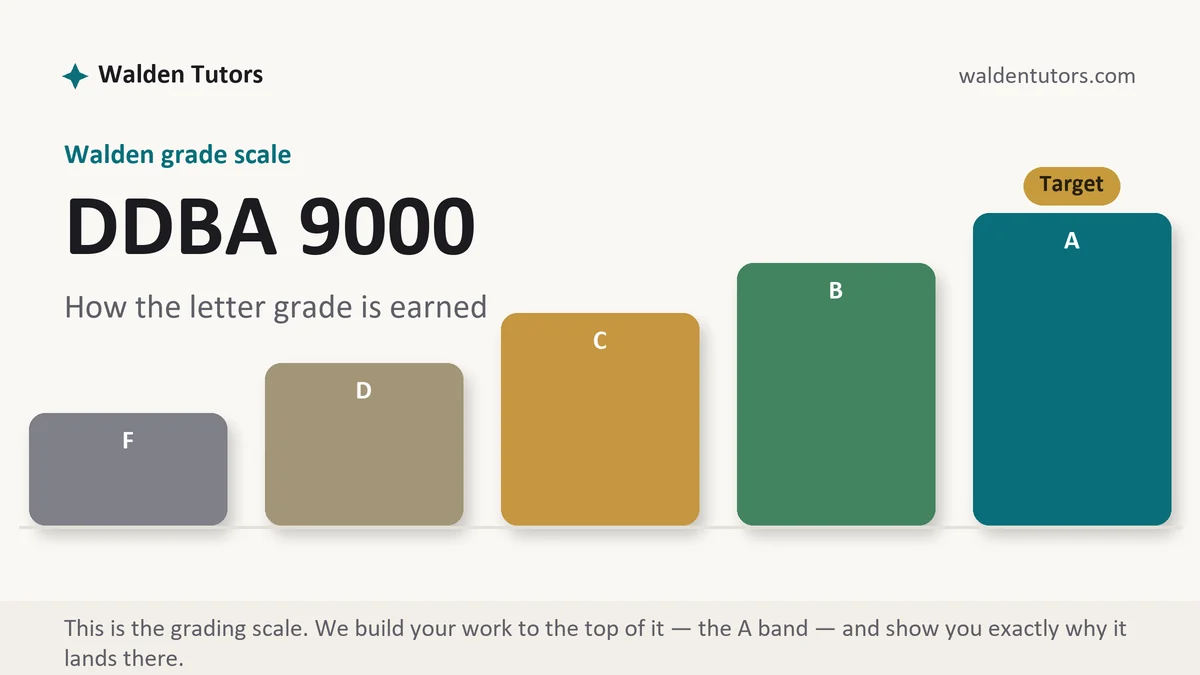
What DDBA 9000 actually grades
The Doctoral Study itself: problem statement through findings, chapter gates, committee cycles, and the long middle where DBA timelines quietly die. Every section must satisfy both a rubric and a chair, two audiences that do not always agree.
How we help in this course
We stage 9000 as a dated chapter plan, draft in doctoral register, pre-review against the rubric before your chair ever sees it, and fold committee feedback into revisions within days. The next chapter is always drafted before the current one clears; that single habit is why our 9000 clients finish.
A placed order gets the whole staffing chain. Rubric interpretation belongs to the research analyst, drafting to a writer matched on program, and checking to two separate people, since APA and originality are reviewed apart from the rubric pass. Files land in a 24 to 48 hour window, with revisions open until you reach the target.
Weekly manuals for this course
Public manuals were appearing for DDBA 9000's weekly deliverables as each one verified, and that work stopped at the renumbering. The chat desk holds the live inventory, so ask there rather than reading it off this page.
Still finishing DDBA 9000?
Send the week or assignment and the rubric from Canvas. First premium sample free, back in 24 to 48 hours.
One document, two graders
Every 9000 section answers to a rubric and to a chair, and the two disagree often enough that drafting for either alone is how timelines slip. Each chapter is scored against the rubric in-house first, so your chair only ever reads work that already survived that pass; when committee comments arrive, they are folded into a revision inside days, not weeks, and both audiences converge on the same document instead of trading it back and forth across a term. Chair styles differ enormously, some line-edit, some gesture, and the desk adapts its revision approach to the feedback style you actually receive rather than the one a handbook imagines.
The cadence that finishes doctorates
The rule is simple and non-negotiable: while one chapter sits in review, the next one is drafting, always. Waiting is where DBA years disappear, and the dated chapter plan exists to make waiting structurally impossible. On this rhythm the long middle of the study, the stretch where most timelines quietly die, stops being long. Dated means dated: each section carries a calendar week, and slippage surfaces within days instead of being discovered at the end of a term.
Doctoral study questions, without varnish
Can you start mid-study?
What does a full engagement look like?
How to actually write DDBA 9000: where to begin
Two documents you did not write govern everything here: the rubric your program applies to each section, and the template the study has to be poured into. Read both before writing a sentence. The rubric is a list of what has to be demonstrable, and the best-spent hour of the term turns its rows into headings in an empty file so the study grows into the shape it will be judged in. Weighting matters less than completeness at this level, since section reviews tend to run pass-or-return rather than partly credited, but the points attached to any classroom deliverable still tell you where reading time belongs.
The second thing to accept is structural. Doctoral Study Completion is less a course with weekly assignments than a term-long production line with a chair at the end of it. What you produce is one document, built section by section, read by people who have seen hundreds of them. So the unit of work is not the week, it is the section, and one pacing rule decides whether a study finishes: something must be drafting while something else is under review. Draw a dated map of the remaining sections at the start with the review windows marked on it, and the months that would have been empty become visible immediately.
Then start at the problem, because everything downstream inherits its errors. A doctoral study problem has to be specific, evidenced from current literature and from practice, and small enough for one researcher to address. Write it, then test it by asking what data would answer it; if no method suggests itself, what you have is still a topic. From there the chain is fixed: problem to purpose, purpose to research question, question to design, design to data, data to findings, findings back to the problem they came from. Students searching DDBA9000 mid-term report the same symptom, a section returned again, and the cause usually sits two links up that chain rather than in the pages that came back.
| Section | What goes in it | What earns full rubric points |
|---|---|---|
| Problem statement | The specific business problem, evidenced from current literature and from documented practice. | A problem a practitioner would recognize and a researcher could address, bounded and sourced on both sides. |
| Purpose and research question | What the study will do, and the question it answers, aligned to that problem. | Purpose, question and design that could be read in any order without contradicting one another. |
| Framework and literature | The conceptual lens, and the review that positions this study inside what is already known. | A review that argues, showing what is settled, what conflicts, and where this study sits in the argument. |
| Method and design | Population, sampling, instruments, procedures, and the ethical protections in place. | Choices justified against the alternatives you rejected, with reliability and validity addressed rather than asserted. |
| Findings and application | What the data showed, and what practice should do differently as a result. | Findings tied back to the framework and the original problem, with the limits stated plainly. |
Discussion posts that actually earn the points
Not every doctoral study term carries a graded thread, so check your classroom before assuming either way. Where one runs, it is scored on its own rows like any Walden discussion, and it usually asks for progress, a methodological question, or a section put up for peer reading. Post the actual difficulty rather than a status line. Saying you are in week six and still working on chapter two teaches nobody; saying your sampling plan yields eleven participants and you cannot tell whether that is defensible for this design gets answers from people solving the same problem, and it reads as scholarly engagement to whoever is scoring the row.
Replies carry a separate deadline set by your classroom rather than by convention, and the gap between agreeing and helping is wider here than anywhere else in the program. A colleague who posts a shaky alignment between purpose and question does not need encouragement, they need somebody to write out where the two diverge and point to a source that shows the standard. Do that with the courtesy the setting deserves, and quote the exact phrasing you are answering. The peers reading your thread this term are the closest thing to a committee rehearsal you will get for free, which is worth more than the points attached to it.
Citations and APA the way Walden grades them
A doctoral study is the most APA-sensitive document you will ever produce for Walden, and the template enforces much of it before you type anything. Follow it exactly: heading levels, seriation, table and figure formatting, and a reference list reconciled against every in-text citation with no orphan on either side. The Walden Writing Center supports capstone writing specifically, and its guidance on the study template will save more hours than any advice about prose.
Source expectations are heavier than coursework and different in kind. Programs generally want the bulk of the literature peer reviewed and current as of completion rather than as of proposal, which makes the review a living section and makes stale citations a returned chapter waiting to happen; confirm the currency standard your program applies rather than guessing at it. Search the Walden Library systematically and keep a log of search strings and databases, so the review's own method can be described when somebody asks. Give each source a role in an argument. Originality checking runs across the finished study, so paraphrase from your own notes rather than from an open source document, and keep every citation inside the sentence making the claim.
The mistakes that cost points in DDBA 9000
- A problem statement written as a topic, broad enough that no method follows from it.
- Purpose, research question and design that drifted apart across drafts and were never reconciled afterward.
- A literature review assembled as an annotated list, when the section exists to argue its way toward a gap.
- Method choices asserted rather than justified, with no alternative considered and no limitation admitted.
- Waiting on a review with nothing else drafting, which is where doctoral calendars quietly disappear.
DDBA 9000 questions students actually ask
How long does the doctoral study actually take?
Longer than the term it begins in, for nearly everybody, and the variable is not writing speed. Time disappears into review cycles, revision rounds and approvals, each running on somebody else's calendar. Your program publishes enrollment expectations for the capstone and your chair can say what is realistic for your design; treat those as the planning numbers rather than anything read in a forum. What you control is whether a section is always in motion while another is being read.
What do I do when chapter feedback contradicts what I was told before?
Write both instructions down side by side and take the pair back to your chair as a question rather than a complaint. Contradictions usually come from different reviewers holding different parts of the same standard, and they resolve in one conversation. What never resolves is revising twice in opposite directions and hoping. Keep a running file of every decision and who made it, because in a document this long you will be asked to defend a choice you made eight months earlier.
Can I change my research question partway through?
Yes, and changing it early beats defending a misaligned study to the end. Understand what moves with it: the purpose statement, the framework, the review's argument, the design, and any approvals already secured. Nothing in a doctoral study is local. Ask your chair what the change costs in approvals before you touch anything, because that answer, not the writing, decides whether it is worth doing.