DNRS 6052 help and tutoring

DNRS 6052 · 5 cr · evidence-based practice
The short answer

One question sits under every assignment in this course, and it is harder than it sounds: how good is this evidence, and what should a practice do about it. DNRS 6052 carries five credits in Walden's doctoral nursing listing, and it grades that judgment in writing rather than in conversation. Lifting the rubric rows into an outline before you draft anything is what shortens the work.

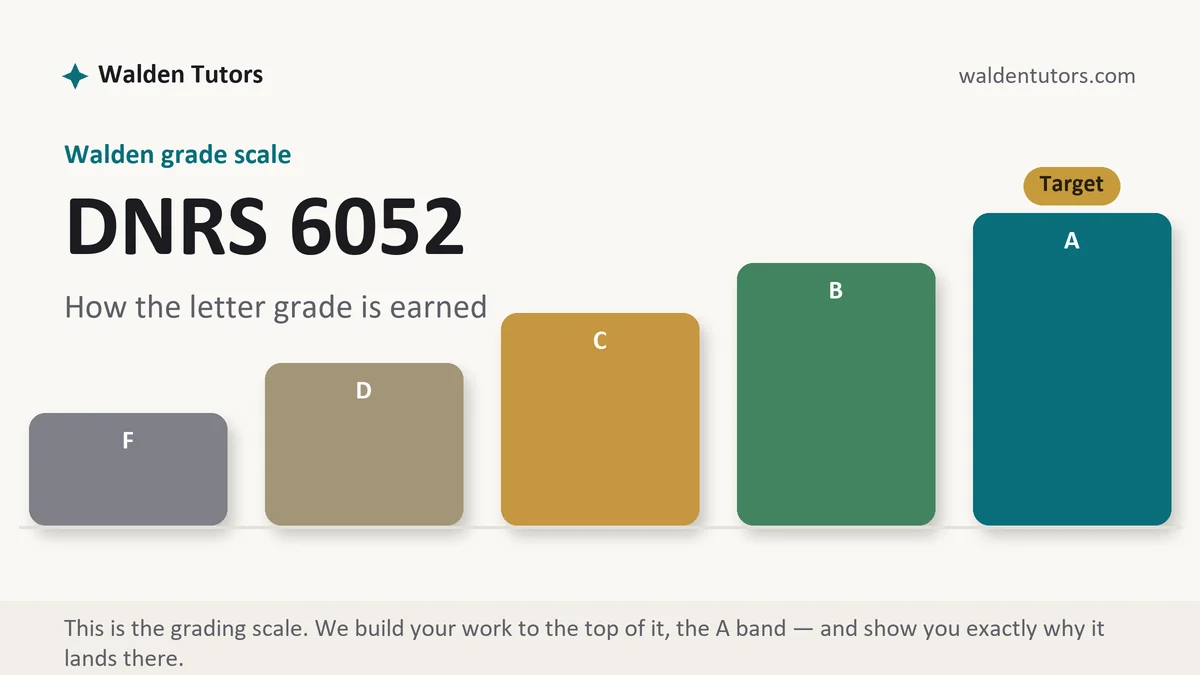
DNRS 6052 grading scale at Walden, how the work is graded, from Walden Tutors
How Walden grades DNRS 6052, visualized by Walden Tutors.

What DNRS 6052 actually grades

Walden's own description of the course marks the territory. Students work out how evidence based practice sits alongside research and quality improvement, use databases to find evidence, apply what they know about research methodology to appraise it critically, strengthen synthesis and integration until they can say whether practice ought to change, and then look at implementation, evaluation and dissemination, including what it takes to lead that change inside an organization. Every one of those verbs turns into a graded document at some point in the term.

Syllabi sit behind the classroom login, so treat any week-by-week list you find on the open web as somebody's guess. What holds across doctoral nursing is a mix of graded threads and written assignments, each carrying a rubric posted beside it, with a letter grade assembled row by row. Here the rows are unusually literal about their verbs. Appraise is not describe. Synthesize is not summarize. A document that walks through six studies in six tidy paragraphs has answered a row nobody wrote.

How we help in this course

Our doctoral bench writes the appraisal and synthesis work with the judgment visible on the page, which is the part most drafts leave implied. Send us the prompt along with whatever rubric the classroom attached to it, and what comes back has each section pointed at a specific row.

Delivery sits at 24 to 48 hours. Nothing ships until two people have read it: the first grades it row by row the way your instructor will, the second checks APA and runs originality, and revision stays open until the work hits its target. Attach something you wrote in an earlier term and the draft is tuned toward your own sentence habits, so making it yours is a short job.

Weekly manuals for this course

None of the week-level manuals for DNRS 6052 are live yet, and each goes up only after it has been checked against a real classroom. Quarters, not semesters, carry doctoral nursing here. Walden publishes that full term at eleven and twelve weeks and runs a six-week half term as well, so the deliverable count in front of you follows the section you registered for, not the four digits in the code. Bring the week you are actually sitting in to chat and you get an honest scope answer before committing to anything.

Behind in DNRS 6052?

Send the prompt plus the rubric attached to it. The first premium draft is free and rarely takes longer than two days.

The difference the rubric is paying for

Two students can read the same eight articles and hand in documents three letter grades apart. The weaker one reports what each article said. The stronger one decides what each article is worth, then says what the set of them, taken together, supports.

Appraisal breaks into a short list of judgments you can make in order. What design produced this finding, and what is a design of that kind able to establish. Who was in the sample, how many of them were there, and how close are they to the patients you actually care for. What was measured, with which instrument, and was it measured the same way for every participant. What else could have produced this result besides the explanation the authors prefer. How big is the effect once you look past the p value, and how wide is the interval around it. Put those judgments into your sentences and the appraisal row has something to score.

Synthesis is the step after appraisal, and it means arranging the literature by claim instead of by author. A synthesized paragraph opens with something you believe, carries two or three citations that support it, and then names the study that disagrees. The mechanical test is whether any paragraph in your draft cites more than one source while making a single point. If every paragraph belongs to exactly one article, you have written an annotated bibliography with the headings stripped off.

Evidence hierarchies help as long as you use them to reach a conclusion rather than to apply a label. Telling a reader that a source sits at level three does nothing. Telling them that the only support for this intervention comes from small single-site work, so it deserves a monitored pilot rather than a system mandate, uses the hierarchy to arrive somewhere, and arriving somewhere is what a doctoral row wants.

Where DNRS 6052 sits in the doctorate

The word essentials in the title is accurate. Almost everything the DNP asks of you later, the quality improvement work, the practice change proposal, the doctoral project itself, is assembled from the two skills scored here: finding the evidence that bears on a practice question, and judging it honestly enough that another clinician could act on your conclusion. Students who treat this as a writing hurdle meet the same rubric language again much later with nothing new to bring. Students who learn to appraise properly find the later courses mostly a question of scale.

Try the desk on one paper

A free first sample suits an evidence course better than most, because a single appraisal document shows at once whether a writer can weigh a study or only retell it. Pick whatever is due next, send the instructions and the rubric with it, and read what comes back against the rows before any money changes hands. If it holds up, the seasonal offer covers your first paid batch.

How to actually write DNRS 6052: where to begin

Do not start with the prompt. Start with the rubric, and start by retyping it. Paste each row title into an empty document in the order a grader will meet them, then stop. What you are holding is an outline that cannot mislead you, because the person assigning your grade wrote it. A paper organized around the articles you happened to find will scatter the material for any single row across four separate pages, and nobody working down a column goes hunting.

Put the point value beside each heading next and convert it into a word target. A row carrying a third of the score has earned about a third of the words, and the heavy rows here are nearly always appraisal and synthesis rather than background. Most first drafts arrive upside down, with three pages explaining why the topic matters and a page and a half doing the work that pays. Setting the budget before you write is what stops that imbalance forming.

Build the question before you open a database. Practice questions in this course usually take PICOT form, and the reason is practical rather than ceremonial: a well-formed question tells you which terms to search and which studies are eligible before you waste an evening. Name the population precisely enough to exclude somebody. Name the intervention as something a unit could actually do on a Tuesday. Name the comparison even when the comparison is current practice. Name an outcome that can be measured, and attach a timeframe to it. A question that survives those five tests has done most of your searching for you.

Run the search through the Walden Library, not a public search engine, and record it as you go: which database, which terms, which limiters, how many results came back, how many you kept and on what grounds. Plenty of assignments ask for that trail outright, and where yours does not, having it converts a vague methods paragraph into a reproducible one. Expect to run the search twice. The first pass usually proves your terms were wrong, and the second pass is the one worth reporting.

Build a matrix before you build paragraphs. One row for each study, columns for design, sample, setting, intervention, outcome measured, result, and your own appraisal note. It costs about twenty minutes and it writes your synthesis for you, because themes show up as vertical patterns down a column instead of as something you have to hold in your head across a stack of PDFs.

End with a recommendation somebody could act on. Say what should change, for which patients, in what setting, and how you would know inside a stated period whether it worked. Name the barrier you expect and the person whose agreement you need to get past it. Conclusions calling for further research or for staff education score badly precisely because they would have been true whatever your evidence had shown.

Citations and APA the way this course grades them

APA 7 is scored twice over, once as mechanics and once as source behavior. Mechanics covers the Walden title page, heading levels used correctly, and a bibliography holding no entry the text failed to cite and missing no citation the text actually made. Source behavior is where an evidence course parts company with the rest of the curriculum. Cite the primary study for a finding rather than the review that mentioned it. Give publication year visible weight wherever currency changes the answer. Keep secondary citations rare and label them honestly on the occasions you need one. The Writing Center keeps the templates Walden grades against, and starting from one of those is cheaper than arguing your own layout with a grader later.

SectionWhat it doesCommon failure
Practice problemStates the clinical problem, who it affects, and why a change is worth considering.An essay on why the topic is interesting, with no patient population anywhere in it.
PICOT questionTurns the problem into a searchable, answerable question with a measurable outcome.An outcome nobody could measure, such as better care or improved understanding.
Search strategyRecords databases, terms, limiters and the count of results kept and discarded.Naming a database and stopping, so the search cannot be repeated by anyone.
Appraisal of the evidenceJudges each study on design, sample, measurement, bias and effect size.A paragraph per article describing what the authors did, with no verdict attached.
SynthesisGroups findings by theme and shows where the literature agrees and where it fights.Themes announced in a topic sentence, then abandoned for another round of article summaries.
Recommendation and implementationNames the practice change, the setting, the measures and the people who have to agree.A closing call for more research, which requires none of the evidence just presented.
Evaluation and disseminationExplains how the change would be measured and who hears about the result.Dissemination reduced to a sentence about sharing findings with the team.

Discussion-post craft in an evidence thread

Boards in this course carry rubric rows of their own, and the prompts usually put a question, a study design or a single article in front of you and ask what you make of it. Treat the initial post as a compressed appraisal: the claim, the evidence standing behind it, the weakness in that evidence, and what you would do anyway. Put citations inside the post itself. Unsupported opinion is the one thing an entire term of evidence based practice is arguing against.

Spread the posting across several days rather than emptying the week into one late evening. Consistent, substantive, timely contributions are what Walden's grading policy asks for, and the floor it suggests is two to four separate posting days. Replies carry a separate row, and agreement is not a reply. Ask what a classmate's sample size can support, offer the study that complicates their conclusion, or point out the outcome their evidence never measured. How much posting counts is decided inside each course, and occasionally inside each week, so read your own classroom instead of importing last term's habit.

The mistakes that cost points in DNRS 6052

  • An article-by-article march through the literature, presented as synthesis because the heading says synthesis.
  • Design and sample size mentioned in passing but never used to decide how much a finding is worth.
  • A PICOT outcome that no unit could measure, which quietly makes the rest of the paper unanswerable.
  • Sources gathered from an open browser instead of the library, so half of them are trade pieces rather than research.
  • A recommendation with no setting, no measure and nobody named who would have to approve it.
  • Statistics reported as significant with no effect size and no interval, leaving the reader unable to judge the size of anything.

DNRS 6052 questions students actually ask

How many studies does a synthesis actually need?

Fewer than students fear, and each one has to be doing work. A tightly argued paper built on six studies you can defend outscores one that name-checks fifteen, because the appraisal row grades depth of judgment rather than length of reference list. Where your assignment names a number, that number governs and you meet it. Where it does not, the working test is whether every citation in your draft could be described in a short phrase: this one establishes the effect, this one contradicts it, this one gives me the population data. Anything you cannot describe that way is padding.

Can I use a systematic review as one of my sources?

Usually yes, and read your assignment first because some weeks restrict source types on purpose. A good review is efficient evidence and it belongs near the top of most hierarchies. The trap is using it as a substitute for reading anything yourself. If a row asks you to appraise, appraising somebody else's appraisal does not satisfy it, so pull one or two of the primary studies the review rests on and judge those directly. Cite the review for the pooled picture and the primary studies for the specific claims you build your recommendation on.

My practice question has almost no evidence behind it. What do I write?

You write that, carefully, because a thin evidence base is a finding rather than a failure. Say what you searched, where, and with which terms, then say what came back and what it can and cannot support. Judge the little you found on its merits, name the gap plainly, and scale your recommendation to fit: a small single-site body of work supports a pilot with defined measures, not a policy change across a system. Doctoral rows reward that kind of honest calibration far more than they reward a confident conclusion resting on nothing.

Keep going

Online now