DNRS 6512 help and tutoring

DNRS 6512 · 5 cr · health assessment
The short answer

Your grader was not in the room. Everything they can score about your assessment skill has to survive the trip onto the page, which is why DNRS 6512 is a writing course wearing clinical clothes. It carries five credits in the doctoral nursing listing, and the reliable way in is to turn the rubric rows into headings before you write a word of the encounter.

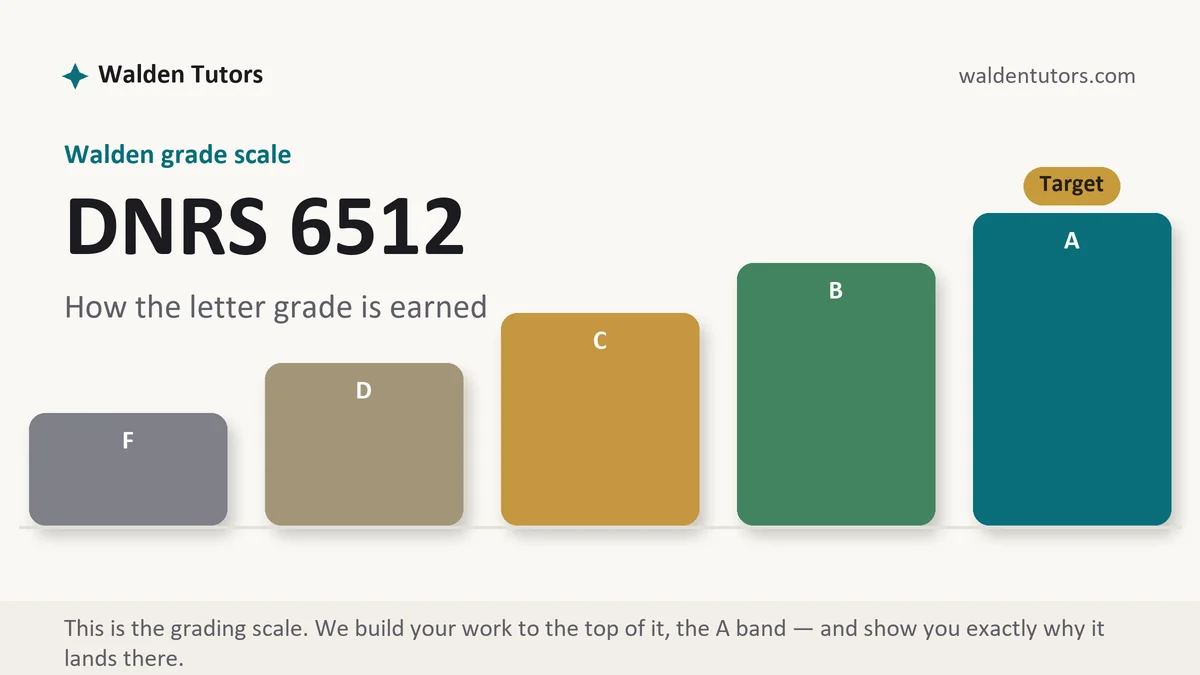
DNRS 6512 grading scale at Walden, how the work is graded, from Walden Tutors
How Walden grades DNRS 6512, visualized by Walden Tutors.

What DNRS 6512 actually grades

Walden describes the course as assessment concepts and skills across the lifespan, with diagnostic reasoning and physical assessment used to identify changes in health patterns, and with preventive care approached through risk evaluation of healthy people alongside those carrying acute or chronic conditions. The catalog also names advanced clinical skills that surprise students who expected a purely narrative course: suturing, reading a 12-lead EKG, and interpreting an X-ray. Risk assessment, diagnostic reasoning and evidence-based assessment across the lifespan is how the description sums up the emphasis.

What lands in front of a grader, though, is documentation. Written encounters, focused notes, reasoning narratives, and threads where you have to justify an approach. Walden does not post syllabi publicly, so let your classroom define the exact mix instead of borrowing a list from a search result. The pattern that holds is a rubric attached to each item and a letter grade built from its rows, and in an assessment course the rows are asking one question repeatedly: can the reader see how you got there.

How we help in this course

The gap this course punishes is between knowing and showing, so our drafts make the reasoning explicit at every step where a clinician would normally think silently. Send the instructions, any template your classroom attached, and the rubric. The draft returns with sections labeled the way the template labels them and delivery notes tying each one to its row.

Turnaround runs 24 to 48 hours. Nothing ships before it clears two readers, the first scoring the rubric rows and the second on APA plus originality, and we go on revising until it reaches the target. Send one note you have written before and what returns sounds close enough to you that adapting it costs minutes rather than an evening.

Weekly manuals for this course

Week-level manuals for DNRS 6512 are not published yet. They go live one at a time, each after its content has been checked against a real classroom, because guessing at a week grid would only point you at the wrong file when you are already short of time. Quarters govern doctoral nursing at Walden. The published full term covers eleven and twelve weeks, and there is also a half term lasting six weeks, so how many deliverables you face is a fact about the section you registered in. Name the week in chat and you will hear what the desk can cover.

A DNRS 6512 write-up due soon?

Send the case, the template if your classroom posted one, and the rubric. There is no charge for the opening draft, and forty-eight hours is the outside limit.

The note is the only evidence a grader has

Experienced nurses lose points in this course for a reason that feels unfair at first. Charting at work is built for speed and for readers who share your context. A colleague reading your note knows the unit, knows the patient, and can fill three gaps without noticing. A grader has none of that and is not permitted to assume it.

So the habits that make you efficient become the habits that cost you. Abbreviations nobody is obliged to expand. A system marked unremarkable when that system is the whole reason the patient came in. Findings recorded as conclusions, so the reader gets your verdict and never sees the observation underneath it. Each of those is a small omission clinically and a missing rubric row academically.

The fix is to write findings before verdicts, every time. Describe what you observed in terms someone else could picture, then say what you concluded from it, then say why that conclusion beat the alternative. Three sentences where you would normally write one. That expansion is not padding, it is the exact material the assessment and reasoning rows exist to score.

The lifespan span in this course adds a second demand. What counts as a normal finding, a reasonable screening question or an appropriate examination technique shifts between an infant, an adolescent, an adult and an older patient. Notes that read identically regardless of the patient's age tend to lose the rows about developmentally appropriate assessment, so let the age visibly change something in your history, your technique or your interpretation.

The skills the catalog names

Suturing, 12-lead EKG interpretation and X-ray reading appear in Walden's own description of this course, and they are worth planning for because they sit oddly beside the narrative work. Skills of that kind get assessed in ways your classroom will specify, so read the week's instructions rather than assuming everything arrives as a paper. Where a written component accompanies them, the expectation still runs the same direction: name the technique, name the criteria you applied, and state your interpretation as a judgment somebody could disagree with rather than as a label. An EKG described as abnormal tells a reader nothing. An EKG described by rate, rhythm, axis, intervals and the specific finding that concerns you has done the work.

Send one write-up before you pay anything

The free first draft is unusually informative in this course, because one documented encounter shows everything at once: whether the register is right, whether the reasoning is visible, whether the sections match a template, and whether APA appears where it belongs. Choose the assignment in front of you, send it with its rubric, and read what arrives the way your instructor will. The seasonal offer then covers your first paid run of deliverables.

How to actually write DNRS 6512: where to begin

Begin with the rubric and build your headings out of it. Retype each row title into an empty file, in order, and treat that file as the shape of the finished document before a single clinical detail goes in. Assessment writing has a strong pull toward narrative, and narrative scatters the material a row is looking for across the whole encounter. Where your classroom supplies a documentation template, use its headings instead and map the rows onto them, so the grader can find each row without leaving the format they expect.

Read the weighting next and give each heading a length target. In this course the reasoning rows almost always outweigh the data-collection rows, which means a full page of history sitting above a short paragraph of differentials is a scoring problem rather than a thoroughness problem. Decide the proportions before writing, because history is the comfortable part and it will expand on its own if you let it.

Then pick or read the encounter. Where the week lets you choose a patient, take one whose complaint has a recognizable cluster of findings, whose age and history make certain explanations plausible and others unlikely, and whose story you can populate with real detail. Thin patients produce thin notes. Where the case is handed to you, read it a second time for the details planted deliberately: a medication, a family history, an occupation, a recent travel or a missing piece of information is usually there because a row wants you to notice it.

Write in the order a reader reasons, not the order you gathered. Subjective before objective. Observation before interpretation. Differentials before a plan. Each stage should visibly earn the next, and the connecting sentences are where the grade lives. This finding, weighed against that absent one, is what moves a diagnosis up the list. Record pertinent negatives on purpose, because they are how a reader sees what you excluded and why.

Rank the differentials rather than listing them, and defend the ranking with findings you already documented. A differential supported by evidence appearing nowhere else in your note reads as a memory exercise. Then tie every element of the plan to something: this test would confirm or exclude that diagnosis, this treatment follows current guidance for this presentation, this education addresses the risk you identified, this follow-up interval exists because of the specific thing you are watching for.

Finish by reading the draft as a stranger. Ask whether an examiner who never met this patient could reconstruct the encounter, agree or disagree with your reasoning on the evidence given, and see which findings pushed you where. If any step requires them to trust you rather than to follow you, that step is a row you have not earned.

Citations and APA in assessment writing

The mechanics are the usual Walden expectations: the template title page, heading levels applied correctly, in-text citations matching the reference list both ways, and clean hanging indents. What changes in an assessment course is where citations belong. Your own observations need none. The judgments built on them usually do.

Two places carry most of the citation load. The first is technique, where an established assessment text can support the maneuver or the screening tool you used, and an older edition is fine when it is the edition your course assigns. The second is clinical criteria, where diagnostic thresholds, screening intervals and treatment recommendations change often enough that currency matters, so pull them from present guidance through the Walden Library and check the year before you lean on it. Where a rubric sets an explicit recency window, that number governs. Copy the Writing Center templates rather than rebuilding format from memory, and give each source one nameable job so nothing sits in the reference list doing nothing.

SectionWhat it doesCommon failure
Chief complaint and historyPuts the reason for the visit in the patient's terms and builds the story around it in a structured form.A history written as a paragraph of everything remembered, with no structure a reader can follow.
Review of systemsCovers the systems the complaint touches, recording both positives and pertinent negatives.A head-to-toe review on a focused complaint, which reads as padding and buries the relevant findings.
Physical examinationReports the focused exam findings described so a reader can picture them.Systems reported that the note never claimed to examine, or normal used in place of a description.
Differential diagnosesRanks the plausible explanations and attaches the findings that place each one where it sits.An unordered list, with nothing on the page explaining why one entry outranks another.
Working diagnosisNames the leading explanation and argues it against the closest competitor.A diagnosis announced with no comparison, so the reasoning row has nothing to score.
Diagnostics and planTies each test, treatment and piece of education to what it confirms, excludes or addresses.A list of orders with no purpose stated for any of them.
Follow-up and reflectionSets the return interval and what would change the plan, then names one thing you would do differently.A closing paragraph of general appreciation for the learning experience.

Discussion-post craft in an assessment thread

Boards in this course usually assign a body system, an age group or a short case and ask how you would approach it. Build the initial post as a compressed encounter: the focused questions you would ask and what each would rule in or out, the examination you would perform, the findings that would change your mind, and the differentials with reasoning attached. Bring a source into the post rather than after it, since a confident approach with nothing behind it reads as preference to a row asking for evidence.

Replies carry their own score, and agreement adds nothing your classmate had not already written. Do something to their approach instead: add the question they skipped and say what it would exclude, challenge a ranking by pointing at a finding they wrote down and then left out of the reasoning, or bring guidance that complicates the plan they proposed. Post across two to four days at minimum, which is what Walden's grading policy recommends for participation that is consistent, substantive and timely, and read your own classroom for the response count and the closing day, since these vary between courses and between weeks.

The mistakes that cost points in DNRS 6512

  • Workplace shorthand carried into an academic note, leaving a grader to decode abbreviations they are not obliged to know.
  • An examination section covering systems the encounter never claimed to assess, which costs a documentation row outright.
  • Findings recorded as conclusions, so the observation underneath the judgment never appears anywhere.
  • Differentials listed alphabetically or by memory, with no defense of the order they landed in.
  • Pertinent negatives omitted, leaving the note able to show what the patient has and unable to show what was excluded.
  • A note that would read identically for a toddler and an eighty-year-old, which loses the developmentally appropriate rows.

DNRS 6512 questions students actually ask

Is this the same course as NURS 6512?

Walden's catalog prints the same title under both prefixes, and the prefix tells you which program build your seat sits in rather than describing a different subject. DNRS is the doctoral nursing listing. Register from the plan of study your program gave you, and if the code on your enrollment does not match the code you were expecting, settle it with your student portal or your advisor before the term opens rather than after. The writing expectations described on this page apply to the doctoral listing.

How long should a write-up be if the assignment gives no page count?

Long enough that every rubric row has visible territory and short enough that nothing repeats. Documentation assignments run shorter than most students expect, because the register is compressed and padding shows instantly. A useful check is to read your draft with the rubric beside it and mark which row each paragraph serves. Any paragraph you cannot assign to a row is a candidate for deletion, and any row with no paragraph beside it is why the grade came back lower than the work felt.

Do I have to cite sources inside a documentation assignment?

Yes, wherever you make a claim that could be argued with. Findings you recorded need no citation because they are your observations. The reasoning attached to them usually does: the criteria that make a diagnosis fit, the screening interval you followed, the guideline behind a test you ordered. Check the week's instructions for a required number and a recency window, and where none is given, cite the technique to an established source and the clinical judgment to current guidance pulled through the Walden Library.

Keep going

Online now