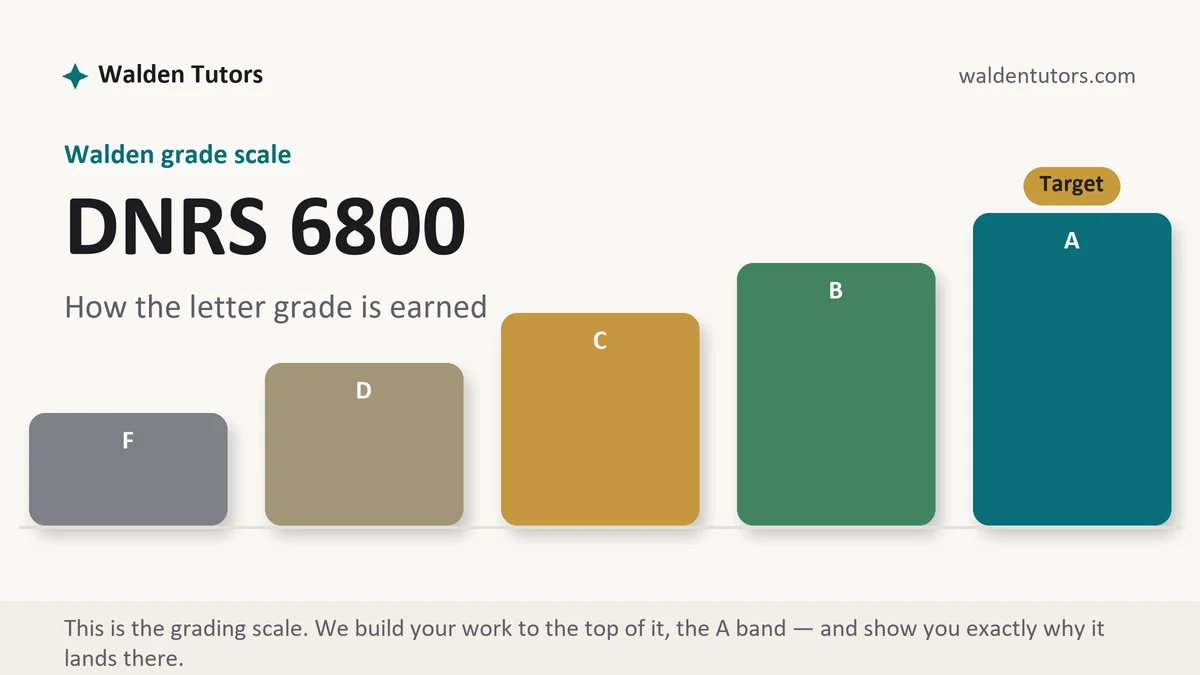
In this course the finding is usually something you never saw yourself. A parent reports one behavior, a teacher reports a different one, and a normed screening tool turns both into a score with a wide band around it. Advanced Pediatric Development and Behavior carries five credits in the DNP sequence, and what it grades is how carefully you reason in writing from evidence of that kind.
What DNRS 6800 actually grades
Walden's own course description marks out the territory: developmental and behavioral milestones, family systems, parenting styles, screening, surveillance and assessment of infants, children and adolescents, together with management strategies, referral options, and the legal, ethical and policy questions attached to each. Anticipatory guidance for the child and family at every stage sits beside all of that. Every item on the list reaches a grader as prose.
Walden does not publish syllabi to the public, so let your classroom tell you the exact deliverable mix rather than taking a count from any website. The pattern that holds across the doctoral nursing sequence is graded discussion threads plus written assignments, each with its own rubric posted alongside it, and a letter grade assembled from those rows. What the rows reward in a developmental course is not recall of a milestone table. It is judgment: whether a described behavior falls inside the expected range for that age, what evidence moved you toward that call, and what you would do next.
How we help in this course
We draft the written work with the screening logic spelled out rather than assumed, in the register a doctoral row expects. Send the assignment instructions plus the rubric your classroom posted, and the draft returns with every section tied to the row it answers.
Turnaround is 24 to 48 hours. Two reviewers read each order before it leaves, one scoring it against the rubric rows the way your grader will and one auditing APA and originality, and revisions stay open until the target is reached. Attach a paper you wrote earlier and the draft is tuned toward your sentence habits, which cuts personalizing down to a short sitting.
Weekly manuals for this course
Per-week manuals for this course publish one at a time, as each week is verified, and none are live yet. Walden runs doctoral nursing on the quarter calendar, where the published Fall 2026 quarter spans August 31 to November 15, seventy-six days, which is the arithmetic behind the eleven to twelve week figure people quote. A six-week half term also runs inside the quarter. Because of that, the number of weeks sitting in front of you belongs to the section you registered for, not to the course code. Send the week you are actually in through chat and the desk will tell you what it covers and what it can turn around.
Stuck on a DNRS 6800 assignment?
Share the instructions and the rubric your classroom posted. First premium sample is free and lands within 48 hours.
What counts as evidence in a developmental course
Most nursing courses hand you a finding you can check for yourself. Here the raw material arrives secondhand and already interpreted by somebody else. A mother says her toddler does not talk much. The father, asked separately, says the child talks constantly at home. A preschool teacher fills in a form and marks concerns nobody in the family has noticed. None of those accounts is dishonest, and none of them is a measurement.
That gap is why validated screening instruments matter to the rubric more than they matter to your clinical instinct. A tool exists to convert reported behavior into something with known properties: a cutoff, a sensitivity, a normative sample it was built on. Writing that scores well names the instrument that produced the score, states what the score means against that instrument's norms, and admits what the instrument was never designed to answer. Writing that scores badly prints the number and treats it as a diagnosis.
Three evidence problems run through nearly every assignment here, and naming them inside your own paragraphs is most of the work:
- Variation against delay. Milestone ranges are wide by design. A behavior at the edge of the expected band is a reason to look again, not yet a finding.
- The informant. Who described the behavior, in which setting, and with what stake in the answer. Parent report, teacher report and direct observation disagree routinely, and the disagreement itself is information.
- The normative sample. An instrument normed on a population unlike your patient's tells you less than its cutoff suggests, and a rubric row about cultural responsiveness is usually asking about precisely this.
Surveillance is the fourth problem, and it is the one students skip. Screening is a single event; surveillance is the longitudinal habit of watching development unfold across visits and comparing a child to their own earlier self. A paper that treats one screening result as the entire assessment has walked past half of what the course title names.
Where DNRS 6800 sits in the sequence
The catalog lists DNRS 6501, DNRS 6512 and DNRS 6521 as prerequisites, which tells you exactly what this course assumes you are carrying: advanced pathophysiology, advanced health assessment with diagnostic reasoning, and advanced pharmacology. DNRS 6800 is where that trio gets pointed at children, and Walden describes it as an introductory course built for pediatric advanced practice nurses. Read introductory as pediatric content that will be new to many students, not as a softer writing bar. The scholarly expectations you met across the three sciences carry straight through.
Try the desk on one assignment
The free first sample fits a course like this unusually well, because a single written case shows whether a writer can hold the line between a screening result and a diagnosis for a whole paper. Pick the assignment you are staring at right now, send its instructions and rubric, and read what comes back the way a grader would before any money changes hands. The seasonal offer then applies to your first paid batch of deliverables.
How to actually write DNRS 6800: where to begin
Open the rubric before you reread the prompt a second time. Copy its rows into an empty file and use them as your headings, because a grader works down that column in order and any other organization makes them hunt. In a developmental assignment the rows tend to split along predictable seams: the presenting concern, the developmental and behavioral assessment, family and contextual factors, the evidence base, management and referral, anticipatory guidance, and a scholarly writing row. Give every one of them visible territory on the page.
Then choose your case where the week allows a choice. What makes the writing tractable is a child whose age band you can defend and whose concern is developmental rather than acute. A toddler with a language question, a school-age child whose attention has been flagged by a teacher, an adolescent whose parents describe a shift in mood: each of those has a normative literature you can actually reach and a screening pathway you can name in a sentence. Steer away from a case whose real trouble is medical, because the draft will slide into pathophysiology and the developmental rows will go hungry.
The thesis in this subject is a judgment rather than a topic. Aim for something shaped like this: given the presentation, the history and this screening result, the pattern falls inside or outside expected development for this age, and the next step is a named action. Write that sentence first, then hold every section against it. If a paragraph neither advances that judgment nor qualifies it, it is background, and background belongs in one place near the front instead of leaking across six pages.
Synthesis is the row most students lose without ever being told why. A summary paragraph marches source by source, reporting that one author found this and another found that. A synthesis paragraph moves claim by claim, with citations arriving inside an idea as support and as counterweight. The practical test is whether two sources ever share a sentence doing different jobs. This subject makes that easy, because the literature genuinely argues with itself about screening intervals, about where a cutoff should sit, about how much weight teacher report deserves. Put the argument on the page and the row scores itself.
APA 7 gets graded here as mechanics and as source behavior. Mechanics means the Walden title page, correct heading levels, and a reference list where each entry has a matching in-text citation and nothing spare. Source behavior is where a developmental paper is won or lost: cite an instrument to its own validation literature rather than to a page that merely mentions it, cite normative claims to the data that produced them, and anchor anticipatory guidance content in current pediatric guidance rather than a textbook chapter summarizing it. Reach all of it through the Walden Library, where the nursing and behavioral science databases live, and copy the Writing Center templates instead of rebuilding formatting from memory. Each source should be doing one nameable job, and if you cannot say in a short phrase what a citation proves, cut it.
Last, the clock. Course-Based work closes at 10:59 p.m. Central, 11:59 p.m. Eastern, on the days your classroom sets, and Walden expects you to log in and post an assignment or discussion during the first week of the term. Budget somewhere near fifteen to twenty hours a week for a Course-Based nursing course and the pace stops ambushing you.
| Section | What it does | Common failure |
|---|---|---|
| Presenting concern | Names who raised the worry, in what setting, and in the family's own words. | Opening with a diagnosis the paper has not yet earned the right to state. |
| Developmental and behavioral history | Establishes the trajectory: what the child could do before, and when that changed. | A milestone checklist with no timeline, leaving the reader unable to see whether anything regressed. |
| Family and context | Structure, parenting approach, stressors, culture, school and care arrangements. | Recorded as demographics up front and never used again to explain the behavior. |
| Screening and surveillance | The instrument chosen, who completed it, the result, and what the tool actually measures. | A score reported without the tool or its cutoff, so the number carries no meaning. |
| Interpretation | The call: expected variation, a concern worth monitoring, or a finding that warrants referral. | Hedging so completely that no judgment appears anywhere in the document. |
| Management, referral and guidance | Next steps, who they go to, and the anticipatory guidance suited to this stage. | Advice so general it would fit any child of any age. |
| Legal, ethical and policy note | Consent, reporting duties, adolescent confidentiality, and access to services. | Bolted on as a closing paragraph with no thread back to the case. |
Discussion-post craft in a developmental thread
Boards in this course are graded work carrying rubric rows of their own, and the threads usually set a case or an age band in front of you and ask how you would assess it. Build the initial post as a compressed version of the paper: the developmental questions you would ask and why, the instrument you would reach for, the result that would change your mind, then the call you would make. Cite inside the post. A confident post carrying no sources reads as opinion to a row that asks for evidence.
Spread your posting across the week instead of firing everything into one evening. Walden's grading policy asks for participation that is consistent, substantive and timely, and recommends posting on at least two to four different days. Replies are scored on their own, and agreeing is not replying. Take a classmate's assessment plan and do something to it: name the informant they never consulted, ask what their instrument was normed on, or offer the alternative explanation their screening result cannot rule out. Posting requirements vary across courses and even between weeks inside a single course, so read your own classroom instructions rather than carrying a previous term's habit forward.
The mistakes that cost points in DNRS 6800
- Treating a positive screen as a diagnosis, when the instrument was built only to decide who needs a closer look.
- Milestones recited straight from a table, with nothing said about this particular child's own trajectory.
- Family information gathered in an early paragraph and then never used to explain a single later observation.
- Anticipatory guidance pitched so broadly that it would suit a newborn and a sixteen-year-old equally well.
- One informant's account accepted as the whole picture, with the gap between home and school left unexamined.
- A referral recommended without naming who receives it, on what timeline, or what would trigger it.
DNRS 6800 questions students actually ask
How do I know whether a behavior is a delay or normal variation?
You often cannot know from the behavior by itself, and saying so carefully is what earns the row. The defensible move is to place the behavior against the expected range for that exact age, then look for corroboration: a second informant, a different setting, a screening instrument with a published cutoff, or a change over time. One report sitting at the edge of a wide band is a reason to watch, not a finding. Write the judgment you can defend, name what would change it, and say when you would look again.
Which screening tool should I write about?
Whichever one your week names. If the week leaves it open, pick a validated instrument that matches the age and the concern rather than the one you have heard of most often. Then argue the fit: what it screens for, who completes it, the age range it was designed around, and the population it was normed on. Graders pay for the fit argument more than for the choice itself. If your patient sits outside the instrument's normative sample, put that on the page as a limitation instead of hoping nobody notices.
How much of the paper should be about the family?
Enough that the family explains something. Structure, parenting approach, stressors and the care setting belong in a developmental paper because they change what a behavior means, not because a rubric asked for demographics. The working test is whether your interpretation section reaches back and uses them. If you can delete the family paragraph and every later sentence still stands unchanged, it was decoration, and the contextual row will score it that way.