MMHA 6700 help and tutoring

MMHA 6700 · 5 credits · MHA core
The short answer

This is the course that makes the next one honest. Walden's published MHA curriculum places Building Healthcare Brand and Alliances straight after Healthcare Operations, and a brand promise is only worth making if the process underneath it can carry the volume. So MMHA 6700 asks you to look at how work actually moves through a health organization and to argue for a change with numbers attached. It is listed at 5 credits, the calendar behind it is quarter or semester depending on your program, and only your student portal can tell you which one you are on.

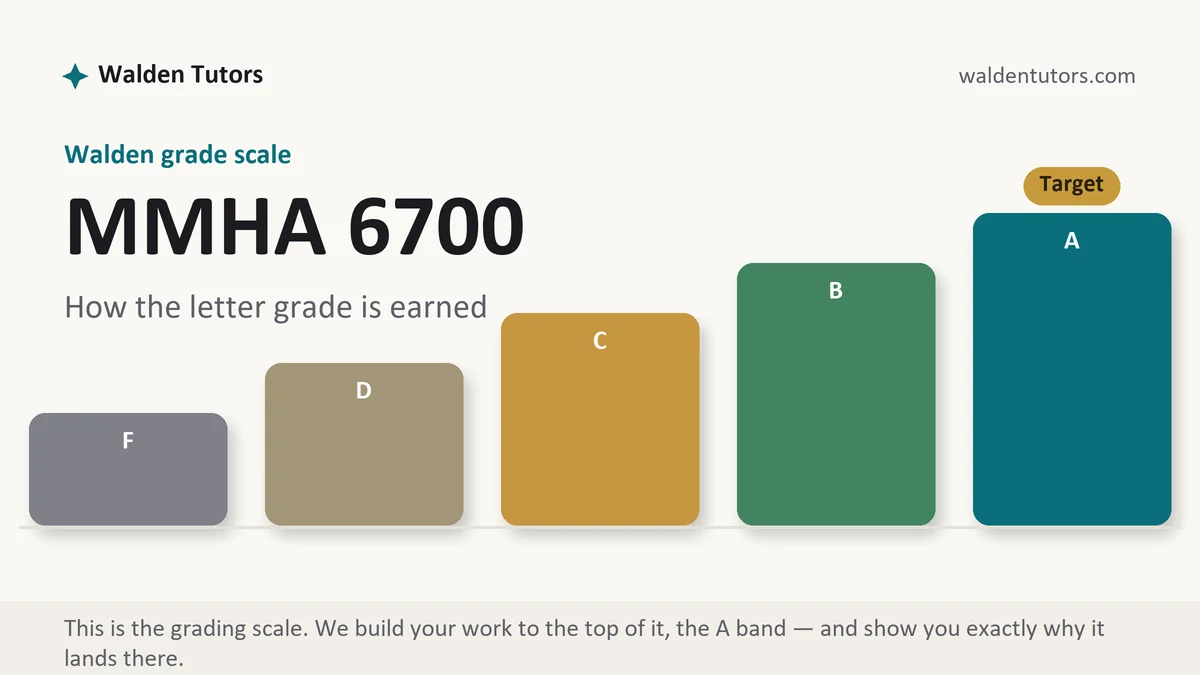
MMHA 6700 grading scale at Walden, how the work is graded, from Walden Tutors
How Walden grades MMHA 6700, visualized by Walden Tutors.

What MMHA 6700 actually grades

Walden frames the course around a health system moving from paying for volume to paying for results, and that frame decides the deliverables. You are typically asked to examine forces acting on organizational and operational performance, to look at how reliable organizations build and sustain their operating practices, and to consider what changes in structure, logistics and supply chains do to patient outcomes. Assignments follow that shape: analyses of a process, of a performance problem, of a supply or capacity decision, argued with evidence.

What earns marks is traceability. A grader reading an operations paper is checking whether each claim connects to the one before it, so a recommendation has to sit at the end of a chain that began with a defined problem and a measured baseline. Papers that state the problem, jump to a solution and finish with hope for better outcomes lose the analysis rows even when the solution is sensible, because the reasoning that would justify it never appeared on the page.

How we help in this course

Our writers build 6700 work backward from the measure. Before drafting, we settle what the process is, where it starts and stops, what indicator would move if the change worked, and who inside the organization owns that indicator. The paper then walks the reader from the problem statement to the intervention without a gap, with the improvement framework applied to the case rather than defined in the abstract.

Service terms hold steady whatever the course: original work delivered in 24 to 48 hours, written to reach an A against your posted rubric, two separate review passes before it reaches you, and revisions carried at no charge until the piece does its job.

Weekly manuals for this course

You will not see a numbered week list on this page yet, because a manual goes live only after we have verified that week's requirements ourselves. Turnaround does not depend on it. Bring the deliverable with the nearest due date into chat and we will confirm coverage the same day.

In MMHA 6700 right now?

Send the brief, the scoring sheet, and the process you want put under the microscope. The first premium sample carries no charge and returns inside two days.

Why the shift to value changes what you measure

Under volume, the operating question was how many. Under value, it becomes how many, at what cost, with what result, and for whom. That single change is why an operations paper in an administration program cannot stop at efficiency. Shortening a visit is only an improvement if the outcome held. Cutting supply spend is only an improvement if the substituted item performed. Every recommendation in this course therefore needs a pair of measures, one for the thing you are improving and one for the thing you might break, and naming the second one is what tells a grader you are thinking like a manager rather than a technician.

Reliability sits in the same argument. Organizations that operate safely under pressure are described in the literature as paying attention to small failures, resisting simple explanations, staying close to frontline work, building the capacity to recover, and letting expertise rather than rank decide in the moment. Bring that idea into the paper only where it explains something specific about your case, because a paragraph defining reliability with nothing attached to it is a paragraph the rubric cannot reward.

What to attach when you order a 6700 draft

Send four things and the draft starts immediately: the instructions, the scoring sheet, the week number, and the process or department you want at the center of the analysis. If your instructor posted a case file or a data extract, include it, since operations rubrics often score whether you used the supplied material rather than a substitute of your own. One line about your work setting helps too, because a paper set in an emergency department reads differently from one set in a clinic or a supply chain office. Deadlines in Course-Based sections fall at 10:59 p.m. Central time, an hour later than that on Eastern clocks.

How to actually write MMHA 6700: where to begin

Begin with the rubric, laid out as headings in an empty file, with each row's weight typed beside it. Operations prompts are full of interesting side roads and the rubric is the map that keeps you on the paid ones. In this course the heaviest row is nearly always analysis or recommendation, and the lightest is nearly always the background description that students most enjoy writing.

Then bound the process, tightly. Patient flow is not a topic. Time from arrival to provider contact in a twelve-bed urgent care is a topic. Say where the process starts, where it ends, who touches it, and what the customer of that process actually receives. A bounded process gives you something you can map, something you can measure, and something a reader can picture, and all three of those become rubric points later. If you cannot draw the steps on one page, the boundary is still too wide.

Establish a baseline before you diagnose anything. State what the process currently produces, in a unit that means something: minutes, cases per day, percentage of first cases starting on time, stockouts per month, denials per hundred claims. Where you have no measured figure, use published data or a clearly labeled illustrative value. Consider a simple worked example, offered only to show the arithmetic and not as a claim about any real facility. Four operating rooms running five cases each have four turnovers apiece, which is sixteen turnovers in a day. At twenty minutes each that is 320 minutes, better than five hours of room time, and it makes visible why a ten minute reduction is worth a project. Show the multiplication, label the inputs as assumed, and the reader can check you.

Diagnose before you prescribe. Map the steps in order, mark where work waits and where it moves backward, and separate the constraint from everything that merely annoys people. The point of a root cause pass is to stop you improving a step that was never the limit, which is the single most common wasted recommendation in student operations papers. Ask why the delay occurs until the answer is something a manager could change, then stop asking. Two or three causes, evidenced, beat a list of ten guessed at.

Bring your sources in as instruments rather than decoration. Health services research, operations management scholarship and quality improvement literature reached through the Walden Library give you the evidence that an intervention has worked elsewhere and under what conditions. Federal agencies and national associations give you comparison figures and definitions you can rely on. Synthesis in this discipline means putting two studies against your case in the same breath: one found the change worked in a setting resembling yours, another found it failed where staffing differed, and your case has the second setting's staffing. That sentence is analysis. Three consecutive summaries of single articles are not.

Finish with an implementation and measurement plan that somebody could execute. Name the owner, the sequence, the timeframe, what you will track weekly, and what result would tell you to stop and rethink. Then say what could go wrong and what you would do about it. Papers that end on a confident prediction score below papers that end on a plan with a check built into it.

SectionWhat it doesThe common failure
Problem and boundaryDefines the process, its start and end points, and the performance gap in a measurable unit.A whole department named as the problem, so nothing in the paper can be measured or fixed.
BaselineReports what the process currently produces, sourced or clearly labeled as an assumed figure.Adjectives instead of numbers, leaving the later improvement claim with nothing to be compared against.
Process mapShows each step in sequence, where the work waits, and where it loops back on itself.A tidy diagram of how the process is supposed to run rather than how it runs.
Cause analysisTraces the gap to a small number of evidenced causes and identifies the actual constraint.A long list of contributing factors with no attempt to say which one limits the whole system.
InterventionSelects a change, justifies it with evidence from comparable settings, and names its cost.Better communication and more training, proposed for a problem neither of them touches.
Implementation and measurementAssigns an owner, a sequence, a timeline, tracked indicators and a balancing measure.A recommendation with no owner and no way of ever knowing whether it worked.

Discussion-post craft in an operations course

Threads in this course reward specificity more than opinion. Open with the process and the setting, give one number or one observable fact, then make a claim about cause and support it with a source. A post that says throughput matters in modern care could have been written without reading anything. A post that says a particular step consumes a third of the cycle time and explains why has given classmates something to argue with. The university's grading policy wants posts that say something, arrive on time, and land on separate days rather than in one burst, with two to four days named as the floor.

For replies, the strongest habit here is to look for the balancing measure the original poster left out. If a classmate proposes speeding one step, ask which downstream unit absorbs the faster arrival, or what the change does to error rate, or who works the extra hour the plan quietly assumes. Attach a source to that challenge and it becomes a graded contribution rather than a hunch. Reply counts and closing days vary between sections, so read your own classroom instructions rather than assuming.

Sourcing your numbers, and the APA around them

Formatting is the part of the grade you can bank without thought, so give it twenty minutes at the end. Pull the university template instead of assembling a title page by hand. Let each heading sit one level below the section containing it. Keep an author and a year attached to every borrowed claim, then reconcile the back page against the body before you submit. Walden's Writing Center is where the live guidance sits, and lifting the format from there beats improvising one.

Beyond mechanics, operations writing has one particular citation duty: sourcing your numbers. Every figure in the paper needs a visible origin, whether that is a published dataset, a peer-reviewed study, a national report or your own labeled assumption. Say which it is in the sentence where the number appears. A reader who cannot tell whether 320 minutes came from research or from your head will discount everything built on it, and rubric rows about evidence and reasoning both feel that discount.

The mistakes that cost points in MMHA 6700

  • Improving a step that was never the constraint, so the system produces exactly what it produced before.
  • Averages used where variation is the real problem, which hides the days that actually hurt the operation.
  • Naming Lean or Six Sigma in a heading and then never running its steps against the case beneath it.
  • Cost savings claimed with no offsetting effect examined anywhere, as though nothing else in the system moved.
  • A plan with no owner, so the recommendation reads as advice to the universe rather than to a manager.
  • Quality and operations treated as the same subject, when the rubric is scoring how work flows and what it consumes.

MMHA 6700 questions students actually ask

Do I need real numbers from my own workplace?

No, and reaching for them can create problems you do not need. Internal volumes, staffing figures and financial detail belong to your employer, and an assignment goes into a platform your employer never approved. Build the analysis on published sources instead. Federal and state agencies, hospital association reporting, quality registries and peer-reviewed operations studies all publish figures you can cite openly. Where the paper needs a number to make the reasoning visible, state a reasonable value, label it as an illustrative figure rather than a measured one, and show the arithmetic so a grader can follow the logic without believing the input.

Which improvement methodology should I pick?

Pick the one that matches the shape of your problem, then say why in a sentence. Lean fits waste, motion, waiting and handoffs. Six Sigma and its define, measure, analyze, improve and control cycle fit variation, defects and processes where the same step produces inconsistent results. Plan, do, study, act fits small tests you want to run several times quickly. High reliability thinking fits failures that are rare but severe. Choosing is not the graded part. Applying the chosen method step by step to your own case, so the reader sees the tool doing work rather than being defined, is what the analysis row is looking for.

How do I write about a bottleneck I have no authority to fix?

Write it as an administrator would, which means separating the constraint from the decision right. Describe the bottleneck fully, name the role or committee that owns it, and then propose two things: the change you would ask that owner to make, and the smaller change your own span of control allows in the meantime. That pairing reads as maturity rather than helplessness. It also protects you from the most common failure in these papers, which is a recommendation aimed at nobody in particular, with no owner named and therefore no chance of anyone acting on it.

Keep going

Online now