MMHA 6900 help and tutoring

MMHA 6900 · 5 credits · MHA core
The short answer

Almost everything that happens to a grade in Healthcare Quality Management is settled at one moment, when you decide which quality problem the paper is about. Choose something countable, inside one setting, across a stated stretch of time, and the rest of the work has somewhere to stand. Choose a topic nobody puts a number on and every later section turns into opinion dressed as analysis. Walden gives this course as 5 credits and prints no calendar word beside the figure, so your student portal is the place to confirm whether your own build runs on quarters or semesters.

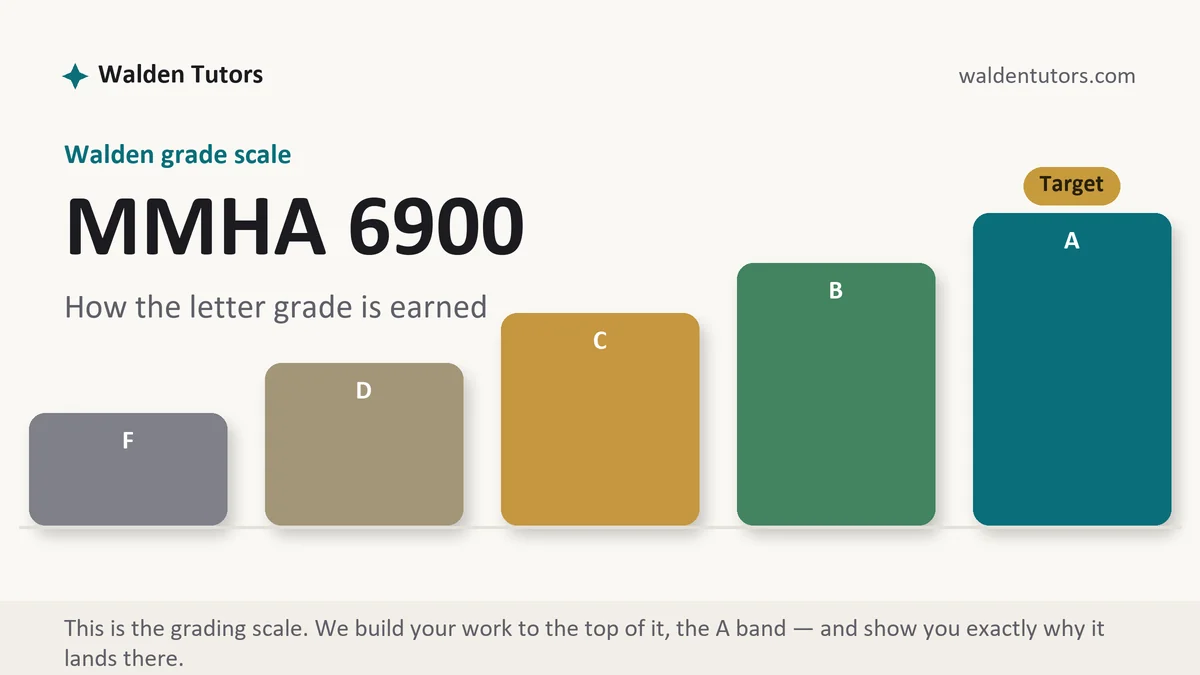
MMHA 6900 grading scale at Walden, how the work is graded, from Walden Tutors
How Walden grades MMHA 6900, visualized by Walden Tutors.

What MMHA 6900 actually grades

Walden frames this course as an overview of how quality and patient safety are assessed and improved, and the graded work tracks that framing closely. You get asked to say what quality means in a particular setting, to select measures, to judge whether an initiative achieved anything, and to tell a management reader what should happen next. The rows reward measurement discipline. Enthusiasm for improvement earns nothing on its own, and papers that read as advocacy for better care rather than analysis of it lose ground across several rows at once.

The published description also draws a line between clinical quality and customer service quality, and that line shows up in grading more often than students expect. Answering a safety question with survey results has quietly changed the subject, and whichever row asked about outcomes will stay unfed. The same description points at the part played by government agencies and accrediting bodies, which means an analysis carrying no external standard anywhere in it has skipped a layer the course deliberately built in. Structure, process and outcome are treated as three different things to count, not three ways of saying the same thing, and assignments frequently ask you to show all three.

How we help in this course

Drafts for this course begin where the rubric begins, at the measure. Before a writer starts on prose we settle what is being counted, where that count would come from, what the current level looks like, and what an improved level would be. Every later section then has an anchor instead of a theme.

Commercial terms hold steady across everything we cover. Turnaround runs 24 to 48 hours. The target is an A measured against whichever scoring sheet your classroom posted, two reviewers read the document separately before anything ships, and revisions carry no extra cost until the piece performs.

Weekly manuals for this course

No numbered week list appears here yet. A manual goes live once we have confirmed what that week genuinely asks for, and quality assignments differ enough between sections that publishing a guess would help nobody. Send whichever item sits nearest its deadline into chat and you will have coverage and timing back the same day.

In MMHA 6900 right now?

Send the assignment brief and the scoring sheet from your classroom. No charge for the first premium sample, and it returns within two days.

Why the measure decides everything after it

A usable quality measure has five parts, and you can test a topic in about a minute by trying to name them: the thing being counted, the population it is counted against, the source the count comes from, the window of time it covers, and the person or department accountable for reporting it. Falls on a medical unit fills all five. Better outcomes for patients fills none of them. Topics that fail this test do not announce themselves early; they fail later, at the paragraph where you were supposed to compare a result to a benchmark and instead wrote a sentence about the importance of monitoring.

Rates matter more than counts, and this trips people up. Say a 24-bed unit records 14 falls across a quarter in which patients occupied beds for 6,200 patient days. That works out to roughly 2.26 falls per 1,000 patient days, which is a figure another unit can be compared against, while 14 on its own is not. Those numbers are invented here to show the arithmetic, and the arithmetic is ours rather than Walden's; run your own or take published figures from a source you cite. The habit worth carrying out of this paragraph is simply that a raw count without a denominator cannot be benchmarked, and benchmarking is what most of these rubrics are asking you to do.

Getting a 6900 draft started

Four things move an order immediately: the week, the prompt, the rubric, and whatever case or organization the assignment attaches. A fifth helps enormously, which is one line telling us whether you have access to any real data or are working entirely from published sources, since that single fact changes how the measurement section gets built. Course-Based deadlines land at 10:59 p.m. Central and 11:59 p.m. Eastern, so a Tuesday or Wednesday send leaves room for a read, a question or two, and a revision before a Sunday item closes.

How to actually write MMHA 6900: where to begin

Put the rubric rows on the page before you write anything else. Drop each row into a blank file, turn it into a heading, and write its weight beside it so your word budget tracks the points rather than your enthusiasm. Quality assignments punish this badly when it is skipped, because the sections students enjoy writing, background on the problem and general argument for improvement, are usually the lightest rows on the sheet, while the heaviest ones ask for measures, comparison and evaluation.

Next, cut the problem down until it can be argued about. Bind it to a setting, a population and a period. Hand hygiene compliance in one intensive care unit over two quarters is a paper. Infection control in American hospitals is a topic for a book nobody assigned. Narrowing buys you three things at once: published evidence specific enough to cite, a process you can trace from beginning to end, and named people whose work would visibly change if your recommendation happened.

Then build the measurement set at three levels rather than one. Structure asks what the organization has in place, meaning staffing, equipment, policy, training, the fixed conditions under which care happens. Process asks what people actually do, and it is the level where improvement work usually lives because it responds fastest. Outcome asks what happened to patients. Name at least one measure at each level and state how each would be collected, because a paper carrying only outcomes cannot explain why anything changed, and a paper carrying only process cannot show that the change mattered.

Bring in the external layer deliberately. Accrediting bodies publish standards, federal agencies publish reporting requirements and national benchmark sets, and improvement organizations publish tested change packages. Cite those for what they are, meaning standards and requirements, and cite peer-reviewed evaluation for whether an intervention worked. Keeping those two source types separate in your prose protects the credibility row, because a claim of effectiveness resting on an organization's own promotional material reads as marketing to anyone scoring it.

Pick one improvement method and genuinely run it rather than defining several. A plan-do-study-act cycle, a root cause analysis, a failure modes review or a lean process map will each carry a paper if you apply it to your case and show its output. Naming a method in a heading and then writing generic recommendations underneath is the single most common way this section collapses. Close by making the recommendation operational: who owns it, what happens first, over what timeline, which measure will be watched, at what interval it gets reviewed, and what result would tell the organization to stop or change course. That last condition is the sentence that separates a management proposal from a wish.

SectionWhat it doesWhere drafts fail it
Problem statementNames the quality gap, the setting it occurs in, and the population it affects.A problem stated at national scale, so nothing in the paper can be sized, sourced or compared.
Evidence and benchmarkEstablishes what good looks like using published standards and comparable performance.An assertion that current performance is poor, with no reference point offered against it.
Measurement planSets out structure, process and outcome measures with their sources and collection intervals.One outcome number standing alone, leaving the reader unable to see what would produce a change.
Improvement methodApplies a named method to this case and reports what applying it produced.A textbook summary of the method followed by recommendations that could have preceded it.
ImplementationAssigns ownership, sequence, resources and a schedule that a manager could act on.Passive recommendations about what should be done, with no one in the paper responsible for doing it.
Evaluation and sustainmentStates how success gets judged, when it gets reviewed, and how the gain is held.An ending that hopes for continued improvement without naming a review point or a trigger.

Discussion posts that actually earn the points

Boards in a quality course go well when you bring a number and badly when you bring a position. Open with the setting and the specific gap, give the measure you would watch, say where that measure comes from, then raise the management difficulty it creates. A post arguing that safety culture matters is unanswerable and therefore unscoreable, while a post proposing one measure invites classmates to disagree with something concrete. Walden's grading policy asks that participation stay substantive, timely and consistent, and it recommends your posts land on no fewer than two to four separate days each week.

Replies work best when they attack the measurement rather than the goal. Ask whose behavior the proposed measure would actually change, what it would miss, how it could be gamed by a unit under pressure, or what the collection burden would fall on. Attach a source and the reply becomes graded contribution instead of conversation. Reply counts and closing days get set section by section, and they can shift from one week to the next, so take the rule from your own classroom rather than from memory.

Citations and APA the way Walden grades them

Mechanics first, because they are free points. Use the Walden template, keep headings in level order, make sure each in-text citation has a matching reference and each reference has a matching citation, and check that every source was reachable through the Walden Library rather than a general web search. The Writing Center maintains the formatting guidance Walden actually scores against, and copying it costs less time than defending a variation to a grader.

Source discipline matters more here than in most administration courses because quality writing sits so close to institutional publicity. A hospital announcing its own improvement is a primary document about a claim, not evidence that the claim is true. Accreditor manuals and agency reporting rules are authoritative for standards and requirements. Peer-reviewed studies are authoritative for whether an intervention changed anything. Give every source a single job you could name in a short phrase, and keep each citation beside the claim it supports rather than parked at the end of a paragraph.

The mistakes that cost points in MMHA 6900

  • Writing about quality in general instead of one measurable gap in one identified setting, which leaves every claim untestable.
  • Reporting raw counts with no denominator, so nothing in the paper can be compared with anything else.
  • Substituting satisfaction results for clinical outcomes, or the reverse, and never telling the reader which question is being answered.
  • Explaining an improvement method at length and then producing recommendations that show no trace of having used it.
  • Treating an organization's own announcement of success as proof that the intervention worked.
  • Finishing without an owner, a timeline or a review point, so nothing in the proposal could actually be started on Monday.

MMHA 6900 questions students actually ask

How do I choose a quality problem that will actually score well?

Choose one you can count. Before committing, try to fill five slots out loud: what is being counted, out of what population, from which data source, across what period, and who inside the organization owns that number. A topic that fills all five is ready to write. Medication administration errors on one surgical unit across a quarter fills them. Improving patient safety across a health system does not, and a paper built on it drifts into general advice by the second page. Narrow beats important, because the rows ask you to measure, compare and evaluate, and none of those verbs work without a denominator.

Does patient satisfaction count as a quality measure?

It counts, but not for everything. Walden separates clinical quality from customer service quality in its own description of this course, and satisfaction data sits on the service side of that line. Use it where the question concerns experience, access, communication or trust, and use it as supporting evidence in most other places. What it cannot do is stand in for a clinical result. If the paper asks whether an intervention reduced harm and answers with higher survey scores, the outcome row stays empty. Report both where you have both, and say plainly which one is answering the question in front of you.

Do I need real data from my own organization?

Usually not, and you should assume you cannot use it unless your instructor says otherwise. Internal quality data carries privacy and permission problems, and most assignments in this course are built so that published material is sufficient. Federal agency reporting, accreditor standards, national benchmark sets and peer-reviewed evaluations supply figures you can cite and defend. Where you do draw on something from your workplace, remove identifiers, describe the setting generically, and state in the text that the numbers come from practice rather than publication, so the reader knows which kind of evidence is carrying the claim.

Keep going

Online now