Thirty seconds into a budget paper, the grader already knows whether numbers are being used or merely displayed. Tables with no interpretation under them, figures with no source note, percentages that never become an argument: all of it reads instantly. MMPA 6431 is a 5-credit core course in Walden's Master of Public Administration, and it grades whether you can read public money and explain it to somebody who has to make a decision.
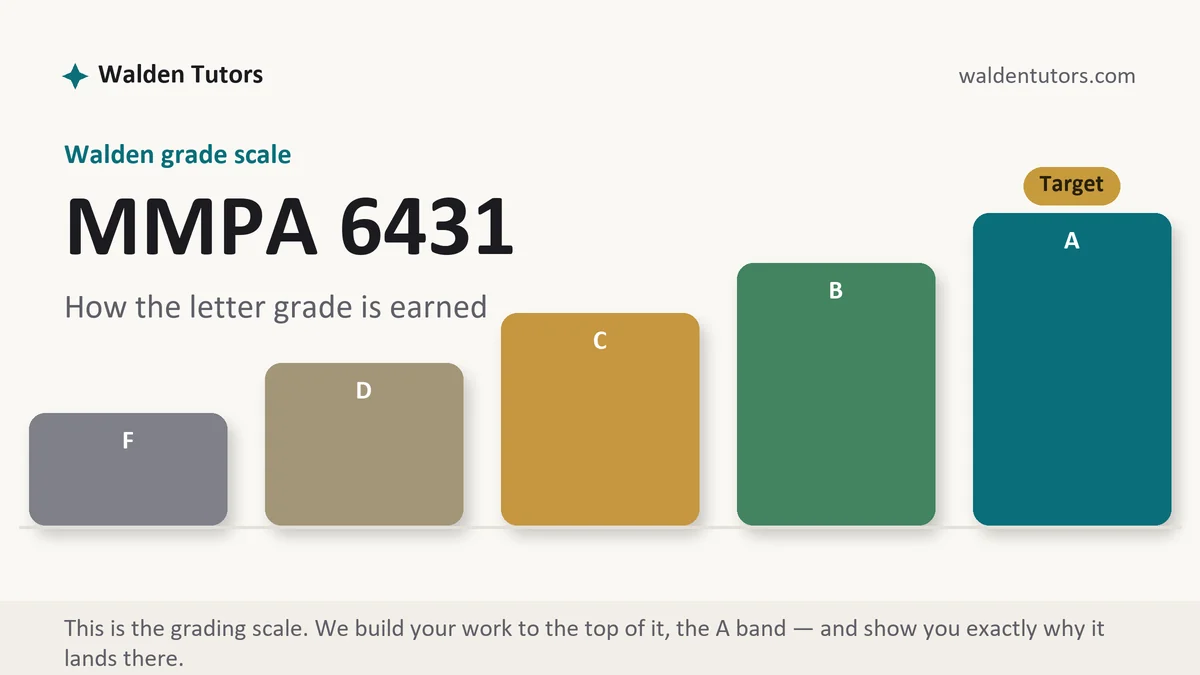
What MMPA 6431 actually grades
The catalog frames this as budgeting and financial administration across government and nonprofit organizations, taken from a management viewpoint rather than an accounting one. Students work with budgets, financial statements and reports, and the named themes are equity, transparency, ethics, accountability and social change in the handling of public money. Two skill strands run through the rubrics: getting the quantitative work right, and communicating financial information to people who do not do finance for a living.
That second strand is where most of the marks move. Public managers do not compute for a living; they explain. A rubric in this course typically rewards a correct calculation modestly and rewards the sentence that says what the calculation means for a decision far more heavily. If your paper reports that the general fund balance fell from 18 percent of expenditures to 9 percent over four years and stops there, you have done half the assignment. The other half says what that trajectory means about revenue volatility, reserve policy, and what the council should be asked to decide before the next downturn.
MMPA 6431 carries 5 credits and lists MMPA 6200 as its prerequisite. The term runs quarter or semester depending on your program, so confirm your start and end dates in the student portal instead of inferring them from another course. Submissions close at 10:59 p.m. Central, which is 11:59 p.m. Eastern.
How we help in this course
Two requests dominate this course. The first is the calculation itself, done correctly and shown transparently so you can check every step rather than trusting a number. The second, and the more common one, is the writing that has to sit on top of it: turning a ratio into a finding, a finding into an implication, and an implication into something a board could vote on. We do both, and we label which figure came from which page of which document so nothing in your paper is unsourced.
Drafts arrive inside 24 to 48 hours, having passed two separate review stages, one testing the work against your rubric rows and one auditing arithmetic, citations and originality. Revisions are free until the target is met. Send the assignment file, the rubric, and the budget or financial statement you are working from if the assignment supplied one, since starting from your own document beats us picking a jurisdiction you have never heard of.
Weekly manuals for this course
Week-level manuals for this course are published one at a time, after the week has been checked against the live classroom rather than reconstructed from a catalog blurb. Where yours has not appeared yet, put the prompt in chat and coverage plus pricing come back the same day. The drafting side of the desk runs regardless of what is documented here.
Facing a 6431 budget assignment?
Send the prompt, the rubric and any financial documents the week gave you. The first sample costs nothing.
The tell a budget grader spots immediately
Anyone who has marked public finance coursework knows the shape of a paper that will disappoint before reading a sentence of it. The signs are visual. Tables appear with no title and no source line. Numbers arrive with no unit, so a reader cannot tell thousands from millions. A figure sits in the middle of a page with white space above and below it, which means nobody wrote a sentence explaining why it is there. And the headings promise description, an overview of the budget, a summary of revenues, rather than a question the analysis will answer.
Fixing this is largely typographic discipline plus one habit. Give every table a number, a title, a unit and a source note naming the document and page. Then follow each table with a sentence that begins with what it shows, not with what it is. Not "Table 2 presents revenue by source" but "Sales tax supplies 41 percent of general fund revenue, which is why the 2020 collapse hit this city harder than its neighbors." A grader who sees interpretation attached to the first table reads the rest of the paper expecting analysis, and expectations set early are difficult to lose.
How to actually write MMPA 6431: where to begin
Start with the rubric and find out how the marks divide between calculation and interpretation, because that ratio decides how you spend your evening. In most public administration finance assignments the analysis and communication rows outweigh the computational rows, which means the spreadsheet is a means and the memo is the deliverable. Turn the rows into headings in an empty file, note the weights, and if a row asks about equity or transparency, give it a section of its own instead of hoping a sentence in the conclusion will cover it.
Get the documents before you get an opinion. For a local government you want the adopted budget and the annual comprehensive financial report, and you want at least three consecutive years so that trends exist to talk about. For a nonprofit, the Form 990 is public and gives you revenue mix, program versus administrative spending, and compensation. Read the transmittal letter or the management discussion first: the finance director has already told you what worries them, and it is usually a better starting question than anything you would invent from outside.
Then pick the small number of measures that answer your question, rather than computing everything you know how to compute. Revenue concentration tells you about vulnerability. Fund balance as a share of expenditures tells you about cushion. Year over year change per capita, adjusted for inflation, tells you whether a service is actually growing or only appearing to. Debt service as a share of the operating budget tells you how much of the future is already committed. Four measures used well produce a stronger paper than twelve computed and left uninterpreted, and the four should be chosen because they bear on the decision you framed at the start.
Now handle the equity and transparency material with the same rigor as the arithmetic, because it is graded and it is where hand-waving usually appears. Equity in a budget is a question about distribution: which neighborhoods, populations or programs receive what, and how does that compare with need. If the organization publishes spending by district or by program, you can answer it with evidence. If it does not, that absence is itself a transparency finding worth stating plainly. Say what a resident could and could not learn from the published documents, and what it would take to close the gap.
Write the analysis for a reader with authority and no finance training, which is the professional skill this course is teaching. Define a term the first time you use it, in a clause rather than a footnote. Round to the precision that carries meaning, because 41 percent communicates and 40.7382 percent does not. Put your recommendation early rather than saving it for a reveal, then support it. Pull scholarly work on public budgeting through the Walden Library to frame what your numbers mean, cite each financial document as a report from its issuing body with the year printed on it, and give the whole thing a separate APA 7 pass at the end, including table formatting, which the manual treats specifically and rubrics in this course usually score.
| Section | What it does | Where it usually fails |
|---|---|---|
| Purpose and question | Names the organization, the decision at stake, and the financial question the analysis will answer. | Opens as a general profile of the jurisdiction, so nothing that follows has anything to be relevant to. |
| Data and sources | States which documents supplied the figures, which years are covered, and any limitation in the data. | Numbers appear with no document behind them, leaving a grader unable to verify a single one. |
| Calculations and tables | Presents the measures with units, titles and source notes, and shows the method where it is not obvious. | Untitled tables with unlabeled columns, or a single year of data offered as if it were a trend. |
| Interpretation | Says what each figure means for the organization's financial condition and for the decision in question. | Description restated in words, so the reader learns what the table already showed and nothing more. |
| Equity, transparency and accountability | Examines who benefits, what the public can actually see, and who answers for the result. | A paragraph of general commitment to fairness with no distributional evidence attached to it. |
| Recommendation | Proposes a specific action, priced, sequenced, with the trade-off it imposes stated openly. | Advice to monitor the situation and improve efficiency, which commits the writer to nothing. |
Discussion posts that actually earn the points
Threads in a finance course are graded separately from the papers and they reward one thing above all: bringing a number. A post about the general importance of reserves is worth little; a post reporting that your own city's reserve policy sets a floor of two months and that the fund balance sat below it in three of the last five years starts a real conversation and earns the evidence row at the same time. Cite the document you took it from, and give the year so classmates can check it.
Spread your posting over several days rather than compressing everything into one late night, which is what Walden's grading policy asks for, participation that is consistent, substantive and timely across two to four days at minimum. Replies are scored on their own row and pure agreement earns nothing. In this subject the productive reply usually compares jurisdictions: your state's balanced budget requirement against theirs, your revenue mix against theirs, the way your organization reports program spending against the way theirs does. Check your own classroom for how many replies are required and when the thread closes, since those rules differ between courses and can differ between weeks.
Citations and APA the way Walden grades them
Financial documents are cited as reports, with the issuing body as author and the fiscal year that appears on the cover. A city's adopted budget for fiscal 2025 is not cited as a webpage because you found it as a PDF on a website, and the year is the document's, never the date you downloaded it. Where a figure comes from a specific page or schedule, give the page, because a reader who wants to verify a number should not have to search four hundred pages for it.
Scholarly sources do different work and come through the Walden Library: peer reviewed research on budgeting practice, fiscal condition and public financial management, used to interpret what your numbers signify rather than to prove that budgets matter. Keep the two families visibly separate so a grader can see which claims rest on your organization's own reporting and which rest on independent research. APA also has rules for tables and figures, and in a course full of both, following them is free marks. Run the Writing Center's guidance over your table formatting once and reuse the pattern for the rest of the term.
The mistakes that cost points in MMPA 6431
- Tables presented without titles, units or a source note, which makes every figure in them unverifiable.
- One year of data described as a trend, when the entire point of the exercise is direction over time.
- Computation performed correctly and then left to speak for itself, in a course that grades explanation.
- Nominal dollars compared across several years with no adjustment for inflation or population.
- Equity discussed as a value rather than as a distribution, with no evidence about who received what.
- A recommendation with no price attached, in a paper whose entire subject is what things cost.
MMPA 6431 questions students actually ask
How much math is actually in this course?
Arithmetic, ratios and percentage change, not calculus. If you can build a formula in a spreadsheet and read a table without panic, you have the quantitative range this course asks for. The harder skill is interpretive: knowing that a fund balance equal to two months of operating expense means something different for a city with volatile sales tax revenue than for one funded mostly by property tax. Students with finance backgrounds sometimes lose more points than nervous beginners here, because they compute confidently and forget to explain what any of it means to a reader who has to decide something.
Where do I find a real public budget to analyze?
Most American local governments publish the adopted budget and the annual financial report on their own website, usually under a finance or transparency heading, and the audited report is the one with the reliable numbers in it. State agencies publish through the state comptroller or budget office. Nonprofits file the Form 990, which is public and reachable through several free databases. Before you commit to an organization, confirm you can get at least three consecutive years, because a single year gives you no trend and a trend is what most of these assignments are really asking you to see.
Do the spreadsheets get graded or just the written analysis?
Both, in the sense that the calculation has to be right and the writing has to make it mean something. Where an assignment asks for a worksheet or a table, expect rows for accuracy and for presentation, which means labeled columns, stated units, a note on the source of every figure, and a title a reader can understand without you standing beside them. The written analysis then carries the heavier weight in most public administration rubrics, because the course is training managers who must explain finance to councils and boards rather than accountants who only have to produce it.