PHLT 8270 help and tutoring

PHLT 8270 · 5 credits · PhD in Public Health
The short answer

Health Informatics and Surveillance carries the code PHLT 8270 at Walden, is worth five credits, and sits in the PhD in Public Health with RSCH 8110 listed ahead of it. Two subjects share one syllabus. The first is the plumbing that moves health data between systems: standards, controlled vocabularies, transmission protocols, electronic records, exchange, and the database design holding all of it up. The second is surveillance practice, where trend data gets read for aberrations by person, place and time. Doctoral rubrics in this course tend to punish papers that handle only one of the two.

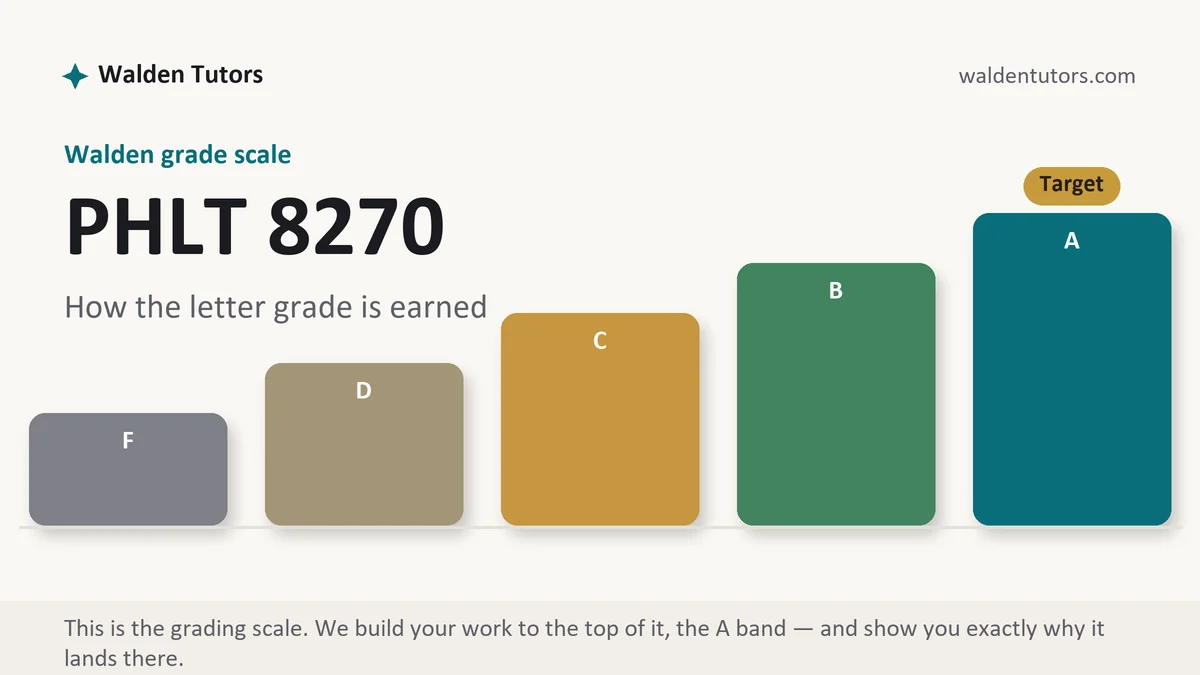
PHLT 8270 grading scale at Walden, how the work is graded, from Walden Tutors
How Walden grades PHLT 8270, visualized by Walden Tutors.

What PHLT 8270 actually grades

Graded work here is doctoral writing about systems rather than about patients. Expect analyses of a named surveillance system, appraisals of a data standard or vocabulary measured against a stated use case, applied pieces where you interpret trend data and argue what a signal means, and design work in which information architecture, storage, security and privacy get reasoned about together instead of parked in separate paragraphs. Threaded discussions carry scored rows of their own and usually ask you to defend a technical judgment in front of peers able to test it.

Precision a reader can verify is what moves these rows. Writing that a system detects outbreaks early earns almost nothing. Writing that a syndromic system built on emergency department chief complaint text produces a signal days ahead of laboratory confirmed reporting, then explaining that the price of the head start is paid in specificity, is the level this course is pitched at. Every claim about performance should arrive with the mechanism that produces it.

Privacy and security are graded as engineering questions, not as a closing gesture toward ethics. A rubric row asking about protected information wants to know which identifiers travel, where they rest, who holds the keys, what the re-identification risk looks like once two files are joined, and which agreement governs the transfer. Papers ending with a line about maintaining patient confidentiality have answered nothing.

How we help in this course

Send the assignment page, the scoring guide and whatever system or dataset the week assigned you. What comes back is a draft with the technical spine visible: the system described at the level of its data flow, the standards named and justified, the analysis carried out and reported in doctoral register, and the governance section written as decisions rather than as principles.

Turnaround runs 24 to 48 hours. Each draft is written toward the top band of the rubric, annotated so you can see which row a paragraph answers, checked once for scoring and again for APA and originality by a second reader, and revised at no cost until the target is met.

Weekly manuals for this course

There are no week pages for PHLT 8270 on this site yet, and inventing one would be worse than having none. Walden keeps its syllabi inside the classroom, so a week manual only publishes here after somebody has confirmed what that week actually contains. Until yours appears, paste the assignment into chat and a scope comes back the same day.

Surveillance analysis due this week?

Send the rubric and the system you were given. The first sample costs nothing.

Informatics and surveillance are one argument

The course carries two vocabularies, and students who keep them apart end up writing two short papers stapled together. They are the same argument. What a surveillance system is able to see gets decided upstream, by which fields the source system captures, which code set those fields are expressed in, and whether the message format carries them intact to the receiver. A syndromic system reading free text complaints needs language processing because nobody coded the complaint. A registry fed by structured laboratory results does not, but it only sees what a laboratory chose to report.

So when a prompt asks about detection performance, the honest answer starts with the supply of data. Mapping between vocabularies loses granularity in predictable places. Exchange across organizations introduces delay, and delay is the whole currency of early warning. Records created for billing describe encounters rather than diseases, and the gap between those two things is where false signals live. Name the mechanism and the evaluation writes itself.

Geography deserves the same treatment. Putting cases on a map is presentation; the analytic questions are whether the denominator under the map is the population at risk, whether the geographic unit was chosen before or after you saw the pattern, and whether an apparent cluster survives a change of boundary. Aberration detection across person, place and time is a claim about all three at once, and an analysis that varies only one of them has stopped early.

The quarter this course sits in

The PhD in Public Health is a quarter program, and Walden says so on its own catalog page rather than leaving it to be worked out. The plan of study there is printed in blocks running from Quarter 1 to Quarter 13, and the MPhil exit point described on the same page is set at a minimum of 45 quarter credits. There is nothing to hedge here, so ignore any advice written for the university's semester degrees.

The published forward terms are Fall 2026 from August 31 to November 15, Winter from November 30 to February 14, Spring from March 1 to May 16, and Summer from May 31 to August 15. Every one of those spans covers 76 days, which divides out at a shade under eleven weeks. Walden labels its full term as eleven and twelve week rather than printing a week count on the calendar page itself, and a six week half term also runs inside the quarter, so treat the week figure as arithmetic rather than as a promise about your section.

Submissions close at 10:59 p.m. Central, which is 11:59 p.m. if your clock runs on Eastern. The opening week needs a genuine post or assignment from you before attendance is settled. Your grade arrives as a letter assembled from rubric rows, so a brilliant section cannot rescue a row you left empty.

How to actually write PHLT 8270: where to begin

Print the scoring guide and turn every row into a heading before you write a sentence. In a doctoral informatics course the rows are usually verbs, analyze, evaluate, justify, recommend, and the verb tells you what shape the paragraph has to take. A row saying evaluate is not satisfied by description, however accurate the description happens to be.

Then choose a real system and stay with it for the term. This course rewards concreteness the way clinical courses reward specificity: a named national or state system, a registry, an exchange, or a hospital's own reporting pipeline gives you documentation to cite, a governance structure to describe and known weaknesses other people have already written about. An invented example forces you to make up exactly the details a grader wants to check.

Structure the paper as the route the data actually takes. Where does the observation originate, what is it recorded as, which standard encodes it, how does it move, who receives it, what analysis runs on it, who acts on the output, and what happens to the record afterwards. Following that path stops you writing a paragraph about interoperability that never touches your own case.

Synthesis at this level means putting sources into conversation about a disagreement. Two evaluations of the same surveillance approach that reached different conclusions are worth more to you than five that agree, because explaining the difference forces you to name the conditions under which the approach works. Lay the setting, the data source and the outcome definition side by side and the reason for the disagreement usually falls out.

When a week hands you data, resist leading with the method. Say what the series does, then say what would have to be true for that movement to be real, then rule out the boring explanations: a changed case definition, a new reporting site, a laboratory that switched assays, a holiday week, a data pull that landed before late reports arrived. Doctoral readers score the elimination of alternatives, not the size of the effect.

SectionWhat it doesWhere it usually fails
System and purposeNames the surveillance system, who runs it, what it exists to detect, and for whom.A general account of surveillance with no institution, jurisdiction or date attached to it.
Data sources and flowTraces the observation from its point of capture through every hop to the analyst.Boxes and arrows that never say what the message traveling between them contains.
Standards and vocabularyIdentifies the code sets and message formats in play and says why each one is used here.Acronyms listed with no use case, leaving a reader unable to judge whether they fit.
Analysis and detectionStates the method separating signal from ordinary variation, along with its assumptions.A claim that aberrations get detected, with no threshold, baseline or comparison named.
Privacy, security, governanceWorks through identifiers, access control, agreements and re-identification risk for this system.Principles that would read identically for any system in any country in any decade.
LimitationsSays what this system structurally cannot see and what the blind spot costs the people relying on it.Caveats about data quality in general, with no consequence attached to any conclusion.
RecommendationProposes a change, names who would make it, and says how anybody would know it worked.Advice to improve interoperability, addressed to nobody, with no measure of success.

Discussion threads in a technical course

Threads go badly here when everyone agrees the topic is important. A post carrying its row states a position, supports it with something specific, and gives peers a handle to grab: the standard you think is wrong for the use case, the detection threshold you would move, the privacy tradeoff you would accept and why. Bring a source into the first post so the technical claims are not floating.

Walden asks for substantive participation spread out instead of delivered in one sitting, and its guidance points students toward posting on at least two to four separate days in a week. The university also states openly that requirements differ between courses and sometimes between weeks inside a single course, so the reply count and the closing day come from your own classroom. When you respond, do the technical work: ask which field a proposed indicator would actually be computed from, or point out that the system somebody praised does not receive results from the settings where the cases are.

Sources, data and APA 7 in an informatics paper

Three source types carry this writing. Peer reviewed evaluations, found through the Walden Library rather than a general web search, give you evidence about performance. Standards and specification documents, cited to the body that issued them with the version identified, give you the technical detail. Agency documentation and data dictionaries, cited with the year of release, describe the system as it currently runs. A vendor page describing its own product is marketing, and should be labeled as such if you use it at all.

Keep the citation inside the sentence making the claim, especially for numbers and dates, since technical figures go stale quickly and a reader needs to see the vintage without hunting for it. Use the Walden Writing Center templates for headings, tables and the reference list. Where you build a table from several sources, note underneath which figure came from where, because an unsourced table is the fastest way to give back a row you had already earned.

The mistakes that cost points in PHLT 8270

  • Acronyms deployed as evidence, with no statement of what the standard does or why it suits the case in front of you.
  • A surveillance system described in the present tense from a source published years ago, with no check on whether it still runs that way.
  • Detection discussed with no baseline, no threshold and no account of what ordinary variation looks like in the series.
  • Maps presented as findings, when the pattern shown is a population map wearing a different color scheme.
  • Privacy handled as a closing paragraph of principle rather than as a set of decisions about identifiers and access.
  • Recommendations addressed to the field in general, so nobody named could act and nothing could be measured afterwards.

PHLT 8270 questions students actually ask

Do I need to write code or run software to get through this course?

Usually not in the sense students fear. The writing asks you to reason about data structures, standards and detection logic, and reasoning about them well does not require you to implement them. Where a week does hand you data, the task sits closer to interpretation than to programming, and any tool your classroom names will arrive with instructions. What you do need is comfort with the vocabulary: knowing what a code set is for, what a message carries, what a denominator does, and why a field being optional in a specification matters. Build that vocabulary in the opening week and the technical assignments stop being frightening.

How do I choose a surveillance system to write about?

Pick one that publishes. The best candidates have public documentation, a data dictionary, an annual report and at least one independent evaluation you can cite, because those four things supply almost everything a rubric will ask for. National notifiable disease reporting, syndromic surveillance networks, vital statistics, cancer and immunization registries and health information exchanges all qualify. Choose a system connected to the topic you expect to carry into your dissertation, since the reading you do now becomes background you will not have to repeat. Avoid anything you can only learn about from news coverage.

How much detail does the privacy section need?

Enough that a reader could disagree with you. Name the categories of identifier the system handles, say where they rest and who can reach them, state which legal or contractual instrument permits the transfer, and describe one realistic way the data could be re-identified if it were joined to something else. Then say what you would do about that risk and what the fix would cost in analytic value, because suppression and aggregation are never free. A section that reaches a tradeoff is doing doctoral work; a section that recites obligations is not.

Keep going

Online now