PHLT 8560 help and tutoring

PHLT 8560 · 5 credits · PhD in Public Health
The short answer

PHLT 8560 is Advanced Analysis of Secondary Data, a five credit doctoral course whose catalog entry lists RSCH 8210, PHLT 8270 and PHLT 8066 as prerequisites. The work is about using data somebody else collected: finding public health and biomedical datasets that already exist, designing a study their contents can genuinely support, and being straight about what is gained and what is lost by not collecting your own. For a lot of students this is the course where the dissertation stops being an idea and becomes a variable list.

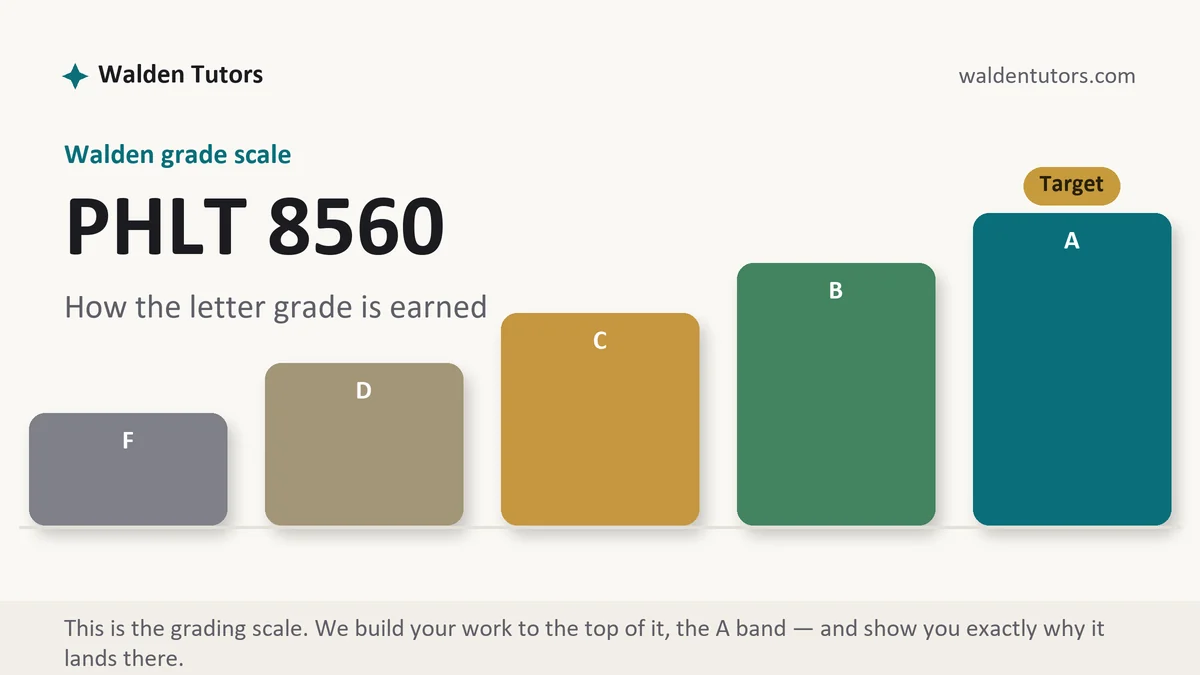
PHLT 8560 grading scale at Walden, how the work is graded, from Walden Tutors
How Walden grades PHLT 8560, visualized by Walden Tutors.

What PHLT 8560 actually grades

Deliverables cluster around three tasks. Appraising a dataset, which means reading a codebook and a methods report closely enough to say what the data can and cannot answer. Designing an analysis on top of it, where a question gets rewritten until the available variables can address it. And writing about limitations in a way that is specific rather than apologetic.

What the rows reward is evidence that you read the documentation. A student who names the sampling design, the response rate, the years available, the variable that comes closest to their construct and the reason it is only close, has done work a grader can see. A student who names a famous dataset and describes it from memory has not, and the difference usually shows inside a single paragraph.

Alignment is the recurring rubric word here and it means something precise: the question, the design, the variables, the analysis and the conclusion all have to be about the same thing. Secondary data breaks alignment easily, because the temptation is to keep the question you love and pretend a nearby variable measures it.

How we help in this course

Send the assignment, the rubric and the dataset you are working with, or ask for help choosing one. Drafts come back with the appraisal grounded in the actual documentation, the research question rewritten into something the variables support, the operational definitions stated, and the limitations section written as consequences rather than as regrets.

Expect it in 24 to 48 hours, built toward the highest band of the scoring guide and annotated by row. One reviewer scores it the way your instructor would and another checks APA and originality, and revision requests are handled free until the piece does its job.

Weekly manuals for this course

Week manuals for PHLT 8560 are not published here yet. This site only puts up a week page once the contents of that week have been confirmed, and because Walden syllabi live inside the classroom, confirmation comes from students rather than from a catalog. Send yours to chat and you will get a scope back the same day.

Dataset chosen and the question will not fit?

Send the codebook and the rubric. The first sample is free.

Where your question meets somebody else's codebook

Primary research lets you build a measure for the concept you care about. Secondary analysis reverses the order: the measures already exist, and your concept has to be expressed through them or abandoned. Most of the work in this course is the negotiation between those two facts, and doing it openly is what separates a doctoral analysis from a hopeful one.

Start with the codebook, not the data file. It tells you the exact wording of the item, the response options offered, the skip pattern deciding who was asked, the year the wording changed, and the code marking a refusal as opposed to a genuine zero. Those details decide what your variable actually means. An item asking whether a respondent has a personal doctor is not a measure of access to care, though it often gets used as one, and saying so in your operational definitions is a scoring move rather than a weakness.

Then write the definitions down before computing anything. For each construct, state the item or items you are using, the recoding you applied, the values you treated as missing, and the reason for each. Doing this early makes the methods section almost write itself, and it protects you from the quiet drift where a variable slowly becomes the thing you wish it measured.

Sampling design, weights, and the mistake that voids a result

Large public datasets are rarely simple random samples. They stratify, they cluster, they oversample groups that would otherwise be too small to describe, and they publish weights that make the estimates represent a population rather than a sample. Ignoring those weights does not produce a slightly worse answer. It produces standard errors that are wrong and estimates describing nobody in particular.

So the appraisal has to reach the design. Find the methods report, identify the strata and cluster variables, locate the weight the documentation tells you to use for your kind of analysis, and check whether that weight changes when you subset the file or combine years. Complex sample procedures exist in the usual software for precisely this reason, and using them is a rubric row in disguise.

Missing data deserves the same seriousness. Report how much is missing on each variable you use, look at whether it goes missing in a pattern, and state what you did about it. Dropping incomplete cases is a decision with consequences rather than a neutral default, and a reader wants to know how many people left the analysis and whether they differed from those who stayed.

The quarter clock behind this course

Walden runs this doctorate on quarters, and its own catalog is unambiguous about it: the program of study is printed as a run of quarters, thirteen of them on the longer track, and the master of philosophy contained inside the program is defined there as a minimum of 45 quarter credits. Nothing about this degree uses the semester structure some other Walden programs follow.

Dates published for the coming year run August 31 to November 15 for the Fall 2026 quarter, November 30 to February 14 for Winter, March 1 to May 16 for Spring, and May 31 to August 15 for Summer. Each span covers 76 days, so eleven weeks is arithmetic rather than a figure Walden prints; the university describes its full quarter term as eleven and twelve week, and it also runs six week half terms, which is why the portal rather than a calendar screenshot should tell you when your work is due.

The nightly cutoff is 10:59 p.m. Central time, 11:59 p.m. Eastern. Attendance in the opening week depends on submitting something graded, not on logging in. One thing worth planning for in this course specifically: getting access to a restricted dataset can take weeks of correspondence, so start that request the moment you know you need it.

How to actually write PHLT 8560: where to begin

Turn the rubric into headings first, as always, but pay particular attention to any row containing the word alignment. That row is usually worth more than students expect, and it gets scored by reading the paper backwards to check that the conclusion is about the same construct as the question.

Pick the dataset before you finalize the question. This feels backwards and it is the correct order for secondary analysis. Look for a source with public documentation, a published methods report, a searchable variable list, and enough years to support whatever comparison you have in mind. National health surveys, vital statistics files, hospital discharge and claims data, cohort study archives and surveillance releases are the usual families. Choose one connected to the topic you intend to carry into your dissertation, because the hours you spend inside its codebook now are hours you will not spend later.

Then write three versions of your question and test each against the variable list. The first version is what you want to know. The second is what the data could answer with the variables exactly as they stand. The third is what it could answer with defensible recoding. Choose between the second and the third, and keep a note of the first, because the gap between them is the honest core of your limitations section.

Structure the paper around the decisions rather than around the dataset. Purpose, then the source and why it fits, then the sample and how it was drawn, then the variables and how you defined them, then the analytic approach with the design features accounted for, then results, then what the design will not let you say. A reader should be able to rebuild your analytic file from your methods section without asking you a single question.

Synthesis in this course means reading other people's secondary analyses for method rather than for findings. Two teams using the same national survey to study the same outcome and disagreeing is a gift, because the reason usually sits in the operational definitions or in the years selected. Comparing how each defined its exposure teaches you more about your own definition than another literature summary would, and it gives the discussion section something to say beyond noting agreement with previous research.

SectionWhat it doesWhere it usually fails
Purpose and questionStates a question the chosen data could actually answer, with the population named.An aspiration carried over from a primary design that these variables cannot support.
Data sourceIdentifies the dataset, its custodian, its years and the documentation you read.A dataset named from memory, described with no codebook or methods report in sight.
Sampling and weightsDescribes how respondents were selected and which weight and design variables apply.Weights ignored, so both the estimates and the intervals around them describe nothing real.
Operational definitionsGives the exact items, the coding and the recoding used for every construct.A construct claimed for an item whose wording will not carry it, with no acknowledgment.
Missing dataReports the amount, the pattern and the handling for each variable in the analysis.Incomplete cases dropped in silence, so nobody knows who left or whether they differed.
AnalysisMatches the method to the outcome type and to the sampling structure of the file.A standard procedure run on a complex sample as though every case counted equally.
Strengths and limitationsSays exactly what this data cannot show and what that costs the conclusion.An apology for secondary data in general, with no consequence for any specific claim.

Discussion threads when everyone has a different dataset

The most useful posts here are practical: which file you chose, which variable you settled on for a construct with no good measure, and which part of the documentation defeated you. Peers who have opened the same codebook can answer in one line what would otherwise cost you an afternoon. Bring the citation for the methods report into your first post so people know which version you are reading.

Substantive posting spread over the week is what Walden asks for, with two to four separate days named in its guidance as the least it expects, and the university is clear that individual courses and individual weeks set their own requirements. Check the classroom for the count and the deadline. When you reply, be concrete: ask which weight your classmate applied, question whether their two survey years used identical wording, or point out that the subgroup they want to compare may be too small once the design effect is taken into account.

Citing data and documentation in APA 7

Datasets get cited, not merely mentioned. An APA reference for a data file names the responsible organization, the year of the release, the title including its version or wave, and where it was obtained. The methods report, the codebook and the user guide are separate documents with separate references, and citing them is the clearest signal to a grader that you opened them.

In the text, attach each citation to the specific claim: the response rate to the methods report, the item wording to the codebook, the analytic guidance to the user guide. Where you follow the custodian's published recommendation about weighting or about combining years, say so and cite it, since that turns a technical decision into a documented one. Peer reviewed studies using the same file, found through the Walden Library, help you justify definitions and give the discussion something to compare against.

The mistakes that cost points in PHLT 8560

  • A question kept intact from an earlier assignment while the data quietly fails to contain the variable it needs.
  • A dataset described from its home page, with no sign that the codebook or the methods report was ever opened.
  • Survey weights and design variables left out, which invalidates both the estimates and the intervals around them.
  • Two waves combined without checking whether the question wording or the sampling frame changed between them.
  • Missing values treated as real values, or refusal codes left in a variable and analyzed as though they meant something.
  • Causal claims drawn from a cross sectional file that was never able to establish which thing came first.
  • A limitations section apologizing for secondary data in general instead of naming what this file cannot show.

PHLT 8560 questions students actually ask

How do I tell whether a dataset can answer my question?

Do a variable audit before you commit. Write the question out, break it into its parts, and for each part search the dataset's variable list for the item that would measure it. Then read the exact wording of every item you found and ask whether it captures the construct or something merely adjacent. Check that the years you need exist, that the subgroup you care about is large enough to analyze, and that the file lets you see exposure and outcome in the order your question implies. Half an hour with the codebook saves a month, and if the audit fails it is far cheaper to change the question now than to argue with the data later.

Does analyzing an existing dataset still need ethics review?

Assume you need a determination and let the people whose job it is make it. Publicly available and fully de-identified data often qualifies for exempt or expedited handling, but the decision belongs to Walden's review process rather than to the student, and restricted files usually carry a use agreement with conditions on storage, publication and minimum cell sizes. Ask your instructor first, since course assignments and dissertation research get treated differently, and start any application early because the correspondence takes longer than anyone expects. Nothing here substitutes for what your own committee and review board tell you.

How do I write limitations without wrecking my own study?

Attach each limitation to a specific claim and to what you did about it. Vague regret weakens a paper; precise accounting strengthens it, because a reader can then see exactly how far the finding travels. Say the exposure measure is self reported and likely to be understated, then say which direction that pushes your estimate. Say the design is cross sectional, then state that temporal order cannot be established for this association and describe what a future study would need. Finish with what the data does support, stated plainly, so the section ends by defining the claim instead of retreating from it.

Keep going

Online now