SOCW 6051, Diversity, Human Rights, and Social Justice, is a 5-credit foundation course in the Walden MSW that follows SOCW 6002 and SOCW 6101. Walden describes it as a broad treatment of race and ethnicity, nationality, gender and sexuality, class, spirituality, ability, and age as parts of social identity. Your grade is built from threads, applied assignments, and reflective writing about your own position.
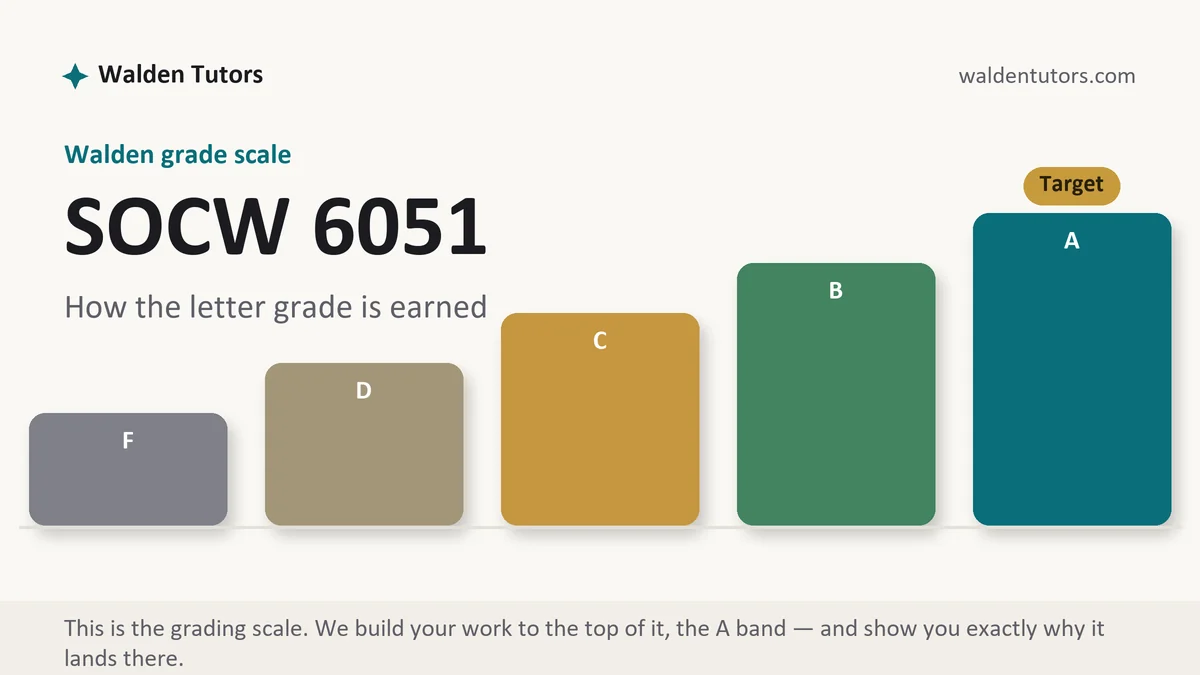
What SOCW 6051 actually grades
The catalog description contains two halves, and rubrics treat them as different jobs. One half is analytic: how power and marginalization shape what happens to a client, and what an assessment or intervention looks like when it answers culture instead of flattening it. The other half is reflective, since the course asks you to sit with where you stand inside the systems you are studying, in journals and structured exercises rather than in essays.
Analytic rows want evidence. Named populations, current research, and a claim somebody could argue with. Reflective rows want honesty with a consequence attached, so not what you felt but what the feeling would do to a professional decision and what you intend to do about that. Mixing the registers is the classic error in this course, and it happens in both directions. An analytic section written from conviction alone forfeits the evidence row. A reflective section written in the flat voice of a literature review forfeits the self-awareness row.
The final letter is stacked from those rows one at a time, so read the rubric as a list of separate assignments that happen to share a document.
How we help in this course
Tutoring helps you keep the analytic and reflective registers apart and marks which paragraph in your draft answers each row. Feedback checks whether analytic claims are sourced and whether reflection examines your own stated background and reactions without inventing experience. You remain the author and decide every final revision.
Every order moves through the same four hands. Someone decodes the rubric into what it is really asking for, a writer matched to your program builds the draft, a scorer marks it row by row the way your instructor will, and an APA and originality check clears it last. Turnaround is 24 to 48 hours, and revisions stay open until the work sits where you wanted it.
Weekly manuals for this course
Individual week manuals for SOCW 6051 appear on this site as each one is checked against a live classroom, and none are up yet. Nothing slows down while you wait: name your week in chat and the coverage answer comes back the same day.
The week two deadlines collide
Ask anyone who has finished this course where it got hard and you will hear about a single week rather than the whole term. The journal or reflective exercise runs quietly underneath everything, small enough each time that it never feels urgent, until a full applied assignment lands in the same seven days as a response deadline. Three things owed, one of which you had been treating as optional.
Get in front of it before the term picks up speed. Print the schedule, mark every graded item on it, and look for the date carrying more than one. Then move work backward. Reflective pieces are the easiest to bank early because they do not depend on reading you have not done yet, so drafting two of them during a quiet stretch turns the collision into an ordinary week.
Everything is owed by 10:59 p.m. in the Central zone, 11:59 in the Eastern one, on whichever day your classroom names. Your MSW may run on quarter terms or on semester terms depending on the version of the program you enrolled in, so pull the real dates from your student portal rather than borrowing the shape of a classmate's term.
What a reflective order needs from you
For the analytic half we need the prompt and the rubric, and nothing more. For the reflective half a short note helps: the parts of your own background that feel relevant, one moment in practice or in life where a difference in identity changed how a conversation went, and anything you would rather keep off the page. That last item matters as much as the first two. Whatever you share stays inside the order, and the draft works around the lines you draw instead of pushing at them.
Working through SOCW 6051 right now?
Send this week's prompt and rubric over chat. Your first premium sample carries no charge and returns inside 48 hours.
How to actually write SOCW 6051: where to begin
Read the rubric twice before you type anything, and read it as a set of separate questions rather than as a description of a paper. Then let it become the outline: every row its own heading, every weighting noted where you can still see it while you draft. Here that step earns double, because analytic and reflective rows sit next to each other on the same page and turning them into headings forces you to notice which voice each section needs.
Choose a specific population rather than a category. Papers in this course fail on breadth more often than on anything else. Writing about immigrant families is writing about nothing in particular. Writing about recently resettled families from one region, in one city, meeting one system, gives you edges to argue at. The narrow choice also makes the literature findable, and that is the practical test: if the Walden Library returns fewer than three recent peer reviewed articles on your framing, the framing is either too tight or too vague, and you should adjust before committing a weekend to it.
Then settle what the paper claims. A description of a group is not an argument. An argument names a mechanism, so this policy or this intake practice or this unexamined assumption inside an agency produces this outcome for these people, and the evidence sits here. Write that sentence out and keep it in front of you while you draft. Each analytic section either supports it, complicates it, or gets cut.
Treat intersectionality as analysis rather than as a list. Naming four identity categories in one sentence is inventory, not intersectional writing. The graded version shows two or more positions interacting to produce something neither would produce alone, and it shows this on a specific case. One worked example outperforms a paragraph of terminology every time.
For the reflective sections, use a causal shape. Something happened or something was read, you had a reaction, that reaction traces to a position you occupy, and it would have moved a professional decision in a direction you can name. Close on what you did or will do: a question for supervision, a habit worth interrupting, a source you plan to read. Reflection that stops at the feeling is the easiest row to lose in this course, and capable students lose it constantly.
Cite the profession's own documents wherever they apply. The NASW Code of Ethics addresses cultural competence and treats social justice as an obligation rather than a preference, and quoting it accurately with a year attached beats paraphrasing it from memory. Where a paper touches human rights, the underlying international instruments are citable documents too, with authors and dates like anything else.
Build the reference list out of the Walden Library instead of the open web. Search SocINDEX, PsycINFO, and Social Services Abstracts, and set the date filter before you start rather than after. Then run the closing check: every citation matched to a reference, every reference matched to a citation, heading levels holding steady from first page to last, all of it sitting on the Writing Center's APA 7 template. Those are free points, and they go missing more often than any others.
| Section | What goes in it | Common failure |
|---|---|---|
| Introduction and claim | The population, the system, and the argument the paper intends to defend. | An opening that announces a topic without ever committing to a position a reader could dispute. |
| Identity and social position | The dimensions of identity genuinely in play for this population and this setting. | Categories listed for coverage rather than chosen because they do work later in the paper. |
| Power and marginalization | How advantage and disadvantage get produced by the system under discussion. | A general statement that inequity exists, with no mechanism named and no evidence behind it. |
| Practice implications | What a culturally responsive assessment or intervention would look like in this setting. | Advice so broad that no worker could act on it before Monday morning. |
| Ethics and human rights | The NASW standard or rights framework the situation engages, and the duty it creates. | The Code invoked by name only, without a year, a standard number, or an application to the case. |
| Self-reflection | Your own position, your reaction, and what that reaction would do to your judgment. | Disclosure with no consequence, so the feeling is reported and the professional decision never appears. |
Posting in a discussion about identity
Threads here get graded twice, once for your opening contribution and once for what you do with other people's. The opening post works best as a small sourced claim about the week's material, grounded in one example rather than three. Bring the citation into the post itself. A confident paragraph standing on nothing gets read as personal opinion where the rubric asked for research.
The policy underneath every Walden discussion row asks for three things: posts that say something, posts that arrive on time, and posts that keep arriving. Walden's own guidance suggests touching the thread on at least two to four separate days instead of emptying your week into one late sitting. Requirements are not identical from course to course, and Walden says so plainly, so read what your own classroom asks for this week rather than importing a pattern that worked somewhere else.
Replies carry an extra difficulty in a course about identity, because disagreement lands harder in writing than in a room. The move that works is to take a colleague's example seriously and add to it: a factor their reading left out, a second population where the same mechanism produces a different result, or a source that complicates their conclusion. Address the argument, cite something, and let the courtesy come from the specificity.
The mistakes that cost points in SOCW 6051
- A topic pitched at the size of a whole continent or a whole identity category, leaving nothing specific to argue about.
- Identity terms set out in a row, as though naming them were the same act as analyzing them.
- Reflection written as disclosure, where the feeling gets reported and the professional consequence never arrives.
- Disparity statistics presented as the argument, when the paper still owes an explanation of what produces them.
- Cultural responsiveness described as respect in general, with no change to any actual assessment or intervention.
- Advocacy sites used as sources while the library holds peer reviewed work making the same point with data attached.
SOCW 6051 questions students actually ask
Can somebody else write my reflective journal?
Not honestly, and this is the one part of the course where outsourcing the thinking fails on its own terms. What does work is structure. You describe the moment and the reaction, a tutor shapes it into the causal form the rubric scores, confirms it ends in a decision rather than a feeling, and cleans the mechanics. The content stays yours, because invented self-awareness reads false to anyone who has marked a hundred of these.
How do I write about privilege without it turning into a confession?
Keep a professional consequence in every paragraph. The rubric is not asking you to feel bad; it is asking whether you can see how your own position shapes what you notice, what you assume, and what you might miss with a client. Write it as a working problem: here is a position I occupy, here is an assumption it made easy for me, here is a case where that assumption would have cost something, here is what I will do differently. That version is analysis. Apology is not.
What makes a source good enough for a diversity paper?
Peer reviewed, recent, and about a population close enough to yours that the finding transfers. Research on one group's experience of a system does not automatically describe another's, and a grader who knows the literature will notice. Government and international bodies are usable for data and for rights frameworks, and the NASW Code of Ethics is citable for professional obligations. What weakens a reference list is a stack of commentary pieces standing in for research when the Walden Library holds the studies themselves.