Human Behavior and the Social Environment I is the first HBSE course in Walden's MSW, coded SOCW 6200 and worth 5 credits, running from birth through young adulthood with the environment treated as part of the explanation rather than as scenery behind it. Papers stall in one predictable place. To write that low income affected a client's development is to state a correlation; to write the two moves in eighteen months, the three schools, and the reading gap that is an attendance story before it is an ability story is to state a mechanism, and only one of those can be marked.
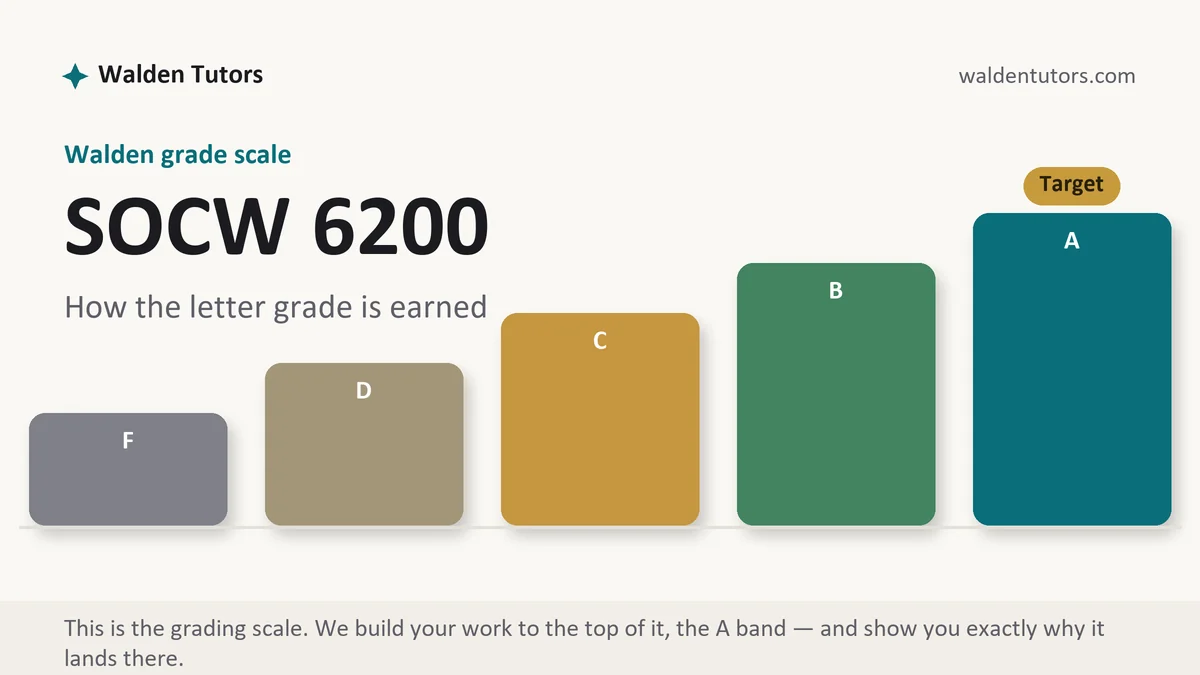
What SOCW 6200 actually grades
Your ability to explain a person using both development and environment at once. Walden's catalog entry places the course at the intersection of the social environment and healthy lifespan development for individuals, families, groups and communities. It covers the dynamics of human behavior across biological, psychological and social systems from birth to young adulthood, and it asks you to analyze case studies for the ways gender, socioeconomic status, sexual orientation, race and ethnicity, and disability shape development. The course description also frames all of it through the lens of human development, the environment and social context, which is the person-in-environment stance the whole degree rests on.
The written work follows from that. Case analyses, applied theory papers, short lifespan pieces, and discussions where you argue about what best explains a given behavior. Two questions run underneath nearly every scoring guide you will meet in it. Whether the theory you name is doing explanatory work on this specific case, and whether the environmental factors are written as forces with mechanisms rather than as labels attached to a person.
How we help in this course
Tutoring reviews your 6200 paper around the de-identified case rather than around a reading summary. Feedback checks whether theory is used continuously, environmental factors have traceable paths to developmental outcomes, and diversity analysis changes the reading of the case. A row map shows which paragraph answers each criterion and where work remains.
Service terms are the site's standard set: your first premium sample is free, paid drafts land within 24 to 48 hours, each one clears a scoring review and then a separate APA and originality check by a second reviewer, and revisions continue at no cost until the target grade is met.
Weekly manuals for this course
Manuals for particular SOCW 6200 weeks appear here as each deliverable is confirmed against published material, which means no invented list of weeks sits on this page. Some social work programs here are built on quarter terms and some on semester terms, and the number of graded submissions in front of you follows from the one you were enrolled into, so the dates and the deliverable list live in your student portal rather than on this page. Ask in chat about the week you are working on and the desk will tell you what is live today.
In SOCW 6200 right now?
Send the case study, the prompt and the scoring guide. The first premium paper is free, returned in about two days.
Person in environment, on the page
Most 6200 papers lose marks in the same place. The theory section is competent, the case summary is competent, and nothing connects them, so the grader reads two essays stapled together instead of one analysis. What the rows want is a single argument in which a stage, a task or a system is used to explain something the case actually reports, and in which every environmental factor you introduce ends in a consequence for this person's development. Drafts from this desk are built as that one argument, with the connective sentences written in rather than assumed, and the delivery notes point at the sentence answering each row.
One HBSE week, handled together
Foundation weeks in this course usually carry a discussion and a short paper drawn from the same case or the same set of readings, and sending both at once is the cheaper way to do it. The reading is worked once, the paper carries the full analysis, and the post takes a narrower line so that your instructor is not reading the same paragraph twice. Standard turnaround is 24 to 48 hours from the arrival of the scoring guide, Course-Based work is due at 10:59 p.m. Central and 11:59 p.m. Eastern, and a heavy week is flagged when you get the quote rather than on the day.
Read one paper before you commit
Take the free sample on a case analysis, because that is where the difference between reading knowledge and writing skill shows up. In one paper you can see whether the theory is applied or merely described, whether the diversity section changes anything, whether the sources are current and pulled from the library, and whether the register sounds like social work. Send the assignment you are behind on, read the return with your own scoring guide beside it, and decide on evidence rather than on a promise.
How to actually write SOCW 6200: where to begin
Read the scoring guide first and let it build your outline. HBSE prompts often read like invitations to discuss, and the rows underneath are far more specific than the prompt sounds. Copy the rows into a blank file as headings, put the mark value beside each, and set your section lengths from those numbers. The row that asks you to apply theory to the case is nearly always heavier than the row asking you to describe the theory, yet the description is the part that comes easily at the end of a long shift, which is exactly why the outline has to exist before the writing does.
Work the case before you touch the reading. Go through it and pull out the developmental facts on one list and the environmental facts on another. On the first list belongs anything about age, milestones, health, temperament, attachment, schooling and identity. On the second belongs housing, income, migration, neighborhood, school quality, caregiver work patterns, community, faith, discrimination and access to services. Then draw the lines. Every environmental fact you keep should be joined to something on the developmental list, and any fact you cannot join is probably not earning its place in a short paper.
Pick your theory by what the case needs explaining. When the question is about identity formation in an adolescent, psychosocial stage theory has something to say. When it is about how an infant learned what to expect from adults, attachment does the work. When it is about why the same street keeps producing the same outcome, ecological systems theory is the better tool, and when the question is about how a young adult learned a behavior by watching, social learning fits. Name one main lens and, if the case needs it, one supporting lens, then apply both continuously. A theory named in your introduction and abandoned by the third page surrenders the row that matters most in this course.
Now write the mechanism sentences, which is where HBSE papers are actually won. A category is not an explanation. Poverty, disability, race and sexual orientation are starting points, and the mark comes from tracing how each one operated in this particular life. Instead of asserting that poverty affected school performance, write the chain: the family moved twice because the rent rose, the child changed schools three times in two years, the reading instruction never ran continuously, and the gap that shows up now is an attendance story before it is an ability story. Do the same for the protective factors, because the rows on strength and resilience are usually there and usually thin in student drafts. A grandmother two streets away, a teacher who kept a place at lunchtime, a church group that fed people on Sundays: those are mechanisms too, and they belong in the analysis rather than in a closing sentence about the client being resilient.
Handle the sources as argument rather than as ballast. A theory paper needs a primary or standard source for the framework itself, then current empirical work that shows the pattern you are claiming, ideally in a population resembling the one in your case. Synthesis means putting two sources into conversation, saying where they agree, where they part, and what that means for this case, rather than writing a paragraph per article. Pull the journals through the Walden Library, since PsycINFO and SocINDEX are where this literature sits and an open search returns abstracts you cannot read. Fold each citation into the sentence carrying the claim, keep the reference list matched exactly to your in-text citations, and start from the Walden Writing Center template so the APA 7 row is settled before you write a paragraph.
| Section | What goes in it | What earns full rubric points |
|---|---|---|
| Case picture | Age, household, community, and the situation the case is asking you to explain. | Short, and built only from the details the later analysis will actually use. |
| Developmental stage | Where this person sits in the lifespan and the tasks that stage carries. | The stage is compared against what the case reports, including where the fit is imperfect. |
| Biological dimension | Health, disability, nutrition, sleep, puberty, neurological factors, prenatal history. | A biological fact is followed through to a behavior, not left as an entry on a list. |
| Psychological dimension | Attachment, coping, identity, cognition, emotional regulation, meaning made of events. | Inference is separated from evidence, so the reader can tell what the case says from what you concluded. |
| Social systems | Family, school, peers, workplace, neighborhood, services, policy, and how they interact. | At least one system is shown constraining or enabling another rather than described alone. |
| Diversity and oppression | How gender, income, sexual orientation, race, ethnicity or disability operated in this life. | Each factor traced through a mechanism to an outcome, never asserted as a general truth about a group. |
| Implications | What the analysis means for a social worker meeting this person now. | Implications drawn from your own analysis, with strengths named alongside the risks. |
Discussion boards in a theory course
The weekly board carries its own scoring guide and normally asks you to apply a concept to a case or to argue for one explanation over another. Open with the claim rather than the summary, since your classmates read the same case and nobody needs it retold. Two or three paragraphs is the right size: the explanation you favor, the case detail that supports it, one current source, and the alternative reading you decided against. Naming the alternative is what separates a post that argues from a post that reports.
Replies are scored separately and on their own schedule, and Walden's grading policy wants your presence on two to four separate days of a week, which is a different thing from posting three times on a Sunday night. In a theory course the useful reply usually offers a competing lens, points at the case detail your colleague's explanation cannot account for, or asks what would have to be true for their reading to hold. The rule is not the same everywhere at Walden, and the university says as much out loud, so the number of replies that earn credit, and the hour they stop earning it, are things only your own classroom can tell you.
Sources, synthesis and APA in an HBSE paper
Two source problems recur in this course. The first is textbook dependence, where a whole paper rests on the assigned text and the reference list carries three entries. The second is the literature review that never becomes an argument, four paragraphs each summarizing one article with nothing linking them. Both are fixed by the same discipline: decide what you are claiming about the case, then find sources that support, qualify or complicate that claim, and write them into your sentences rather than into a queue.
On mechanics, keep the heading levels consistent from the start, match every reference to an in-text citation and back again, and give page numbers whenever you take a definition from a text. Older foundational work is legitimate when you are citing the original statement of a developmental theory, and current work is what you need for anything empirical, so a mixed reference list is a sign of judgment rather than a problem. Where your scoring guide sets its own recency window, that number governs whatever any general rule of thumb says.
The mistakes that cost points in SOCW 6200
- Theory explained at length in one section and never used again once the case begins.
- Environmental factors listed as characteristics of the person instead of forces acting on them.
- A whole developmental stage described when only one of its tasks is relevant to the case.
- Claims about a cultural group offered as fact, with the individual in the case disappearing behind the generalization.
- Strengths and protective factors reduced to one closing sentence about resilience.
- Inference presented as evidence, so a reader cannot tell what the case reported from what you decided.
SOCW 6200 questions students actually ask
Which developmental theory should I use if the prompt does not say?
Let the age and the presenting issue choose for you. A question about identity in late adolescence points toward psychosocial stage theory. A question about how a toddler learns to expect comfort points toward attachment. A question about why a neighborhood keeps producing the same outcome points toward ecological systems. Name one main lens and one supporting lens, use them both on the case rather than defining them, and say in a line why the pairing suits this person. Two lenses used well beat four lenses introduced and dropped.
How do I write about diversity without generalizing about a group?
Write about what a category did in this life, not what it means in general. Being an immigrant is not an explanation on its own, but arriving at fourteen with interrupted schooling and becoming the household translator is a mechanism you can trace. Keep the claim tied to the individual, use the source to show that such a pattern is documented rather than to license a sweeping statement, and check whether you can imagine a person in the same category for whom your sentence would be false. If you can, narrow the sentence until it is true of this case only.
Does an HBSE paper want practice recommendations or only analysis?
Read the rows, since this varies by assignment. Some HBSE prompts stop at understanding and mark you down for drifting into a treatment plan you were not asked for. Others close with a short implications section asking what a social worker should attend to given the analysis. When the prompt is silent, one restrained paragraph is the safe answer: what a practitioner should watch for, what the environment would need to change, and which system has the most influence over the outcome. Keep it as an implication of your analysis rather than as a plan.