Macro Social Work and Social Change is SOCW 6221 in Walden's catalog, worth 5 credits, sitting behind SOCW 6111 as its prerequisite. It moves your attention from the client in front of you to the institutions producing the problem, and it asks you to design change at that level. Walden's advanced field course counts a finished specialization or elective course among its own prerequisites, so what you build here is the analysis you take into that placement.
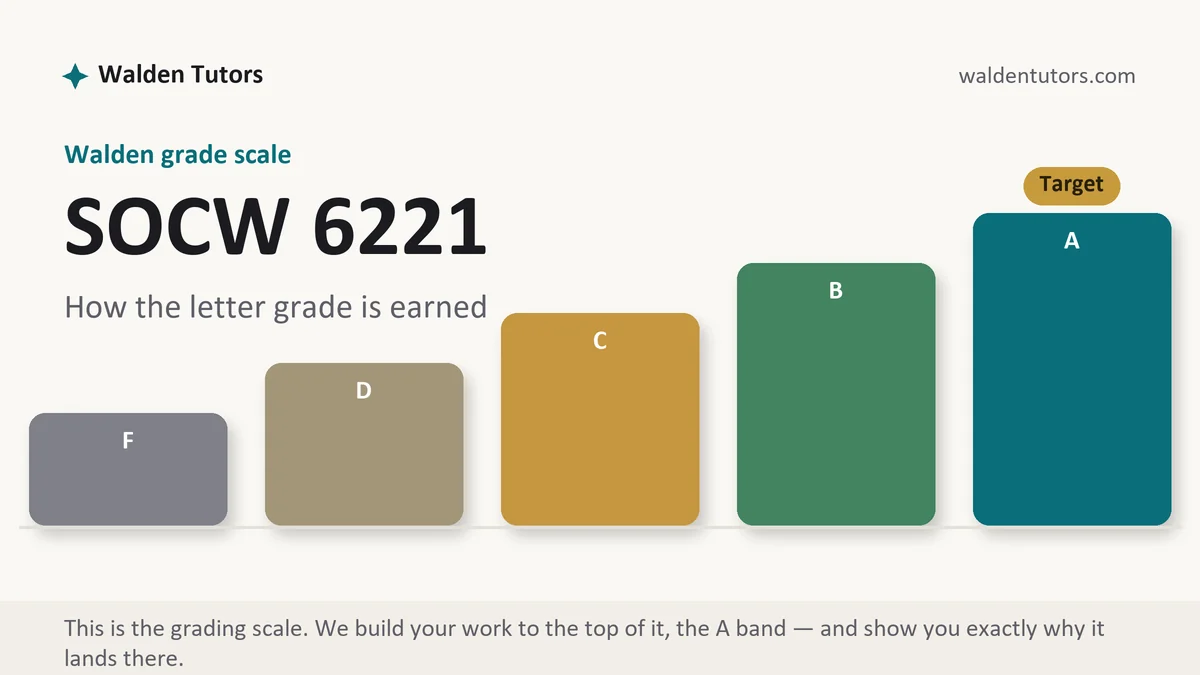
What SOCW 6221 actually grades
The writing here is proposal writing rather than case writing, and that shift catches people. You are typically asked to select a community-level problem, assess the community it sits in, trace the problem back to the systems and institutions maintaining it, then design an intervention with stakeholders, money and an evaluation attached. Discussions run alongside and usually push on the political or ethical edge of that work. What the rows keep rewarding is specificity plus causation. Naming a problem earns a little. Naming the policy, the funding formula or the institutional practice that keeps producing it earns the section. Which deliverables land in which week is set by your classroom, so let the syllabus and the announcements govern your planning.
The catalog gives a credit value and declines to say whether the term is a quarter or a semester. That silence is not an oversight on our part: which schedule applies turns on the build of the program you entered, and your student portal is the one place holding your actual dates. The daily rhythm does not vary either way: submissions close at 10:59 p.m. Central, the same instant as 11:59 p.m. Eastern, and your final mark is a letter assembled row by row from the rubrics rather than a single overall impression.
How we help in this course
Macro drafts from our desk arrive with real institutions named, real funders identified, and a causal chain a reader can follow from the policy to the household. That is the part students find hardest to produce under deadline, and it is the part the rubric weights most heavily. Send the prompt with the rubric attached and the draft is back within 24 to 48 hours, targeted at the top band of each row.
Every file passes two people who did not write it. The first grades it against your own rubric; the second checks sourcing, APA and originality. Revision is included until the draft does what you needed it to do.
Weekly manuals for this course
Every week-by-week 6221 schedule circulating online was reconstructed by somebody who never opened the syllabus. Walden does not release its social work syllabi publicly, and a guess about a due date is worse than no information at all, so this page prints none. Manuals appear as verified weeks arrive, and none for this course has arrived yet. Tell the chat desk which week you are working and you will hear back the same day about coverage. Drafting support for any week is already open.
Community assessment or intervention plan due?
Give us the prompt, the rubric and the community. Your first premium draft is on us.
What it hands to your advanced practicum
Clinical students often treat a macro course as a detour from the work they came to do. It is closer to the opposite. Walden's advanced field education requirements include a completed specialization or elective alongside the practice sequence, and placements routinely hand students exactly the tasks this course rehearses: a grant section, a program evaluation, a policy summary for a board, an argument for why a service should exist. Students who arrive already able to read a budget document and name a funder get given interesting work. Students who cannot get given intake forms. Keep the community assessment you write here, because a placement supervisor will ask for something very like it inside your first month.
A macro week on the desk
The recurring pattern is one discussion plus one build stage of the larger proposal, and they share their research, so we run them together. What comes back has the institutions named, the data cited to its source, the funding routes checked for current eligibility, and a mapping note pairing every heading with the row it answers. Include an earlier assignment of yours and the draft picks up your sentence rhythm, which cuts personalization down to a short pass rather than a rewrite.
Try one community assessment free
The free sample works best on the largest thing you are afraid of, and in this course that is usually the assessment or the intervention proposal. Send the instructions and the rubric, name the community, and read the returned draft with the rubric beside you before any payment enters the conversation. If the institutions in it are real and the funding is plausible, you already know how the rest of the term goes. Ask about the seasonal rate before the first paid week is invoiced.
How to actually write SOCW 6221: where to begin
Begin by shrinking the problem until it has an address. Most failed macro papers fail in the first paragraph, where the student announces an intention to address homelessness, or the opioid crisis, or educational inequity, at a scale nobody could design an intervention for. Cut it down along three axes: a defined population, a defined geography, and a defined mechanism. Youth aging out of foster care in one county without stable housing within six months. Now every later section has something to bite on, because you can count that population, name the agencies serving it, and find the money attached to it.
Second, split assessment from advocacy in your own head before you write either. Assessment is the section where you find out what is true, including the parts that undercut the intervention you were hoping to propose. Advocacy is the section where you argue. Students who start advocating in the assessment produce a document that reads as a pitch, and graders discount pitches. Let the assessment include what already works, who is already doing it, and what has been tried here and failed, because a proposal that ignores a failed predecessor invites the obvious question and answers it badly.
Third, do the root-cause work as a chain rather than a label. Naming structural racism, poverty or underfunding is the beginning of the analysis, not the whole of it. The chain looks like this: a specific policy or institutional practice, which produces a specific decision, which produces a specific outcome for a specific group. Zoning that forbids multifamily construction, so new units get built elsewhere, so the wait for a subsidized unit runs years, so families cycle through motels. Each link is checkable and each link is a place an intervention could cut in. Where the outcomes fall unequally by race, say what mechanism produces that pattern, because a paper that reports a disparity without explaining it has described the problem twice instead of analyzing it once.
Fourth, write a thesis that commits to a change and a lever. Something like: this outcome persists in this place because of this institutional practice, and it can be shifted by this intervention operating through this lever. Levers are worth naming plainly, since there are only a handful: money, rules, capacity, coalition, information and access. A proposal that cannot say which lever it pulls is usually a proposal to raise awareness, and awareness is not an intervention. It is a step some interventions include.
Finally, source like an analyst rather than an essayist. Peer-reviewed literature from the Walden Library carries claims about what works and why. Government and agency publications carry the eligibility rules, the budget figures and the program facts, cited to the issuing body with the year of the edition you actually read. Community-produced reports, local journalism and public testimony carry the lived detail that makes a plan sound like it belongs somewhere. Synthesis in this course means putting those three kinds in conversation inside one paragraph: the literature says this generally, the local data shows this specifically, the residents describe this experience of it. Where they disagree, say so and explain the gap, because that gap is often the most interesting finding in the paper. APA 7 applies throughout, and the Walden Writing Center holds the templates and reference examples that make the formatting row a cheap win.
| Section | What it does | Common failure |
|---|---|---|
| Problem statement | Defines the population, the place and the measurable condition being addressed. | A national problem announced at a scale no proposal could act on. |
| Community profile | Describes the setting with data, including who lives there and what already exists. | Demographics pasted in as a block and never used again anywhere in the paper. |
| Assets and existing capacity | Names the organizations, networks and strengths the intervention can build from. | A deficit-only portrait that treats the community as a container of problems. |
| Root cause and systems analysis | Traces the outcome back through institutional practice and policy to a mechanism. | A structural label supplied instead of a causal chain anyone could follow. |
| Disproportionate impact | Shows who carries the burden unequally and identifies what produces that pattern. | A disparity reported as a statistic with no explanation of how it came about. |
| Intervention design | Sets out activities, participants, sequence and the lever the change works through. | Awareness raising presented as the intervention rather than as one component of it. |
| Stakeholders and coalition | Maps who gains, who resists, who decides and who has to be at the table. | A list of allies with no opposition named, as though nobody benefits from the status quo. |
| Funding and sustainability | Names plausible sources, the size of the ask, and what happens after the first grant. | A budget with no funder, or a funder that has never given at anything like that scale. |
| Evaluation | States what would count as success and how it would be measured and by whom. | Success defined as the activity happening rather than as something changing. |
Discussion-post craft in a macro course
Macro discussions invite generality and the rows punish it. Anchor your initial post to one place and one mechanism, even when the prompt is framed nationally, because a concrete example is what allows an argument to be evaluated. Take a position, support it with a source cited inside the sentence that needs it, and acknowledge the cost your position carries, since every macro choice moves resources away from something else. Short and specific outperforms long and sweeping on every row here.
The reply is scored on its own and it is not a place for endorsement. The moves that pay are structural: name the stakeholder your colleague's plan would antagonize, ask who pays for year two, or point out that the outcome they measure would improve even if nothing changed for residents. Walden asks students to log in and post an assignment or discussion during the opening week of the term, and its grading policy calls for participation that is substantive and consistent, recommending posts distributed across two to four days of the week rather than stacked into one session. Because requirements differ between courses and even between weeks inside one course, treat your classroom instructions as the authority on how many replies count and when they close.
Citations and APA the way Walden grades them
Macro papers cite a wider range of document types than clinical ones, and that is where the formatting row gets lost. Agency reports, statutes, budget documents, foundation grant guidelines and community needs assessments each have their own reference pattern in APA 7, and all of them are cited to the organization as author when no individual is named, with the year of the specific version you consulted. Data pulled from a public dataset is cited to the dataset, not to the news story that mentioned it. Reconcile the two at the end, since a stray entry costs you as much as a missing one.
Currency matters more here than in most courses. Eligibility rules, award amounts and program availability all change, and a proposal resting on a grant program that closed two years ago collapses under one question in the discussion. Check the date on everything financial or regulatory before you build a section on it. Give each source a defined role, place the citation inside the claim it supports, and avoid the long parenthetical stack at a paragraph's end, which signals padding rather than depth to anyone reading with a rubric.
The mistakes that cost points in SOCW 6221
- A problem scoped so broadly that no intervention described afterwards could plausibly touch it.
- Community described entirely through deficits, with no existing organization, network or strength named.
- Root causes announced as labels, so the paper asserts a structural explanation without tracing one.
- An intervention with no funding route, or a budget attached to a funder that has never made an award that size.
- Stakeholder analysis that lists supporters only, leaving the reader to wonder who is defending the current arrangement.
- Evaluation written as counting activities, so the plan could be judged successful while nothing improved for anyone.
- Cultural humility claimed in a sentence but absent from the design, where residents advise and somebody else decides.
SOCW 6221 questions students actually ask
How narrow does the community have to be?
Narrow enough that you could name the streets, the agencies and the funders, and no narrower than that. A county is usually workable, a neighborhood or a school catchment is better, and a state is almost always too wide to say anything specific about assets or institutions. The test is whether your intervention could actually be delivered where you say it would be delivered. If the plan would read identically for three different cities, the community you picked is not doing any work in the paper and the specificity rows will show it.
Where do I find funding sources I can actually name?
Four places, in roughly this order of ease. Federal and state agency grant listings, which publish eligibility and award ranges openly. Community foundations serving your area, which post recent grantee lists showing who they already fund and at what size. Larger nonprofits in the same field, whose annual reports name their own funders. And local government budget documents, where line items for social services are public record. Cite each one to the issuing body with the year of the document you read, and match the ask to what that funder has historically given rather than to what your program would ideally cost.
How do I write about a community I am not part of?
Carefully, and with the limits stated rather than hidden. Say early who you are in relation to this community and what that position lets you see or miss. Then let residents and local organizations speak through your sources instead of speaking for them: community-produced reports, local news, testimony, published needs assessments run by people who live there. Build participation into the intervention itself, so residents hold decision-making roles and not only advisory ones. Cultural humility is graded as a practice in this course, and the practice is visible when your plan gives away power rather than merely acknowledging that power exists.