Social Work Practice Research I is cataloged as SOCW 6301 and carries 5 credits. Walden describes it as the first of a two-course pair, and the catalog backs that up twice over: on the traditional MSW track SOCW 6311 lists this course among its prerequisites, and Social Work Field Education II lists it too. That makes 6301 a gate rather than a hurdle, and it is worth writing the proposal properly the first time because you will be building on it next term.
What SOCW 6301 actually grades
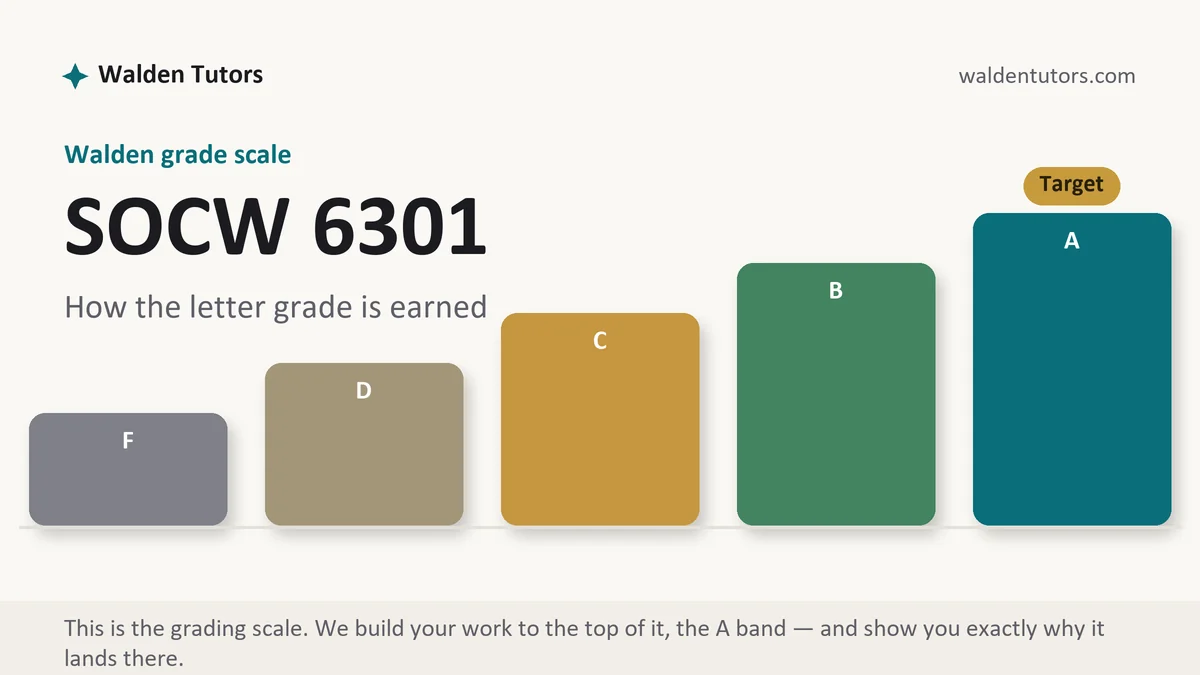
This is a foundation research course, which in practice means you are graded on reading published studies accurately and on assembling a proposal in stages. Expect discussions where a method or an ethical question gets argued, article critiques or annotated entries where you have to say what a study did and how well it did it, and then a proposal that grows section by section across the term until it stands as one document. The rows reward precision above enthusiasm. A paragraph that reports a study's design, sample and limitation correctly outscores a paragraph that praises the study warmly. Which pieces are due in which week is your classroom's decision, so read the syllabus rather than a schedule someone posted online.
Nothing in the catalog entry says how long the term runs. Some social work builds sit on quarters and others on semesters, so read your own start and end dates off the student portal instead of borrowing the pattern a classmate describes. What holds either way is the nightly cutoff, 10:59 p.m. Central and 11:59 p.m. Eastern, and the fact that your final mark is a letter built out of rubric rows, which is why a strong proposal with an empty ethics section still loses.
How we help in this course
Tutoring reviews student-authored research proposals the way a reviewer reads them: question first, design chosen because it answers that question, sampling and measurement that match the design, and ethics that engage the actual risk. Feedback checks whether synthesis preserves real disagreement in the literature. Send the live rubric and your current stage for criterion-mapped review; you remain the researcher and author.
Two reviewers see the file after the writer does. One works through your rubric row by row, the other verifies every citation resolves to a real source and checks the formatting and originality. If it is not where you want it, the next version costs nothing.
Weekly manuals for this course
The honest answer about 6301 week pages is that we do not have any yet. Anything you see elsewhere claiming to list the SOCW 6301 schedule was not taken from a syllabus, because Walden keeps those inside the classroom. We add a week here once the genuine materials for it have been checked. Bring your week to the chat desk and you will get a coverage answer the same day. Drafting is available for every stage of the proposal right now.
Proposal stage due this week?
Send the section, the rubric and your topic. The first premium draft is free.
The two doors this course opens
Most courses feed one thing. This one feeds two, and both are printed in Walden's own prerequisite lists. Social Work Practice Research II names SOCW 6301 in front of it on the traditional track, so the topic you choose now is the topic you carry into the advanced course, where you will be asked to apply research to practice rather than merely propose it. Field Education II names this course too, alongside the first field course, which means your placement progression is waiting on it. Students who treat 6301 as a box to tick tend to pick a topic they dislike and then live with it for two terms. Spend the extra hour on topic selection in week one and you buy back a great deal of misery later.
A research week on the desk
A typical week here pairs a discussion with one building block of the proposal, and because both usually rest on the same set of studies, we research them once and write them twice. Drafts come back with the studies characterized accurately, the design justified against the question rather than asserted, the reference list checked entry by entry, and a note pairing each heading to its rubric row. Send an earlier paper of yours and the draft comes back sounding like your writing rather than a methods textbook.
One free draft to check us
Take the free sample on the section you trust yourself least on, which for most students is either the literature review or the method. Send the instructions, the rubric and your topic, then read the returned draft against the rubric before deciding anything. Check whether the studies cited actually exist and actually say what the draft claims, because that is the fastest way to test any writing service. Whatever promotion is live that month comes off the first invoice.
How to actually write SOCW 6301: where to begin
Everything in this course descends from the question, so spend real time there before writing anything else. A usable practice research question has four visible parts: a population, an intervention or exposure, an outcome, and a setting. Compare a vague opening, does trauma therapy help veterans, with a workable one, among veterans receiving outpatient services at a rural clinic, is a brief trauma-focused group associated with lower reported avoidance at three months. The second version tells you what to search for, which design fits, who you would need to recruit, and what you would measure. The first tells you nothing and will quietly sabotage every later section.
Search like a researcher rather than a shopper. Inside the Walden Library, work in the social work and psychology databases with controlled vocabulary rather than typing your whole question into a single box. Set filters for peer review and a date range, then read abstracts to decide what to open rather than opening everything. Keep a running record of each study with six fields: purpose, design, sample, measures, findings, limitations. That record is the raw material for both the critiques and the review, and building it as you read costs nothing extra while rebuilding it later costs an evening.
Now the part that decides your grade. A literature review is an argument about a body of work, not a queue of study descriptions. Organize by theme, not by article. Each paragraph should open with a claim about the field, then bring in two or three studies as support, and close by saying what the claim leaves unresolved. Where the studies disagree, put the disagreement on the page and account for it, since different samples, different measures and different follow-up windows explain most contradictions in this literature. Then finish the review by naming the gap your question addresses, because that sentence is the hinge the whole proposal turns on.
Choose the design after the question and never the other way around. Questions about how much, how often or whether an effect exists point toward quantitative work. Questions about how something is experienced, why people leave a program, or what a process feels like from inside point toward qualitative work. Mixed methods answers both at once and costs twice as much to plan properly, so choose it only when you can say what each strand contributes. Then keep your vocabulary consistent with the choice: samples are recruited and variables are measured on one side, participants are selected and themes are developed on the other, and mixing those vocabularies is a reliable signal to a grader that the design was picked before the question was settled.
Write ethics as a real section rather than a formality. Name the specific risk your study creates for these participants, not risk in general: a client asked about their own treatment by a student who may hold power over their case, a survivor asked to recall an event, a small community where any published detail identifies someone. Then say what protects them, in order, informed consent that explains withdrawal, confidentiality with the storage arrangement described, and a plan for what happens if a participant becomes distressed. Add the cultural dimension in the same place, because who is invited, in what language, through which gatekeeper, is both a methods question and an ethics one. Our guide to Walden's review process covers what changes once a study stops being hypothetical.
Formatting is straightforward points and students still lose them. APA 7 governs the title page, the heading levels, the reference list and the tables. Walk the list against the text one entry at a time, since an uncited reference and an unlisted citation are equally cheap points to give away. Cite the study itself rather than a review that mentions it wherever you can get to the original, and never cite an abstract as though you had read the paper, since a grader who checks will find the design described in the abstract does not match what you claimed. The Walden Writing Center holds the template and the worked examples, and copying their formatting is faster than reconstructing it.
| Section | What it does | Common failure |
|---|---|---|
| Problem and practice relevance | Establishes that a real practice difficulty exists and that answering the question would change something. | A topic justified by personal interest alone, with no practice consequence attached to the answer. |
| Literature review | Argues about the state of the evidence, theme by theme, and lands on the gap. | A parade of study summaries in the order they were found, with no claim organizing any paragraph. |
| Research question | States population, intervention or exposure, outcome and setting in one answerable sentence. | A question so broad that no single study could ever answer it, which unbalances every later section. |
| Design and rationale | Names the approach and explains why it fits this question rather than another. | A design announced without justification, or chosen because it seemed the easiest to describe. |
| Participants and sampling | Fixes the boundary of the sample and the route to reaching it, including who is deliberately left out. | Recruitment described as though access were free, ignoring gatekeepers, consent and reachability. |
| Measurement or data collection | Specifies the instruments, interview approach or records used, and why they suit the outcome. | An outcome named but never operationalized, so nobody could tell whether it had changed. |
| Ethics and protections | Identifies the specific harm this study risks and the safeguards answering it. | A recital of consent and confidentiality with no risk from this study ever named. |
| Limitations | Concedes what the design cannot show and how that bounds any conclusion. | Limitations written as apology, or omitted entirely as if the proposal were flawless. |
Discussion-post craft in a research course
Research discussions reward exactness in a way practice discussions do not. When you describe a study, give its design, its sample and its main finding in one compact sentence before you evaluate it, because an evaluation of a study the reader cannot picture is worth nothing to the row. Take a clear position on the methodological question in the prompt, cite inside the sentence rather than at the paragraph's end, and name the specific feature of the study that supports your judgment.
Replies form a separate graded event and the productive move here is technical. Ask what the comparison group was. Point out that the measure captures something adjacent to the outcome rather than the outcome itself. Note that a small purposive sample cannot support the general claim your colleague drew from it. Walden expects students to log in and post a discussion or assignment within the first week of the term, and its grading policy asks for participation that is substantive and consistent, suggesting posts be spread over two to four days at minimum instead of arriving in a single burst. Requirements are not uniform across courses or even across weeks within one course, so follow the instructions in your own classroom on how many replies count and when the thread closes.
Citations and APA the way Walden grades them
In a research course the citation row is doing double duty, checking your formatting and checking your reading. Formatting means the Walden title page, headings in order, hanging indents, DOIs where they exist, and a list that matches the text exactly. Reading means the citation supports the claim actually being made. A study of adolescents cited for a claim about older adults is a formatting-clean error that a careful grader will still catch, and it costs more than a missing italic ever will.
Two specific habits are worth building now, because the advanced course assumes them. First, keep the reference entry the moment you use a source, rather than reconstructing the list at midnight from a folder of untitled downloads. Second, when you paraphrase, put the source away and write from your notes, then check back. Paraphrases written with the article open drift toward the original wording and land you in an originality conversation nobody enjoys. Quote sparingly and only when the exact phrasing is the point.
The mistakes that cost points in SOCW 6301
- A question with no population, no outcome or no setting, which leaves the method section with nothing to fit itself to.
- A literature review organized one paragraph per article, which the synthesis row reads as a reading list.
- Quantitative and qualitative vocabulary used interchangeably, signaling that the design was never really chosen.
- An outcome that is never operationalized, so the proposal cannot say how anyone would know whether it changed.
- Ethics reduced to the words consent and confidentiality with no risk specific to this study identified.
- Sources cited from abstracts or from other people's citations, which falls apart the moment a grader opens one.
- A topic chosen for convenience in week one and resented for the two terms that follow.
SOCW 6301 questions students actually ask
How do I choose a topic that will still work in the second research course?
Choose something a practicing social worker would actually need answered, and check that a body of published work already exists on it. Run three quick tests before committing. Search the library and see whether you find fifteen usable studies in twenty minutes; if you find four, the topic is too narrow or too new. Ask whether the answer would change what somebody does on Monday; if not, it is a curiosity rather than a practice question. And ask whether you could still stand reading about it in three months, because the second course builds on this one and a topic you resent becomes very heavy.
What is the difference between summarizing the literature and synthesizing it?
Look at what your paragraphs are organized around. If each paragraph is about one study, you are summarizing, no matter how well written the paragraphs are. If each paragraph is about one finding or one disagreement, with several studies appearing inside it as evidence, you are synthesizing. The practical fix is mechanical: build a grid with studies down the side and themes across the top, fill in the cells, then write one paragraph per column instead of one per row. Your citations end up clustered mid-paragraph, which is exactly what a grader looking for synthesis expects to see.
Does a proposal written for this course need IRB approval?
A proposal that stays on paper is not research being conducted, so students normally write one in this course without submitting anything for review. The moment you would recruit a participant, collect data, or use client records, that changes and the university's review process applies. Because expectations differ between classrooms and between assignments, confirm with your instructor before you approach anyone, and never gather data first and ask afterwards. The ethics section of your proposal should still be written as though the study were real, since that is what the row is scoring.