SOCW 6361 is Social Policy: Analysis and Advocacy, a 5-credit MSW course carrying SOCW 6351 and SOCW 6510 as its listed prerequisites, and what it grades is applied strategy rather than commentary. The choice that quietly wrecks the project is aiming an advocacy plan at a cause instead of at a person who can say yes. Raising awareness of food insecurity is not a target. Persuading a named county board to change one eligibility rule at its next budget vote is.
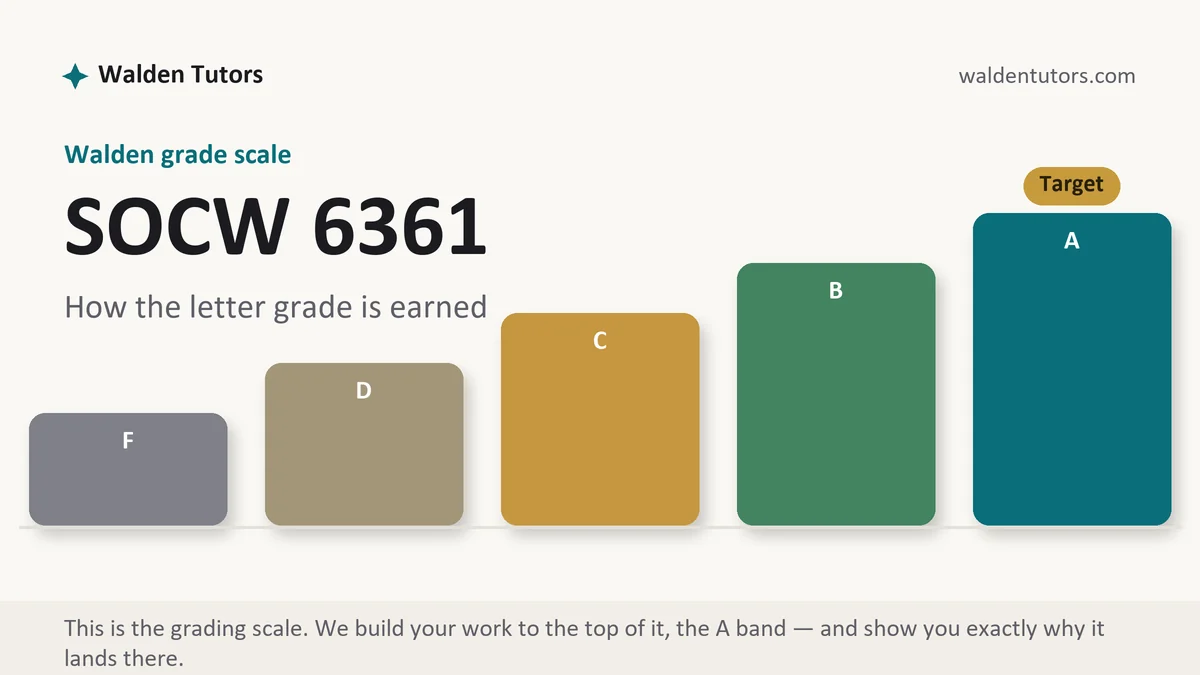
What SOCW 6361 actually grades
The catalog description frames this course around building on practice skills to advocate for systemic change: you identify a social problem, examine the policies attached to it, assess possible solutions for vulnerable populations, and construct an advocacy platform using current tools to move colleagues and community members. So the graded object is not an essay about a problem. It is a piece of applied strategy, argued from analysis.
Expect written work that carries two halves in one document. The analytic half applies a framework to an existing policy and reaches a judgment. The advocacy half turns that judgment into a plan with an audience, a message, and a sequence. Graded discussion threads run alongside, usually about a problem area or a campaign tactic. Walden keeps its syllabi inside the classroom rather than publishing them, so the assignment list and its order come from your course shell.
What distinguishes a strong submission is that the two halves stay connected. When the analysis identifies a specific defect and the plan asks for a specific repair, the rubric rows line up almost automatically. When the analysis criticizes a whole program and the plan proposes a social media campaign, the reader cannot tell what would change if the campaign succeeded.
How we help in this course
Advocacy drafts begin with three items: the assignment brief, the scoring rubric, and the problem you intend to work on. You get back a document where the analysis and the plan are built to fit each other. If your instructor assigned a particular analysis framework, name it in the order and the draft applies that one rather than a generic template.
Terms are identical to every other course on this site. Drafts return in 24 to 48 hours, they are written against the rubric rows with an A as the objective, two reviewers examine the work separately before delivery, and revisions continue free of charge until it scores where it should.
Weekly manuals for this course
SOCW 6361 week manuals are published one by one, as each week gets verified rather than assumed. If the week you are working on has not appeared yet, message the details through chat and you will have a scope and a price the same day. Nothing in the drafting queue is held up waiting for a manual.
In SOCW 6361 right now?
Name the problem, attach the rubric, and say whether the plan is a proposal or a live campaign. First sample free.
The ask, not the cause
Advocacy assignments reward precision in an area where passion is easy and precision is rare. An ask has four parts a grader can check: who decides, what exactly you want them to do, when the decision window opens, and what you will offer or show them to make yes easier than no. A cause has none of those. Students arrive at this course with real commitments built from real caseloads, and the commitment is an asset, but the paper only converts it into points once it names a decision maker with the authority to grant the request.
Timing deserves the same discipline. Legislative and budget cycles have windows, and a request that arrives after a budget is adopted has to wait a year regardless of how good the argument was. Your own term has a clock too. Some programs at this university sit on quarter terms and others on semester terms; where the MSW falls is not stated in any public source we can send you to, so treat the student portal as the only authority on your own dates. Whatever the term turns out to be, the deadline itself does not move: 10:59 at night measured in Central time, 11:59 for anyone whose clock says Eastern.
How to actually write SOCW 6361: where to begin
Start from the rubric and treat it as the assignment's real table of contents. In an advocacy project the scored rows almost always split between analysis quality and plan feasibility, and students who love one half tend to starve the other. Lay the rows out as headings, write the point value next to each, and check the balance before you have written a word, because a plan section carrying a large share of the score cannot be two paragraphs tacked on at the end.
Define the problem in a way that already implies a lever. There is a difference between saying a population lacks stable housing and saying that a local voucher program loses applicants at a documentation step that requires an in-person appointment during working hours. The first invites sympathy, the second invites a change. Bring numbers, and bring them from the body that produced them: agency data, government surveys, program reports, peer-reviewed studies. A problem statement grounded in evidence sets up every row that follows.
Apply your analysis framework strictly. Whichever set of analytic questions your course assigns, cite it and run every policy through it in the same order, covering the stated goals, who is eligible and who is excluded, how the benefit is delivered, how it is financed, what effects the research reports, and how the design sits against social work values. Consistency is what lets you compare two policy options honestly. When the framework produces an uncomfortable result for the option you prefer, print it anyway; the rubric can tell the difference between analysis and advertising.
Map the people before you write the message. List everyone with a stake, then sort them by two things: how much the decision affects them and how much influence they hold over it. That sorting produces your allies, your persuadable middle, your opposition, and, most usefully, the people who are heavily affected and hold little power, whose participation is the ethical center of social work advocacy. Say how you will bring their voice into the campaign as participants rather than as case studies, because speaking about a population without them is the failure this course exists to prevent.
Then build the platform. Your core message needs one sentence stating the problem, one stating the ask, and one stating what happens if nothing changes, in language a person outside the field can repeat accurately. Tailor the supporting material to each audience: a decision maker wants cost and constituency, a coalition partner wants alignment and workload, the public wants a story with a person in it. Choose channels you could actually staff, whether that is a hearing testimony, a briefing sheet, a coordinated email push, a local news pitch, or an organized social campaign. Two channels executed well beat six listed in a table nobody could run.
Close by saying how you would know it worked. Advocacy plans lose their final rows when success is left undefined, so name a short-term indicator, such as a meeting secured or a co-sponsor recruited, and the outcome indicator that matters, which is the rule actually changing. State what you would do if the ask is refused, since a plan with a second move reads as strategy and a plan without one reads as a hope.
| Section | What it does | Where it usually fails |
|---|---|---|
| Problem definition | States the condition with sourced data and frames it so a specific decision could improve it. | Framed so broadly that no single decision maker could act on it, which leaves the plan aimless. |
| Policy analysis | Runs the existing policy through a named framework and reaches a judgment about its design. | The framework is named once and then abandoned, so the analysis becomes an opinion essay. |
| Options compared | Weighs at least two realistic alternatives on the same criteria, including cost and equity. | One preferred option described at length with a token alternative dismissed in a sentence. |
| Stakeholder and power map | Identifies who decides, who influences, who is affected, and where each of them stands. | A list of organizations with no indication of their position or their pull on the decision. |
| The advocacy plan | Names the target, the ask, the messages, the channels, the timeline, and the resources needed. | Awareness raising with no request attached, so nothing about the plan can succeed or fail. |
| Ethics and evaluation | Addresses professional obligations, participation of affected people, and how success is measured. | Bolted on as a closing paragraph rather than shaping the plan it is supposed to govern. |
Discussion posts that actually earn the points
Advocacy threads tempt everyone toward declarations, and declarations score poorly. The initial posts that earn full marks bring something usable into the room: a tactic that worked somewhere with a source attached, a barrier the writer hit in their own community, a piece of the political arithmetic that shows why a popular proposal keeps stalling. Cite even short factual claims, because a thread about what governments should do fills quickly with assertions and the rubric is looking for the post that is grounded.
Responses carry their own scored row, and in a policy thread the useful reply is the one that tests the plan. Ask who signs off. Point out the group that would resist and why their objection is not unreasonable. Suggest a channel that fits the writer's setting better than the one they picked. Keep the exchange about strategy rather than about the classmate's politics, which is both the professional standard and the safer route through a row that grades tone. Walden asks for participation that is regular and substantive rather than compressed into one sitting, recommending posts spread over two to four days, while the number of replies and the closing day are set by your own classroom.
Citations and APA the way Walden grades them
An advocacy paper mixes source types more than almost anything else you will write in the MSW, and APA 7 has a specific shape for each. Legislative material, agency reports, organizational publications, data tables, and journal articles all sit in one reference list, and formatting them consistently is a visible competence signal. Where a document has no personal author, the issuing body takes the author position. Keep report numbers where they exist, and link to the document rather than to a portal search.
Watch the balance of your sources. Advocacy organizations produce excellent material and they also have positions, so pair them with independent research or government data whenever you make an empirical claim. Route the scholarly half through the Walden Library, where the full text sits behind the citation you are about to write, and use the Writing Center for the mechanical parts of APA 7 that a grader checks quickly and marks without discussion.
The mistakes that cost points in SOCW 6361
- An advocacy goal written as awareness, which cannot be granted, refused, or evaluated by anyone.
- A target chosen without checking who actually holds the authority, so the plan lobbies a body that cannot change the rule.
- Analysis and plan that never touch, where the defect identified in one half is not the thing the other half asks to fix.
- Affected communities described as beneficiaries throughout and never given a role in the campaign itself.
- A timeline that ignores budget and legislative cycles, proposing action in a month when no decision is available.
- Opposition presented as uninformed rather than as holding interests, which makes the strategy section unusable.
SOCW 6361 questions students actually ask
Can I build the advocacy project around my own workplace?
Often yes, and an organizational policy is a legitimate target when the assignment allows one. Two cautions apply. Keep every client detail out, since the confidentiality standard that governs your field writing governs this too, and describe the practice pattern rather than the people it happened to. Second, be careful about naming your employer in a submitted document that argues its rules are harmful. Describe the agency by type and size instead, which protects you and costs the analysis nothing at all.
Does the advocacy plan have to be something I will really do?
Check your own prompt, because some versions ask for a proposal and some ask you to run a piece of it. Either way, write it as though it were real. A plan with an actual decision maker, a resource estimate you could defend, and a timeline that respects how slowly public bodies move will score better than an ambitious campaign that could never be staffed. Feasibility is a graded quality in advocacy assignments, not a limitation on your imagination.
What counts as a policy analysis framework?
A framework is just a fixed set of questions applied in the same order to any policy, which is what makes two policies comparable. Social work versions typically ask about the social problem and its definition, the goals the policy states, who is eligible and who is left out, how benefits are delivered and financed, what the evidence says about effects, and how the policy sits against professional values and social justice. Use whichever framework your course assigns and use it consistently, naming the framework and citing its source. Inventing your own categories midway through is where analyses lose their structure rows.