Walden lists SOCW 6520 as Social Work Field Education III at 3 credits, and it belongs to the advanced practice year: 250 hours in an approved social services agency at roughly 20 to 24 hours a week, professional social work supervision, plus a seminar running beside the placement. What decides the mark is usually settled on the first screen a grader reads. Open with a client system nobody can picture, or an approach you never say you chose, and the remaining pages spend themselves catching up.
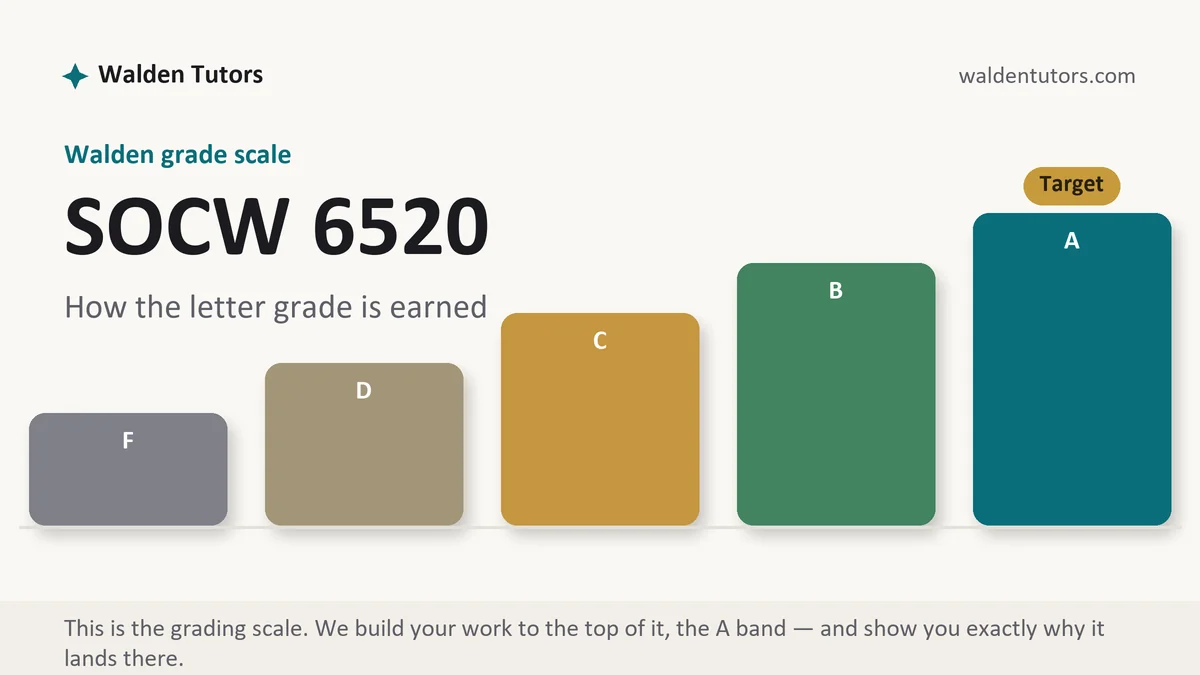
What SOCW 6520 actually grades
The catalog description is unusually specific about the intellectual work. Alongside the 250 placement hours, this course expects practice with diverse populations and with groups that have been marginalized or oppressed, clinical work with the client system, advocacy aimed at well-being and at social and economic justice, and a critical reading of intervention research so that the approach you use is one you selected and can defend. The seminar exists to force the classroom material and the agency material into contact with each other.
None of those hours are graded directly. Your mark comes from the documents the placement generates: intervention rationales, practice write-ups, advocacy and systems analysis, competency-linked reflections, seminar threads, and the log of hours and supervision. Which submissions arrive and in what order is set by your classroom and by the MSW field education manual your program issues, and since Walden does not publish course syllabi openly, those two documents outrank anything you read here about sequence or due dates.
Two rows tend to carry more weight than students plan for. One asks whether the intervention was chosen against evidence instead of inherited from the agency without comment. The other asks whether justice and advocacy appear as something that happened in this case rather than as a paragraph of values near the end.
On the calendar, this page will not guess. Walden operates quarter terms in some degrees and semester terms in others, and which one governs your MSW enrollment is not something we can point at a published source to settle, so pull the term length and the end date from your student portal. The pacing the catalog does give you, 20 to 24 hours a week, works out to somewhere between about ten and a half and twelve and a half weeks of attendance for 250 hours. Treat that as arithmetic off their figures, not as a term length Walden published.
How we help in this course
Advanced-year field writing is built out of material only you have, so an order here begins with whatever de-identified notes, assessments, and agency context you are willing to hand over. The more of your own case detail arrives, the less generic the draft is, and the closer the register sits to how you already write. Send the assignment file and the rubric with it.
Service terms are the same across this site. Work comes back within 24 to 48 hours, written against each scored row separately and pitched at an A, with a second reviewer checking the first before delivery and free revisions until the grade lands where you wanted it. Nothing you send reaches your agency, your field liaison, or the university.
Weekly manuals for this course
Individual week manuals for SOCW 6520 publish one at a time, as each week is confirmed, which means the set is incomplete by design rather than by neglect. If the submission in front of you has no manual yet, paste the instructions into chat and a tutor will scope it the same day. Drafting does not wait on the manual.
In SOCW 6520 right now?
Send the assignment, the rubric, and any de-identified case notes you have. The first field submission is free.
What a field grader takes in during the first thirty seconds
Someone marking a stack of advanced practicum submissions does not begin at word one and read to the end. They open the file and sweep it, and in about half a minute they have formed four judgments that color everything after. Is there a specific client system on this page, or a category. Is an intervention actually named. Does a citation appear anywhere near that naming. And has any identifying detail survived into a document that should not carry it.
You can win all four cheaply. Put the client system, the setting, and the presenting concern in the opening lines, using role descriptors rather than a story. Name the approach you used in plain words, early, before the section that defends it. Let one citation appear beside that first naming, so the evidence strand is visible from the top rather than gathered into a block near the references. And run the de-identification pass before you write, not after, because the sweep will catch a surviving name faster than it catches a weak argument.
How to actually write SOCW 6520: where to begin
Start from the scored rows and let them become your headings. Field paperwork looks administrative and is marked like an essay, and the rows carrying the highest weight in this course are nearly always the ones asking you to justify rather than to recount. Write the point value beside each heading before you draft a word, then hold the narrative sections to the space their weight earns. Description expands to fill whatever room you leave it.
Choose the client system with the assignment arc in mind. Advanced-year submissions want a case you can follow through selection, implementation, and consequence, which rules out the striking first encounter you never repeated. A person or family still on your calendar in the back half of the placement gives you something to write about three times. Where the agency's flow makes that impossible, and in some settings it genuinely is, write the constraint into the submission and describe how you worked around it. Naming a real limit is gradeable. Pretending to a continuity you did not have is not.
Now do the part the course is named for, which is the intervention reasoning. The catalog asks you to examine intervention research critically and then select, so a submission that reports what you did without saying why that and not something else has skipped the graded step. Work in three moves. First, state what the assessment concluded, in a sentence or two, because the choice has to answer something. Second, put candidate approaches side by side, with what the literature says each does for this concern and this population, and be honest where the evidence is thin or was generated on a group unlike your client. Third, choose, and give the reasons that decided it: the setting's mandate, the number of sessions available, the client's own preference, the fit between the model's demands and the person's circumstances.
Write implementation as sequence and adjustment, not as summary. What you did in session one, what you noticed, what you altered in session two because of it. Graders in the advanced year are looking for a student who is responsive rather than obedient to a manual, so the moment you changed something is worth more space than the moment everything went as planned. Record the client's response in their terms where you can, and separate what the client said, what you saw, and what you inferred, since running the three together turns a practice account into an opinion.
Then handle the justice and advocacy strand, which is where this course parts company with the earlier placement courses. Marginalization is not a topic to introduce in the abstract here; it is a set of forces that did something specific to this case. Find where power, income, immigration status, language, disability, race, or geography actually touched the work, and follow the consequence: a service withdrawn, a wait that outlasted the crisis, a form nobody could complete without help. Then put your own action beside it, including advocacy that failed. A request refused, documented with what you tried and what you would try next, scores better than an unbroken record of success nobody can verify.
Handle confidentiality before you draft rather than in a cleanup pass at the end. Use initials or roles, leave the agency unnamed, widen dates to the week, and generalize any detail that would identify someone in a small community even with no name attached. A rare diagnosis, an unusual job, a single-school town: any of those can identify a person on their own. Your field manual sets the standard you are held to, and it overrides whatever shorthand your placement uses internally.
| Section | What it does | Where it usually fails |
|---|---|---|
| Client system and setting | Establishes who the work is with, what the agency is funded to do, and how the case arrived. | A category in place of a person, or so much color that confidentiality is already compromised on page one. |
| Assessment summary | Compresses the earlier assessment into the specific conclusion the intervention is answering. | The full intake pasted forward, which buries the one finding the rest of the paper depends on. |
| Intervention research review | Weighs the candidate approaches against this concern, this population, and this setting. | A list of models with no comparison, or evidence quoted from studies conducted on an unlike group without saying so. |
| Selection and rationale | Commits to one approach and gives the reasons that decided it. | The agency's default reported as though it were a choice the student reasoned toward. |
| Implementation account | Tracks what happened session by session and what you adjusted in response. | A smooth summary with no adjustments, which reads as either fiction or inattention. |
| Advocacy and justice analysis | Names the structural forces acting on the case and records what you did about them. | Values language with no incident attached, or an incident named with no action recorded. |
| Supervision and next steps | Shows what you took to your field instructor and what changes as a result. | Reflections on personal growth where a supervisor needed a question they could answer. |
Seminar posts that actually earn the points
The seminar thread is scored on its own rubric and it carries the same confidentiality duty as a submitted file, so strip identifiers inside the post itself and describe a pattern wherever a particular would expose someone. Strong posts in the advanced year bring a decision rather than an anecdote: the approach you nearly used and rejected, the evidence that did not match the person sitting in front of you, the advocacy move that went nowhere. Put a citation in the post when you make a claim about what works, because a rubric row asking for evidence cannot credit a confident opinion.
Replies are marked separately and they reward the behavior of a colleague in supervision, not the behavior of a marker. You did not see that session, so avoid ruling on whether a peer practiced well. Better moves are available: offer a second reading of what the client's response might have meant, raise the population question their evidence does not cover, or say which piece of assessment information would change your own view. Walden's grading guidance asks for participation spread across the week and suggests two to four separate days as a minimum rather than one long sitting, while the number of replies and the closing day come from your own classroom. Course-Based deadlines fall at 10:59 p.m. Central, 11:59 p.m. Eastern.
Citations and APA the way Walden grades them
APA 7 shows up on these rubrics in two guises. The mechanical one wants the title page format Walden expects, correctly levelled headings, and a reference list where every entry has a partner in the text and no entry is stranded. The behavioral one is about where the sources came from: current, peer reviewed, and pulled from the Walden Library databases rather than assembled from open search results.
In this course the sourcing load sits mostly under the intervention argument. Every claim that an approach helps a given population needs a study behind it, and the study should be described accurately enough that a reader can see whether it transfers. Ethical reasoning rests on the NASW Code of Ethics. Policy and eligibility claims cite the body that issued the rule, whether that is a state plan, a funder's condition, or an agency manual. First person is correct throughout, because the practitioner making the decisions is exactly what the rubric is scoring, and passive constructions hide the actor the reader is looking for. Keep the encounter in past tense and the analysis in present, so the two stay visibly distinct. The Writing Center's templates settle formatting arguments faster than a grader will.
The mistakes that cost points in SOCW 6520
- An intervention reported rather than selected, with no sign the student considered anything else.
- Research cited for the model in general while nothing connects it to this client's circumstances.
- Diverse populations addressed as a sentence of respect instead of as something that changed the practice.
- An implementation section where nothing was ever adjusted, which no experienced reader believes.
- Advocacy claimed at the level of intention, with no request made, no document filed, and no outcome recorded.
- Client speech, student observation, and student inference blended into one paragraph a grader cannot take apart.
- Hours entered in a single retrospective session, which turns a routine audit into a conversation you cannot win.
SOCW 6520 questions students actually ask
How do I choose an intervention when my agency only uses one model?
Treat the agency model as a constraint you write about rather than a problem that ruins the assignment. The scored thinking is the comparison, so put two or three approaches the literature supports for this presenting concern beside one another, say what each would predict, and then explain why the setting permits one of them. Where the mandated model is a poor fit for the person in front of you, name the gap and describe what you adapted inside it: the pacing you slowed, the module you reordered, the cultural material you brought in. A student who defends a constrained choice honestly reads as a practitioner. A student who pretends the constraint did not exist reads as someone who did not notice it.
What counts as evidence that an intervention fits this particular client?
Two kinds, and the rows want both. The first is population and problem evidence: peer-reviewed work showing the approach has done something useful for people with this concern in a comparable setting, retrieved through the Walden Library rather than a search engine. The second is fit evidence drawn from your own assessment, which means naming the specific features of this person that make the approach plausible, such as the reading level the workbook demands, the transport the schedule assumes, or the family involvement the model expects. Studies alone leave the choice generic. Fit reasoning alone leaves it unsupported. Together they answer the row.
How much of the social justice strand belongs in a case-based submission?
As much as the case can carry, and no more than that. The catalog puts advocacy and economic justice inside this course for a reason, so a submission that never mentions how power, income, or exclusion touched the work is missing something the rubric asks about. The way to include it without drifting is to keep every sentence attached to a consequence you observed: the appointment that was unreachable without a car, the interpreter who was not booked, the eligibility rule that treated the client's income as too high. Then record what you did in response, even where the answer is that you raised it in supervision and were overruled. Description of injustice in general scores far below one traced instance of it with your action attached.