WMBA 4990 help and tutoring

WMBA 4990 · 0 sem cr ยท MBA foundation
The short answer

Business Essentials is the on-ramp Walden puts in front of its MBA, and it exists because business argument runs on a form of proof many incoming students have never had to produce: a figure with a traceable source behind it. Walden's catalog carries WMBA 4990 at zero semester credits and lists what it covers, from leadership and ethics through accounting, finance, economics, statistics, information systems, global business, marketing and strategy. What the classroom shell asks you to hand in is set inside the course itself.

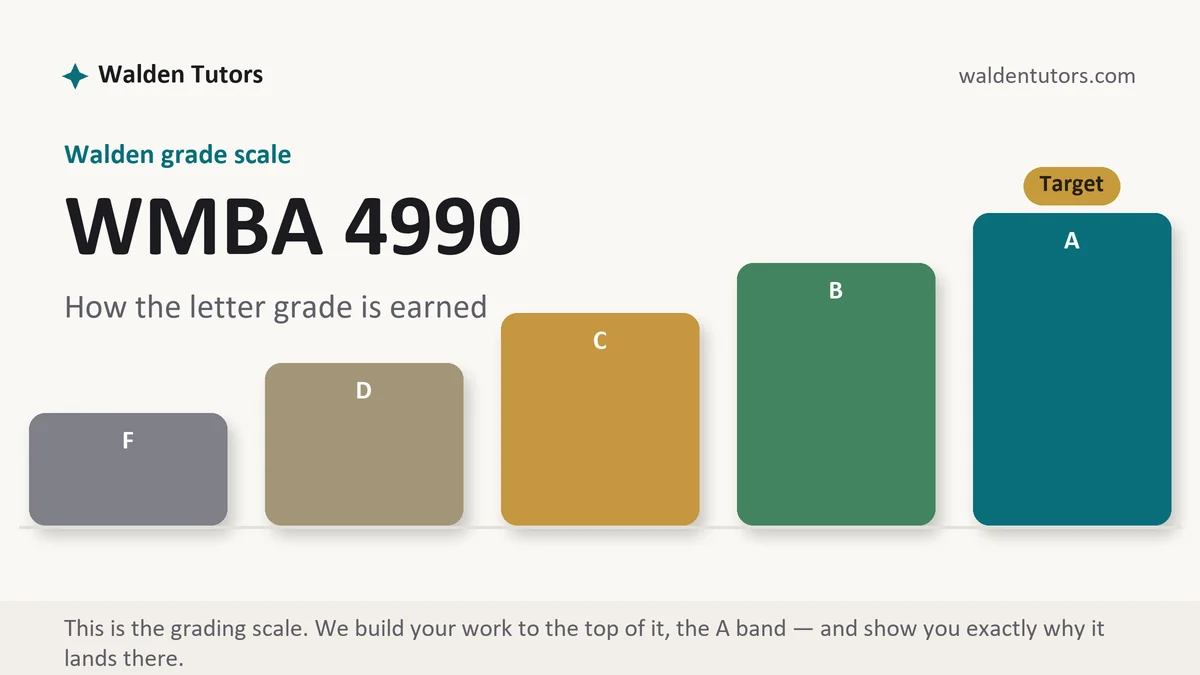
WMBA 4990 grading scale at Walden, how the work is graded, from Walden Tutors
How Walden grades WMBA 4990, visualized by Walden Tutors.

What WMBA 4990 covers, and what it counts for

Two things about this course are published and certain. The first is the credit value: zero. That is an arithmetic statement about your program total, not a comment on effort. The second is the scope, and Walden states it plainly enough to plan around. Business leadership and management, business ethics, the legal environment, accounting, finance, economics, quantitative methods and statistics, information systems management, global business, marketing and strategic management all sit inside the one shell.

Everything past that belongs to the classroom. Walden does not put the syllabus for this course on the public web, so the number of modules, the format of each check, the deadlines and the way completion gets recorded are visible only once the shell opens. Treat the grading page inside the course as the ruling document and treat anything you read elsewhere, including this page, as orientation. If your enrollment adviser attached conditions to the foundation requirement, those conditions come from Walden and not from a study site.

The reason to care is downstream. Later in the WMBA sequence, a professor writes contribution margin or working capital or regression into a prompt and moves on, because the foundation is assumed to have handled it. Wherever you feel a small flinch reading that sentence, you have found the module worth your weekend.

How we help in this course

Most of what people want here is not a ghost-written paper. It is a fast, patient explanation of one thing that will not sit still, usually a statement of cash flows or the difference between a fixed and a variable cost, plus somebody to check whether their understanding survives a question. We run that as tutoring: send the module, say where it stopped making sense, and get a worked explanation back with a small example you can rebuild yourself.

Where the shell does ask for written work, the usual machinery applies. A research analyst reads the requirement, a business writer with MBA credentials drafts it, one reviewer scores the draft against whatever the classroom is scoring, a second reviewer audits sourcing and originality, and delivery lands inside 24 to 48 hours with revisions until the target holds.

Weekly manuals for this course

Module-level manuals for this foundation course go public one at a time, as each is confirmed against a live classroom rather than guessed. Nothing invented gets posted. If the module you are stuck on has no manual yet, ask in chat and the desk will answer from what it has in front of it today.

Stuck in Business Essentials?

Tell us which functional area stopped you and we will explain it properly, with one worked example, at no cost the first time.

What counts as evidence once you are writing business

Ask a manager why a decision was right and you usually get a story. Ask an MBA rubric the same question and it wants a number, the place the number came from, and the reasoning that connects the two. This is the single largest adjustment most students make, and the foundation course is where it should happen, because from WMBA 6000 onward the graders assume it is finished. Evidence in this subject has three ordinary forms: a figure from a financial statement or an operating report, a finding from peer reviewed research, and a documented fact about a market or a regulation. An opinion held confidently by someone senior is not one of the three, however useful it was in the meeting.

Practice the habit while nothing is at stake. When a module hands you a chart, write one sentence saying what it shows and one saying what it does not, then look for the year and the publisher. When it hands you a term, write your own definition and a workplace example beside it. Those two-line notes are worth more than a highlighted textbook, because they are the exact move the graded courses will ask you to make at length.

How a foundation week runs at the desk

People arrive here in one of two states. Either the semester has not started and they want the on-ramp cleared before it does, which is the calm version, or the first graded course has already exposed a gap and the foundation is being worked in parallel with real deadlines, which is the common one. Both are fine. The second just needs sequencing, so we ask which graded assignment is nearest, cover the foundation material that assignment depends on first, and leave the rest for the gap between terms. Working adults do not have infinite evenings, and pretending otherwise is how study plans die in week three.

Try it on a single module

The free first sample fits an explanation as easily as an essay. Pick the module that has beaten you twice, send it with a line about what you already tried, and read what comes back before any money is involved. If it lands, the rest of the foundation is a scheduling problem rather than an academic one. If it does not, you have spent nothing to learn that.

How to actually work WMBA 4990: where to begin

Open the course and read the grading page before the content. It tells you what the shell wants back from you, and that answer shapes how you read everything else. If the checks are knowledge based, your job is retention and you should be building recall notes as you go. If the shell asks for written responses, your job includes structure and sourcing, and you should be collecting citations from the first module rather than reconstructing them at the end. Guessing between the two costs a week.

Then take an honest inventory. Write the eleven areas from the catalog description down the left of a page and score yourself one to five on each. Almost nobody scores evenly, and the pattern of your scores is your study plan. A five in marketing and a two in accounting means the accounting modules get your fresh morning hours and the marketing modules get whatever is left. Working through the areas in the order the shell presents them, at a uniform pace, is comfortable and wasteful.

Work the quantitative areas with a pen and real figures rather than by reading. Accounting, finance, economics and statistics are procedural subjects, and procedural subjects only stick when your hand has done the work. Take a small set of numbers, build the statement or the calculation yourself, then change one input and predict what moves before you check. Predicting and being wrong teaches more in ten minutes than an hour of watching a worked solution scroll past.

For the discursive areas, ethics, the legal environment, global business and strategy, do the opposite. Attach each concept to something you have actually seen. A conflict-of-interest policy you had to sign, a contract clause that caused an argument, a supplier in another country whose holidays wrecked your schedule. Concepts anchored to a memory survive; concepts anchored to a definition do not. This is also the raw material for the later graded courses, where prompts routinely ask for your own organization and the students who have collected examples along the way are the ones who write quickly.

Give the whole thing a fixed slot rather than a good intention. A foundation course with no grade attached loses every negotiation with a course that has one, so book the hours in a calendar and defend them the way you would defend a deadline. If your first graded semester has already begun, remember the register you are being built for: Walden's assignment clock closes at 10:59 p.m. Central, which is 11:59 p.m. Eastern, and the MBA runs on a semester of roughly sixteen weeks, three starts a year. Foundation work has to fit around that, not the other way round.

AreaWhat it does for the graded coursesCommon failure
AccountingGives you the three statements and the vocabulary every later finance and performance prompt assumes.Memorising the definition of an accrual without ever building a statement, so the terms return as strangers.
FinanceTurns money and time into something you can compare, which is what an investment recommendation needs.Treating the formulas as the subject, then being unable to say what a result means for the business.
EconomicsExplains why prices, demand and competitor behavior move, which is the backbone of any market argument.Reciting a curve rather than applying it to the one industry you will keep writing about.
Quantitative methods and statisticsLets you read someone else's data honestly and say how much confidence it deserves.Avoiding the module because of old maths anxiety, then hedging every numeric claim for the rest of the program.
Ethics and the legal environmentSupplies the frameworks graders expect when a scenario has a defensible answer and a comfortable one.Answering with personal morality where the assignment wanted a named framework applied step by step.
Marketing, strategy and global businessProvides the language for positioning, advantage and cross-border operating decisions.Collecting model names as trivia instead of testing one model against a real firm.

If the shell asks you to post

Where a foundation module includes a discussion, treat it as rehearsal for the graded ones rather than a formality. Walden's own guidance on participation asks for contributions that are substantive, consistent and on time, and it recommends spreading your presence across at least two days of the week, with three or four better than the minimum. Walden also says plainly that posting requirements differ between courses and even within a single course, so read the item in front of you instead of importing a rhythm from somewhere else.

A useful post in a foundation area does one small thing well: it takes a term from the module and shows it working somewhere real, then asks a question that is genuinely open. Replying is where the rehearsal pays. Add the piece of operational detail from your industry that the other person could not have known, or point at the assumption their example rests on. Agreement with a compliment attached teaches nobody anything, and by the time you reach a graded course it stops earning marks as well.

Sources and APA before it costs you

Learn the citation habit here, in the course where a slip costs nothing. Walden grades on APA 7 across the program, which means a title page, headings at their proper levels, author and year appearing inside the running text, and a reference list that reconciles in both directions with the body. The Walden Writing Center publishes the template and the current rules, it is already paid for inside your tuition, and one careful hour with it now removes a recurring irritation from every later week.

Get into the Walden Library at the same time. Business students who search the open web keep landing on vendor blogs and undated summaries, and the graded courses want peer reviewed work and current industry data instead. Learn two things: how to filter a business database by date and by peer review, and how to reach a librarian when a search comes back empty. Both take one sitting to learn and save many hours later. Give every source you keep a stated job, one sentence long, so the reference list never fills with material you have not read.

The mistakes that cost you later

  • Racing the foundation to reach the real courses sooner, then paying for the skipped module during a week with a graded deadline in it.
  • Reading the accounting and finance material passively, so nothing survives contact with a prompt that asks you to calculate anything.
  • Building no habit of writing down where a number came from, which becomes an evidence problem in every graded rubric afterwards.
  • Leaving the Walden Library and the Writing Center until an assignment forces the introduction, at the worst possible moment.
  • Assuming the areas you already work in need no attention, when the shell tests vocabulary and framing you may never have needed on the job.

WMBA 4990 questions students actually ask

Is a zero-credit course worth doing properly?

Zero semester credits describes what the course adds to your credit total. It says nothing about how much easier the rest of the MBA gets when you already read a balance sheet without flinching. Students who treat the foundation as a formality tend to meet the same material again in WMBA 6050 and WMBA 6070, where it is graded and where the pace does not pause for catch-up. Spend the hours here, where nothing is at stake, rather than there.

I have worked in business for years. Can I move quickly through it?

Probably through the areas you live in, and rarely through the ones you do not. A sales director usually flies through marketing and stalls at cost behavior; an accountant does the reverse. Read the module list first and grade yourself honestly against each area, then spend your time only where you scored yourself low. Speed is fine. Skipping the two areas you have quietly avoided for a decade is what causes trouble later.

How much mathematics does the quantitative material actually need?

Arithmetic, percentages, ratios and the reading of a table or chart carry most of it, plus enough statistical vocabulary that terms like mean, median, correlation and confidence do not stop you mid-paragraph. You are being prepared to interpret numbers other people produced and to defend a decision built on them. If arithmetic anxiety is the real obstacle, say so early, because it is far cheaper to fix in a foundation course than in a finance course with a deadline attached.

Keep going

Online now