In the MBA path, WMBA 6000, Dynamic Leadership, 3 sem cr · MBA opener, is where this page points its help. Take the rest of this page as the unvarnished version, course first and service second.
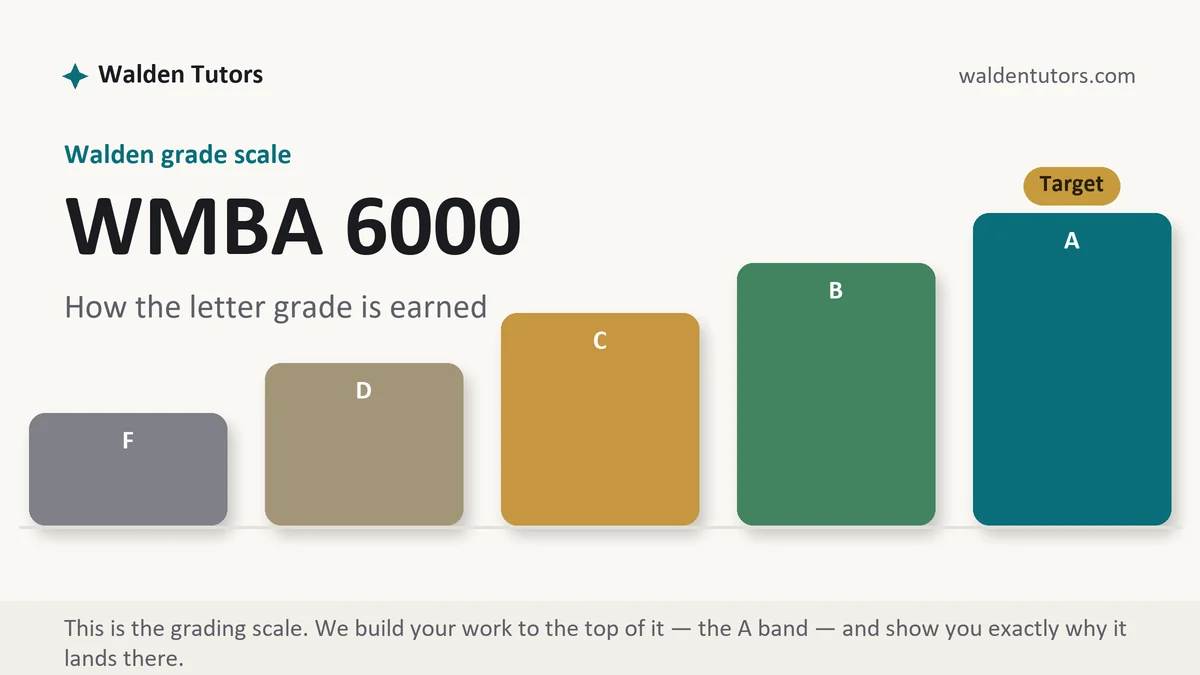
What WMBA 6000 actually grades
The MBA's first move: leadership instruments turned into a personal development case with evidence attached. The rubric wants candor with structure, strengths and gaps costed like business variables, and punishes the polished-resume tone managers default to.
How we help in this course
Send your instrument results and a sketch of your role; the draft returns as a development case with real teeth, reflective where required and concrete everywhere else. It sets the executive register the rest of the WMBA sequence keeps grading.
Ordering puts a small team on the assignment: an analyst to decode the rubric, a program-matched writer to draft, a QA reviewer working the rubric rows, and a separate check for APA and originality. The turnaround is 24 to 48 hours, and revisions continue until the target is met.
Weekly manuals for this course
As WMBA 6000's weekly deliverables verify, each gets a public manual. Whether a given week is up already is a question for chat, where the list stays current.
In WMBA 6000 right now?
Send the week or assignment and the rubric from Canvas. First premium sample free, back in 24 to 48 hours.
Candor is a rubric row here
The opener's instrument-based reflection grades a strange pair: honesty about your gaps and business discipline in how you cost them. The polished-resume voice managers default to is precisely what the rows deduct for, and the fix is structural, strengths and development areas treated as variables with evidence and a plan attached, not as adjectives. Drafts here are built on that structure, reflective exactly where the rubric requires and concrete everywhere else it allows. The graded move is treating each instrument result as data, named, interpreted, and costed against your actual role, which the polished tone avoids because the middle step feels risky.
Instrument results in, development case out
The intake is short: your leadership instrument results, a few lines about your actual role, and the rubric. What returns reads like a development case with stakes, your data argued rather than summarized, in the executive register the rest of the WMBA sequence keeps grading. Delivery runs the standard 24 to 48 hours with row-mapped notes you can reuse as a template for later courses. If your results arrive late, say so; the desk schedules around instrument timing the way it schedules around everything else, ahead of the clock.
Open the MBA with proof, not hope
First course, first sample, no cost: one deliverable drafted to the A standard so you can evaluate the bench before the program gets expensive. If the register fits, the weekly plan is ready behind it; if it does not, you found out for free, which is the correct price for finding out. Most WMBA clients decide here, one way or the other, and both outcomes are cheap.
How to actually write WMBA 6000: where to begin
Read the rubric first and the prompt second. Walden hangs the rubric on the week's item in the classroom, and it is the only document that decides your grade, so let the instructions fill in details after you know what is being scored. Copy each rubric row into a blank file and make it a heading. You now hold the outline, in the grader's order, with nothing left out. Then look at the points sitting beside each row and budget your words to match them. A row carrying a third of the total deserves roughly a third of your page count, and the instinct to write most about the part you personally find interesting is what leaves the heaviest row underfed.
The material this course runs on is you. Dynamic Leadership opens the MBA by asking you to take leadership self-assessment results, or a framework from the week's readings, and put them against a situation you have actually stood in. Pick that situation before you pick your words, and pick a small one. A single decision with a date, two stakeholders and a measurable outcome will carry a leadership analysis further than an eighteen-month reorganization, because a small case can be described completely inside the word limit and a large one cannot. Write out what happened, what you did, what it cost, and what the numbers looked like afterward. Those raw notes are the stock every rubric row draws from.
Then run the framework instead of describing it. Students who type WMBA6000 into a search bar the night before a deadline are usually stuck at the same place: they have summarized a leadership model competently, they have told a story about work, and the two sit in separate halves of the document with nothing joining them. The row that pays is the one where the model is used as an instrument on the case, its terms applied to behavior you have named, the fit argued and the misfit admitted. Executive readers, and the faculty grading you, want the analysis to land somewhere: a recommendation you would defend in front of the people it affects, with a first action, an owner, and a way to tell whether it worked.
| Section | What goes in it | What earns full rubric points |
|---|---|---|
| Opening frame | The situation, the leadership question it raises, and where the paper is going to land. | A position stated in the first paragraph, so the grader knows what the evidence is being spent on. |
| Evidence about yourself | Instrument results, feedback, or documented behavior, reported without editing. | Scores and quotes reproduced accurately, including the ones you would rather not print. |
| The framework applied | The model from the week's readings run across the case, term by term. | Each term of the model tested on named behavior, with the places it does not fit said out loud. |
| Development or action plan | What changes, who does it, by when, and how anyone will know it worked. | Actions costed and dated, each carrying a measure rather than an intention. |
| Sources and conventions | APA 7 citations, reference list, and the formatting the rubric asks for. | Every claim about leadership theory carried by a current source, worked into the sentence making the claim. |
Discussion posts that actually earn the points
Walden grades discussion as work, with its own rubric rows and its own dated deadlines, so a week where the paper is excellent and the thread is thin still loses marks. Build the initial post like a very short paper: a position in the first sentence, one piece of evidence from the readings, one from your own workplace, and a closing line that gives classmates something to push against. Stay inside the length the prompt sets, because sprawl reads as unedited rather than generous.
The response day is a separate graded event. Your classroom decides which day replies are due and how many are required, so check the week's item rather than carrying the pattern over from your last course. A substantive response is not agreement with decoration. Agreement adds nothing to a thread, and a grader reading forty of them can tell inside a sentence. Advancing a colleague's point means doing one of three things: bringing a source they did not have, applying their claim to a case where it breaks, or drawing the consequence they stopped short of. Name the person, quote the exact phrase you are answering, then add the thing only you could add, which in an MBA classroom is usually the operational detail from your own industry.
Citations and APA the way Walden grades them
Formatting is the cheapest thing on this page to get right and the most expensive habit to leave broken, because you will pay for it again every week of the program. Walden applies APA 7 to all of it: a title page, a scholarly voice held steady, headings sitting at their proper levels, author and year appearing in the running text, and a reference list that reconciles both ways against the body with nothing stranded on either side. The Walden Writing Center supplies the template and the current rules, it comes with your tuition, and one visit in week one settles the question permanently.
Source quality is the other half of the same rows. Reach for business scholarship inside the Walden Library instead of an open search engine, so what you cite is peer reviewed and current and so a librarian can step in when a search comes back empty. Then give every source a job: this article establishes the model, this study supplies the evidence linking it to turnover, this trade report supplies the industry numbers. A source without a job is padding, and padding is visible. Work the citation into the sentence that makes the claim, so the reader sees who said what while the argument is still moving, rather than finding a parenthesis parked after the paragraph has finished.
The mistakes that cost points in WMBA 6000
- Theory summarized in one half of the paper and a workplace story told in the other, with nothing joining them.
- Instrument results reported selectively, flattering scores quoted and uncomfortable ones dropped, which the reflection rows exist to catch.
- A development plan made of intentions, improve communication, be more strategic, with no action, no date and no measure attached.
- Leadership claims resting on consultant blog posts and airport paperbacks when the Walden Library holds peer reviewed work on the same question.
- A case so large that describing it consumes the word count the analysis needed.
WMBA 6000 questions students actually ask
How honest should I be about my weaknesses?
Honest and specific, but written as an analyst rather than a confessor. The rows reward development areas handled the way you would handle a variance in a budget: named, sized, traced to a cause, answered with a plan. Vague self-criticism scores no better than self-praise, because neither gives the grader anything to assess. Write that your last two project handovers slipped because you delegated late, not that you struggle with delegation.
Can I write about a job I no longer hold?
Yes, and it is often the better choice. Distance makes the analysis cleaner, and a closed situation has an outcome you can report. What the rubric needs is access to detail, so pick the role where you still remember the numbers, the sequence and the people well enough to be specific. If the only leadership situation you can describe at that depth came from a volunteer board or a family business, that works; the framework does not care where the organization sits.
How much of the week's reading has to show up in the assignment?
Enough that the grader can see you used it, which usually means the assigned framework appears by name and does real work in the analysis, alongside sources you found yourself. Reading the week's material and then writing entirely from experience is the most common way capable managers lose the evidence rows. Check what your week's rubric says about source count and currency, since that expectation moves between assignments and the row is the authority.