Managerial Finance is listed as WMBA 6070, three semester credits, and it sits behind two prerequisites, WMBA 6000 and WMBA 6050. Walden points the course at deploying money well: the analytic methods behind capital investment decisions, a critical look at traditional financial theory, and the stakeholder and ethical questions that ride alongside every funding choice. Load in this course is not flat. It piles up in the back half, where each analysis assumes the one before it, and the students who stay comfortable are the ones who banked reusable pieces while the term was still young.
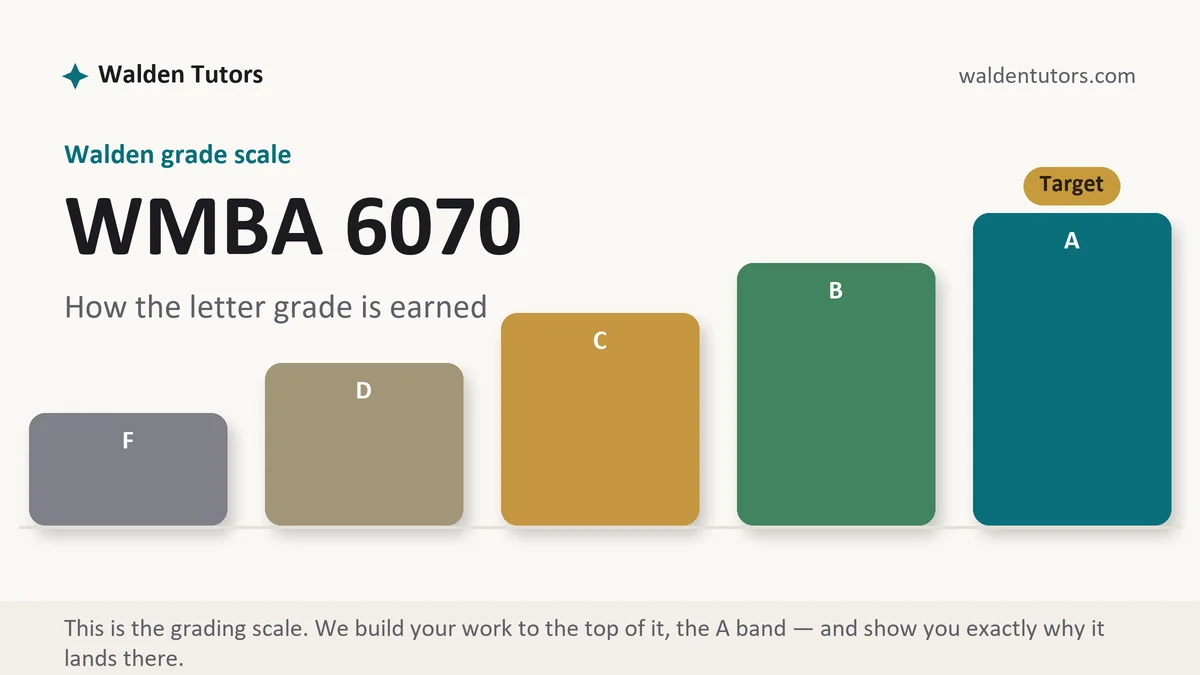
What WMBA 6070 actually grades
Walden's description names three things at once. First, the tools and analytic methods that make a capital investment decision defensible. Second, a critical reading of traditional financial theory rather than an obedient application of it. Third, the contemporary issues and techniques attached to sound and ethical decisions about money, with the interests of stakeholders held in view while the numbers are being run.
The graded output is a recommendation with its evidence bolted on. You get a project, an investment, a firm or a scenario, and you have to say what should be done and why the analysis supports it. Rows tend to fall into four families: whether the inputs were reasonable and stated, whether the method suited the question, whether the interpretation followed from the output, and whether the wider consequences were faced rather than waved at. A right answer with no visible reasoning scores worse here than a defensible answer that shows all of itself.
Everything totals into a letter grade assembled from those rows. The rows sit in the classroom next to the item, which means the standard you are being held to is readable before you write anything.
How we help in this course
We need three things: the assignment, the rubric hanging off it, and whatever case file, dataset or template the week came with. The draft returns with the analysis worked, the inputs declared, the method justified, and a recommendation that follows visibly from the output rather than sitting next to it.
Work comes back inside 24 to 48 hours. Two reviewers see it before you do, one marking it against the rows in the way your faculty member will, one checking sources, formatting and originality, and revision passes remain free until the draft reaches the agreed standard.
Weekly manuals for this course
Per-week manuals for WMBA 6070 are published one at a time, each after a live classroom has verified what that week actually contains. Walden holds its syllabi behind the student portal, so a published week grid that nobody had checked would simply be a fabrication. Where your week has no manual yet, send the item through chat and the desk works from what you were assigned.
Stuck on a WMBA 6070 capital budgeting item?
Send the assignment and the rubric from your classroom. The first premium sample is on us and lands within two days.
Where the WMBA 6070 workload spikes
The MBA is a semester program, which puts it on the longer of the two calendars Walden operates and well away from the quarter structure that governs the nursing side. Fall Semester 2026 appears on the academic calendar with a start of September 7 and an end of December 27, a stretch of 111 days. Seven days to the week makes that a little short of sixteen, and because the calendar page lists dates rather than week numbers, the week figure is a conclusion you drew instead of one the university stated.
Finance loads unevenly for a structural reason. Early items tend to be conceptual, and they take an evening. Later items are cumulative: a valuation that depends on a cost of capital you were supposed to have worked out, a recommendation that assumes you already built the cash flow schedule, a comparison that only works if you understood the earlier method. The moment two of those arrive in the same two weeks as a graded thread, the term stops feeling manageable, and by then there is no cheap way to catch up because the missing piece is understanding rather than hours.
The way ahead of it is to build assets in the quiet weeks. Make yourself one workbook that never gets thrown away: assumptions on a sheet of their own, a cash flow schedule that reads left to right in periods, and every rate typed once into a labeled cell the formulas point back at. Alongside it keep a running page where you restate each method in your own words the week you first meet it. Both compound in your favor later. Two fixed facts belong on the plan as well. Graded work shuts at 10:59 p.m. Central, the moment an Eastern clock shows 11:59 p.m., and the university treats showing up as a graded act in itself, since an assignment or a discussion post has to be on record before the opening week expires.
How to actually write WMBA 6070
Take the rubric out of the classroom before you take anything else, then stop reading it. The only thing it holds that the prompt does not is where the weight sits, so let the heaviest row have the longest section and spend the time you just saved on the analysis, which is where finance papers are genuinely won and lost.
Now settle what decision is on the table. Finance items usually reduce to one of a small set: accept or reject this project, choose between competing projects, decide how to fund something, or judge whether a firm is worth what is being asked for it. Write the decision down in plain language at the top of your draft. Analysis that never names a decision becomes a demonstration of method, and method demonstrated for its own sake collects very little of what is on offer.
Declare your inputs where they can be inspected. Every finance result is downstream of assumptions: the cash flows, their timing, the horizon, the terminal value if you used one, the tax treatment, and the rate. Put them in a labeled block or a small table before the analysis begins. A grader who can see your inputs can mark your reasoning even when they would have chosen differently. A grader who cannot see them has only your final number to look at, and a lone number is impossible to give credit to.
Justify the rate rather than importing it. This is the row where most students in this course quietly lose ground. Whether you are using a weighted average cost of capital handed to you in a case, a published figure, or a rate you constructed, say where it came from and why it fits the risk of what you are evaluating. A project riskier than the firm's existing operations should not be discounted at the firm's ordinary rate, and noticing that in a sentence signals exactly the critical reading of theory the course description asks for.
Know where the two headline measures disagree, because this is the trap the course lays most often. Net present value and internal rate of return rank projects the same way only when the projects are independent and broadly alike in size and timing. Set a small project with a spectacular percentage return beside a large one with a modest percentage and a far bigger dollar gain, and the two will point in opposite directions. Net present value settles that argument, because a percentage cannot be spent. Say so on the page when it happens, rather than reporting both figures and leaving your reader to referee, and name the reinvestment assumption underneath the internal rate that makes it flatter aggressive projects in the first place.
Then test the answer instead of defending it. Ask what would have to be true for your recommendation to flip, and report it. If a positive net present value turns negative when the growth assumption drops two points, that fact is more useful to a decision maker than another decimal place of precision. Sensitivity work also protects you from the trap this course sets, which is treating an output as a fact when it is a conditional statement about a set of guesses.
Face the stakeholders and the ethics in the same breath as the money. Walden puts both in the course description, and the rubric normally has somewhere for them. The version that scores is specific: this financing choice shifts risk onto employees, this timing choice moves a cost into a period where it is harder to see, this assumption flatters the project because the person proposing it is measured on the project succeeding. On sourcing, cite the scholarship behind each method you used, use current material through the Walden Library business databases for market rates and industry figures, and treat company filings as fair evidence for a company's own numbers. APA 7 rules apply to tables and figures too, which means a number, a title, a mention in the text, and a reference list that reconciles cleanly in both directions.
| Section | What it does | Where it goes wrong |
|---|---|---|
| Decision statement | States the question being settled and the answer you intend to defend. | Opening with firm history so the reader reaches page three before learning the question. |
| Inputs and assumptions | Lists cash flows, timing, horizon, tax treatment and the rate, each with a source. | Figures that appear in the analysis without ever being introduced or justified. |
| Method and result | Names the technique, explains why it suits this question, and reports the output. | Three methods run because they were taught, with no reason given for any of them. |
| Sensitivity | Shows how far an input can move before the recommendation changes. | A single scenario presented as certainty, with no acknowledgement of estimate risk. |
| Stakeholders and ethics | Names who carries the risk or the cost and what should be done about it. | A closing paragraph about acting ethically that touches nothing in the analysis above. |
| Recommendation | The action, the conditions under which it holds, and what to monitor afterwards. | A recommendation that repeats the output number without committing to a course of action. |
Threads in a finance course
Discussion carries its own rubric and its own share of the marks, so a polished analysis will not compensate for a neglected thread. The initial post reads best as a compact case: the question, the input you consider decisive, the method you would apply, one cited source, and a closing question that invites disagreement rather than applause. Where a word limit is set, treat it as a constraint on the writing rather than a target to overshoot.
Replies score independently. Walden asks for a thread presence that is substantive and spread through the week rather than filed in one late block, putting the lower bound at two to four days of posting. In finance the strongest reply usually changes an input and reports the consequence, questions whether the rate a classmate used matches the risk they described, or points out a stakeholder their recommendation would move a cost onto. Walden also states that thread requirements are not uniform across courses or even inside one, so check your own item rather than assuming it works like the last course you took.
The mistakes that cost points in WMBA 6070
- A discount rate used without a word about where it came from or why it suits the project.
- Net present value and internal rate of return both computed and neither one interpreted for the decision at hand.
- Cash flows that mix real and nominal treatment, or that quietly omit working capital and salvage.
- An output reported to several decimals when the inputs behind it were rounded estimates to begin with.
- Textbook explanation of a formula occupying the space where analysis of the actual case should be.
- An ethics paragraph bolted on at the end with no connection to any choice made earlier in the paper.
WMBA 6070 questions students actually ask
Do I need to show the discounted cash flow arithmetic?
Show the inputs and name the method, then put the grinding into a table or an appendix. A grader needs to see which cash flows you assumed, the rate you discounted at, the horizon you allowed, and the answer you reached, because those four items are what the row is scored against. Nobody needs a paragraph walking period by period through the arithmetic. Where the item asks for a workbook, let the cells carry the detail and let the document carry the decision.
Which discount rate am I supposed to use?
The one your item supplies, and where it supplies none, the one you can defend in two sentences. Graduate finance work is marked on whether the rate matches the risk of the project rather than on matching a figure someone else had in mind. Say where yours came from, whether that is a cost of capital given in the case, a published number you cited, or a build-up you constructed, and then check how far your recommendation moves if the rate turns out to be wrong by a point or two. A recommendation that survives that check is worth more than a precise answer with no defense.
How do I handle the ethics part without padding?
Attach it to a decision you actually made in the paper. Walden's description for this course puts stakeholder interests and ethical financial decision making beside the analytic tools, so the rubric normally wants ethics applied rather than announced. Find the place in your recommendation where somebody bears a cost the headline number hides, name who that is, and say what you would do about it. One concrete paragraph doing that beats a page of general principle every time.