WMBA 6604 help and tutoring

WMBA 6604 · 3 semester credits · MBA healthcare track
The short answer

Law, Ethics, and Policy in Healthcare Administration is Walden's WMBA 6604, three semester credits, sitting behind WMBA 6000 as its prerequisite. Think of it as the course that builds your constraint list, since the finance and operations work waiting further along the healthcare track has to survive the rules you learn to read here.

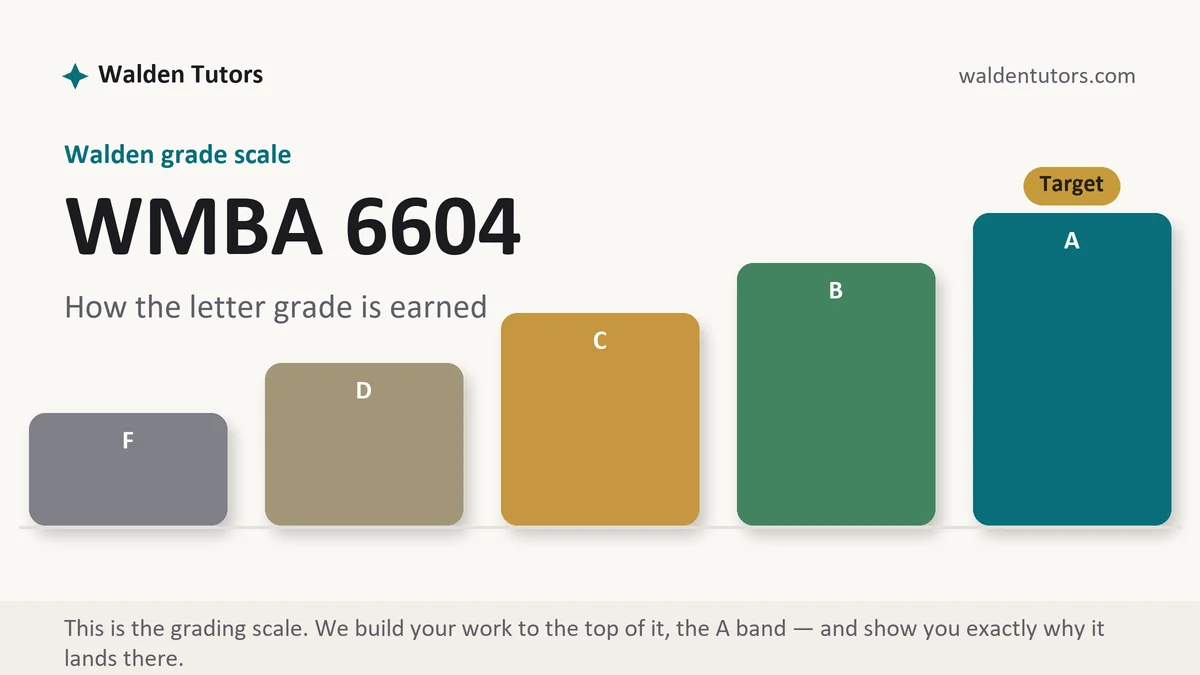
WMBA 6604 grading scale at Walden, how the work is graded, from Walden Tutors
How Walden grades WMBA 6604, visualized by Walden Tutors.

What WMBA 6604 actually grades

The graded output is analysis of healthcare law and healthcare policy applied to situations that have real parties standing in them. Expect policy papers argued from more than one stakeholder position, write-ups that trace an exposure back to the specific statute or regulation creating it, ethics cases where two defensible answers compete for the same decision, and graded discussion threads running beside the written work.

Rubric rows in a course of this shape tend to cluster around four moves. Name the governing rule instead of gesturing at regulation in general. Apply that rule to the facts you were handed rather than to a cleaner hypothetical. Keep what the law compels apart from what the organization ought to do, because those two answers separate more often than students expect. Then say who absorbs the cost of each option, by name, since the stakeholder row is where general papers go thin.

Your grade is a letter assembled from those rows. A paper that is excellent on ethics and quiet on the legal question does not average into a fine result. It loses the row that asked the legal question and keeps only the one it answered.

What this course hands the next one

Healthcare administration students rarely stop at 6604. The track continues into financial and economic analysis of the same kind of organization, and further on into capstone work where the deliverable has to be something a real administrator could sign. Your own program map settles the exact order, so read it rather than assuming, but the direction of travel is steady: this course teaches you to spot the failure points, and the courses after it ask you to design inside them.

That is worth knowing while you are still writing 6604 papers, because it changes what you keep. Start a running file of every statute, regulator and ethical framework you research, one line each on what it actually governs and where it bites. When a later course asks for a service-line proposal or a capital request, the compliance section assembles itself out of that file instead of out of a panicked search at eleven at night.

How we help in this course

Give us the assignment instructions, the scoring guide as it appears in your classroom, and whatever case document the week attached. Back comes a drafted analysis with the legal question and the ethical question kept visibly separate, stakeholders named individually, and every statement about a rule carried by a source you could defend if asked.

The terms match the rest of the site. Turnaround runs 24 to 48 hours, the target is an A set row by row, one reviewer scores the draft the way your faculty will while a second audits APA and originality, and revisions continue until the target is met.

Weekly manuals for this course

No week-specific manuals are published for WMBA 6604 yet. Walden keeps its syllabi inside the classroom, so a week manual only goes up once students in the course have confirmed the deliverable behind it. If the week in front of you has no page, describe it in chat and the desk works straight from your own classroom materials. Drafting has never waited on a manual.

In WMBA 6604 right now?

Paste in the assignment page and its scoring guide. The first premium sample costs nothing and lands inside two days.

The semester clock behind the work

The MBA runs on Walden's semester calendar rather than the quarter calendar the nursing programs use, and the gap matters for pacing. Published semester spans run about sixteen weeks. Fall Semester 2026 is listed as September 7 to December 27, which is 111 days end to end. Spring 2026 ran January 5 to April 26 and Summer 2026 ran May 4 to August 23, each exactly the same length. Treat the week count as arithmetic performed on those published dates, not as a number Walden prints.

Inside the span the deadlines are fixed and the clock is Central. Work is due at 10:59 p.m. Central, which is 11:59 p.m. Eastern. Walden also expects you to log in and submit an assignment or a discussion post during the opening week of the term. That requirement is administrative rather than academic, so missing it creates a problem no strong paper repairs afterwards.

What a calendar cannot tell you is how many deliverables your particular section carries. Posting and assignment requirements differ across courses and even between weeks of the same course, so the classroom is the only honest place to count them.

How to actually write WMBA 6604: where to begin

Start from the scoring guide, and start there before you have an opinion. Open the rubric attached to the week's item, copy each row into an empty document, and turn those rows into headings. You are now holding the grader's outline. Read the weight beside each row and set your section lengths to match it, because spending your best two pages on the row that pays least is both common and expensive.

Pin the facts next. Legal and policy writing falls apart when the facts drift, so before arguing anything, write a short neutral statement of them: who the parties are, what happened, in what sequence, and which details are disputed. Keep the verdict out of it. If the case says an administrator approved a referral arrangement, write exactly that, not that the administrator improperly approved it. The word improperly is your conclusion, and conclusions belong after the rule has been stated.

Then name the governing rule. Healthcare administration sits under a stack of federal and state law, and strong papers refuse to treat that stack as one undifferentiated mass. Privacy questions run through HIPAA and its breach notification requirements. Emergency screening and transfer questions run through EMTALA. Referral and payment arrangements run through the physician self-referral rules and the federal anti-kickback statute, and billing exposure runs through the False Claims Act. Employment disputes sit in a separate body of law again. Your job is to say which regime applies and why these facts trigger it, then to check whether state law is stricter, because in health care it very often is.

Apply the rule element by element. This single move separates a graded analysis from an essay about health care being complicated. A rule has parts. Take each part and say which fact satisfies it or fails to. Where a fact is missing, say what would need to be true and what evidence would establish it. Graders reward that honesty, because it shows you understand the rule structurally rather than by reputation.

Handle the ethics as a separate operation. Once the legal requirement is settled, ask the different question of what the organization should do, and run it through a named framework rather than instinct. Autonomy, beneficence, nonmaleficence and justice give you four angles on a clinical dilemma. A stakeholder analysis gives you another cut entirely, listing patients, clinicians, payers, the community and the organization itself, then stating what each one gains and loses under each option. In a good case, duties and consequences point different directions, and saying so out loud is stronger than pretending the answer was obvious.

Close with a recommendation somebody could act on. Name the option, show it clearing both the legal test and the ethical one, and attach a first step, an owner and a way to tell within ninety days whether it worked. Papers that end by summarizing the issues surrender the row that asked for a recommendation.

On sources, pull them through the Walden Library instead of an open search. Peer reviewed health policy and health law scholarship lives in databases your tuition already covers, and a librarian will find an annotated statute faster than you will. Primary law is fair game and usually better than commentary, so cite the regulation itself where you can and follow it with a secondary source that interprets it. Assign each source a single job you could state in half a dozen words. APA 7 governs all of it, in text and in the reference list, reconciling in both directions with nothing stranded on either side.

SectionWhat goes in itThe failure that costs points
Statement of factsParties, sequence of events, and a clear mark on anything the record leaves disputed.Conclusions smuggled into the description, so the analysis is decided before it is argued.
The governing ruleThe specific statute, regulation or standard that applies, plus any stricter state requirement.A paragraph about regulation in general with no rule anyone could look up.
ApplicationEach element of the rule tested against a named fact from your own statement.Rule and facts sitting in different paragraphs with nothing tying one to the other.
Ethical analysisA named framework run over the same situation, with the competing option taken seriously.Ethics reduced to restating the legal answer in warmer language.
Stakeholders and impactWho is affected, what each party gains or loses, and where interests genuinely collide.A list of stakeholders with no consequence attached to any of them.
RecommendationOne defended course of action with a first step, an owner and a review point.A summary of the dilemma offered where a decision was requested.
Sources and APAPrimary law where available, peer reviewed interpretation behind it, APA 7 throughout.Blog commentary and consultancy pages standing in for law the library holds.

Discussion posts that earn their row

Threads in this course are graded work with rows of their own, and they usually hand you a scenario and ask where the legal or ethical line falls. Write the opening post as a compressed version of the paper: the issue in one sentence, the rule that governs it, the fact that decides it, then the position you are taking. Cite inside the post. A confident position with no authority behind it reads as opinion to a row that says evidence.

Walden's grading policy asks for participation that is consistent, substantive and timely, and it recommends spreading your posts across at least two to four days of the week rather than emptying them into one sitting. The reply carries a score of its own, and agreeing with someone earns none of it. Advance a classmate's argument instead: apply their rule to a fact pattern where it breaks, bring the state requirement they did not check, or name the stakeholder their option quietly costs. How many replies count, and when they close, is set by your own classroom, so read the week's item rather than importing the pattern from a previous course.

Citing law and policy in APA 7

Legal material behaves differently from journal articles under APA, and it is the detail most often fumbled in this course. APA 7 sends legal references to a separate convention, so statutes, regulations and cases are formatted as legal citations rather than squeezed into the author and date pattern. Government reports from bodies such as the Office of Inspector General or the Centers for Medicare and Medicaid Services do use the standard organizational author form. Keep the two families straight and the reference list stops looking improvised.

Everything else follows the rules you already meet elsewhere in the program: a Walden title page, headings held at their proper levels, author and year visible in the running text, and a reference list that reconciles against the body with nothing extra and nothing missing. The Writing Center publishes the templates Walden grades against, and copying their formatting is faster than defending your own.

The mistakes that cost points in WMBA 6604

  • An issue described at length while the rule that decides it is never named or cited.
  • The ethical section restating the legal conclusion, so two rubric rows collect the same answer twice.
  • Stakeholders listed as categories with no statement of what any of them actually stands to lose.
  • State law skipped entirely on a question where the state requirement is the stricter one.
  • A recommendation with no owner, no first step and no way for anyone to check it later.
  • Patient or employee details reproduced from a real workplace situation that should have been anonymised.

WMBA 6604 questions students actually ask

Do I argue the law or the ethics first?

Law first, almost always. Settle what the organization is required to do before you ask what it ought to do, because the legal answer sets the floor and the ethical answer chooses among the options left standing above it. Reversing the order produces papers that recommend something admirable and unlawful. Where the rubric names the two as separate rows, give them separate headings so the grader does not have to hunt for either one.

Can I use my own employer as the case?

Yes, if the week allows a self-selected case and you can write about it without disclosing anything protected. Strip patient identifiers completely, keep employee details general, and do not reproduce internal documents. A lightly anonymised version of a compliance question you actually watched unfold usually outperforms an invented scenario, because you know the sequence and the pressures. If the situation is live or under investigation, pick something else.

How current do the legal sources need to be?

Current as of the version in force today, which is a different test from a publication date window. Statutes and regulations get amended, so confirm you are citing the operative text rather than an older analysis of it. Commentary can be a few years old and still sound if the underlying rule has not moved. Check whether your rubric sets a recency requirement for scholarly sources, and treat that number as binding on the peer reviewed half of your list.

Keep going

Online now