Building Organizational Culture: Leaders as Architects is WMBA 6615 at Walden, worth three semester credits, with WMBA 6000 listed as its pre-requisite. Its premise, stated in the catalog, is that leaders shape the cultures they work in and get shaped right back. What follows from a premise like that, in the writing a course of this kind asks for, is a standing demand for evidence: read the culture accurately first, and treat permission to propose changing it as something the reading has to earn.
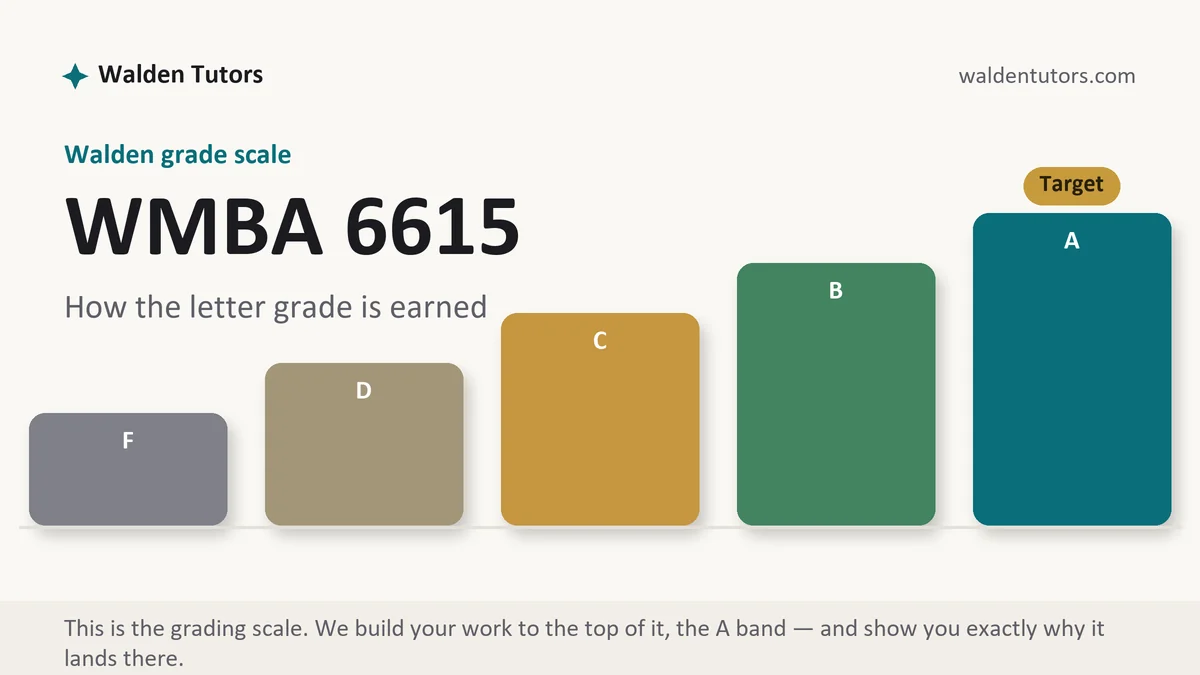
What WMBA 6615 actually grades
Written diagnosis, then written design. Before the specifics, the honest caveat: Walden publishes syllabi only inside the classroom, so no outside page can hand you this course's assignment list, and any page that presents one as fact is guessing. What the catalog commits to is the subject matter. It names recognizing the elements that make up an organization's culture, harnessing those elements for change, making conceptual sense of the cultural terrain an organization occupies, and examining what all of that implies for leading communities at several levels of an organization.
Subject matter of that kind usually reaches a grader as culture analyses of a chosen organization, papers testing what a company says it values against what it visibly rewards, a proposal aimed at shifting one element rather than all of them, reflective work on your own effect as a leader, and threads that carry their own scoring criteria. Read your week before assuming any particular item is coming.
The rows in a culture course reward evidence above opinion, which is harder than it sounds because everyone arrives with strong instincts about the places they have worked. A high scoring paper names the framework it is using, produces observable material as proof, reads that material through the framework rather than around it, and only then recommends. A low scoring paper describes an organization the writer dislikes and calls the description an analysis.
Grades come back as letters assembled from those rows. The row worth guarding is whichever one asks for evidence, because confident characterization with nothing observable underneath it reads as anecdote no matter how accurate it happens to be.
What 6615 sets up after it
The skill this course builds gets spent later rather than here. Coursework on change, on performance management, on teams and on the capstone all assume you can characterize an organization accurately before recommending anything to it, because a recommendation aimed at a culture you have misread will fail in ways no implementation plan rescues. Sequence is set by your own program map, so read that rather than a general expectation, but the pattern holds: diagnosis first, design after.
Which suggests a habit worth starting now. Keep a single working file on whichever organization you analyze, with the artifacts you collected, the quotes you gathered, the dates you observed things, and the framework you applied. Later assignments frequently allow you to keep the same case, and a student returning to a documented organization writes in a couple of evenings what a student starting fresh spends a week assembling.
How we help in this course
Three things get an order moving here: the assignment worded the way your classroom words it, the scoring guide with its rows visible, and whatever you have already gathered on the organization you picked. What returns is a drafted analysis with one framework applied consistently, every characterization attached to something observable, and the recommendation built so that it names what changes, who owns it and how anyone would know it worked.
Service terms are the same across this site: 24 to 48 hour turnaround, an A targeted row by row, one reviewer scoring the draft against the rubric while another checks APA and originality, and revisions continuing at no charge until the target is hit.
Weekly manuals for this course
There are no per-week pages for WMBA 6615 on the site at present. Because Walden publishes syllabi only inside the classroom, a week manual can go up only after students confirm what the week actually asks for. Send yours through chat in the meantime and the desk drafts from your classroom materials directly, which is how most orders in this course arrive anyway.
In WMBA 6615 right now?
Send the week and its rubric. Your first premium sample is free and returns in two days or less.
Term length and due times
Walden runs the MBA on a semester calendar while the nursing programs run on quarters, and the two are not interchangeable when you are planning your workload. Semester spans published for 2026 are January 5 to April 26, May 4 to August 23, and September 7 to December 27. Each of those is 111 days wide, and dividing gives roughly sixteen weeks. The university lists dates rather than week counts, so treat that division as your own arithmetic on its calendar and not as a figure Walden states.
Every due time inside the term is set in Central. The nightly cutoff falls at 10:59 p.m. there, which lands at 11:59 p.m. for anyone living on Eastern. Separately, there is a first week requirement: sign in and submit an assignment or post a discussion before that opening week ends. It is an administrative obligation rather than an academic one, and it cannot be made up with good work later.
What the calendar will not settle is how many graded items your section contains. Requirements are set course by course, and Walden acknowledges they even differ between weeks of a single course, so count from your own syllabus instead of from anyone else's experience.
How to actually write WMBA 6615: where to begin
Start at the scoring guide and let it build your outline. Copy every row into an empty document and make each one a heading, then read the point weight beside it and size your sections accordingly. Do that reading properly instead of guessing, because people arrive at a culture course wanting to fix something and pour their best pages into the fix. If your guide turns out to pay more for the diagnosis than for the recommendation, the diagnosis is where the evening goes.
Choose your organization on the basis of evidence access, not passion. The strongest papers are written about places where you can actually see things: a current or former employer, a client organization, a well documented company, or a unit small enough to observe properly. Enthusiasm for a famous brand is not a substitute for material. Before committing, ask whether you could produce five concrete pieces of evidence about the place by the end of the week. If not, choose again.
Then collect artifacts before forming a view. Artifacts are the visible surface of a culture and they are everywhere once you look: office layout and who gets a door, dress, what the walls say, the vocabulary people use for customers and for each other, how meetings open and who talks, what gets celebrated publicly, what onboarding emphasizes in its first hour, the wording of job advertisements. Record each one with a date and a source. This is the material your analysis rows are paid for, and gathering it after you have decided your conclusion produces a paper that only finds confirming evidence.
Next, separate what the organization says it values from what it rewards. Every employer has stated values, on a website or a lanyard. The analytical move is to test them. If the stated value is collaboration, look at who was promoted last year and what they were promoted for. If the stated value is safety, look at what happens when a deadline collides with a procedure. The distance between the espoused value and the enacted one is where most of the interesting writing in this course lives, and naming that gap precisely, with an example on each side, will carry a paper further than any amount of description.
From there, reason down to assumptions. Underneath artifacts and values sit the beliefs nobody states because everybody shares them: what this organization thinks people are like when unsupervised, whether disagreement is treated as loyalty or as threat, whether time belongs to the individual or the institution. You cannot observe these directly. You infer them, and you must show the inference, since a rubric row that says analysis is asking to watch you reason from evidence to conclusion rather than jump.
Commit to one framework and use it properly. A layered model, artifacts down through espoused values to underlying assumptions, gives you a way to move from observation to inference. A typology gives you a way to characterize the whole and compare it against strategy. Subculture analysis matters when different units clearly run on different rules, which in large organizations is nearly always true and rarely acknowledged in student papers. Pick the one that suits your evidence, name it in the introduction, and stay in its vocabulary throughout.
Only now design the intervention, and design it narrow. Culture does not respond to announcements, so a recommendation to build a culture of accountability is worth nothing. Leaders move culture through a small number of concrete levers: what they consistently pay attention to and ask about, what gets measured and rewarded, how people are recruited and socialized, what happens visibly after a failure, and what they model themselves under pressure. Choose one or two levers, aim them at one specific element you diagnosed, attach an owner and a first action, then say what you would measure at ninety days and what result would tell you it had not worked.
On sources, work through the Walden Library rather than an open search. The management and organizational behavior literature these rubrics assume lives in databases you already have access to, and seminal work on culture is worth reading in the original rather than through a summary. Use each source for a stated purpose you could name in six words. Where you cite the organization's own material, an annual report, a careers page, a policy document, cite it as evidence and treat it as a claim the organization is making rather than as a fact. APA 7 covers formatting throughout: the Walden title page, correct heading levels, author and year in the running text, and a reference list that matches the body in both directions.
| Section | What goes in it | The failure that costs points |
|---|---|---|
| Framing the question | The organization, why it was chosen, and the specific cultural question the paper answers. | An introduction promising a broad look at organizational culture with no question inside it. |
| Artifacts and evidence | Observable material with dates and sources: language, rituals, layout, rewards, recruitment wording. | Impressions of the workplace offered as observation, with nothing a reader could verify. |
| Espoused versus enacted values | The stated values set against the behavior actually rewarded, with an example on each side. | The published values list quoted approvingly and never tested against anything. |
| Underlying assumptions | The shared beliefs you infer, with the reasoning from evidence to inference shown. | Assumptions asserted as though they had been read directly off the organization's surface. |
| Framework and diagnosis | One named model applied consistently, producing a defended characterization of the culture. | Two or three models mentioned, none of them used long enough to reach a conclusion. |
| Intervention design | One or two levers aimed at a specific element, with an owner, a first action and a timeframe. | A call to build trust and improve communication, which nobody could start on Monday. |
| Measurement and risk | What you would track, when you would check it, and how you would recognize resistance early. | A proposal with no way of ever being judged as having succeeded or failed. |
| Sources and APA | Peer reviewed organizational literature, cited company material treated as claims, APA 7 throughout. | Consultancy blog posts and leadership listicles standing in for scholarship. |
Discussion posts that earn their row
Threads here usually ask you to bring a piece of a real culture into the classroom and analyze it. The opening post works best as a compressed case: the artifact or incident, what it appears to signal, what the framework says about that signal, and the judgment you are prepared to defend. Bring one citation into the post itself. A vivid workplace story with no theory attached collects the participation row and misses the analytical one entirely.
Walden's grading policy expects contributions that are regular, substantive and punctual, and it recommends spreading them over two to four days at least rather than filing everything in a single sitting. Replies are scored apart from the opening post, so agreement is wasted effort. Give a classmate something to work with: propose the alternative reading of their artifact, ask whether the subculture in their own department contradicts the picture they painted, or point out that the value they called enacted is only visible in an official document. Reply counts and closing days are set inside your classroom, so read the week rather than assuming the pattern repeats from an earlier course.
Handling the organization's own material in APA 7
Culture papers lean on documents that are not scholarship, and treating them correctly is worth easy marks. A careers page, a values statement, an internal handbook or an annual report is cited with the organization as author, the year, and a location a reader could reach. Anything internal and unpublished cannot be reproduced casually, so paraphrase it and say what kind of document it was. A conversation with a colleague is personal communication, cited in the text alone and kept out of the reference list.
Keep the scholarly sources in the usual APA pattern, and let the Writing Center's templates handle the title page and heading structure. Their formatting is what Walden grades against, and adopting it removes a whole category of small deductions that add up quietly across a term.
The mistakes that cost points in WMBA 6615
- An organization characterized from feeling and memory, with no artifact anyone else could have observed.
- Stated values reported as though they were the culture, so the gap the course exists to examine never appears.
- A framework named in the opening paragraph and then never applied to a single piece of evidence.
- Subcultures ignored in an organization large enough that departments visibly run on different rules.
- Recommendations addressed to everyone, owned by nobody, and measurable by no one.
- Grievance about a former employer dressed as analysis, which readers detect within two paragraphs.
- Identifiable colleagues described in ways that would embarrass them if the paper were read aloud.
WMBA 6615 questions students actually ask
Which culture framework should I commit to?
Whichever one your week assigns, and if the choice is yours, the one that fits the evidence you can actually collect. A layered model works well when you have artifacts and stated values in hand and want to reason down to assumptions. A typology works well when you need to characterize a whole organization and compare it against a strategy. What loses marks is holding two frameworks loosely instead of one properly. Pick, name it in your introduction, and use its own vocabulary consistently for the rest of the paper.
How do I get evidence about a culture I am not allowed to survey?
Most of what you need is already lying around in public or in plain sight. Job advertisements reveal what an employer says it prizes. Onboarding material, intranet posts and all-staff emails reveal what leadership repeats. Meeting behavior, who speaks first and who is interrupted, is observable without permission. Published reviews, annual reports and press coverage add outside views. Three or four independent sources pointing the same direction is a defensible finding, and saying which evidence you could not get is a strength rather than an admission.
Is it acceptable to conclude the culture should not change?
Yes, if you argue it rather than default to it. A culture that fits the strategy, the workforce and the operating conditions is an asset, and recommending preservation is a legitimate finding when the evidence supports it. The rubric row is asking for a defended judgment, not for change specifically. If that is your position, show what would be lost by intervening, name the one element you would still reinforce, and say what would have to happen for you to reconsider.