WMBA 6620 help and tutoring

WMBA 6620 · 3 semester credits · MBA project management
The short answer

The grade here is mostly settled before the real work starts, by which project you pick to plan. Practices in Project Management is WMBA 6620, three semester credits, and WMBA 6000 has to be behind you first. It travels the full project life cycle from initiating through closing, and the graded output is planning documents you build rather than essays about building them.

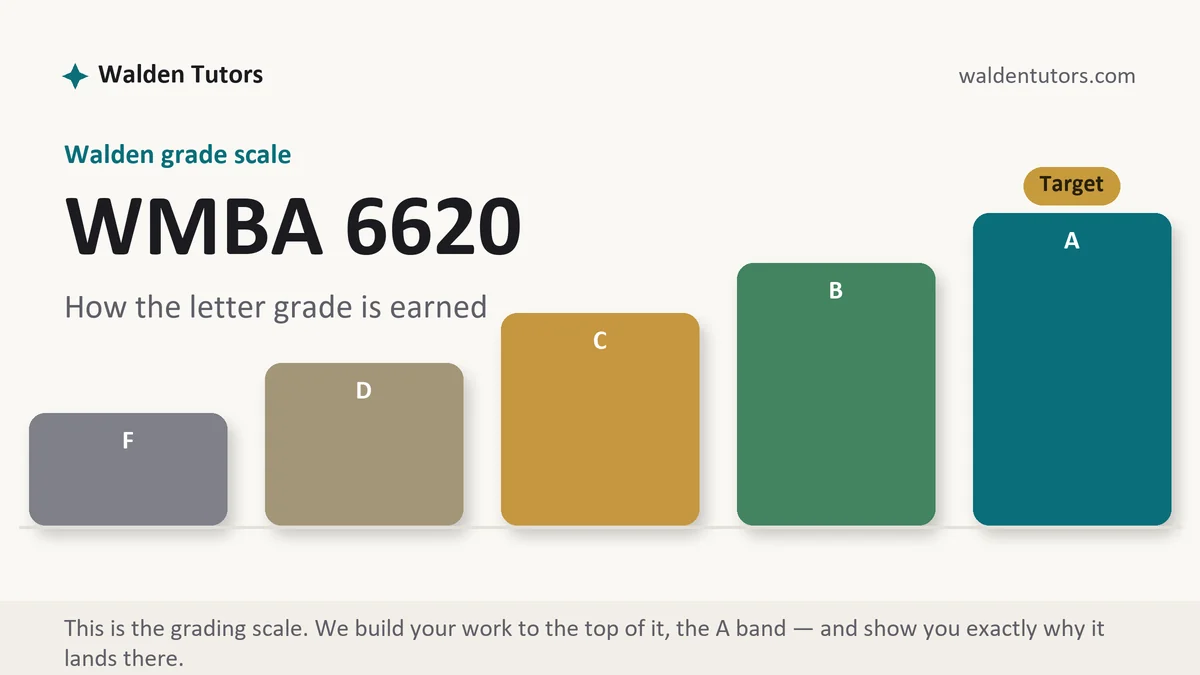
WMBA 6620 grading scale at Walden, how the work is graded, from Walden Tutors
How Walden grades WMBA 6620, visualized by Walden Tutors.

What WMBA 6620 actually grades

The output here is artifacts. Charters, scope statements, work breakdown structures, schedules with dependencies behind them, cost estimates, communication and quality plans, and closing documentation. Around those sit graded discussion threads and shorter analytical write-ups that ask you to explain a choice you made in one of the artifacts.

Walden frames the subject along two dimensions, the Knowledge Areas and the Process Groups, and asks you to see how they interact across initiating, planning, executing, monitoring and controlling, and closing. Rubric rows in this course tend to test four things. Is the artifact complete in the format the profession expects. Is it applied to one specific project instead of hovering above projects in general. Does it agree with the artifacts you produced earlier in the term. And can you defend the technique you used rather than simply having used it.

Internal consistency is where most points quietly leak. A scope statement promising four deliverables and a work breakdown showing three is a scoring problem even if both documents look tidy on their own. Graders read your submissions as a set, because a project plan that contradicts itself would not survive its first status meeting.

The project you choose decides the grade

Pick something bounded. The test is simple: name the thing that will exist on the final day and did not exist on the first, in one sentence, with no conjunctions. If that sentence needs an "and" you have picked a program, not a project, and every artifact downstream will fight you.

Students who choose an enterprise system rollout, a merger, or a company-wide culture change discover the problem at the work breakdown. There is no honest way to decompose an ambition that large inside a term paper, so the decomposition turns into headings, the schedule turns into guesses, and the risk register turns into a list of worries. Choose a new intake process for one clinic, a website rebuild for one product line, a warehouse relocation, a two-day training program delivered to forty people. Small enough to plan truthfully, real enough to have a sponsor and a budget.

How we help in this course

Upload three things: the assignment page, whatever your classroom calls the scoring guide, and any template attached to that week. Back comes a drafted set of artifacts built to agree with one another, each estimate carrying the technique that produced it, plus a short mapping note pointing every section at the row it answers.

Terms match the rest of the site. Turnaround sits inside 24 to 48 hours, the target is an A read row by row, two reviewers work in sequence, one marking the draft against the rows and the other going over sources and formatting, and revision requests stay open until the work reaches the mark.

Weekly manuals for this course

No week grid exists here for WMBA 6620, and inventing one would be guesswork. Syllabi stay inside the Walden classroom, which means a week manual publishes only after somebody enrolled confirms what that week really demands. Where yours has no page, describe the deliverable in chat and the desk drafts from your own materials. Nothing about the service is blocked by a missing manual.

In WMBA 6620 right now?

Send the artifact you are stuck on plus its scoring guide. Your opening premium sample carries no charge and lands inside a 48 hour window.

The term you are planning inside

The MBA sits on semesters. Nursing programs at Walden run quarters instead, and a pacing plan built on the wrong one falls apart quickly. Semester spans are long: the published Spring 2026 semester opened January 5 and closed April 26. That is 111 days between the two dates, and 111 divided by seven lands a shade under sixteen weeks. The university publishes the dates but no week count, so sixteen is a figure you derived, not one to quote back as theirs.

Nothing inside the span flexes. The cutoff falls at 10:59 p.m. Central, one hour behind an 11:59 p.m. Eastern clock. There is also an opening-week requirement: sign in and put up either a graded assignment or a discussion contribution, because that record is administrative and later brilliance will not repair it.

How many deliverables your particular section carries is a question only your classroom answers. Walden states plainly that posting requirements differ across courses and between weeks of the same course, so count them where they are published rather than assuming a pattern.

How to actually write WMBA 6620

Open the scoring guide before you open a blank document. Copy each row out of it and paste those rows into your file as headings, then delete them at the end. You are writing to a checklist somebody has already agreed to use, and the fastest way to lose points is to produce a beautiful document that answers a different checklist. Weight your effort against the points beside each row, not against which section you find interesting.

Write the charter first and treat it as the source of truth for everything after it. A charter that earns its row names a sponsor with authority to fund, states the business need in terms of a problem the organization currently pays for, gives objectives that somebody could measure, marks the boundary between what is in scope and what is deliberately out, and lists the assumptions and constraints you are working under. Constraints are not decoration. If your budget is capped or your go-live date is fixed by a lease, every later artifact has to respect that, and graders check.

Then decompose. A work breakdown structure divides deliverables, not activities, and each level should account for the whole of the level above it with nothing extra smuggled in. Name the elements as nouns, because "training materials" is a deliverable while "develop training" is a task pretending to be one. Stop decomposing when you reach a package that one owner can estimate honestly and be held to. If you cannot say who would own a package or how long it would take, you have not gone far enough down; if you are listing individual emails, you have gone too far.

Sequence before you schedule. Take the work packages and ask, for each one, what has to finish before it starts and what it releases when it ends. Most of those relationships are finish to start, some are not, and the ones that are not deserve a sentence explaining why. Only after the logic exists does a timeline mean anything. A bar chart drawn without dependencies underneath it is a picture of your hopes, and a grader who asks which path is critical will find nothing to answer with. Say which sequence drives the end date and where the float sits, because that is the sentence the schedule row is looking for.

Estimate with a named technique. Analogous estimating borrows from a similar past project and is fast and rough. Parametric estimating multiplies a rate by a quantity and is strong wherever the work is repetitive. Three-point estimating averages an optimistic, a likely and a pessimistic figure and is the honest choice when uncertainty is real. Pick one per estimate, say which you used, and show the arithmetic. Any worked number in your paper is your illustration, not Walden's, so label it that way and let the reasoning carry the row.

Keep the two dimensions visible. When you write about a document, say which Knowledge Area it belongs to and which Process Group it lives in, and note where those two intersect. Scope, schedule, cost, quality, resource, communications, risk, procurement and stakeholder are the areas the course teaches; initiating, planning, executing, monitoring and controlling, and closing are the phases. Showing that a risk register is planning work in the risk area, and that it gets revisited during monitoring and controlling, is precisely the understanding the course was built to test.

For sources, use the Walden Library rather than an open web search. Professional standards and peer reviewed project management research both live in databases your tuition already pays for, and the terminology in the course comes from that literature. Cite the standard when you use its vocabulary, cite research when you claim a practice improves an outcome, and give each source one job you could describe in six words. APA 7 rules the title page, the heading hierarchy, every in-text citation and the reference list, and no entry may sit in one of those last two without a partner in the other.

ArtifactWhat belongs in itThe failure that costs points
Project charterSponsor, business need, measurable objectives, high-level scope boundary, assumptions and constraints.Objectives written as ambitions nobody could confirm or disprove at the end.
Scope statementDeliverables listed one by one, acceptance criteria, and an explicit out-of-scope list.No exclusions stated, which leaves the boundary undefended and the later artifacts unmoored.
Work breakdown structureDeliverable-based decomposition down to work packages with a single owner each.Verb phrases standing in for deliverables, or a level that does not add up to its parent.
ScheduleDependencies, durations with a stated estimating method, the driving path and the float.A timeline with dates but no logic, so nothing explains why anything happens when it does.
Cost baselineEstimates rolled up from the work packages, with the technique and any contingency named.A round total appearing from nowhere with no line of sight back to the breakdown.
Risk and communicationsIdentified risks with owners and responses, plus who hears what, how often, through which channel.A generic communication plan that would fit any project ever attempted.
ClosingAcceptance, handover, released resources, and the lessons captured while they are still fresh.Closing treated as a formality instead of the phase that proves the objectives were met.

Discussion threads in a planning course

Threads carry their own rubric rows and usually ask you to defend a planning choice or critique somebody else's. Build the opening post the way you build an artifact: state the situation in a line, name the technique or process you would apply, show the one piece of reasoning that makes it the right pick, then say what you would do differently if a constraint moved. Put a citation inside the post itself. A confident claim with no source underneath it gets scored as a claim, and the row in question asked for evidence.

The grading policy asks for contributions that are steady, substantive and punctual, and it nudges you toward two to four separate posting days instead of emptying a whole week into one sitting. Replies score apart from the opening post, and agreement earns nothing. Do something to a classmate's plan instead: point at a dependency their sequence ignores, ask what their estimate assumes about resource availability, or name the stakeholder their communication plan leaves out. Your section decides how many responses it wants and when the thread stops accepting them, so read its instructions rather than importing last term's rhythm.

The mistakes that cost points in WMBA 6620

  • A project so large that the work breakdown becomes a table of contents rather than a decomposition.
  • Artifacts that disagree, with deliverables in the scope statement that never surface anywhere in the schedule.
  • Durations and costs presented with no estimating technique named and no arithmetic shown.
  • A schedule offered without dependencies, leaving nobody able to say which path drives the finish date.
  • Process Group and Knowledge Area vocabulary used as labels while the paper never shows the two interacting.
  • Risks described as general worries rather than events with owners, triggers and planned responses.

WMBA 6620 questions students actually ask

How big should the project I plan actually be?

Small enough that you can decompose it honestly in the space you have. A useful ceiling is a project one team could finish inside a few months with a budget somebody could approve without a board meeting. If your work breakdown starts producing packages you cannot assign an owner or a duration to, the project is too large and the rest of the term will be an argument with your own scope. Shrinking it is not a compromise, it is what makes the artifacts gradable.

Do I have to use the standard project management terminology?

Yes, and it works in your favor. The course is built around the Knowledge Areas and the Process Groups, so rubric rows are written in that vocabulary and a grader scanning for it should find it quickly. Use the terms precisely rather than decoratively: call a work package a work package because it meets the definition, not because the word sounds professional. Where your workplace uses different names for the same thing, mention the local term once and then stay with the course vocabulary.

Can I plan a project from my own workplace?

Usually yes, and it tends to produce better artifacts because you already know the constraints, the politics and who actually signs. Keep it anonymised. Change the organization name, avoid naming individuals, and do not paste internal documents into a submission. Check that the week allows a self-selected project before you commit to one, and if the situation is still unfolding at work, pick something already settled so you are not writing about a moving target.

Keep going

Online now