WMBA 6647 is Applications in Corporate Finance II, three semester credits, with WMBA 6070 listed as its prerequisite and WMBA 6643 as the ground it builds on. The graded territory is valuation, advanced capital budgeting, cost of capital and risk handled through standard deviation, variance, covariance, the capital asset pricing model and beta, widening into leasing, option pricing, derivatives and hedging. One thing separates the strong submissions from the weak: whether risk is treated as a quantity or as an adjective. Papers that call a project risky and move on read as undergraduate work no matter how tidy the rest is, while papers that say how variable the outcome is, how that variability relates to everything else the firm holds, and what the firm should therefore be paid for carrying it, are already scoring.
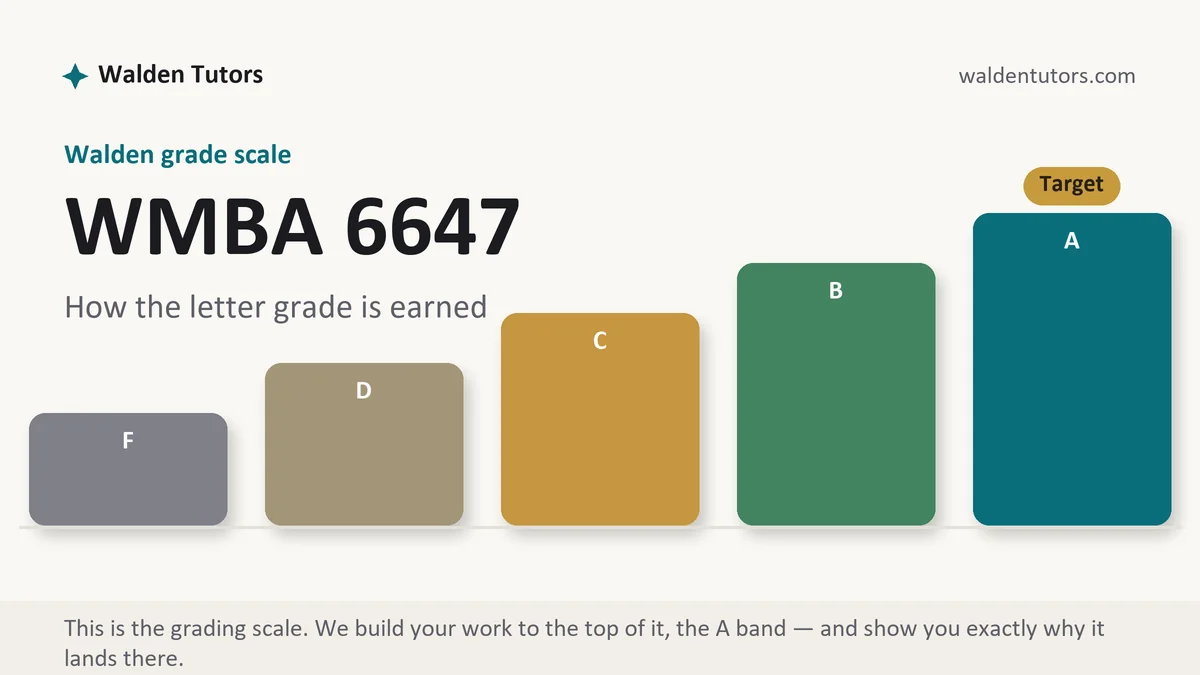
What WMBA 6647 actually grades
This is the second half of the corporate finance sequence, and Walden describes it as building on the work started in WMBA 6643, pushing into current issues and into what an optimal financial decision looks like when the easy assumptions are removed. Students are asked to demonstrate financial management competence in practice rather than describe it. The published ground covers valuation, advanced capital budgeting, cost of capital, and risk measured properly through standard deviation, variance, covariance, the capital asset pricing model and beta. Beyond that sit multinational questions, leasing, option pricing, derivatives and hedging.
Assessment arrives as applied work: valuation exercises, risk analyses built from return data, financing and leasing comparisons, hedging recommendations, case memos, and graded discussion threads carrying their own points. Because the course is explicitly about optimal decisions, the rubric rows tend to test whether you chose well rather than whether you computed accurately, and those are different things.
Three moves earn rows in almost every item. Quantify the uncertainty rather than gesturing at it. Connect the risk you measured to the return you are demanding, so the discount rate and the risk analysis are visibly the same conversation. And state what the recommendation gives up, since advanced finance has no free choices and a paper that finds one has usually missed a cost. Your letter grade assembles from those rows, and because they hang beside the item in the classroom, the standard is visible from the first day of the week.
Risk as a measured quantity
The statistical vocabulary in this course exists to answer practical questions, and it goes down easier if you attach each term to its question. Variance and standard deviation describe how widely an outcome scatters around its expected value, which tells you how wrong you might be. Covariance and correlation describe whether two things move together, which is the entire reason diversification works. Beta expresses how strongly an asset responds to the market as a whole, which is the piece of risk an investor cannot diversify away. The capital asset pricing model then converts that number into a required return, which is where the risk analysis meets the discount rate you use everywhere else.
Two errors recur. The first is treating total variability as the thing investors get paid for, when the model in front of you says they are compensated only for the part that cannot be diversified. The second is measuring risk in one section and then discounting at a rate chosen in another section for unrelated reasons, which leaves the paper contradicting itself in a way a finance faculty member spots immediately. Write the link out loud: this is the risk we measured, this is the return it justifies, this is the rate the valuation therefore uses.
How we help in this course
Give the desk three inputs: the graded item, the rubric rows your classroom displays, and any data file, case or template the week attached. The draft comes back with the uncertainty quantified, the required return tied to the risk you measured, the instrument matched to a stated exposure, and a recommendation that says what it costs as well as what it gains.
Terms do not shift between courses. Work returns in a 24 to 48 hour window, written toward the top band on every row. One reader marks it as your faculty member would, a different reader audits sources, format and originality. Revisions continue without charge until the piece reaches what we agreed.
Weekly manuals for this course
Week-level pages for WMBA 6647 have not gone up yet. Walden keeps syllabi inside the student portal and publishes only course descriptions in the open, so any outside site listing a week-by-week grid for this course is guessing. Manuals go up individually, and only once somebody sitting in the section has told us what that week actually required. Where yours is missing, describe the item in chat and the desk works straight from the materials you were given.
In WMBA 6647 right now?
Pass along the item, the rubric and whatever return data or case file came with it. Your first premium sample is on the house, delivered inside a two-day window.
Sequencing the second finance term
The MBA sits on Walden's semester calendar, a longer structure than the quarter terms the nursing programs run, and the extra weeks matter more here than in most courses because the material is cumulative. Fall Semester 2026 is listed as opening on September 7 and closing on December 27. Dividing that stretch into weeks yourself puts it around sixteen, an inference drawn from Walden's published dates rather than a number the calendar states, so the schedule issued for your specific program settles the dates you are actually working to.
Difficulty in this course does not rise evenly. It steps. Everything after the first few weeks assumes a working cost of capital, and everything after the risk block assumes you can read a beta and say what it implies. A student who lets one of those steps pass without understanding it does not fall behind gradually, they hit a wall in a specific week and cannot climb it with extra hours, because the missing item is comprehension rather than time. The remedy is unglamorous: after each new technique, write a short worked example in your own words while it is fresh, and keep those examples in one file you can reopen.
Two fixed points anchor whatever schedule you build. The clock that matters is the university's rather than the one on your wall: work is due by 10:59 at night in Central time, which lands at 11:59 for Eastern students. Walden also expects everyone to appear during week one and put up either an assignment or a thread contribution, so the term makes a demand of you before the content does.
How to actually write WMBA 6647: where to begin
Take the rubric out of the classroom before anything else. It hangs on the graded item, states things more directly than the prompt does, and every row names a thing your marker has undertaken to check. Convert the rows into headings in an empty document, note each weight beside its row, and let the weights decide how long each section runs. In a course this technical, the modeling section grows without permission and the interpretation section starves, and the weights are the fastest correction.
Frame the decision before you frame the model. Advanced corporate finance items nearly always reduce to a choice: buy this business or do not, lease the equipment or borrow to buy it, hedge the exposure or accept it, fund this project at this required return or send it back. Name that choice in the opening paragraph. Once it is on the page, every calculation that follows has a visible reason to exist, and a grader can tell in seconds whether your analysis is pointed at anything.
Build the cost of capital deliberately and show your components. In this course the required return is not a number you are handed and use, it is an argument you make. Say where the risk-free rate came from and as of when, say how you obtained beta and whether you adjusted it, say what market premium you assumed and on what basis, and if you weighted debt and equity, say whether the weights are book or market values. A grader who can see those components can mark your reasoning even where they would have chosen differently, and this is the single most reliable place to gain ground over a classmate who wrote one unexplained percentage.
Quantify uncertainty, then interpret it. Producing a standard deviation is arithmetic; saying what it means for the decision is analysis. Report the dispersion, say how much of the risk is specific to the asset and how much rides with the market, and then run the outcome under a small number of clearly labeled scenarios rather than a single point estimate. Finish that section with the range within which your recommendation still holds. Decision makers care far more about where the answer breaks than about another decimal on the base case.
When the item involves an option, leasing or a derivative, describe the structure before you value it. For an option, name what is being decided, by whom, by when, and what would trigger exercise. For a lease against a purchase, state the horizon, the tax treatment, the residual value assumption, and who carries the obsolescence risk. For a hedge, measure the exposure in currency and time before naming any instrument. Structure first, valuation second is the order that keeps these sections honest, because a model built before the structure is understood usually values something the case never described.
Give the multinational content its own explicit treatment. Say which currency the flows are in, how they were converted and using which rate, and where country risk is being carried, in the cash flows or in the discount rate, but never in both. Then say what exposure the firm retains after your recommendation, since a paper that treats currency as a rounding detail forfeits the row that asked about it.
On sources, cite the scholarship behind each technique rather than describing formulas from memory, and pull rates, betas, comparable multiples and market data through the Walden Library business databases, noting the date you retrieved them because these figures move. Filings are fair evidence for a company's own reported numbers. Synthesis means two sources brought into contact with your case added on top, not summaries stacked in sequence. On format, APA 7 dictates the title page, the heading hierarchy, citation form, and a bibliography that balances against the text in both directions. Any table or figure needs its own number, a caption, and a sentence that refers to it by that number.
| Section | What it does | Common failure |
|---|---|---|
| The decision | States the choice in front of you and the answer you mean to argue for. | Modeling that begins before the reader has learned what is being decided. |
| Structure of the instrument | Describes the option, lease, or exposure in words before any valuation begins. | A model built and run against a structure the paper never actually explained. |
| Risk measurement | Reports dispersion, co-movement and market sensitivity from stated data. | Risk described with adjectives while the numbers that would support it stay absent. |
| Required return | Builds the rate from named components with each source and date given. | A single percentage used throughout with no account of where it came from. |
| Valuation or comparison | Applies the method to the structure and reports the result plainly. | An answer stated to four decimals on inputs that were rounded estimates. |
| Scenario range | Shows the band within which the recommendation continues to hold. | A single base case delivered as certainty with no break point identified. |
| Recommendation | Names the action, the residual risk accepted, and how it will be monitored. | A conclusion that claims the upside and never states what was given up. |
Threads at the advanced end of the sequence
Discussions carry their own rubric and their own points, so a strong valuation memo will not offset a thin posting record. Treat the initial post as a compressed argument: the question, the figure you consider decisive, the technique behind it, one cited source, and a closing line that invites a counterargument rather than applause. If a word range is set, edit into it, because posts that run long read as undisciplined rather than thorough.
Replies score separately and agreement contributes nothing on its own. What Walden's policy calls for is substance, punctuality and distribution, with a stated preference that your contributions land across two to four days instead of arriving in a single evening. At this level the reply that earns its row usually questions whether a classmate's beta suits the business they described, recalculates their valuation with a different growth assumption and reports the swing, or points out that their hedge removes an upside they were counting on elsewhere. Since Walden concedes that no two sections need match, the number of replies and the cutoff day are whatever your own instructions say.
The mistakes that cost points in WMBA 6647
- Risk described in adjectives across a whole paper with no measurement offered anywhere.
- A discount rate that contradicts the risk analysis appearing two pages earlier in the same document.
- Total variability treated as the compensated risk, when the model applied says otherwise.
- An option or lease valued before its structure, timing and residual assumptions were ever described.
- Beta lifted from a source with no date, no market index named and no comment on whether it fits.
- Country risk counted twice, once inside the cash flows and again inside the discount rate.
- A hedge recommended with no measurement of the exposure it is supposed to cover.
- A conclusion listing benefits only, in a course built around tradeoffs between them.
WMBA 6647 questions students actually ask
How much statistics do I need for the risk section?
Less computation than students fear and more interpretation than they expect. You need to be able to produce a standard deviation and a covariance or correlation from a return series, usually in a spreadsheet rather than by hand, and you need to read a beta rather than derive one. What the rubric actually rewards is the sentence afterwards. Say what the dispersion means for a decision maker, say why an asset that moves against the rest of the portfolio is worth holding even when its own variability is high, and say which figures you took from a source rather than calculated.
Do I have to build an option pricing model by hand?
Almost never, and check the item before assuming otherwise. Most graded work in this course wants you to identify that something contains an option, name which inputs drive its value, and explain what happens to that value when an input moves. Where a model is required, a spreadsheet implementation or a binomial lattice with the steps labeled is normally acceptable, and the marks sit in the explanation rather than the mechanics. Being able to say why more volatility makes an option more valuable is worth more than reproducing a formula you cannot interpret.
What makes a hedging recommendation score well?
Naming the exposure before naming the instrument. Weak submissions recommend a forward or a swap without ever establishing what the firm stands to lose, how large the position is, and over what period. Strong ones open with the exposure measured, then match an instrument to it, then state what the hedge costs and what residual risk survives it. Say plainly what you are giving up, because a hedge that removes downside also removes upside, and a recommendation that admits the tradeoff reads as judgment rather than enthusiasm.