WMBA 6695 help and tutoring

WMBA 6695 · 3 semester credits · semester calendar
The short answer

Communication for Leaders and Managers is cataloged at Walden as WMBA 6695, worth three semester credits, with WMBA 4990 and WMBA 6000A listed ahead of it. Every working manager arrives holding opinions about communication, and that is exactly the difficulty: an instinct about how a meeting felt is not the kind of proof a graduate scoring guide will accept.

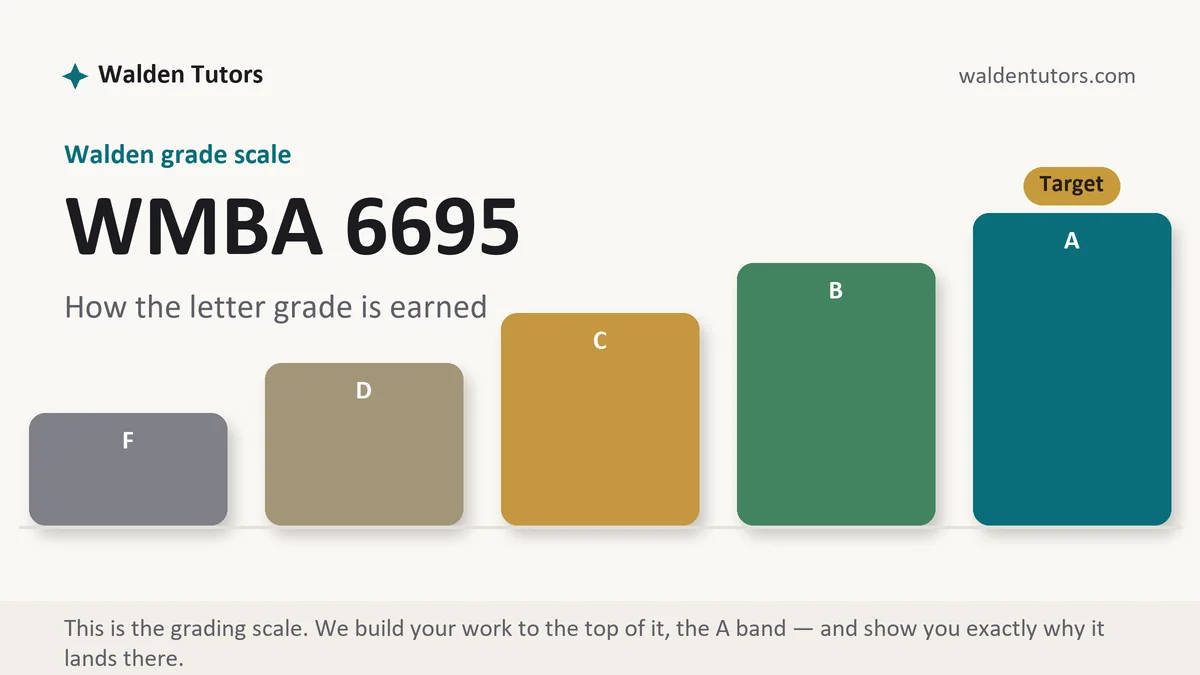
WMBA 6695 grading scale at Walden, how the work is graded, from Walden Tutors
How Walden grades WMBA 6695, visualized by Walden Tutors.

What WMBA 6695 actually grades

The catalog builds the course around the communication process itself, around the way self perception and your reading of other people shape an exchange, around choosing between channels and mediums, and around messages that have to survive a trip across a whole organization. Graded output follows those topics closely. Expect written analyses of an exchange you can describe in real detail, audience work produced before any message is drafted, plans for carrying an unwelcome message through a chosen medium, candid inventories of your own habits as a communicator, and threads that carry scored rows of their own.

Scoring guides here tend to ask the same four things, over and over, in the same order. Name the concept precisely. Attach it to one specific exchange rather than to communication in the abstract. Produce something a reader can check that shows the exchange went the way you claim. Then say what you would change and how anybody would know the change had worked. Those rows add up to a letter, and a paper that is warm, fluent and entirely unsourced claims one of them while giving away three.

What counts as evidence in a communication course

This is the question that decides the grade, and hardly anybody asks it early enough. Three things qualify. Published scholarship qualifies, meaning peer reviewed work on organizational messaging, listening, media choice, or whichever subfield the week sits in. The artifact qualifies: the email as it was actually worded, the agenda as it was actually circulated, the slide that actually went up on the screen, quoted or reproduced rather than recalled. Consequence qualifies too, meaning what people did next, which question got asked twice, what had to be resent.

Impressions do not qualify. A line reporting that the team seemed more relaxed afterwards has nothing beneath it, and a marker reading for proof treats it as padding regardless of whether it is true. Turn impressions into artifacts and consequences before they reach the page. If the team really did relax, then somebody said something you can quote, or a category of message stopped arriving in your inbox, or the follow-up questions took two days instead of two hours.

Anonymise while you gather. Use roles in place of names, an industry in place of an employer, and leave out whatever a confidentiality clause covers. A real exchange with the identifying detail removed beats a fabricated one every time, because the sequence and the discomfort are already sitting there and neither has to be faked.

How we help in this course

Give us three things: the assignment page, whatever the classroom shows you as a scoring guide, and the artifact the week is built around. Back comes a drafted paper in which each statement about an exchange is anchored to something a reader could verify, and each interpretation is anchored to a citation.

Our terms do not change from page to page. Two working days at the outside, drafting aimed at the top band of every row, one reviewer marking the file against your own guide, a second auditing APA and originality before anything is sent, then unlimited free revision until the target is reached.

Communication work rewards one extra attachment. Include something you have written at work, an update note or a short memo, and the draft returns in a register close enough to your own that claiming it becomes a quick pass rather than a rebuild.

Weekly manuals for this course

Week pages for WMBA 6695 have not published here yet. Walden does not put its syllabi on the open web, so a per-week guide is only honest once students in the section report what the deliverable really was. Drop the week you are staring at into chat and somebody will scope it for you within hours. Drafting itself has never waited on a manual, because the work is built from the materials sitting in your own classroom.

In WMBA 6695 right now?

Send the assignment and its scoring guide. First premium sample is free, back inside two days.

Pacing WMBA 6695 across a semester term

MBA coursework at Walden does not sit on the quarter calendar that the nursing programs follow. It runs on semesters. Walden's published Fall 2025 semester opened on September 1 and closed on December 21, a span of 111 days, which divides out to just short of sixteen weeks rather than a clean sixteen. Because the university publishes dates and leaves week counts unstated, that figure belongs to you as arithmetic and should not be quoted as Walden's own claim.

Inside the span, submission times are fixed and quoted in Central. Graded items close at 10:59 p.m. Central, the identical moment as 11:59 p.m. Eastern, and the classroom clock is indifferent to the zone you happen to live in.

An obligation also lands at the very front of the term. You have to turn up in the classroom during the opening week and put up a graded item, either a posted thread contribution or a submitted assignment. That requirement is administrative in nature, and excellent writing in week six does not undo a missed start.

The number of graded items your particular section carries is something only your classroom can answer. Walden itself notes that what a course expects of posting is not fixed, either across courses or within one, which makes the syllabus in your hand the only reliable count.

How to actually write WMBA 6695: where to begin

Begin with the scoring guide rather than the prompt. Break every row out into a blank file as its own heading, and you are holding the marker's outline before a single sentence exists. Check the weight attached to each row and let it dictate how much space that section earns, because effort spent polishing a low value row is money left on the table.

Then choose the exchange you intend to write about, since that choice does most of the work. A workable one has a start you can date, a message you can quote, at least two parties with different stakes, and a result somebody noticed. An unworkable one is a general feeling about how people talk to each other at your company. If the week supplies a case study instead, run the same test on whichever slice of the case you decide to isolate.

Now write a thesis, and make it the sort of claim that could turn out to be wrong. Something in this shape works: the update failed not because the wording was unclear but because it traveled through a channel the audience reserves for low priority traffic, so the whole thing read as optional. That is arguable, and it can be tested against what people did. A promise to examine the importance of effective communication in modern organizations is not arguable, and rubrics do not pay for it.

Build each body section on four beats. State the observable fact. Name the concept that explains it. Bring the scholarship that supports the concept. Say what you would change and how you would tell whether the change worked. Frameworks that carry weight in this course include sender and receiver models with noise accounted for, media richness reasoning about which channel suits which message, audience analysis organized by stake rather than by job title, active listening, and the split between what a message says and what it signals about the relationship. Choose one framework and run it properly instead of listing five.

The move that separates a competent paper from a strong one is putting sources into conversation instead of into a queue. A queue reads like this: a paragraph on what one author found, a paragraph on what another found, then a paragraph about your own case. A conversation reads like this: two bodies of work disagree about whether brevity in written management communication signals respect for the reader's time or signals distance, the email you quoted is brief, and here is which reading the reaction actually supports. Say where your evidence lands and defend the ruling. That sentence is the paper.

Source the scholarship from the Walden Library instead of an open web search. Your tuition already pays for management and communication databases holding the peer reviewed material these rubrics assume you found, and a librarian gets you to a defensible article quicker than a search engine gets you to a plausible one. Every citation should be doing one nameable job. If you cannot say in a short phrase what a given source proves for you, it is decoration and a marker will read it as decoration.

APA 7 carries the rest of the file. Use the Walden title page, hold heading levels at the depth they were built for, keep the author and the year visible in whichever sentence carries the claim, and check that the reference list and the body agree in both directions. Internal company documents are a frequent snag: if the memo you are analyzing was never published anywhere, ask your instructor whether it should appear in the text only. First person is welcome in some parts of this course and unwelcome in others, so read the week rather than assuming.

SectionWhat goes in itThe failure that costs points
Framing the exchangeWho was involved, what was at stake for each of them, when it happened, and what the message was trying to accomplish.An anecdote told at length with no stakes named, so the reader cannot tell what success would have looked like.
The artifactThe actual wording, subject line, agenda or slide, quoted or reproduced, with identifiers removed.A paraphrase from memory, which quietly edits the message into the version that supports your argument.
Audience analysisEach audience segment described by what it needs, what it fears, and what it already believes about the sender.Audience listed as job titles, which tells a reader nothing about how the message would land.
Concept and scholarshipOne named communication framework, explained clearly enough that a reader could apply it themselves, with peer reviewed support.Five theories named in a row and none of them turned on the artifact you supplied.
AnalysisThe framework run over the artifact and the reaction, including the places where the two refuse to line up.Theory stated in the opening, then abandoned while the paper retells the story.
RecommendationThe message you would send instead, the channel you would send it through, and the signal that would prove it worked.Advice to communicate more openly, which nobody could act on or measure.

Discussion posts that earn their row

Threads in a communication course are graded work with their own scoring rows, and they usually ask you to take a scenario or a channel decision and reason about it in public. Write the opening contribution as a compressed version of the paper: the claim, the artifact or scenario detail behind it, the framework that explains it, and the change you would make. Put a citation inside the post. An assured paragraph with nothing cited under it gets marked as opinion by a row that was buying evidence.

Walden's grading policy calls for posts that are substantive, regular and on time, and its recommendation is a spread of two to four days, minimum, instead of one evening spent catching up. Replies score on a separate row, which means agreement earns you nothing. Do something to a classmate's post instead: point out the audience segment they left out and say what that segment would have heard, offer the channel they dismissed and explain what it would have added, or bring the reading of their scenario they stepped around. How many replies count, and when the thread closes, is set inside your classroom, so check the week itself.

Where the citations belong in a communication paper

Citation load in this course falls in two predictable places, and students routinely feed one and starve the other. The first place is the framework: whenever you name a model, a listening technique or a media choice principle, the source belongs in that sentence, not three paragraphs later. The second place is the empirical claim about behavior, meaning any sentence asserting that audiences generally do something, react a particular way, or trust one medium over another. Those are the claims a marker tests hardest, because they are the ones most often lifted from professional folklore.

What happened to you personally carries no citation, though every idea you place on top of it does. A conversation with a colleague that nobody recorded is personal communication, which APA keeps in the text and out of the reference list. An internal policy document, a published corporate report, an industry study: all of those are real sources with real entries. The Writing Center holds the templates Walden actually marks against, and lifting its title page and heading pattern wholesale takes ten minutes while killing off a whole class of avoidable deductions.

The mistakes that cost points in WMBA 6695

  • Writing about communication as a general good rather than about one exchange with a beginning, a middle and a measurable end.
  • Reporting how the room felt instead of what anybody said, did, resent, or asked again.
  • Recommending more transparency or better listening without naming a message, a channel and a signal that would show it worked.
  • Quoting a colleague by name, or leaving in employer detail that the argument never needed.
  • Treating the artifact as background rather than as the object under analysis, so the paper never actually looks closely at any words.
  • Filling the source requirement with practitioner blog posts when the library holds peer reviewed work on exactly the question.

WMBA 6695 questions students actually ask

Can I write about a conversation that actually happened at my job?

Yes, and a real one almost always scores better than an invented scenario, because you can quote the wording and you remember what happened next. Strip the identifiers before you type: roles rather than names, a sector rather than an employer, and nothing covered by a confidentiality agreement. If the episode is still unresolved, or if somebody could be hurt by seeing it in a classroom thread, pick a different one. Where the week supplies a case study instead, apply the same test to whichever slice of the case you choose to isolate.

How many sources does a short communication paper need?

Whatever number the week states is the number that binds, and where no minimum is printed, judge by function rather than by count. Two peer reviewed articles doing real work will outscore six that appear once each and never touch your evidence. A useful check is to delete a citation and see whether the paragraph still stands; if it does, that source was never load bearing. Anything you analyze also needs a home, so remember that the memo, transcript or deck you quote is itself a source and has to be handled as one.

The assignment says analyze a channel choice. What does that actually mean?

It means arguing that the medium changed the meaning, not simply reporting which medium was used. Take the message, name what it demanded of the audience, then explain what the channel added or removed. A layoff delivered by group email removes the chance to answer a question and signals distance. The same words delivered in a room add tone and add witnesses. Write the trade-off in both directions, say which one the evidence supports, then name the channel you would have picked and what would have told you it worked.

Keep going

Online now