Capstone: Sustainable Business Practices and Strategies is the closing course of Walden's MBA, cataloged as WMBA 6990 and printed at three semester credits, with all required core and concentration coursework standing as its prerequisite. It asks you to pull the entire degree into one sustained argument about how a real business should compete, and about whether that way of competing can hold. The effort does not arrive evenly across the term, and the students who end up cornered are almost always the ones who spent the quiet opening deciding what to write about.
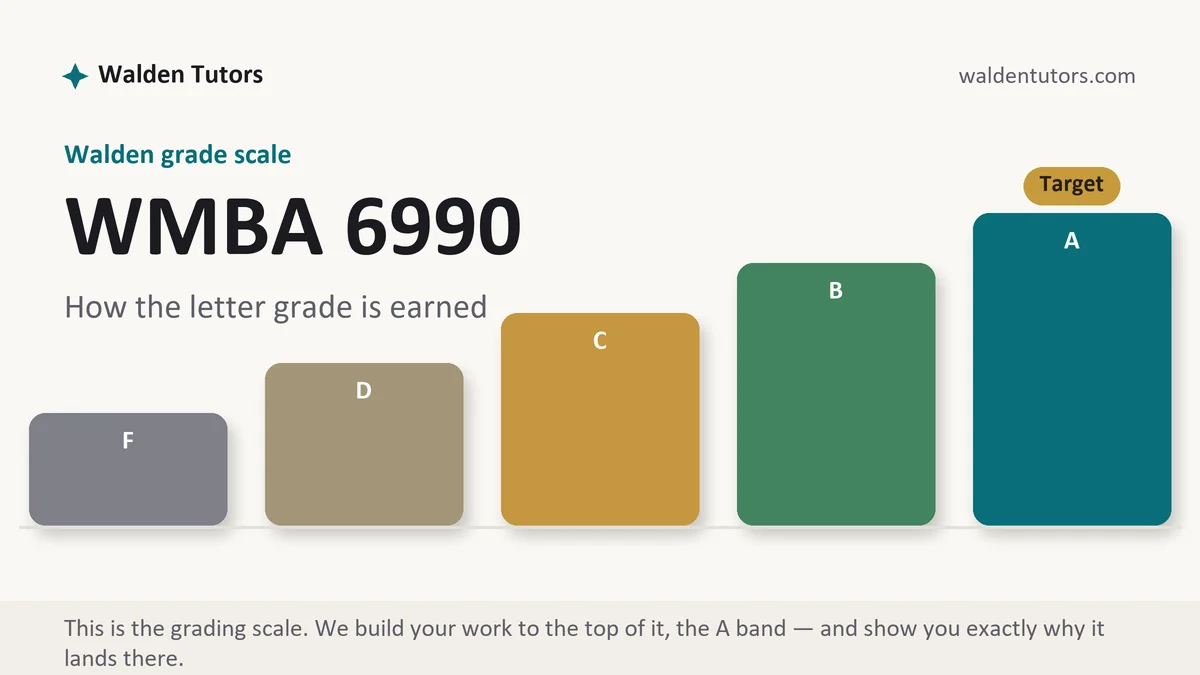
What WMBA 6990 actually grades
The catalog frames this course as integration. You are meant to take the accounting, the marketing, the operations and the leadership material back out of storage and aim all of it at a single problem, weighing strategies that could hold an advantage rather than rent one for a quarter, and naming the openings and the threats sitting inside a business setting that refuses to stay still.
Graded output follows that framing. Expect a sustained analysis of one organization, built in stages and assembled into a final document, sometimes with a presentation or an executive summary traveling alongside it, plus threads carrying scored rows of their own. The exact staging belongs to your section. Walden keeps its syllabi off the open web, so the schedule showing in your classroom is the only version that binds you.
What the rows reward stays fairly steady across capstone scoring guides of this kind. They want analysis resting on figures a reader could go and check rather than on adjectives. They want more than one functional area in play, because a capstone reading like a marketing paper has missed the point of the word. They want a recommendation somebody could authorize, carrying a cost, an owner and an order of operations. And they want the sustainability reasoning welded into the strategy rather than parked in a closing passage about corporate responsibility.
Where the workload spikes, and how to get in front of it
Here is the honest version of the timing. A capstone is back weighted by design. The early stretch asks you to choose, frame and get agreement; the later stretch asks you to produce the artifact carrying most of the points. So the hours you owe each week do not run flat, they climb, and they climb hardest at whatever moment your job and your family have stopped being polite about it.
Which week that lands in is not something anyone outside your section can tell you, and any page naming one is guessing. Open the classroom calendar during the first week, find the two heaviest submissions, and write those dates on a paper calendar where you will see them. That one small act turns a vague dread into something you can plan against.
The work you do early buys the most. Four moves, all of them possible before the pressure shows up:
Choose the organization and test it for data before committing. A capstone dies when the analysis needs numbers the company never published. Run the test in an afternoon. Can you find several years of financial statements or a defensible equivalent, a named competitor set, and the firm's own account of its strategy in an annual report, an investor presentation or a regulatory filing? If two of those three are missing, switch firms now rather than later. If you plan to write about your employer, settle the confidentiality question first, and assume the answer is stricter than you would like it to be.
Build the source shelf before you need it. A dozen or so candidate readings pulled through the Walden Library in the opening two weeks, each carrying a one line note about what it might prove, is the whole difference between writing and hunting. The reference list is the piece that runs late in every capstone ever attempted.
Write a placeholder recommendation immediately. Not because it will survive, but because an analysis aimed at a target finds its evidence faster than an analysis wandering in hope. You are allowed to change your mind. If the position you defend at the end differs from the one you sketched at the start, that is evidence the thinking happened.
Draft everything that does not depend on your conclusion. The organizational profile, the industry description, the methodology note if your week asks for one: none of it waits on your findings, and all of it is worth points already banked.
One administrative demand also lands right at the front. Walden expects you inside the classroom in week one, having actually filed something graded, whether that is a thread contribution or an assignment upload. Missing it is not a writing problem, it is a registration problem, and a brilliant final document does not undo it.
How we help in this course
Send three things and the work begins the same day: the assignment page, whatever scoring guide your classroom displays, and the organization you have chosen along with any data already gathered. If the firm is still undecided, say so, and what comes back first is two or three candidates that survive the data test.
Terms match the rest of the site. Drafts land inside 24 to 48 hours. Writing aims at the top band of every row rather than the comfortable middle. One reviewer marks the file against your own guide the way an instructor will, a second audits APA and originality, and nothing leaves until both have signed off. Revision stays free until the target is reached.
Capstone orders benefit from one extra attachment. Include a paper you wrote earlier in the MBA and the draft returns in a register close to your own, which matters more here than anywhere else in the program, because a final document reading nothing like your previous coursework invites a question you would rather not answer.
Weekly manuals for this course
Per-week manuals for WMBA 6990 are not published on this site yet. Because Walden does not release its syllabi publicly, a week by week guide would be invention dressed as help until students in a live section confirm what each deliverable actually is. Drop the week you are facing into chat and somebody will scope it for you the same day. Drafting has never waited on a manual, since the work is assembled from the materials already sitting in your classroom.
In WMBA 6990 right now?
Send the capstone brief plus whatever your classroom shows as a scoring guide. Nothing is charged for the opening sample.
Pacing WMBA 6990 inside a semester term
The four letters in front of the number are not decoration. A WMBA code puts you in the semester edition of this degree, which is why the catalog prints this capstone at three semester credits rather than a bare count, and it is a different clock from the quarter calendar the nursing programs run on. That difference stops being cosmetic the moment you start planning a capstone. Take the published dates. Spring Semester 2026 opened on January 5 and closed on April 26. Fall Semester 2026 opens on September 7 and closes on December 27. Both windows measure 111 days end to end. Divide by seven and you land just short of sixteen weeks. That figure is arithmetic done on Walden's published calendar rather than a number the university states anywhere, so present it as arithmetic if you repeat it.
Sixteen weeks sounds generous. It stops sounding generous once you account for the fact that no analysis can start until the organization is settled, and no writing can finish until the analysis has. Assume the usable middle of your term is shorter than the term.
Deadlines run on Central time and are indifferent to where you live. A graded item shuts at 10:59 p.m. Central, and anyone in the Eastern zone sees that identical cutoff printed as 11:59 p.m.
How many graded items your particular section carries is a question only your syllabus answers. Walden says outright that what a course demands of posting is not uniform, varying from one course to the next and sometimes inside a single one, which makes last term's rhythm a poor guide. One more identity check is worth thirty seconds: the catalog also lists the same capstone under an MBAX number, where the credit line prints as a bare count with no calendar word attached, so if your classroom shows MBAX rather than WMBA, take your dates from the student portal instead of from this page.
How to actually write WMBA 6990: where to begin
Work backward from the scoring guide instead of forward from the prompt. Paste each row into an empty file as its own heading and you are looking at the outline your grader will fill in. Read the weights and let them hand out your pages, because a row worth a fifth of the points and given a single paragraph is a self inflicted wound.
Then settle the organization, since everything downstream inherits that decision. Publicly traded firms are easier for a reason: the filings cost nothing, competitor data is already compiled, and the company describes its own strategy in a document you can cite. A private employer hands you access and insight along with a permissions problem and a citation problem at the same time. Whichever you pick, write one sentence naming the strategic problem your paper exists to solve for that firm, and keep it visible on your screen for the rest of the term.
Now build the thesis. In a capstone the thesis is a recommendation, and the test of a real one is that a reasonable person could argue the other side. Something in this shape works: margin erosion at this firm is not a pricing failure but the consequence of a supply arrangement that shifts volatility onto it, so the move is restructuring supply before touching price. That claim can be attacked with evidence, which is precisely what makes it worth defending. A promise to analyze the company's strategic position and offer recommendations is not a thesis, it is a table of contents.
Structure the argument so each part earns the next, and work outside in. External first: the industry, the pressures acting on it, the rivals and what they are doing differently. Internal second: resources, capabilities, cost position, and the assets a competitor would find expensive to copy. The gap third, where those two halves collide and the real problem becomes visible. Options fourth, at least two credible ones, so a reader can watch a choice being made. Recommendation fifth, with a sequence, an approximate cost and named owners. Measurement last, because a recommendation with no indicator attached cannot be judged by anybody, including you.
Frameworks are tools rather than exhibits. Two used properly beat six listed in a row. Run an industry structure analysis and a resource based reading of the firm, then set them against each other: the industry work says the segment is unattractive, the internal work says this company holds something that changes its position within it, and suddenly there is an argument on the page. That collision is the paper. A capstone presenting five framework diagrams while never letting any of them contradict another has summarized rather than analyzed.
Sustainability needs its own instruction, because the course title gets misread here more than anywhere else. The word is doing double duty. It means an advantage that persists, and it also means practices that do not consume the environmental, social and financial base the firm depends on. Scoring guides usually want both, and want them inside the strategy rather than bolted onto the end. So do not write a closing section on corporate responsibility. Write the sustainability variable into the analysis itself: regulatory exposure that bends the cost curve, a labor practice that changes retention and therefore unit cost, a resource dependency making the supply chain fragile, a reputational asset changing what customers will pay. Stakeholder reasoning and triple bottom line accounting are both legitimate structures for that, provided every claim underneath them carries a number or a source.
| Section | What it does | The failure that costs points |
|---|---|---|
| Organization and problem statement | Names the firm, its setting, and the single strategic problem your paper exists to solve. | A company profile reading like an About page, with no problem ever stated. |
| External analysis | Industry conditions, competitive pressure and rival behavior, evidenced with figures and dated sources. | A general description of the sector, no competitor named, no number attached anywhere. |
| Internal analysis | Resources, capabilities, cost position, and the assets a rival would find expensive to copy. | Strengths and weaknesses listed, with nothing explaining why any of them are hard to imitate. |
| The gap | Where outside pressure and inside capability fail to meet, written as the thing that has to change. | Two analyses sitting side by side, never once brought into contact. |
| Options and recommendation | At least two credible courses of action compared against stated criteria, with one chosen and defended. | A single option presented as inevitable, so the reader never sees a decision happen. |
| Implementation and measurement | Sequence, approximate cost, owners, and the indicators showing whether any of it worked. | Advice to improve efficiency and strengthen the brand, which nobody can schedule or measure. |
| Sustainability integration | Environmental, social and governance pressure treated as an input to the strategy and to its risk. | A responsibility section that could be lifted into any other paper without changing a word. |
Sourcing a strategy argument through the Walden Library
Business capstones fail their citation rows in one particular way: plenty of sources, none of them load bearing. Every citation should have a job you can state in six words. Company data proves the condition. Peer reviewed work proves the mechanism. Industry reporting proves the context. A source doing none of those three is filling a count, and a marker reads it as exactly that.
Use the library rather than a search engine. Tuition already buys you management and strategy databases stocked with exactly the peer reviewed literature a capstone rubric quietly assumes you located, plus company and industry report services an open search will only show you the paywall for. A business librarian will put a usable industry report in your hands faster than an hour of your own clicking.
Corporate documents want care under APA 7. An annual report, a regulatory filing and a press release are all citable, each with its own reference shape, and the year that counts is the year of the document rather than the year you happened to open it. Anything you learned from a colleague and cannot point a reader toward is personal communication, which lives in the text and never in the reference list. Take the Writing Center title page and heading pattern as issued, because arguing with a grader about formatting is a fight with no upside.
Discussion posts in a capstone course
Threads here are scored separately, and they usually ask you to expose your own project to the room: your firm, your framework choice, the recommendation taking shape. Treat that as free consulting rather than as an errand. Post the actual claim with the actual evidence sitting under it, cite inside the post, and name the part you are least confident about. A classmate finding the hole early is a gift. An instructor finding it in the final document is not.
The university's grading policy wants posting that is substantive, regular and punctual, and it recommends touching the thread on two to four different days at minimum instead of pouring everything into one late evening. Replies carry their own row, which means a reply that agrees has earned nothing at all. Take a classmate's recommendation and stress it instead: ask what happens to their numbers when the assumption underneath moves, name the competitor response their plan would not survive, or point at the functional area their analysis never opened. Your own section sets the reply quota and picks the hour a thread closes, so lift both figures off the week page instead of trusting recall.
The mistakes that cost points in WMBA 6990
- Picking a company you admire instead of one you can get data on, then padding the analysis with press coverage because the filings never existed.
- Running six frameworks in sequence and allowing none of them to disagree, which produces length without producing an argument.
- Treating sustainability as a closing paragraph about values rather than as a variable moving cost, risk or demand.
- Recommending a strategy with no cost, no sequence and no owner, so nobody could act on it even if they wanted to.
- Writing an implementation plan and stopping before the measures, leaving a reader unable to separate success from failure.
- Recycling an earlier course paper because the topic overlaps, which the originality check reads exactly the way it looks.
- Saving integration for the final week, so the assembled document still reads like the separate assignments it used to be.
WMBA 6990 questions students actually ask
Which organization should I build the capstone around?
The one with data, not the one with a story. Before you commit, spend an afternoon checking whether you can get several years of financial statements or a credible equivalent, a named set of competitors, and the firm's own written account of its strategy. If you cannot find two of those three, the analysis will thin out somewhere around the middle of the term, and no amount of writing skill repairs that. Your own employer is workable when the confidentiality position is clear and settled in advance, and unworkable the moment it is not.
How recent do the sources have to be for a strategy paper?
Split them into two piles. Financial and market data should be as current as the filings allow, because a competitive claim resting on figures from five years back is describing a company that no longer exists. Theory ages far more slowly, and a foundational strategy article from decades ago is often the correct citation for a mechanism rather than a lazy one. If your rubric prints a recency rule of its own, that rule outranks every suggestion made on this page. Whenever you cite something dated, say in the sentence why the date is the right one.
Does sustainable here mean environmental?
It carries both meanings at once, and reading it as only one is the most common misfire in this course. A strategy is sustainable when the advantage holds up under competitive attack over time, and it is also sustainable when the practices producing it do not exhaust the environmental, social and financial base underneath. Strong capstone answers join the two instead of separating them: the resource dependency that raises long term cost, the labor practice that surfaces in turnover figures, the compliance exposure a rival has already priced in.