MMHA 6400 Tempo assessment workflow
One honest manual for every registered assessment in this Tempo course: inventory the live task, map its rubric, demonstrate the course reasoning, and protect the student's attempt.
Walden's active catalog verifies the Tempo or competency context but does not publish a universal assessment count for MMHA 6400. A numbered public sequence would be fiction. This page begins with the registered inventory and applies the same controlled method to each real assessment the student sees.
1. Inventory every live assessment
Inside the registered Tempo environment, list each active competency and assessment exactly as displayed. Record whether Walden labels it a Work Product, Performance Task, Short Answer Assessment, Selected Response Assessment, or another current type; capture the full instructions, rubric, status, prerequisite, evidence requirements, templates, permitted resources, attempt state, feedback, and submission controls. Do not infer a missing assessment from another learner's sequence.
| Inventory field | Live value to record |
|---|---|
| Identity | Competency, assessment name, type, version, and status |
| Task | Every action, audience, artifact, scenario, and required part |
| Rubric | Criterion, performance levels, evidence, and current designation rules |
| Attempt | Attempt number, prior feedback, eligibility, and appeal state |
| Dependencies | Readiness work, field or identity-controlled steps, template, and approvals |
| Delivery | Format, submission route, target date, receipt, and evaluator feedback |
2. Convert the live rubric into evidence
Create one row per rubric criterion. In the next columns write the exact evidence the student must produce, the reasoning operation, where it will appear, the live performance-level language, the current gap, and the revision test. Never substitute a remembered “Mastered formula” for the rubric attached to this assessment; grading policy and the registered rubric jointly control the result.
3. Use the quantitative decision work method
The durable question for this course is: Which decision does the number inform, and what assumptions make the result valid?
Show inputs, units, formula or analytical rule, intermediate result, interpretation, sensitivity, and decision. A correct number without a defensible meaning is unfinished.
Practice on parallel material before applying the method to the student's actual task. For selected-response work, teach concepts and retrieval rather than recording protected questions. For written or performance work, use diagnostic questions and feedback while the student authors and executes the response.
4. Build a traceable evidence set
Separate source data from calculated fields, label units and periods, cite external benchmarks, and keep enough working detail for another reader to reproduce the result.
Maintain a source ledger with the claim, source, authority or design, date, useful finding, limitation, and citation. Use assigned resources whenever the assessment requires them. Do not add citations as decoration; each source must perform a visible job in satisfying the live criterion.
5. Protect each student attempt
Before submission, reconcile the attempt state and all evaluator feedback. Do not resubmit unchanged work, and do not spend an attempt to discover requirements that were already visible in the rubric. The student should be able to explain every decision, calculation, source, and limitation. Where Walden requires an appeal, field action, identity check, or other institutional step, use the official process rather than treating it as a writing problem.
6. Run the assessment quality gate
Recalculate independently, test signs and units, inspect reasonableness, and reconcile every table or figure with the prose recommendation.
Then check every live instruction, rubric criterion, performance level, citation, calculation, template field, format, accessibility requirement, confidentiality boundary, and submission control. Confirm that clinical, field, research, collaborative, proctored, or identity-controlled activity was completed by the student and truthfully represented.
7. Turn evaluation into the next pass
After evaluation, copy criterion-level feedback into the rubric matrix, classify the gap as understanding, evidence, reasoning, completeness, calculation, communication, or process, and plan the smallest revision that actually resolves it. Preserve the lesson for the next competency without copying previously submitted language into a different task.
Student ownership and tutoring boundary
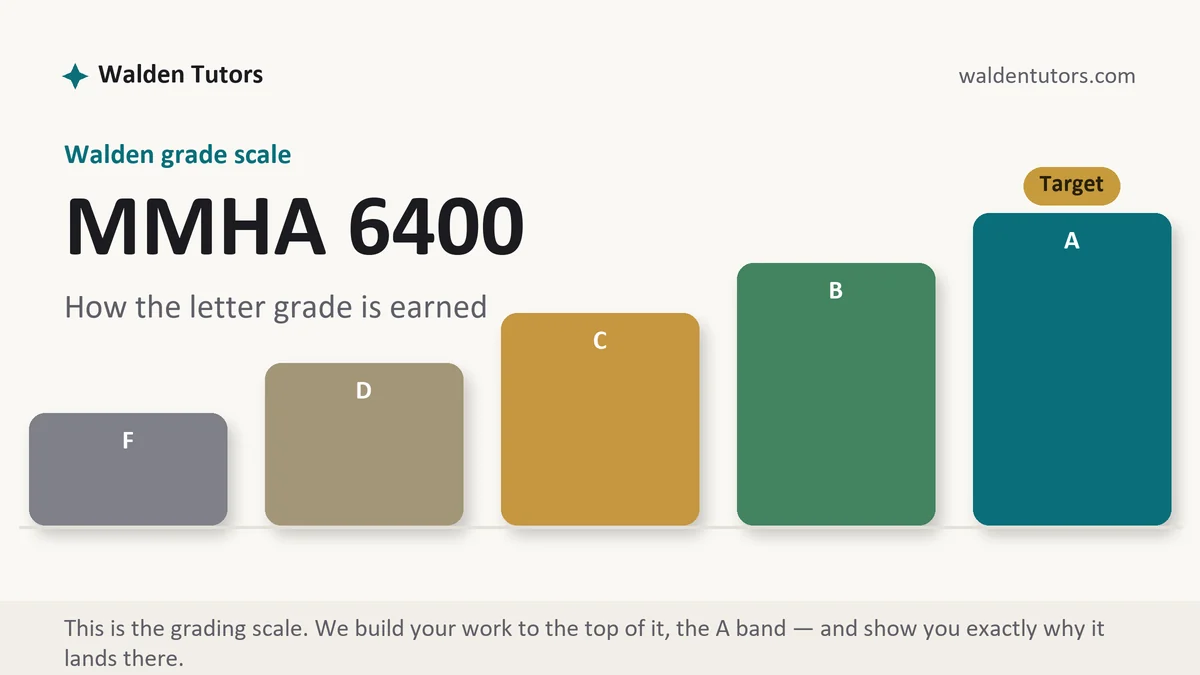
Tutoring can explain concepts, model a method on parallel material, build a learning plan, ask diagnostic questions, and critique student-authored work. The student completes the learning, decisions, calculations, identity-controlled activity, field or clinical work, verification, authorship, personalization, and submission. Walden and its evaluators determine Achieved, Mastered, Not Achieved, attempts, appeals, and progression.
Before submission, the student should explain each live criterion, the evidence provided, the judgment made, the important limitation, and how prior evaluator feedback changed this attempt. Any point that cannot be explained returns to practice before the attempt is used.
Source boundary
Walden's active catalog verifies this Tempo or competency course context. The official delivery and grading policies explain the system. Only the registered environment verifies the current competency, assessment identity, rubric, status, attempt, and feedback, so this manual never assigns a public assessment number.
Tempo questions
How many assessments are in MMHA 6400 Tempo?
The public catalog does not establish one universal count. Open the registered competency inventory and capture every active Work Product, Performance Task, Short Answer, or Selected Response item shown there.
What is the difference between Achieved and Mastered?
Walden's Tempo grading policy controls the designations. Use the current rubric and policy; do not assume a percentage or row target from an older page or a different competency.
Who completes the assessment?
The student completes the learning, decisions, identity-controlled activity, authorship, verification, and submission. Tutoring may teach the method and give feedback on student-owned work.