Early in an adult primary care course the container matters as much as the contents. The university expects every student to log in and submit something graded before the opening week of a term is out, which gives this stretch a floor of its own. What you are learning at this point is the shape of an episodic visit note: a chief complaint in the patient's own language, a history of present illness that argues instead of listing, and negatives recorded because a later section will lean on them. A small acute complaint is the usual vehicle.
Placing note architecture at the front is our own teaching sequence, drawn from how the tutors here walk students into primary care, and not a running order Walden has released. The university keeps syllabi off the open web and parks course guides behind a student login. Whether this stretch of your term holds a discussion thread, a graded write-up, or one of each is a question only your classroom answers. Typed as NRNP6531 or as NRNP 6531, the search lands on this manual either way.
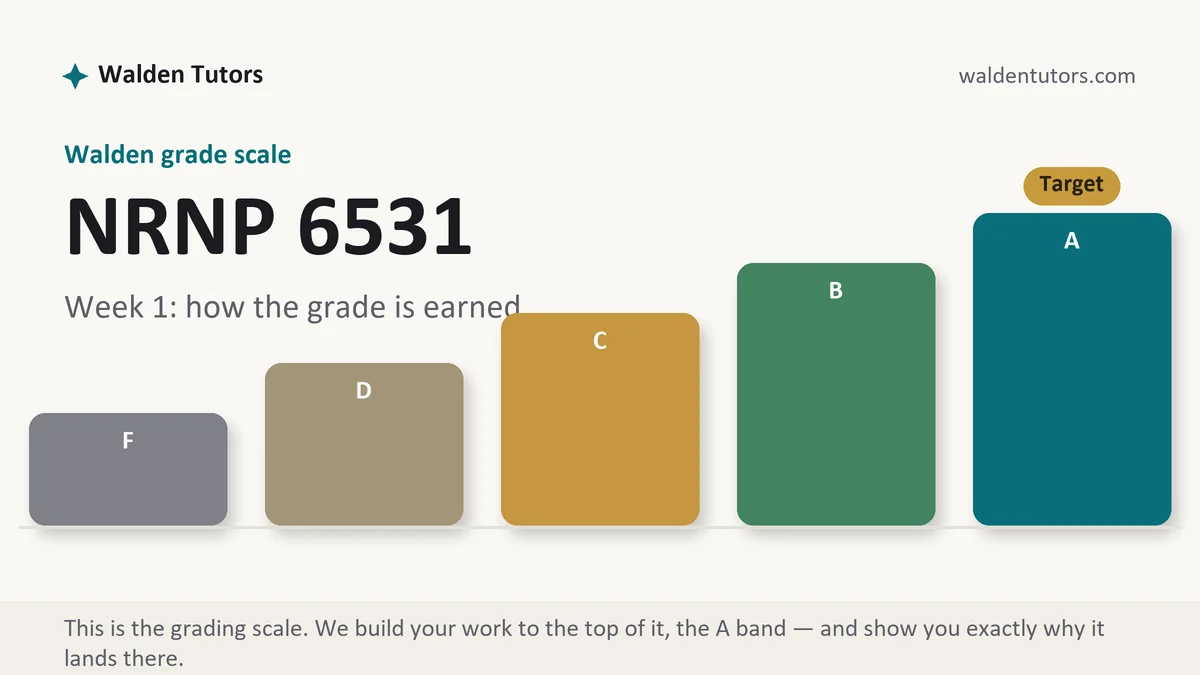
How the opening stage is scored
Your final letter here is stitched together from rubric rows, and each of those rows names one thing the grader has already committed to looking for. Read the weight printed beside every row and let it set the size of the section underneath it, because two rows carrying very different point values should never receive matching paragraphs.
Documentation rows in a first case reward fidelity to the template your classroom posted. Headings in the order the form gives them, subjective and objective kept apart, and nothing invented to fill a field the case never mentioned. Graders working through thirty notes move fastest on the one that matches the form they are holding.
Where a discussion is attached, participation is judged as conduct as much as content. University policy asks for contributions that are steady, substantive and delivered on time, and it points students toward spreading posts over at least two to four separate days. Walden also states outright that posting expectations differ between courses and even inside one course, so read the classroom rather than trusting last term's rhythm.
Reading the rubric row by row
Before the first sentence of the note gets written, open the rubric attached to your own shell and read it the way a grader will: one row at a time, top column first. The top column of each row is a description of finished work, so turn it into a question and put that question to your draft. In an opening-week rubric the rows tend to shadow the sections of the note itself, which makes the mapping nearly one to one: a row about the history is asking whether every element of your named framework was answered, and a row about documentation is asking whether the posted template survived contact with your case.
Pay attention to the space between adjacent columns. The difference between the top level and the one beneath it is usually a named absence rather than a difference in polish: an element left unanswered, a negative never recorded, a heading quietly dropped. Fixing those absences is mechanical once they are listed, which is why the row-by-row read pays better than another hour of wordsmithing.
Treat all of this as method rather than prophecy. Row names, weights and even the number of rows shift between sections and terms, and the rubric in your classroom is the one that decides. When a row reads ambiguously in the opening week, asking the instructor early is itself a habit worth building now.
The opening-week method, step by step
Six moves that take a blank template to a note another provider could pick up cold.
-
Rebuild the posted template as your outline
Copy the classroom's note form into an empty document and leave every heading standing, including the ones this case will barely fill. A heading deleted because it looked empty is the field a grader scores as missing.
-
Fix the chief complaint in the patient's own words
One quoted phrase and a duration, nothing diagnostic. Writing pharyngitis where the patient said their throat hurts when they swallow moves your conclusion into the first line, and everything below then reads as an argument for something already decided.
-
Drive the history through one named framework
Onset, site, duration, quality, what worsens it, what eases it, timing and severity, or whichever mnemonic your faculty prefers. Name the framework, follow it, and answer every element rather than the four that came easily.
-
Choose pertinent negatives that pay off later
A negative earns its place when it will move a differential further down the page. No drooling, no stridor, no one-sided neck swelling: each of those is working. Absence of joint pain in a throat complaint is filler.
-
Keep judgment out of the objective section
An observer records an erythematous posterior pharynx with tonsillar exudate. An observer does not record that the throat looks infected. The second version borrows from your assessment and quietly costs points in two rows at once.
-
Hand the note to an imaginary colleague
Read it as somebody meeting this patient for the first time tomorrow morning. If they could not reproduce your reasoning or find the next step without asking you something, the gap you feel is the one your grader will circle.
Worked reasoning: writing the history backwards from the assessment
Take the sore-throat presentation this manual uses as its running example and watch how the argument assembles. The history you are about to write will be spent later, in the assessment, so decide first what the assessment will need to say and gather accordingly. Three days of worsening pain gives the timeline an acute shape. Pain that is sharply worse on swallowing solids locates the problem and grades its severity in the same breath. The ibuprofen already tried at home tells the reader what has failed, which is a fact the plan must answer.
Now run the same logic through the negatives. The absence of cough and nasal drainage is not trivia; it is an argument that will move one diagnosis above another when the differential is ranked. The absence of drooling and stridor is a safety statement. Every negative you record should be one you can point to later and say: this line did work further down the page.
That is the whole difference between a history that argues and a history that lists. A list answers the framework. An argument answers the framework while quietly setting up every claim the rest of the note will make, and a grader who has read thirty lists will recognize the argument in the first paragraph.
A structure the rubric rows can be read against
The shape an adult episodic note usually takes. Section sizes below are planning advice from our desk rather than anything the university mandates.
| Section | What belongs in it | What the row rewards |
|---|---|---|
| Chief complaint | The reason for the visit in quoted words, with how long it has been going on. | A single line naming a symptom rather than a diagnosis, handing the grader a timeline immediately. |
| History of present illness | The whole symptom story worked through a named framework, plus everything already tried at home. | Every element of the framework answered, including the ones the case forces you to mark as unknown. |
| Past history, medications, allergies | Relevant conditions, surgeries, current prescriptions with doses, over-the-counter products, and allergy reactions. | Selection that shows judgment, where each item listed has a plausible bearing on today's complaint. |
| Review of systems | Constitutional findings and the systems this complaint could involve, recorded as positives and negatives. | A review that does not simply restate the history and stays inside systems the case can support. |
| Objective | Vital signs, general appearance, and the focused examination of the systems in question. | Findings written the way an observer would see them, with normal structures named rather than skipped. |
| Assessment and initial plan | A working diagnosis, two or three ranked alternatives, and the first steps in management. | Each ranking argued from a line already written above it, each plan element attached to the diagnosis it serves. |
Annotated sample excerpt
What follows is our own writing, pitched at the depth a history row expects. Study the moves, then run them across your own case.
A 34-year-old presents with a sore throat that began three days ago and has worsened daily, described as a raw burning pain rated seven out of ten and sharply worse on swallowing solids.1 She reports subjective fever and tender swelling under the jaw, denies cough, hoarseness, nasal drainage and shortness of breath, and has taken ibuprofen every eight hours with partial relief.2 A colleague at work was treated for a streptococcal infection last week; she has never had a tonsillectomy, has no rash, and is handling her own secretions without difficulty.3
- 1Onset, progression, quality, severity on a stated scale and the aggravating factor all appear before any diagnosis is hinted at, which is the order a history row is read in.
- 2The negatives are chosen rather than sprayed. Cough and nasal drainage point away from a bacterial cause, so recording their absence is an argument the assessment will collect later.
- 3Exposure, surgical history and two safety negatives close the paragraph. Naming what the patient can still do tells a grader that severity was assessed rather than assumed.
Send your own opening case and the free draft comes back with the history carried to this depth and every negative earning its keep.
Source work for a first case write-up
Scholarly, for a note like this one, means clinician-facing material: current clinical references, peer-reviewed journal articles, and the texts your classroom assigned, rather than consumer health pages written for patients. The named history framework you drive the interview with came from somewhere, and so did any normal value or examination standard you rely on, so each deserves a citation a grader could follow back to its origin.
Work the source in at the point where it does its work, not in a decorative cluster at the end of a paragraph. A citation sitting beside the sentence that borrowed the idea reads as evidence; the same citation parked at the paragraph's edge reads as furniture. Format each entry in whatever style your classroom requires, and start a running reference list in week one, because the file you build now becomes the seed of every later week's list.
Five mistakes that cost points on a first case write-up
- A history of present illness written as a list. Seven fragments under seven labels satisfies the mnemonic and fails the row, because the story being scored has to run as prose.
- The review of systems used as a second history. Repeating the same sentences under a new heading wastes a row and suggests the two sections were never understood as separate jobs.
- Identifiers carried over from a real clinic patient. Names, service dates and the facility never belong in coursework; an age band, a sex and the clinically relevant history are all any rubric asked for.
- Fields deleted because the case was quiet. An empty heading with the word denied beneath it scores; a missing heading does not, and this is the cheapest score in the assignment to give away.
- A plan with no follow-up interval. Even a straightforward acute visit ends by saying when to come back and what should bring the patient back sooner.
Quieter pitfalls in an opening-week note, with the fix for each
The first pitfall is inheritance. Students read a stack of sample notes before drafting, and phrases from those samples drift into the new note carrying details that belong to somebody else's patient: a finding never made, a duration that contradicts the case. The fix is sequencing: outline from your own case facts first, and only then read models for technique, the way this manual's excerpt is meant to be read.
The second is the timeline contradiction. The chief complaint says three days, the history implies a week, and the review of systems mentions a month of fatigue nobody explains. Graders notice, because contradiction is the easiest thing on a page to notice. The fix is one deliberate pass reading only the time expressions, reconciling every one of them against the case.
The third is the leftover scaffold. Templates arrive with bracketed placeholders and instructional text, and a surprising number of first submissions still contain one. The fix takes a minute: search the final file for brackets and for any sentence addressed to the student rather than written by one, then delete what you find.
Pre-submission checklist
- The chief complaint is quoted and carries a duration
- Every element of the named history framework is answered
- Each pertinent negative has a job in the assessment below
- The objective section contains no interpretation
- All patient identifiers have been stripped from the case
- The plan closes with education, follow-up and a return threshold
First case write-up due this week?
Send the prompt, live rubric, de-identified case material, and your current note; criterion-mapped feedback can return inside a day or two. To be plain about scope: tutoring reviews student-authored academic work and its reasoning. It never enters a live patient encounter or a clinical evaluation.