An abdominal complaint in an ambulatory adult is a sorting problem. Most of what walks through the door is benign, a small share is urgent, and the writing has to show you knew which was which before deciding where the patient went. Expect a region and a timeline, a full sweep of alarm features, a differential built from the structures lying under the pain, and a diagnostic list where every entry says what it would settle.
Putting gastrointestinal presentations at this point reflects how we teach the acute half of primary care, and it is our judgment rather than an official Walden ordering; the university does not post its syllabi openly and the course guide needs a login to reach. Depending on the shell you are looking at, the material may arrive as a discussion, as a case submission, or as both together. Either rendering of the course code, spaced or run together, finds this page.
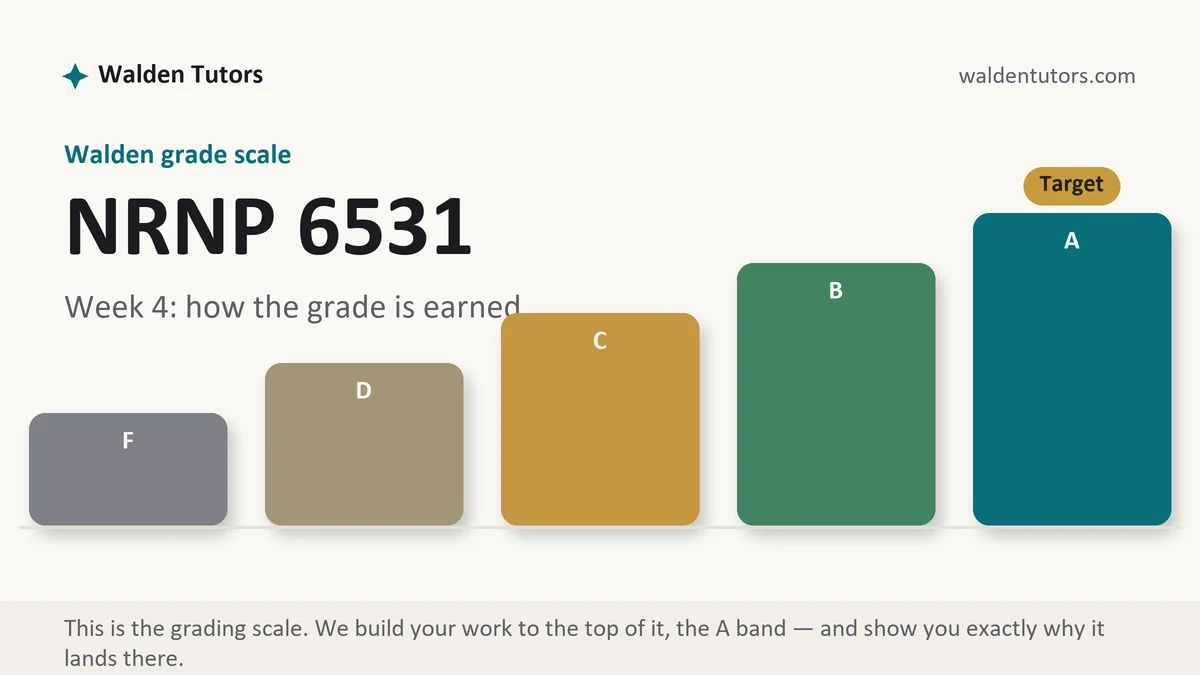
How an abdominal case is graded
The subjective row is scored on completeness of the alarm sweep. Unintentional weight loss, trouble swallowing, vomiting blood or coffee grounds, black or bloody stool, persistent vomiting, a palpable mass, anemia and a first presentation in an older adult: recording each as present or absent is what turns a history into a screen.
The assessment row wants anatomy doing the organizing. Epigastric, right upper quadrant, periumbilical, suprapubic and left lower quadrant each generate their own shortlist, and a differential ignoring where the pain actually sits reads as memorized material.
Diagnostics are graded on purpose rather than volume. Ordering a panel is easy; writing what a lipase result, an ultrasound or a stool study would confirm or exclude is exactly what that row was written to reward.
Reading the rubric row by row
By the middle of the acute block, a rubric expects the note architecture to be automatic, and an abdominal rubric is best read with the sorting problem in mind, row by row. The subjective row is graded, as this page says, on the completeness of the alarm sweep, so its top column is really a checklist wearing prose: count your recorded positives and negatives against the full list before deciding the row is done. The objective row pays for named maneuvers with individual results. The diagnostics row pays for purpose clauses, and the plan row for a destination stated in plain words.
Use the weights to set your drafting order, not just your word counts. If the assessment and diagnostics rows carry the points in your section's version, write those sections first, while your reasoning is freshest, and let the smaller rows take the end of the evening. A paper drafted in rubric-weight order almost always spends its quality where the grade lives.
And keep the standing caution: the rows described here are the pattern our desk sees, while the rubric attached to your own classroom is the authority. When the two disagree, the classroom wins, every time.
The abdominal complaint method, step by step
Six moves that make a gastrointestinal case read as a triage decision with a paper trail behind it.
-
Pin the pain to a region and a clock
Where it began, where it sits now, whether it traveled, and how it behaves across a day. Migration and timing are two of the most discriminating facts available and both cost nothing to collect.
-
Run the alarm-feature sweep in one documented pass
Ask the whole list, record every answer, and do it before committing to a benign explanation. A negative sweep written out is evidence; a sweep performed in your head is nothing.
-
Tie the pain to what the patient eats, takes and does
Relationship to meals, alcohol, anti-inflammatory use, recent antibiotics, travel and bowel pattern. Several common diagnoses in this region are made almost entirely inside this part of the history.
-
Record the maneuvers you actually performed
Name each test and name its result. Guarding, rebound, tenderness at a specific point, an enlarged organ edge or costovertebral angle tenderness are all worth more written singly than summarized as an unremarkable abdomen.
-
Build the shortlist from anatomy, then promote what cannot wait
Begin with the organs sitting beneath the painful area, then move any time-critical possibility high enough that your plan has to address it, and say why it still holds the position you gave it.
-
Give every test a job and the patient a destination
Laboratory work and imaging each take a purpose clause, and the note ends by saying whether this adult goes home with a review date, to imaging today, or to emergency assessment now.
Worked reasoning: the same pain, three different papers
Consider how the method above actually discriminates. Epigastric pain with nothing else attached could sit over three different structures, and the history is what separates the candidates. Tie it to meals and the gastric story strengthens. Add a long anti-inflammatory habit from the context step and one diagnosis gains a mechanism. Let one alarm answer come back positive, black stool for instance, and the entire register of the paper changes: the shortlist reorders, the diagnostics acquire urgency, and the disposition sentence stops being routine.
Migration works the same way. A pain that began in one region and settled in another is a moving fact, and the note that records both positions holds evidence the static description never collects. This is why the method insists on a region and a clock before anything else: the discriminating facts are cheap to gather and expensive to skip.
The drafting lesson is to let each of these facts visibly move something. A history detail that changes nothing downstream is either padding or an unexploited clue, and a grader reading closely can tell which paper knew the difference.
A structure for an ambulatory abdominal note
The sections a gastrointestinal case usually needs. The weighting we suggest is a planning aid and not a university requirement.
| Section | What belongs in it | What the row rewards |
|---|---|---|
| Subjective, pain history | Site, migration, character, severity, timing, relation to meals and to bowel habit, and whatever has helped. | A pain story specific enough that the region alone already suggests three candidates. |
| Subjective, alarm features | The full screen, recorded as explicit positives and explicit negatives. | A complete sweep on the page, which is the whole difference between a screen and an impression. |
| Subjective, context | Medications including anti-inflammatories, alcohol, travel, recent antibiotics, family history of bowel or gastric disease. | Context that changes the ranking, gathered before the ranking gets written. |
| Objective | Vital signs, appearance, abdominal findings by region, and the named maneuvers with their results. | Individual findings rather than a global verdict, with the quiet areas recorded too. |
| Assessment | A working diagnosis with ranked alternatives, including any dangerous possibility not yet excluded. | Ranking argued from region, timeline and alarm status working together. |
| Plan | Laboratory tests, imaging, empiric therapy, red flags and disposition. | Every order carrying its purpose, and a stated destination for the patient today. |
Annotated sample excerpt
Below is a purpose clause from our own writing desk, doing the work that row was built to reward. Use the shape on your own orders.
A complete blood count is requested to look for the anemia that would raise the priority of the bleeding possibilities and change today's disposition, and a comprehensive metabolic panel will show whether transaminases and bilirubin support a biliary rather than a gastric origin.1 Lipase is included specifically to exclude pancreatitis, which sits third on the differential and is the one entry that would move this patient out of ambulatory management altogether.2 Stool antigen testing for Helicobacter pylori is deferred until the anti-inflammatory has been stopped for two weeks, because a result drawn now would be hard to interpret against the current medication history.3
- 1Two tests, two distinct jobs, and both jobs are phrased as consequences. Naming what a result would change is what separates an order from a shopping list.
- 2The test is tied to a specific position on the differential and to the disposition decision, which links the diagnostic row and the plan row inside one sentence.
- 3A deliberate omission is documented with its reason and its timing. Graders credit restraint when the note explains it, while unexplained absence simply looks like forgetting.
Send the abdominal case in front of you and the free draft returns with the alarm sweep complete and every order justified in this way.
Building the evidence base for a GI write-up
Scholarly support in this territory means current gastroenterology and primary care guidance, the peer-reviewed studies behind alarm features, and proper pharmacology references for the medication risks your history uncovers. The anti-inflammatory connection your context questions establish deserves a citation a grader could open, and so does the threshold at which any test or referral becomes indicated. Lecture slides and course announcements, whatever their accuracy, are classroom ephemera rather than citable literature, and rubrics that ask for scholarly support mean the published kind.
Then put the citations where the decisions happen. The natural home for a source in this paper is inside a purpose clause: the sentence explaining what a result would change is precisely the sentence that should name the evidence saying so. Sources threaded through the reasoning read as method; sources gathered at the end read as an afterthought, and the difference is visible in one glance.
Five mistakes that lose marks on a GI case
- An abdomen described as soft and non-tender, full stop. Region-by-region findings and named maneuvers are what the objective row is actually buying.
- Alarm features asked about but never recorded. If the negatives are not on the page, a grader has to assume the questions were never put to the patient.
- Anti-inflammatory and alcohol history missing. Two of the commonest contributors to upper abdominal pain, and each of them is a single question.
- A dangerous diagnosis deleted rather than ranked. Leaving it on the list with a reason for its position is stronger writing and safer practice at the same time.
- No disposition sentence at the end. Home with a review date, imaging today, or emergency assessment now: the note has to choose, in writing.
Traps specific to abdominal write-ups, each with its repair
The first trap is the premature shortlist. The differential gets drafted the moment the region is known, the alarm sweep is transcribed afterwards, and nobody goes back, so a positive answer sits in the history while the ranking still assumes it was negative. The repair is sequence: rank only after the sweep is on the page, and reread the ranking once against every recorded answer.
The second is the circular purpose clause. A complete blood count ordered to check the blood count is a sentence shaped like reasoning with nothing inside it. The repair is to phrase every clause as a consequence, the way the sample above does: name the finding the test could produce and the decision that finding would change, and the row is earned instead of imitated.
The third is the hedged disposition. Papers end by sending the patient home while also gesturing at the emergency department, leaving the actual decision to the reader. The repair is to commit to one destination today and make the alternative conditional on a named finding: home with a review date, and to urgent assessment if the stated threshold is crossed. That single sentence structure resolves the hedge without abandoning the caution.
Pre-submission checklist
- Pain site, migration and timing are all documented
- The alarm-feature screen appears with positives and negatives
- Medication, alcohol and travel context is on the page
- Examination maneuvers are named individually with results
- Every test carries a clause about what it would change
- The note states where this patient goes today
Abdominal case due and the clinic ran long?
Send the assignment, live rubric, and your current draft; criterion-mapped feedback can return within a day or two, with the alarm sweep and rationale for each order checked. Tutoring reviews student-authored coursework only. It documents no live patient encounter and forms no part of a clinical evaluation.