This is where the course changes gear. An acute complaint ends with a disposition; chronic disease management ends with a system, and hypertension is the cleanest place to learn one. The work asks you to confirm a pressure before treating it, stage it against the guideline you intend to cite, estimate cardiovascular risk and record the figure, choose a first agent that respects the patient's other conditions, and build a monitoring schedule that says what happens when the target is missed.
We move into chronic disease at this point because it is the sensible place for it inside a primary care sequence we designed ourselves, not because any order of topics has been posted; syllabi here are not public and course guides require a student account. Your own shell decides whether this material is discussed, submitted as a written case, or handled in both forms. NRNP 6531 and NRNP6531 both lead to this page.
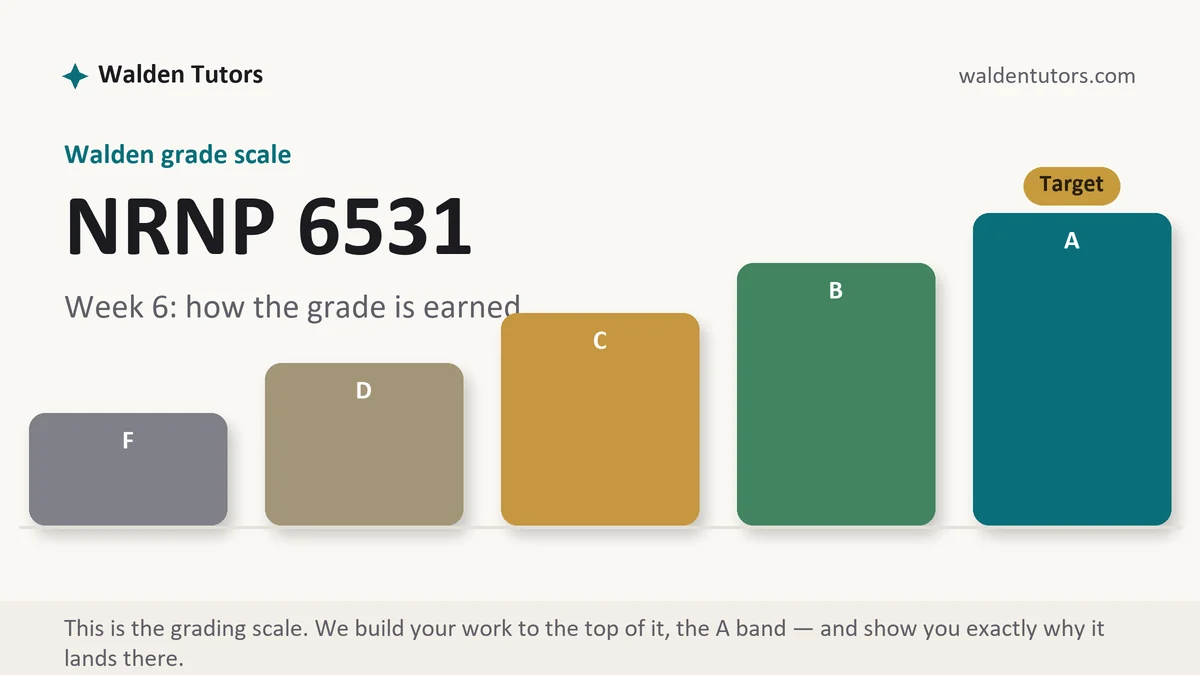
How a hypertension case is scored
Numbers on the page carry the first rows. Readings with the arm, the position and the cuff conditions attached, a stage named against a cited threshold, and a risk estimate reported as a percentage. Chronic-disease rubrics are built to be checked against figures, and prose without them scores as narrative.
Guideline traceability is the second axis. Every threshold, target and drug class you name should be attributable to a document the grader could open, cited to the version in force rather than to the edition you happened to be taught.
The individualization row is where two otherwise identical papers separate. Both students may select the same first agent; the one explaining why it suits this patient's kidney function, comorbidities and cost constraints takes the row.
Reading the rubric row by row
The gear change this manual describes reaches the rubric before it reaches you: chronic-disease rubrics are built to be audited, so audit yours the way it was built, row by row, each row converted into the number or citation it expects to find. One row will want the confirmed readings with their technique. Another wants the stage beside a cited threshold, another the risk percentage with its tool, another the agent choice tied to this patient's comorbidities, and the last the monitoring schedule with its escalation rule. Write those expectations as a literal list in the margin of your draft and tick them off like laboratory results.
The level columns in this territory usually separate on traceability. A middle-column paper says the pressure is high and treatment is warranted; a top-column paper says which stage, per which document, at what risk, on which readings. Moving up a column is rarely about writing more; it is about anchoring what is already written.
Your own section's rubric remains the instrument that scores you, and its wording can differ from any pattern this desk describes. Read it before drafting, mid-draft, and once more against the finished paper, because each pass catches a different class of gap.
The hypertension method, step by step
Six moves that turn a blood pressure reading into a defensible management plan.
-
Confirm the pressure before treating the number
Two or more readings on separate occasions with the right cuff size, the arm supported at heart level, feet flat and nobody talking, plus home or ambulatory readings where the case supplies them. Say how the diagnosis was confirmed, not only what it was.
-
Stage against the guideline you intend to cite
Name the source, name the threshold, place this patient inside it. A stage that appears without an attributable threshold is an opinion, and the plan built on top of it inherits the weakness.
-
Estimate the risk and write the figure down
Ten-year cardiovascular risk, the tool used and the inputs it took. That number moves lipid decisions and treatment intensity, and there is usually a row waiting for it.
-
Screen for secondary causes and organ damage
Renal function, electrolytes, urine albumin, lipids, glucose, an electrocardiogram, and the history features that hint at a secondary cause. Record what was ordered and what each order was chasing.
-
Choose the first agent from the comorbidities
Diabetes with albuminuria, heart failure, prior stroke, potential pregnancy, gout and chronic kidney disease all push the selection. Name the class, the drug, the starting dose and the reason the alternatives lost.
-
Schedule the follow-up and the escalation rule
When the pressure is rechecked, which laboratory tests repeat and at what interval, and what you will do at that visit if the target has not been reached.
Worked reasoning: from two readings to a defended first agent
Follow the chain the six steps describe, joined end to end. Two elevated readings on separate occasions, technique recorded, establish that there is something to treat: the diagnosis rests on repetition, not on one difficult morning. Staging against the named threshold turns the numbers into a category, and the risk estimate turns the category into intensity, because the percentage decides how hard the plan leans. Screening results then join the argument, since renal function and electrolytes are not background; they are eligibility criteria for the drug classes about to be weighed.
Now the agent sentence can be written with every clause pointing backwards. Chronic kidney disease in the history steers between classes; a potential pregnancy vetoes some outright; gout in the problem list argues against another. The winning drug appears with its starting dose, and the losers are named with the reason each lost, which is the individualization row satisfied in one paragraph.
Written in this order, the paper cannot help but hang together, because every section consumes the one before it. Written in any other order, the same facts read as a collection, and collections score as narrative.
A structure for a chronic hypertension write-up
How the sections usually divide in a management paper. The proportions are our planning suggestion and nothing more.
| Section | What belongs in it | What the row rewards |
|---|---|---|
| Subjective | Duration of hypertension, previous agents and why they stopped, adherence, symptoms of organ damage, lifestyle, family history, and everything taken including supplements and decongestants. | A history that already explains the current pressure and identifies what could be reversed without a prescription. |
| Objective | Serial readings with the technique described, weight, body mass index, waist measurement, cardiovascular findings and fundoscopy where available. | Measurements presented as data with their conditions, since the diagnosis itself rests on technique. |
| Diagnostics | Basic metabolic panel, urine albumin to creatinine ratio, lipid panel, glycated hemoglobin, thyroid function, electrocardiogram. | Each investigation attached to either a secondary cause or an end-organ question. |
| Assessment | The stage, the risk estimate, comorbid conditions and any organ damage identified. | A staged diagnosis with a cited threshold and a risk figure that later decisions genuinely use. |
| Plan, non-pharmacologic | Sodium reduction, dietary pattern, physical activity, weight, alcohol, tobacco and home monitoring instructions. | Advice that is quantified rather than a list of virtues, with a home routine the patient can actually follow. |
| Plan, pharmacologic and follow-up | Agent, dose, titration plan, monitoring bloods, review interval and the escalation trigger. | A regimen tied to the comorbidities, with the next decision point already written down. |
Annotated sample excerpt
Here is a follow-up section from our desk, built so a grader can score it line by line. Carry the structure across to your own patient.
The patient returns in four weeks with a home reading log kept twice daily for the seven days beforehand, morning and evening, two readings a minute apart on each occasion.1 A basic metabolic panel is scheduled between two and four weeks after starting the angiotensin converting enzyme inhibitor to check potassium and creatinine, with a creatinine rise beyond thirty percent prompting a call rather than a wait.2 Should the home average still exceed target at that visit, the agreed step is adding a thiazide-type diuretic rather than pushing the current agent to its ceiling, and the patient's agreement to that plan is recorded today.3
- 1The monitoring instruction is precise enough to follow without a second conversation, which is what turns a follow-up row from a date into a plan.
- 2Laboratory monitoring is timed to the drug and carries the threshold that would change behavior, so the safety row and the pharmacology row are answered in one place.
- 3Tomorrow's decision is made today and shared with the patient. Writing the next step into the current note is the clearest single marker of chronic-disease thinking.
Send us the hypertension case you were assigned and the free draft comes back staged, risk-scored and monitored at exactly this level of detail.
Anchoring a hypertension paper to the guideline in force
The scholarly spine of this paper is the current guideline itself, cited by name and year at every threshold, target and class recommendation you use, plus the risk tool identified clearly enough that a reader could reproduce your percentage from the same inputs. Thresholds are precisely the numbers that shift between documents and editions, which is why the scoring section above warns against citing the version you happened to be taught rather than the version in force.
Two habits keep the anchoring honest. First, check the publication year of everything you cite before the final read-through, and replace anything that has been superseded. Second, keep each citation within reach of the sentence that uses it: the stage cites its threshold where the stage is claimed, the agent cites its recommendation where the choice is argued. Peer-reviewed trials can deepen the argument, but the guideline of record is what the traceability rows are reading for.
Five mistakes that cost points on a hypertension paper
- Treatment launched from a single reading. One elevated measurement is a finding, not a diagnosis, and a paper that skips confirmation loses the row before the plan begins.
- A stage named with no source attached. Thresholds differ between documents, so a stage without its citation cannot be checked and will not be credited.
- Risk described but never calculated. Saying the patient is at elevated risk without a tool, inputs and a percentage leaves a scored row half answered.
- Lifestyle counseling written as a list of virtues. Eat better and exercise more is not a plan; grams of sodium, minutes per week and a target weight change are.
- No escalation rule for a missed target. The reviewer wants to know what happens at the next visit if nothing improved, and one sentence settles it.
Three ways strong drafts lose ground here, and the corrections
The first slip is the protocol-free home log. The paper mentions home readings as if the phrase were self-executing, with no schedule, no technique and no rule for averaging, so the follow-up rests on data nobody defined. The correction is the sample's own habit: state the days, the times, the paired readings and what will be done with the average, in language the patient could follow unaided.
The second is the scattered screen. Secondary-cause and organ-damage checks appear piecemeal, one in the history, two in the plan, so the grader cannot see the screen as a screen. The correction is consolidation: gather the orders into the diagnostics section and give each its target, the way the fourth step words it, so the row can be credited at a glance.
The third is the self-contradicting plan. The lifestyle paragraph promises sodium reduction and activity in earnest numbers, then the follow-up schedule never measures either, which tells the reader the counseling was ornamental. The correction is to point the escalation rule at both arms of therapy: the review visit checks the pressure, the laboratory work and the behaviors, and says what happens if each has stalled.
Pre-submission checklist
- The diagnosis rests on repeated readings with technique described
- The stage is cited to a named threshold
- A ten-year risk figure appears with the tool that produced it
- Secondary causes and organ damage have both been screened
- Agent selection is justified by this patient's comorbidities
- Monitoring intervals and an escalation trigger are written down
Chronic management paper due?
Send the de-identified case, live rubric, and your current draft; criterion-mapped feedback can return within 24 to 48 hours, with guideline anchors and monitoring intervals checked. Our boundary is fixed: tutoring reviews student-authored academic work only. It never reaches a live patient encounter or a clinical evaluation.