Function is the outcome variable of this specialty. Blood pressure and glycated hemoglobin reach an older adult mainly through what they do to walking, dressing, cooking and staying in the house she has lived in for forty years, and a write-up that never measures those things has measured the wrong endpoint. Instruments, numbers and a plan built around a documented limitation are what earn marks here. Your own classroom decides whether the work arrives as a threaded discussion, as an uploaded assignment, or as a pair of them falling on different days.
Nothing on this page is a claim about where Walden puts this content. Public syllabi do not exist for these courses and the course guide asks for credentials before it opens, so the ordering across these eleven manuals is our own teaching sequence and yours may run differently. One further boundary, stated plainly: tutoring reviews student-authored coursework only and takes no part in an actual patient encounter or any evaluation a preceptor signs.
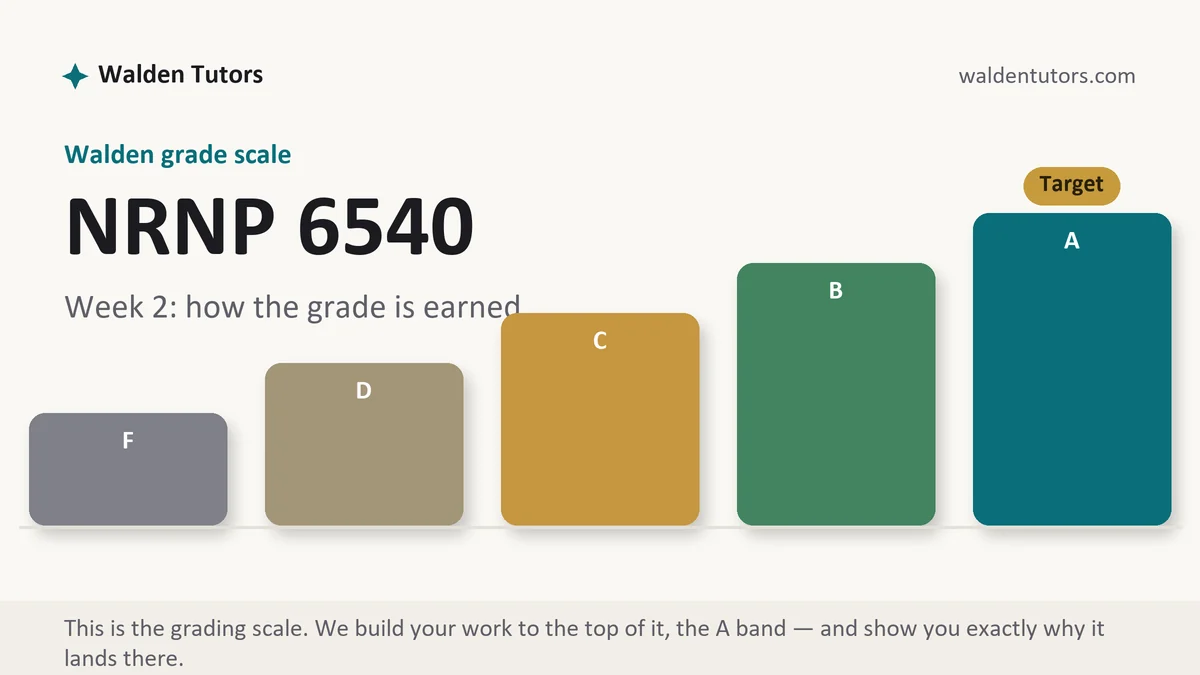
How a functional assessment week is graded
One row wants the correct layer identified. Basic activities cover bathing, dressing, toileting, transferring, continence and feeding, while instrumental ones cover the tasks that keep a household running, and losses usually surface in the second group long before the first.
Another row demands a published instrument, applied fully and cited as a document with authors behind it. A sentence reporting that the patient is mostly independent scores nothing beside a scored index whose result has been interpreted.
The heaviest row is normally the link from measurement to plan. Points accumulate when a mobility result changes the referral, the equipment or the return interval, and they evaporate when the score sits in a table that nothing afterward uses.
Six steps from complaint to a functional plan
The route our team takes from a reported difficulty to a plan resting on measured function.
-
Decide which layer of function the complaint is really about
A woman who can no longer manage her checkbook and a woman who can no longer get out of the bath have different problems on different trajectories. Name the layer in your opening paragraph so the rest of the paper stays in one register.
-
Score it rather than characterize it
Choose an established index for basic activities and a matching scale for instrumental ones, apply every item, then report the total together with the items that failed. Numbers travel between clinicians in a way adjectives never manage.
-
Watch the patient stand up and walk
A rise from a chair, a short walk, a turn and a return tells you about strength, balance and confidence at once. Write what you observed in physical detail, since observed movement is examination and reported movement is only history.
-
Convert each score into a constraint the plan must respect
If dressing consumes forty minutes, a morning medication regimen has to survive that fact. State the constraint inside the plan section so a grader can watch the score doing work.
-
Agree a goal the patient would recognize as her own
Reaching the mailbox without stopping beats improving mobility, because the first can be tested next month and the second cannot. Use her phrasing wherever you have it.
-
Fix the point at which you will measure again
Say which instrument gets repeated and when, and say which result would make you change course. A functional plan with no re-measurement date is an opinion with an appointment attached.
A layout for a functional assessment
What follows is a working scaffold from our desk rather than a Walden template. Read your rubric first and let its weightings decide how long each section runs.
| Section | What belongs in it | What the row rewards |
|---|---|---|
| Reason for the functional review | What prompted the assessment: a fall, a caregiver report, a hospital stay or a routine visit. | A trigger stated, so the reader understands why function is being measured at this moment. |
| Basic activities | Item by item performance in bathing, dressing, toileting, transfer, continence and feeding. | A named index scored across all items, with the failures identified rather than the total alone. |
| Instrumental activities | Shopping, cooking, housework, laundry, transport, medication management, finances and telephone use. | The specific tasks that have slipped, together with the person who has taken each of them over. |
| Mobility and balance testing | Chair rise, gait observation, turning, device use and any timed measure actually performed. | A physical description of movement alongside one scoreable result the next clinician can repeat. |
| Environment and support | Stairs, bathroom layout, lighting, flooring, and the hours of help genuinely available. | The house described as a set of demands the patient has to meet every day. |
| Functional goals and plan | Referrals, equipment, task modification, caregiver teaching, and the review point. | Goals written in the patient's own terms with a repeat measurement scheduled against each one. |
Annotated sample excerpt: an instrumental loss noticed late
Produced in-house to demonstrate how two functional scales can be made to argue against each other.
Scored against a basic activities index, Mrs R is independent across all six items, and a note that stopped at that line would record a well woman.1 The instrumental scale tells a different story: her daughter took over the bills in March, a neighbor now drives her to the pharmacy, and the weekly organizer is filled by someone else after two months in which doses were doubled twice.2 Three instrumental tasks surrendered inside six months with basic activities fully intact is the pattern that ordinarily precedes a cognitive diagnosis rather than a musculoskeletal one, so the plan orders a cognitive screen this week in place of the physical therapy referral that a presenting complaint of tiredness would have produced.3
- 1The reassuring result is reported first and then undercut, which shows a grader that both scales were applied instead of only the convenient one.
- 2Losses are dated and attached to the person who absorbed them, turning a vague sense of decline into a documented sequence.
- 3The pattern is read as a diagnostic clue and it changes the next order, which is exactly the integration these rows are calibrated to find.
Bring the functional case and the criteria your instructor uploaded; your opening premium sample is on us, every instrument scored and interpreted on the page.
Writing the instrument paragraph so the score does work
By the second week the course expects measurement to enter your prose, and there is a reliable shape for the paragraph that carries it. Name the instrument and cite its original publication. Report the total. Then report the items that failed, because the failed items are where the clinical information lives: a basic activities index losing its points on transfer and toileting describes a different morning, and demands a different plan, than the same total lost on feeding. Close the paragraph by converting the result into a constraint, one sentence stating what this score means the plan must now accommodate. A paragraph built this way lets a grader watch the number working, which is what the integration marks on this material are reserved for.
When the two layers of function disagree, write the disagreement as the finding it is. The excerpt on this page holds a clean basic activities result against three surrendered instrumental tasks and lets the gap drive the next order, and that structure transfers to almost any functional case: report the reassuring scale first, then the troubling one, then say what the gap between them most plausibly means. Concordant results deserve a sentence too, since two instruments agreeing is itself evidence, and stating it shows the reader that both were genuinely applied rather than one inferred from the other.
Reading the Week 2 rubric row by row
Functional weeks tend to post rubrics whose rows separate measurement from interpretation from application, and the separation matters because each is scored on its own. Read your classroom's rows with a pen and mark the verbs. A row that says apply wants the instrument administered across all its items. A row that says interpret wants the result explained against this patient's circumstances. A row that says integrate wants the score visibly changing a referral, a piece of equipment, or a review interval. One verb satisfied does not cover its neighbors, and drafts that lose marks here usually performed the measurement and then stopped, leaving the interpretation and application rows empty while feeling finished.
Weights deserve equal attention. Where the posted rubric leans its points toward the plan, a long and lovingly scored assessment followed by a two-line plan inverts the assignment. Divide your word budget in rough proportion to the rows, and remember that only the rubric in your own classroom, not any page of this manual, states where those points actually sit this term.
Source work for a functional assessment
Scholarly support in this material starts with the instruments themselves. Every established functional scale entered the literature through a publication with authors and a year, and citing that original document, rather than a handout or a summary site that reprints the items, is the difference between naming a tool and referencing one. Around the instruments sit the intervention evidence: the trials and reviews behind exercise programs, occupational therapy, and home modification, reachable through the Walden Library's nursing and allied health databases rather than a general search engine.
Bring sources into the draft at the moment of use. The citation for a scale belongs in the sentence where its score is reported. The evidence for a strength program belongs beside the recommendation it supports. And resist the temptation to reproduce an instrument's items in the paper: item lists are the most copied text in this subject, originality checking sees them constantly, and a paraphrased account of what the scale covers serves the argument better than a transcription ever will.
Pitfalls in the measurement weeks, each with its fix
One pitfall is adjectival function: a paragraph reporting that the patient manages fairly well with some difficulty. Nothing in that sentence can be compared against anything at follow-up. The fix is to let no functional claim stand without either a scored item or an observed, described behavior behind it.
A second is the orphaned score, a number reported dutifully and never consulted again. The fix is an audit pass after drafting: for each score in the assessment, find the sentence in the plan that depends on it, and where none exists either write one or ask why the measurement was taken at all.
A third is borrowing gait findings from the history. What the patient says about her walking belongs in the history, and marks for examination require what was watched: the rise from the chair, the turn, the width of the base. The fix is to write observed movement in physical language and label reported movement as reported, so the two kinds of evidence never blur into each other.
Five ways a functional write-up loses marks
- Independent used as a global adjective. Independence is item specific, and a patient can be independent in all six basic tasks while failing nearly every instrumental one.
- An instrument named but never scored. Citing a scale and then writing a paragraph of impressions leaves the measurement row with nothing to award.
- Gait described instead of observed. Reporting that the patient walks slowly is history; recording step length, base of support and what happened at the turn is examination.
- Equipment recommended with no fitting or teaching attached. A walker delivered to a house where nobody was shown how to use it becomes an obstacle, and safety rows notice the omission.
- Goals written for the clinician. Improving functional status is a phrase no patient has ever used about her own week, and it cannot be scored at follow-up.
Before you submit
- Basic and instrumental activities are assessed and reported separately
- A named, cited instrument produces a score rather than an impression
- Observed movement is written in physical detail
- At least one intervention is justified by a specific functional item
- The home environment is described as a set of daily demands
- A repeat measurement is scheduled with a stated decision threshold
Functional assessment due this week?
Forward the case together with the criteria sheet from your classroom. We turn an original functional assessment around in 24 to 48 hours with every instrument applied and its result interpreted, then keep revising for nothing until the rows sit where you wanted them.