Incontinence is common, under-reported and treatable, which is why it earns a graded case of its own. A scoring write-up separates the leak that follows a cough from the leak that follows an urge nobody could defer, works through the reversible contributors before reaching for a prescription, and puts behavioral therapy at the front of the plan where the evidence puts it. Whether your section grades this through a threaded exchange, a submitted document, or a combination of the two, its own syllabus is the only authority.
The number attached to this manual reflects our teaching order and carries no institutional weight. Walden keeps course guides behind a student login and does not publish syllabi openly, so we cannot know where your classroom placed this material, and your rubric outranks everything written on this page. Our remit deserves restating as well: written coursework and documentation exercises only, with live patient encounters and signed clinical evaluations firmly outside it.
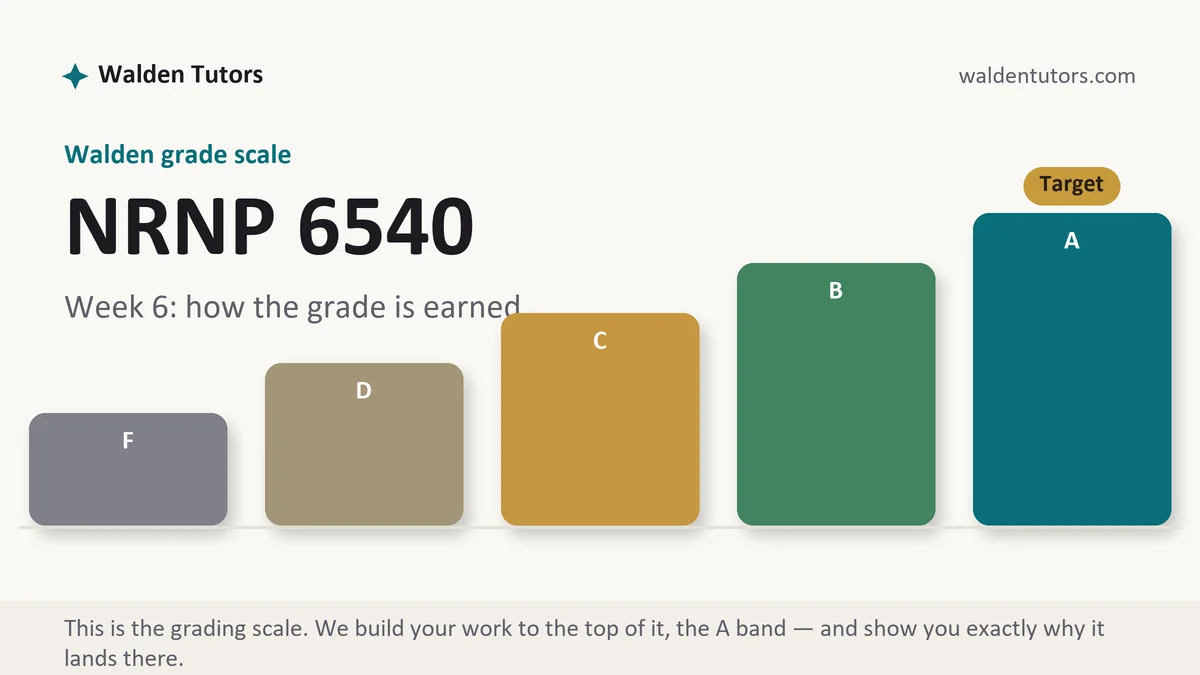
How a continence case earns its points
The classification row rewards precision about provocation. Leaking on a cough, leaking after an urge that could not be held, leaking with no sensation at all and leaking because the toilet was unreachable are four separate problems with four separate plans.
A reversible causes row shows up in nearly every version of this case. Infection, constipation, restricted mobility, delirium, uncontrolled glucose and the diuretic swallowed at six in the evening all belong in the assessment before any bladder-specific diagnosis is made.
The treatment row favors conservative measures first. Timed voiding, pelvic floor work, adjustments to fluid and caffeine and improved access carry the early marks, while drug therapy has to be argued against its own adverse effect profile in this population.
Six steps through a continence evaluation
A sequence built for a complaint that arrives late, quietly, and very often not at all.
-
Ask, because the patient will not volunteer it
Most older adults never raise this complaint and many have rearranged their whole week around it. A direct, unembarrassed question during the review of systems is what puts the problem into the record at all.
-
Sort the leak by what provoked it
Effort, urgency, absent sensation, or an obstacle standing between the patient and the toilet. Ask what she was doing at the moment of the most recent episode and let that answer drive the classification.
-
Clear the reversible contributors first
Screen for infection, check the bowels, look at the glucose, review mobility and read the diuretic timing. Several of these resolve the complaint with no bladder treatment whatever.
-
Replace recollection with a record
A three day diary capturing times, volumes, leaks and what preceded each one converts a vague history into data, and it is the single most useful thing you can ask this patient to bring back.
-
Put the conservative plan in front of the prescription
Timed voiding, bladder training, pelvic floor exercises with proper instruction, less caffeine and a commode within reach after dark all have evidence behind them and no anticholinergic cost.
-
Say what the patient does while treatment takes hold
Products, skin protection and a route to the bathroom that still works at two in the morning. Dignity and skin integrity are both rubric-relevant and both are usually left out.
A layout for a continence case
The frame below is ours. Match it against the criteria your instructor posted and let those criteria dictate the proportions.
| Section | What belongs in it | What the row rewards |
|---|---|---|
| Symptom history | Onset, frequency, volume, nocturia, pads used per day, and the effect on ordinary life. | Quantities the patient supplied, with the impact on activity written in her own terms. |
| Provocation and classification | What triggers the leak, and the type that best fits, including mixed pictures. | A type argued from the trigger rather than assigned from a list of names. |
| Reversible contributors | Infection, constipation, glucose, delirium, mobility, and the timing of every diuretic. | Each contributor addressed by name with a result rather than a blanket denial. |
| Examination and testing | Abdominal and pelvic findings, residual volume where indicated, urinalysis and its interpretation. | Testing chosen for a reason and interpreted, not ordered as a reflex panel. |
| Voiding record | The diary itself, summarized, together with the pattern it revealed. | Data from the record used to support or to overturn the initial classification. |
| Plan | Conservative measures, any pharmacologic step with its risks, products, skin care and follow-up. | Behavioral therapy leading, drug therapy justified against its burden in an older adult. |
Annotated sample excerpt: urgency, or a diuretic at five
Written in-house to show a diary overturning the diagnosis the history had suggested.
Mrs D reported leaking three or four times a day with an urge she could not defer, a history that on its own points toward an overactive bladder and toward the prescription she arrived expecting.1 Her three day record placed nine of the eleven episodes between six in the evening and two in the morning, and her furosemide is swallowed at five when her daughter visits, which drops the peak of her diuresis into the hours when she is least mobile and the hallway is unlit.2 Moving that dose to the morning, putting a commode beside the bed and repeating the diary in three weeks tests the explanation at no pharmacologic cost, and it keeps an anticholinergic away from a woman already scoring in the mildly impaired range on cognitive screening.3
- 1The expected diagnosis is named early so the paragraph can be seen testing it rather than arriving at it.
- 2The diary supplies a distribution across the clock, and a specific dose time is set against that distribution.
- 3The intervention is cheap, reversible and time limited, and the cognitive risk of the alternative is stated out loud.
Send the continence scenario with its rubric and your opening premium sample is on the house, built around the provocation history and a conservative plan.
Letting the diary argue with the history
Entering the back half of the course, the cases begin to test whether you can let data overrule a plausible story, and the voiding record is the cleanest training ground the specialty offers. In writing terms the sequence has three beats. State the hypothesis the history suggested, by name, so the reader knows what is being tested. Summarize the record as a distribution rather than a list: how many episodes, clustered in which hours, preceded by what. Then adjudicate. Either the record confirms the classification, and you say which entries confirmed it, or it points somewhere else, and you follow it there in the plan. The excerpt on this page walks that road from an overactive bladder story to an evening diuretic and an unlit hallway, and its persuasiveness comes entirely from showing the work.
Mixed pictures deserve honest handling rather than forced tidiness. Where effort leakage and urgency both appear, write both, state which dominates by episode count or by impact, and aim the opening intervention at the dominant component while naming what would make you readdress the other. A draft that manufactures purity the data does not contain scores worse than one that manages ambiguity out loud.
Reading the Week 6 rubric row by row
Continence rubrics reward a chain, and reading your classroom's rows in order usually reveals it: elicitation, classification, reversible causes, testing, conservative management, escalation. Against each posted row, ask what a top-level answer physically looks like on the page. For classification it looks like a trigger tied to a type. For reversible causes it looks like a named list with a finding beside each entry, not a sentence asserting they were considered. For management it looks like behavioral measures carrying enough operational detail, schedule, technique, duration, to be followed, since a row cannot award depth to the phrase bladder training standing alone.
Note where your section's rubric places pharmacology. In many versions the drug row wants risk weighed as heavily as benefit, and in an older adult that means the cognitive cost of the obvious class argued explicitly. Whatever the arrangement in your classroom, the posted weights are the ones being counted, and they are worth ten minutes with a highlighter before the draft begins.
Source work for a continence case
Scholarly grounding here means the guideline literature on urinary incontinence in older adults, the trial evidence behind pelvic floor training, bladder retraining, and prompted voiding, and the original descriptions of any symptom questionnaire or diary format you deploy. This is also a subject overrun by commercial and consumer content, which makes provenance checking part of the assignment: a manufacturer's continence-product page and a peer-reviewed effectiveness review are not interchangeable, and graders at this level know the difference at a glance. The Walden Library's nursing and urology holdings carry what the paper needs.
Integrate the evidence at the plan's load-bearing points. The claim that behavioral therapy leads first-line management carries its citation. The technique you specify for pelvic floor work points at the trial or review that shaped it. The caution attached to the anticholinergic option cites the cognitive literature behind it. Sources placed this way argue; sources gathered at paragraph ends decorate.
Pitfalls particular to continence drafts, and the fixes
One pitfall is undocumented elicitation: the write-up opens with the complaint fully formed, as though the patient arrived announcing it. Since concealment is the norm, the fix is a sentence recording how the symptom was asked about and which question finally surfaced it, which also happens to answer the screening row.
A second is quality-of-life silence. Pads per day, outings declined, sleep interrupted, laundry loads: the burden is measurable, and drafts that skip it lose the dimension that justifies treating at all. The fix is two quantities in the history and one goal in the plan expressed in the patient's own terms.
A third is the forgotten medication column. Diuretic timing, sedatives that deepen night-time mobility risk, drugs that provoke cough, agents that constipate: the list reads differently through a continence lens, and a draft that never re-reads it misses reversible causes the rubric expects found. The fix is one deliberate pass through the list asking what each entry does to urine, mobility, or bowel.
Five mistakes that appear in almost every continence draft
- The complaint never asked about. Patients conceal this symptom for years, and a review of systems that waits for it to be volunteered will simply not find it.
- A type assigned without a trigger. Urge incontinence written down because the phrase is familiar, with nothing in the history about what provoked the last episode, fails the classification row.
- Infection assumed from a dipstick. Bacteriuria without symptoms is common at this age, and treating a positive strip in its absence is an antibiotic given for nothing.
- Fluids restricted as the first move. Concentrated urine irritates the bladder and dehydration causes harm of its own, so a blanket restriction usually makes the situation worse.
- An anticholinergic prescribed without weighing cognition. The drug class most associated with this diagnosis is the class most likely to cost an older adult her memory, and the paper has to say so.
Run through this before you post
- The complaint was elicited by a direct question and that question is documented
- The type is argued from what provoked the most recent episodes
- Reversible contributors are each addressed with a finding
- A voiding record informs the classification rather than decorating it
- Conservative therapy appears ahead of any prescription
- Skin protection, products and night-time access are all in the plan
Continence case to write?
Paste the scenario in chat and attach the criteria your instructor published. Original drafting on a continence case runs 24 to 48 hours, the classification argued from provocation and the reversible causes worked through one at a time, revisions free until each row lands.