A psychopathology course has to teach a method before it teaches any disorder, which is why the opening stage belongs to the interview and to the reasoning it feeds. What earns credit here is a psychiatric history gathered in an order that survives scrutiny, a description of what the patient reports that has not already collapsed into a label, and the discipline of keeping rival explanations alive until some piece of evidence separates them. Whether this reaches you as a discussion, an assignment, or both is settled by the syllabus in your classroom and by nothing on this page.
Putting the interview at the front of the term is a clinical educator's judgment made at this desk rather than a sequence Walden released, since the university keeps syllabi off its public site and parks its course guides behind a student login. One opening-week rule is documented: Walden expects you to log in and submit an assignment or a discussion post during a course's first week. Everything beyond that floor comes from your own classroom. The code shows up as NRNP 6635 and as NRNP6635, and this manual answers to both.
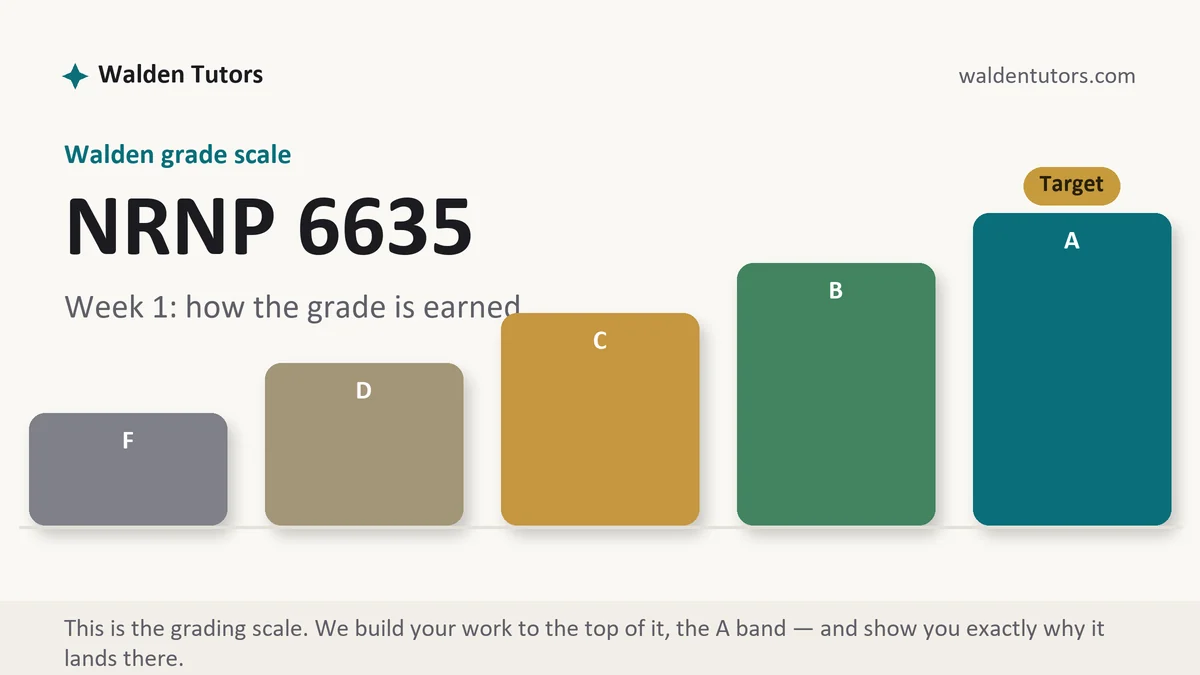
How an opening psychiatric week is scored
Rows in a methods week pay for visible process. Naming a plausible condition and stopping there answers almost nothing, because the grader is quietly checking whether the questions you described asking could have produced that conclusion at all. Put the gathering first and the inference second, and the row finally has something to mark.
Register is the second thing under assessment, and it is graded without ever being announced. Psychiatric writing reports behavior and quotes speech; it does not editorialize. A patient called difficult has been judged rather than assessed, and rewriting the sentence as what that person actually did and said usually recovers the point on its own.
When the stage lands as a discussion, participation carries its own scoring. Walden's grading policy asks for substantive contributions delivered on time and suggests spreading them over two to four separate days at minimum. Draft the initial post early in the week and hold your replies back for later, so both halves get written awake.
The interview method, step by step
Six moves that turn a conversation into an assessable psychiatric history.
-
Open with the complaint in the patient's own words
Record the reason for presenting inside quotation marks and add why today rather than last month. Paraphrasing at this point erases information, and the phrase a patient chooses often carries the affect, the attribution and the level of insight all at once.
-
Build the timeline before you build an impression
Fix onset, then course, then severity, then what has changed recently. Almost every psychiatric distinction that matters turns on duration or sequence, so a history without dates cannot support a diagnosis no matter how vivid the symptoms in it are.
-
Ask the questions that exclude, not only the ones that confirm
Chase the alternative explanations while the patient is still in front of you. Elevated mood, substance use, head injury, thyroid disease and sleep loss all need asking, and the answers become the pertinent negatives your differential will lean on later.
-
Keep what you were told apart from what you saw
Reported experience belongs in the history and observed phenomena belong in the examination. Mixing them makes it impossible for a reader to tell which findings you verified, and the rows that reward evidence cannot credit an observation they cannot locate.
-
Name two rivals and the fact that would separate them
Every impression should carry at least two competitors and one discriminating variable, whether that is duration, the order symptoms appeared in, or a substance timeline. Stating the discriminator is the move that converts a guess into reasoning a grader can follow.
-
Close with risk and with what you still do not know
Ask about self-harm, harm to others and safety at home, then write down the answers rather than implying them. Finish by naming the information that would firm up your ranking and how you would go about getting it.
Worked reasoning: from a transcript line to a defensible impression
Watch the chain run on a single thread. The complaint is recorded as I can't switch my head off at night, in the patient's words rather than yours, which is a quote on the page and not yet a finding. The timeline converts it: the sleeplessness began about a month ago, arrived after a change the patient can name, and has worsened week by week. The exclusion questions then earn their place, because a month of poor sleep could belong to low mood, to worry, to a substance or to a medical cause, and each alternative generates a question you can show yourself asking. By the time the impression arrives, every candidate it weighs has a documented question behind it, which is the property graders scan for in an opening week.
Notice what the chain never does. It never lets an inference appear before the observation that licenses it, never treats a plausible guess as settled, and never buries the one fact that would separate the top two candidates. When you revise, read the draft backwards from the impression: for each claim, find the earlier sentence that entitles you to it. A claim with no upstream sentence is a hole in the interview or a hole in the write-up, and both are cheaper to repair before submission than to explain after it.
That backwards audit is the most transferable habit this stage can give you. Every later category in the course runs the same chain with heavier material, so build it now, on a simple history, and the harder weeks inherit it.
A structure that maps to the rubric rows
A shape for an initial psychiatric assessment or a first-week case discussion. The section proportions are planning guides from our desk, not Walden requirements.
| Section | What belongs in it | What the row rewards |
|---|---|---|
| Identifying data and chief complaint | Who the patient is, what brought them in, and the complaint recorded verbatim. | A complaint in the patient's language, with the reason for presenting now made explicit. |
| History of present illness | Onset, course, severity, triggers, treatment attempted, and the symptoms the patient denies. | A timeline detailed enough that any candidate diagnosis could be tested against it. |
| Psychiatric and substance history | Earlier episodes, hospital stays, medication trials, self-harm history, and patterns of use. | Prior treatment response reported with outcomes, because it constrains what you may recommend. |
| Medical, family and social history | Conditions and medicines that shift mood or cognition, family psychiatric history, living and working circumstances. | Medical contributors addressed rather than merely listed and then abandoned. |
| Observations from the encounter | Manner, speech, movement, engagement and emotional expression as you witnessed them. | Observation kept clean of interpretation, so the reasoning below has evidence under it. |
| Preliminary impression | Two or three ranked candidate explanations plus the information still missing. | A ranking argued from the history above and honest about what remains unresolved. |
Reading the rubric row by row
Before drafting anything in an opening week, open the rubric your classroom attached and read it the way a grader will, one row at a time, top level first. However your section words them, the rows in a week like this usually sort into a few jobs: completeness of the history, quality of the reasoning built on it, scholarly support, and mechanics. Give each row a heading in your outline with its weight written beside it, because the weights are the only honest guide to proportion, and they vary between sections often enough that nothing outside your classroom should be trusted with them.
Then read the top level of each row and underline its verbs. The lower levels of a rubric describe presence, the top describes quality: not that a history appears but that it is thorough, not that a differential is named but that it is justified. Those verbs are instructions, and the distance between the middle of a row and the top of it is usually one sentence of explicit reasoning per paragraph, the because that connects finding to conclusion. Write to the verbs and the row is answered on its own terms.
Annotated sample excerpt
Model prose written by our team, pitched at the depth these history rows expect. Study how it works, then rebuild the technique around your assigned patient.
Mr. R describes eight weeks of low mood that he dates to the week his shift pattern changed, heaviest on waking and slightly lighter by evening.1 He wakes near three most nights and cannot get back to sleep, has lost roughly nine pounds without trying, and rereads routine work emails four or five times before he trusts himself to send them.2 He denies any stretch of reduced need for sleep, unusual energy, or spending that later embarrassed him.3
- 1Onset is anchored to both an event and a duration, and the diurnal pattern is recorded, because each of those will be tested against criteria further down the note.
- 2Every symptom arrives with a quantity or a concrete example, which lets a grader verify severity. A phrase such as poor concentration offers nothing to verify.
- 3The pertinent negative is asked and documented inside the history, which is where a defensible differential quietly begins rather than where it is announced.
Send the vignette your classroom posted and the free sample comes back with the history worked to this level and the impression argued out of it.
Source work for an interview week
Scholarly in this course means the diagnostic manual your program specifies, cited as a full work with edition and year, peer-reviewed articles reached through the Walden Library, and current texts on psychiatric interviewing and assessment. It does not mean study-help sites or the overview pages an open search returns, and the pull toward those is strongest in an opening week because the material feels like common sense. The claims you are sourcing here are method claims: why the complaint is recorded verbatim, why timeline precedes impression, why pertinent negatives count as data. Each has a literature, and citing it separates a professional document from a merely competent one.
Work sources in at the point of the claim rather than clustered at a paragraph's end. A citation attached to the sentence it supports can be verified in a glance, while three citations parked at the close support everything and therefore nothing. Keep the list in APA 7, entries matching the in-text citations exactly, and give every source a job you could say aloud: this one defines the term, this one supports the technique, this one carries the criteria.
Three pitfalls specific to the opening week, and the fix for each
The first pitfall is transcription: the vignette is restated in slightly different words and the restatement is offered as assessment. The opening week invites it, because the material is rich and summarizing feels like progress. The fix is mechanical. For every sentence taken from the case, add what it contributes, a duration, a severity marker, a pertinent negative, a candidate explanation, and delete any sentence you cannot attach a contribution to.
The second pitfall is writing the history in the order the patient told it. Interviews wander, and a write-up that follows the wandering makes the grader reassemble the chronology you were supposed to deliver. The fix is to keep the quotes but re-sequence the material into onset, course, severity and change, so the story reads as an assessment rather than a recording.
The third pitfall is leaving why now unanswered. A complaint that has run for months has a reason it became a presentation this week, and opening write-ups routinely never say what it was. The fix costs one sentence: name the precipitant if the case supplies one, and if it does not, say plainly that the trigger for presenting now is unclear and belongs on the list of what to ask next.
The five mistakes that sink a first psychiatric write-up
- A diagnosis that arrives before the history does. Once the label is on the page, everything after it reads as justification, and the rows measuring assessment quality have nothing independent left to score.
- Symptoms recorded with no duration attached. Duration separates conditions that otherwise look identical, so a symptom list with no time attached to it cannot support any ranking you build on top of it.
- Judgment words standing in for description. Non-compliant, manipulative and attention-seeking are conclusions wearing the costume of findings, and each one costs credit twice, first for accuracy and again for professional register.
- No pertinent negatives in the history at all. What a patient denies is evidence, and an interview that only records what was present has done half the work the diagnostic rows are paying for.
- Risk mentioned nowhere on the page. A psychiatric assessment without a documented safety question reads as incomplete to a grader and worse than incomplete to a clinician.
Pre-submission checklist
- The chief complaint is quoted, not paraphrased
- Every symptom carries an onset and a duration
- Reported history and observed findings sit in separate sections
- At least two competing explanations are named and ranked
- One discriminating fact is stated for the top two
- Safety questions are asked and their answers written down
Starting NRNP 6635 this week?
Send the prompt and the rubric your classroom posted. An original psychiatric draft reaches you within 24 to 48 hours, history, impression and safety section all written to the depth these rows expect.