Anxiety conditions look alike from a distance and separate cleanly once you ask what the fear is about, which is why this stage rewards precision over breadth. Expect to distinguish a panic attack from a panic disorder, to measure impairment through avoidance rather than through distress alone, to tell an obsession from ordinary worry by its form, and to clear the physiological explanations before committing. The container your section uses, a graded thread, a case paper, or both together, is a matter for your syllabus alone.
One more note on ordering, phrased plainly: this site infers the arc of an eleven week psychopathology course because Walden neither publishes syllabi nor opens its course guides outside a student login. Anxiety follows mood here for a teaching reason, since the discrimination skills built on mood cases transfer directly, and that is a decision our team made. Whatever your classroom actually assigns governs the work you submit. NRNP 6635 and NRNP6635 are one course, and this manual serves either spelling.
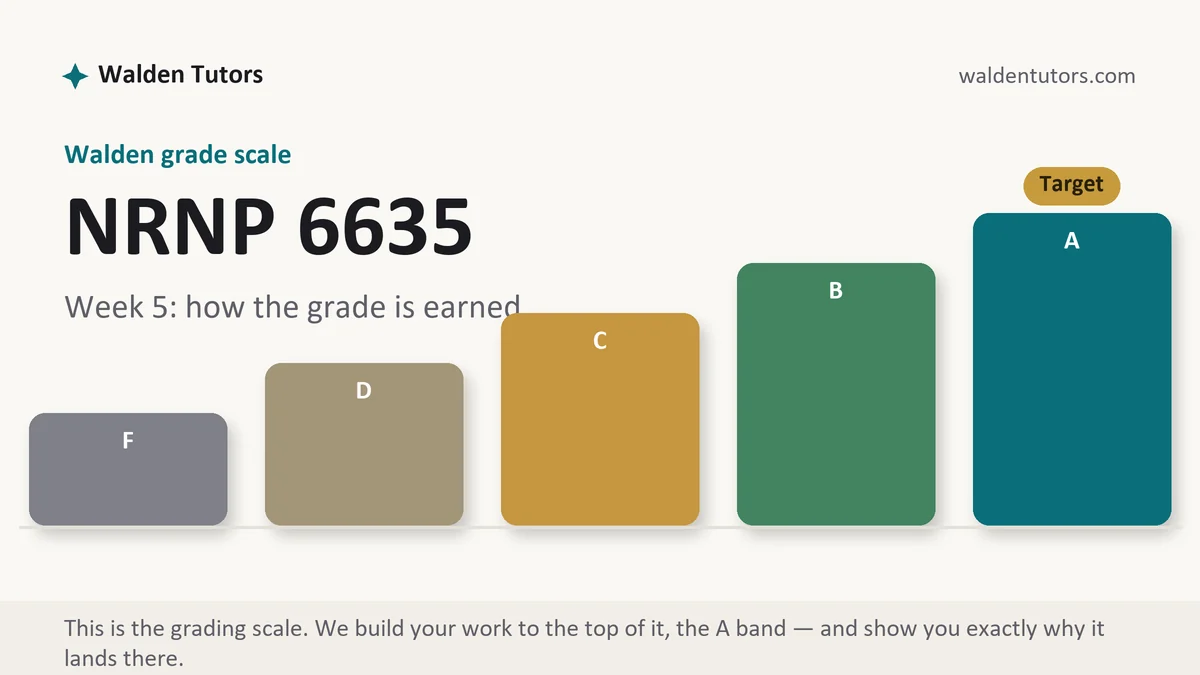
How an anxiety differential is scored
The distinguishing row in this category is about the object of the fear. Panic focuses on the sensations themselves and what they might mean; social anxiety focuses on evaluation; generalized worry roams across domains; a specific phobia has one target. A paper that describes anxiety without identifying what it attaches to cannot rank anything, and graders read for that identification early.
Impairment is the second row, and avoidance is the evidence it wants. Distress is reported by the patient and hard to verify, while avoidance is behavioral and specific: the appointment not made, the road no longer driven, the promotion declined. Write the behavior and the impairment row answers itself.
The third pattern is exclusion discipline. Thyroid disease, cardiac arrhythmia, asthma, stimulant use and caffeine all produce convincing anxiety pictures, and a differential that never addresses them reads as incomplete rather than as confident. Say what you considered and what would settle it.
The anxiety-case method, step by step
Six moves that separate conditions which describe themselves in almost identical language.
-
Find out what the fear is actually about
Ask what the patient believes will happen and what makes the feeling stop. The content of the apprehension, not its intensity, is what sorts this category, and the answer usually arrives in one sentence if the question is asked directly.
-
Separate the attack from the disorder
Discrete surges of intense fear occur across many conditions and are not diagnostic on their own. The disorder requires recurrent unexpected episodes plus persistent worry about further ones or a change in behavior because of them, so document both halves.
-
Trace avoidance, because it measures the damage
List what the patient has stopped doing, when each thing stopped, and what it cost. Avoidance is the most concrete evidence of functional impairment available in this category and the easiest for a grader to credit.
-
Tell an obsession apart from a worry
Obsessions are intrusive, unwanted and experienced as alien; worries feel like the person's own thinking about real problems. Then ask what the patient does to relieve the intrusion, since the compulsion is usually more diagnostic than the thought itself.
-
Clear the physiological explanations first
Ask about thyroid symptoms, palpitations with exertion, inhaler and stimulant use, caffeine load and recent substance changes. Fitting the anxiety timeline against the medication timeline settles more of these cases than any scale does.
-
Rank on the discriminator, not on the loudest symptom
Choose the single variable that separates your top two, whether that is the trigger, the presence of ritual, the breadth of the worry, or the timing, and build the paragraph around it rather than around whichever symptom the patient emphasized.
Worked reasoning: making the object of the fear carry the ranking
Run the discrimination on a presentation that could read three ways. The case describes a racing heart, dread most mornings, and an emergency visit the patient was sure was cardiac. The untrained move is to weigh severity; the trained move is to ask what the apprehension is about. If the dread organizes around the sensations themselves, the pounding heart read as a coming catastrophe, with episodes arriving out of nowhere, the reasoning points one way. If every episode has an audience, meetings, counters, introductions, and being alone switches the feeling off, it points another. If the worry roams, money on Monday, health on Tuesday, the children by Wednesday, with no single trigger and no clean off switch, it points a third. Same adjectives, different objects, different diagnoses, and the write-up that states the object explicitly does in one sentence what pages of severity language cannot.
Then let avoidance carry the impairment argument: list what has actually been surrendered, the declined promotion, the road no longer driven, the appointments routed around, with rough dates, because a dated avoidance inventory demonstrates functional cost in behavior a grader can credit. Where rituals appear, apply the form test before any label. An intrusion experienced as alien and resisted is one phenomenon, worry about a real problem is another, and the relieving behavior, checked, washed, counted or mentally repeated, with the daily time it consumes, is often the most diagnostic fact on the page.
Finish by clearing the body, thyroid symptoms, cardiac history, respiratory triggers, caffeine load, stimulants, each checked against the timeline, because in this category the medical review is the difference between a differential and a description.
A structure that maps onto the anxiety rows
Sections for a case write-up or a discussion built on an anxiety presentation. Section lengths are a drafting recommendation from us, carrying no Walden authority.
| Section | What belongs in it | What the row rewards |
|---|---|---|
| Focus of apprehension | What the patient fears, what they expect to happen, and what brings the feeling down. | An object of fear identified specifically enough to exclude the neighboring conditions. |
| Form and course of symptoms | Whether episodes are discrete or continuous, how long they last, how often, and how they start. | Episode architecture described so that attack and disorder are not conflated. |
| Avoidance and impairment | Activities dropped, situations endured with difficulty, and the cost in work, study and relationships. | Impairment demonstrated through behavior rather than asserted through adjectives. |
| Obsessions and compulsions | Intrusive content, the resistance offered, the relieving behavior, and time consumed daily. | Ritual documented with its function and duration, since both carry diagnostic weight. |
| Medical and substance review | Endocrine, cardiac and respiratory considerations, stimulants, caffeine, withdrawal states. | Physiological alternatives assessed against the timeline rather than named in passing. |
| Ranked differential and plan | Working diagnosis with two rivals, the discriminator for each, then treatment and follow-up. | A first-line recommendation that follows from the ranking directly above it. |
Reading the rubric row by row
Anxiety-week rows usually track the reasoning sequence, characterize the presentation, evidence the impairment, exclude the mimics, rank the differential, then plan, alongside the standing rows on sources and mechanics. Whatever your classroom calls them, audit each with its own question. Characterization: does one sentence state plainly what the fear is about and what turns it off. Impairment: does the draft contain behaviors, things stopped, endured or rerouted, rather than intensity adjectives. Exclusion: are the physiological causes addressed against the timeline, including ones the vignette never mentions, since a documented negative is itself evidence of a complete assessment.
The ranking row separates its levels on discriminators. The middle names plausible rivals; the top attaches to each rival the specific criterion or observation keeping it in second place, and states what would promote it. That promotion condition is the cheapest distinction available this week, one line per rival, and it shows the grader the ranking is held for reasons rather than by habit. Weights differ between sections, and wherever this page and your rubric disagree, the rubric in your classroom is right.
Annotated sample excerpt
This is original teaching prose from our team, built to show what precise anxiety reasoning looks like. Lift the moves, not the case.
The apprehension is organized entirely around being watched and judged, appearing before meetings and at unfamiliar counters and disappearing altogether when the patient is alone or with her sister, which places social anxiety disorder at the top of the differential.1 Panic disorder ranks second because four of her episodes met attack criteria, but every one of them began in an evaluative setting and none arrived unexpectedly, and an unexpected episode is the finding that would reorder this list.2 Hyperthyroidism ranks third on the strength of two months of palpitations and weight loss, and a thyroid panel would resolve its position before any medication is chosen.3
- 1The fear is defined by what triggers it and by what switches it off, and both halves are needed before any label in this category is defensible.
- 2A rival is retained with its evidence stated, and the exact observation that would promote it is named, which is what a ranking row rewards.
- 3A medical alternative is ranked rather than mentioned, and the test that settles it is tied to a decision the plan will have to make.
Send us your case and the free sample comes back with the fear characterized precisely and each rival ranked on a stated discriminator.
Source work for an anxiety week
The scholarly load this week concentrates on boundaries, so choose sources that draw them. The diagnostic manual, cited with edition and year, carries the category definitions and the discriminating criteria your ranking leans on. Current treatment guidance carries the first-line claims in the plan. Between those two, the most useful articles address the boundaries themselves, how worry differs from obsession in form, how panic presentations are separated from cardiac and respiratory disease, how avoidance is assessed, because those are the claims your reasoning actually makes and each deserves more than assertion behind it.
Weave them in at the point of use: the sentence applying the form test cites the source that articulates it, the sentence recommending a modality cites the guidance ranking it, and a cultural note, where your case raises one, cites literature on how anxiety is expressed differently across groups rather than a general remark about sensitivity. Search inside the Walden Library, keep treatment sources current, hold the list to APA 7, and let any source you cannot assign to a sentence fall off the list.
Three pitfalls specific to the anxiety week, and the fix for each
The first pitfall is intensity substituting for identity: the draft escalates through severe, overwhelming and debilitating while never stating what the fear attaches to, and the differential underneath it floats free. The fix is a single early sentence, the fear here is about this, written before any ranking, because every later judgment inherits its precision from that one commitment.
The second pitfall is promoting an attack to a disorder. One documented surge of fear, however dramatic, is a finding many conditions share. The fix is to document the second half of the definition before using the label, the recurrence, the unexpectedness, and the persistent worry or behavior change that followed, and where the case cannot supply those, to say so and rank accordingly.
The third pitfall is skipping the physiological review because the vignette reads psychiatric. Thyroid disease, arrhythmia, asthma, caffeine and stimulants reproduce this picture well enough that their absence from the paper reads as an assessment that never looked. The fix costs two sentences: name the causes considered and the timeline fact that lets each be set aside, so the negative becomes documented evidence instead of a gap.
Five ways an anxiety write-up loses credit
- Anxiety described without its object. Severity language fills the paragraph while the one variable that sorts this category, what the fear is about, never appears anywhere in the paper.
- A panic attack reported as a panic disorder. Attacks occur across many presentations, and calling one a disorder without the persistent worry or behavior change collapses a distinction the rubric is testing.
- Avoidance never documented. Impairment claimed in adjectives is unverifiable, while the list of things the patient no longer does is concrete and would have earned the row outright.
- Worry relabeled as obsession. The two differ in form, not in intensity, and treating everyday rumination as intrusive content sends the differential toward the wrong family of conditions.
- No medical or stimulant review. Several ordinary physiological causes reproduce this picture faithfully, and a paper that ignores them looks less confident than one that considers and excludes them.
Pre-submission checklist
- The object of the fear is identified explicitly
- Attacks and disorder are distinguished in writing
- Avoidance is listed with its functional cost
- Obsessions are described by form, with rituals timed
- Endocrine, cardiac and stimulant causes are addressed
- Each ranked rival carries a named discriminating fact
An anxiety case to write?
Send the prompt, live rubric, de-identified case, and your current draft. Criterion-mapped feedback can return in 24 to 48 hours, checking whether the differential is ranked on stated discriminators and every exclusion is argued rather than asserted.