COUN 6214 is Walden's five-credit Lifespan Development course, and it works the early end of the span: prenatal, childhood, and adolescence. What gets graded is your ability to take a developmental theory and use it on one specific person at one specific milestone, which is a different skill from knowing the theories.
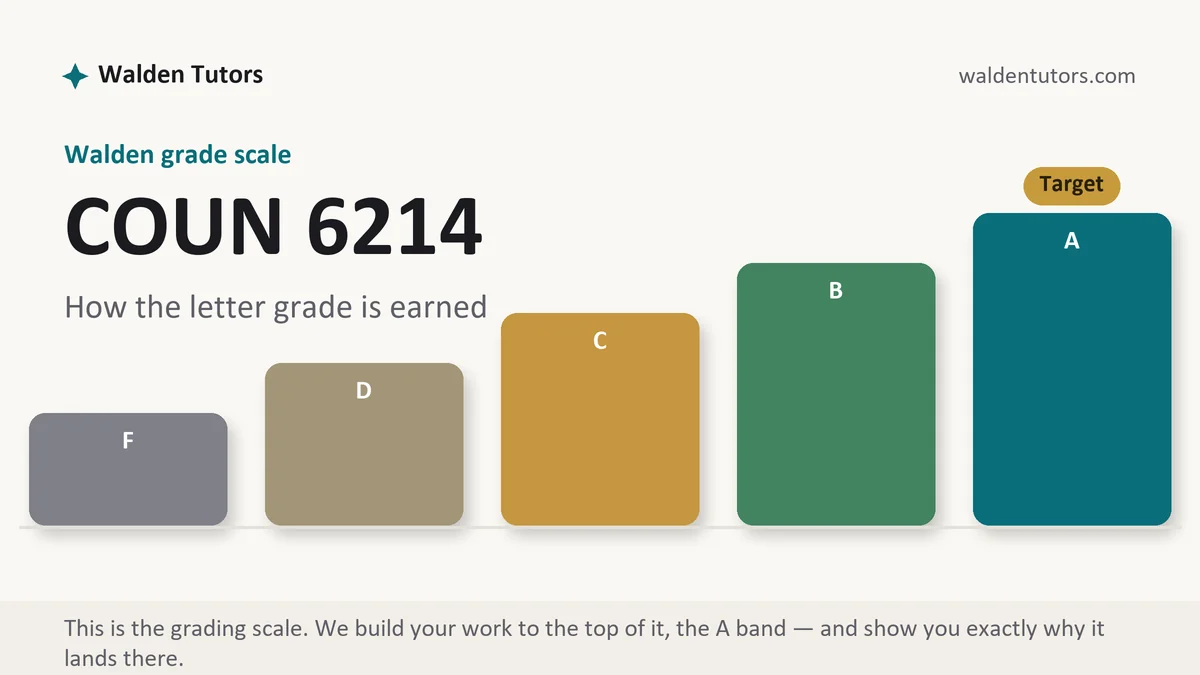
What COUN 6214 actually grades
Applied developmental writing. The scored items are analysis papers, case write-ups, and graded discussion threads, and each one hands you a milestone somewhere in the prenatal, infancy, childhood, or adolescent range and asks you to explain it through a named theory. Diversity, ethics, and research evidence get scored inside that explanation rather than in sections of their own. Students who can recite Erikson and Piaget from memory still drop rows here, because the rubric is not asking what the theory says. It is asking what the theory tells you about this child.
How we help in this course
Drafts come back built as arguments. One framework selected and defended, one milestone examined closely, cultural and family context worked in at the point where it changes the reading, and counseling implications drawn out of the evidence instead of announced at the end. Attach a paper you have already submitted and the register lands near enough to yours that personalizing it is a short job.
Criterion-mapped feedback can return in 24 to 48 hours. One pass checks your draft against the live rubric; another checks APA, source use, and originality. You remain the author, choose each revision, and submit only work you can defend. No grade is promised.
Weekly manuals for this course
Per-week manuals for COUN 6214 go up one at a time, as each deliverable is verified rather than guessed at. Walden does not publish its counseling syllabi to the open web, so you will never see an invented week grid on this page. No manual up for your week yet? Send the live prompt and rubric through chat so tutoring can explain the method and review your draft. Counseling terms run quarter or semester depending on your program, and your student portal is the authority on which one you are sitting in.
In COUN 6214 this term?
Send the assignment prompt and the scoring guide from your classroom. No charge on the first premium sample, and it lands within two days.
The first thirty seconds on a 6214 paper
Your grader opens the file with the rubric already on screen beside it. In that first half page they are hunting for three things: which milestone you chose, which theory you are running on it, and whether those two are actually joined. A paper that opens with general remarks about how children grow and change has spent its best real estate on nothing anyone can score. A paper that names the milestone in its opening sentences, names the framework in the next, and states the claim it intends to defend has already told the reader where each later row will be found. Work is due at 10:59 p.m. Central and 11:59 p.m. Eastern, and what arrives afterwards is a letter grade assembled out of those rows, so an opening that maps them beats an opening that sounds impressive.
What a development week sends us
A typical COUN 6214 week pairs a written analysis with a discussion thread, and each is scored on a rubric of its own. Send the prompt, the scoring guide, any readings the prompt names, and the age range or case you were assigned. Back comes a draft with the theory doing work rather than sitting in a summary paragraph, developmental evidence cited to material you can open through the Walden Library, and delivery notes stating which paragraph answers which row. If the thread closes before the paper does, say so and it moves to the front of the queue.
Test the desk on one paper
The free opening sample suits this course, because a single developmental analysis exposes everything at once: whether the theory is carrying weight, whether the citations are current, whether the cultural discussion is specific, and whether the formatting holds up. Pick the assignment actually in front of you rather than an easy one, send its instructions and its rubric, and read what comes back the way your instructor will before any money changes hands. The seasonal offer then applies to your first paid week of work.
How to actually write COUN 6214: where to begin
Open the scoring guide before you reread the prompt a second time. Walden attaches a rubric to nearly every graded item in this course, and each row is a promise about what will be looked for. Paste those rows into an empty document, convert them to headings, and write the point value underneath each one. Then set your length from the weights rather than from habit. Application is the row that starves most often in 6214, because putting a framework to work on one child takes far more room than reporting what the framework claims, and the background section quietly eats that room while you are still warming up.
Choose the milestone before you choose the theory, and choose a narrow one. Language emergence in the second year. The shift in peer preference around age eight. Identity experimentation in mid adolescence. Prenatal exposure and the behavioral signal it leaves later. A narrow milestone gives you something concrete to hold a framework against. Then select the theory that explains the mechanism behind that milestone rather than the one you find most interesting. Erikson describes a psychosocial task, Piaget describes a reorganisation in how thinking works, Vygotsky describes what a child manages with support that they cannot yet manage alone, and Bronfenbrenner describes why the same child develops differently inside a different arrangement of surrounding systems. Pair a social milestone with a cognitive theory and every paragraph afterwards will strain, which a grader reads as a missing application row.
Application has a shape you can check on your own draft. Name the construct, state what it predicts should be visible at this age, put the observation beside the prediction, and say plainly whether they agree. Where they disagree, that disagreement is your strongest paragraph, because explaining why a real child does not fit a model is precisely the judgment counseling asks for. Summarizing means writing what the theory holds, then writing what the child did, with nothing joining them. The joining sentence is the graded part. If you can delete a paragraph and lose no claim, it was summary.
The catalog entry for this course highlights themes of diversity and lists ethics, research, global perspectives, and social change as additional topics, and none of those are decoration. Diversity scores when it changes the reading: a milestone arriving on a different timetable inside a different caregiving arrangement, a norm drawn from a sample that excludes the population under discussion, a behavior that looks like delay in one setting and like adaptation in another. Ethics scores when it lands on a decision somebody would really face, such as what a counselor says to a parent about a screening result. Research scores when the study you cite tested something close to your claim, which is the argument for searching the Walden Library databases instead of the open web: you can filter by peer review, by population, and by date, then read the method section before you rely on the finding.
| Section | What goes in it | What earns full rubric points |
|---|---|---|
| Opening and focus | The milestone, the age range, the theory you have chosen, and the claim you plan to defend. | A reader can restate your argument after two sentences and knows where the paper is going. |
| Developmental description | What happens at this milestone across the physical, cognitive, and social dimensions the prompt names. | Behavior described concretely enough to picture, instead of a stage label copied from a chapter heading. |
| Theoretical application | The construct, its prediction, and the observation held directly against that prediction. | Prediction and observation share a paragraph and get compared out loud, agreement or not. |
| Research support | Peer-reviewed studies that tested something close to the claim you are making. | Every source does a job you could name in six words, with its study population stated. |
| Diversity and context | Culture, family structure, language, income, and setting, placed where they alter the developmental reading. | A named difference that shifts your interpretation, not a paragraph asserting that context matters. |
| Ethics and counseling implications | The professional standard in play and the practice decision it governs. | A decision a counselor would really face, resolved with reasons and a citation attached. |
Discussion posts that earn their row in a development course
The thread is a graded deliverable with its own scoring guide, and it usually hands you an age band or a short case and asks what you would expect to see. Build the initial post as a compressed analysis: the observable behavior, the framework that accounts for it, one citation, and a line about what a counselor would do with that reading. Two tight paragraphs like that outrank a page of general reflection on how quickly children change. Post early in the window, since a thread only produces the exchange a rubric wants when the first posts land before the final day.
Replies are scored apart from the initial post, and agreeing is not replying. Something useful takes a classmate's developmental reading and moves it: supplies the context that would change the interpretation, names the competing theory that fits the same behavior better and explains why, or brings the study that tested it in another population. Walden's own grading policy calls for participation that is considered, regular, and punctual, and it points to two to four separate posting days as the minimum spread. The university also states plainly that thread requirements are not standardized, shifting between courses and even between weeks inside a single course. So the classroom instructions decide your count and your closing day, not the pattern you learned last term.
Sourcing a developmental claim, and the APA around it
APA 7 gets scored as mechanics and as habit. Mechanics covers the Walden title page, heading levels held steady from the first page to the last, and a bibliography that pairs off exactly against what you cited, leaving no orphan on either side. Habit means where your sources came from. Developmental writing rewards primary research, so cite the study itself rather than a textbook's account of the study whenever you can reach it, and pairing an original theorist with a modern test of the same idea reads as reading rather than as retrieval.
Recency is a live question in this subject because parts of it have moved. Attachment work, early brain development, and adolescent decision making have all been revisited, so a claim about mechanism should rest on something current unless you are quoting a classic deliberately for its historical statement. The Walden Library holds the databases, and the Writing Center holds the templates and the formatting rules your grader scores against, which is faster to copy than to dispute after the grade posts.
The mistakes that cost points in COUN 6214
- A stage described in the abstract, with no actual child, case, or observation for the theory to land on.
- Three frameworks introduced at a paragraph each, which produces three summaries and leaves the application row empty.
- Milestone timing stated as universal when the evidence behind it came from one culture and one era.
- A diversity paragraph that asserts context matters without naming a single thing that context would change.
- Ethics parked in the conclusion as a code paraphrase rather than applied to a decision inside the case.
- Personal experience with children substituted for cited evidence, which reads to a rubric row as opinion.
COUN 6214 questions students actually ask
Is COUN 6214 the same course as COUN 6215?
No. Both carry the title Lifespan Development and both are worth five credits, but they cover different spans and sit behind different prerequisites. The 6214 catalog entry works the prenatal, childhood, and adolescent phases and lists COUN 6210 ahead of it. The 6215 entry runs the whole span through adulthood and aging, with COUN 6306 named for clinical mental health counseling students who entered on or after May 29, 2023. Confirm the code on your own enrollment before you buy a book or recycle an old outline, because the reading lists are not interchangeable.
How many theories should the paper use?
One, applied properly, unless the prompt asks for a comparison. A paper that runs three theories at a paragraph each produces three summaries and no analysis, and the application row is the row carrying the weight. Where a comparison is genuinely required, choose two frameworks that disagree about the same behavior and let the disagreement carry the paper, since two theories that agree leave you nothing to argue.
What counts as a good source for a developmental claim?
A peer-reviewed study whose participants resemble the people you are writing about, recent enough that nothing has overturned it, found through the Walden Library rather than a general search. A textbook is fine for a definition and weak as evidence. A parenting website is not a source at all. Read far enough into the method to learn who was studied and how many of them there were, because the honesty of your claim rests on that sample and a grader who checks will find the gap.