COUN 6250 is Walden's five-credit Group Process and Dynamics course, covering the stages a group moves through, the leadership those stages ask for, and the ethical, legal, and training standards around group work. Its catalog entry also flags a separate zero-credit group lab that runs at the same time, and you have to be enrolled in both.
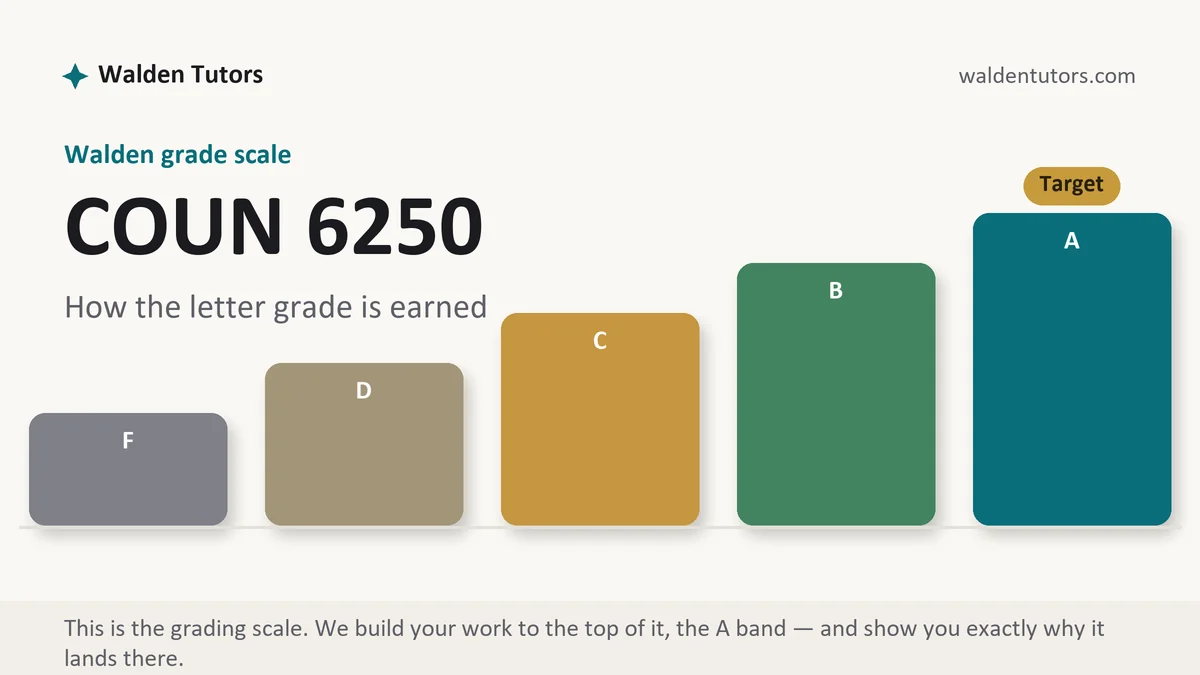
What COUN 6250 actually grades
Written work about things that happen between people. Expect group proposals, session analyses, leadership write-ups, ethical case responses, and reflective pieces on your own behavior inside a group. What the rows reward is process language: not what the members talked about, but what the group did with it. A paper that recounts the content of a session and never names a dynamic has described a conversation, and a course built around dynamics cannot give it much.
How we help in this course
Group writing needs a vocabulary most students only half own by week two, so our drafts install it: stage language used accurately, therapeutic factors named where they are actually operating, leader interventions described as choices with alternatives. Ethics is written into the analysis at the point of decision, since screening, informed consent, and the limits of confidentiality inside a group are where the scored questions live.
The standard applies here as everywhere else on the site. Back within two days, written straight to the rubric rows, checked by a scoring reviewer and again by an APA and originality reviewer, and revised at no cost until the grade target is met.
Weekly manuals for this course
Week manuals for COUN 6250 are published one deliverable at a time, only after that deliverable has been confirmed against a real classroom. There is no public syllabus for this course, and a fabricated week list would be worse than no list. If yours is not up yet, hand it over in chat and the desk works it immediately. Counseling programs sit on a quarter or a semester calendar depending on your program, and the term dates in your student portal outrank anything a website tells you.
COUN 6250 week due?
Upload the group assignment brief along with its scoring guide. First sample free, delivered in a day or two.
The first pass over a group paper
Graders in group courses form their judgment fast, and they form it on vocabulary. Inside the opening paragraphs they are checking whether you write like someone watching a group or like someone reporting a meeting. Phrases such as resistance surfacing in the third session, a member being scapegoated, the leader shifting from directive to facilitative, cohesion arriving late because screening was rushed, all of these signal that the writer has the lens the course teaches. General phrases about members sharing openly signal the opposite. Work closes at 10:59 p.m. Central and 11:59 p.m. Eastern, and the letter grade that follows is stitched together from rubric rows, so the opening that plants the right vocabulary earns credit in every row that comes after it.
What to send with a group assignment
Send the prompt, the rubric, and whatever case or transcript the week supplied. If the assignment grows out of your lab experience, add a short note about what actually happened in the sessions, since a returned draft that references real moments is far easier to make your own than one built on invented events. Delivery notes come back mapping each section to a row, with the ethics passages cited to professional standards rather than asserted, and any place needing your own observation flagged so you can drop it in.
Try one group deliverable free
Use the free first sample on a session analysis or a group proposal rather than something small, because those two show whether a writer can hold process language for several pages. Send the instructions and the scoring guide, read the returned document beside your rubric, and only then decide about paying for anything. The seasonal offer covers the first paid week after that.
How to actually write COUN 6250: where to begin
The rubric goes on screen before the reading does. Rows in group courses are unusually specific, and they tend to ask for four separable things: identify the dynamic, connect it to theory, evaluate the leadership, and address the ethical dimension. Copy them out, make each a heading, write the weight underneath, and then decide your lengths from the weights instead of from your comfort. Most students overwrite identification, which is the easy part, and underwrite evaluation, which is where a counselor's judgment shows. Your classroom decides the exact assignment mix, so check what your week wants before assuming it matches the last one.
Fix the group before anything else. Type, purpose, membership, size, setting, closed or open, time limited or ongoing. These are not administrative details, they are the reason a piece of advice is right or wrong. A confrontation that helps an ongoing process group can damage a six-session psychoeducational group where members never agreed to that kind of work. Once the group is fixed, name the theoretical frame that explains how change happens inside it, and state the mechanism in a single sentence you can hold yourself to. Everything downstream should be traceable to that sentence.
Then write stages as evidence rather than as labels. Saying that a group has entered its conflict stage proves nothing. Saying that two members began challenging the leader's agenda while a third withdrew, and that this pattern fits the conflict stage because authority is being tested rather than rejected, proves the reading. Attach the same discipline to therapeutic factors: universality, instillation of hope, altruism, interpersonal learning, and the rest are useful only when you point at the moment where one of them operated. A quoted line from a transcript followed by your interpretation of it is the single strongest paragraph shape available in this course, and it is available in nearly every assignment.
Handle leadership and ethics as decisions with alternatives. A leader intervention is worth writing about because the leader could have done something else, so name the other option and say what would probably have followed. That comparison is the evaluation row. For ethics, group work carries problems individual work does not: confidentiality cannot be guaranteed because members hold it too, screening decides who is safe for the group and who the group is safe for, informed consent has to cover the risks of disclosure among peers, and dual relationships multiply when members know each other outside. Cite the professional standard governing the decision rather than paraphrasing it, and search the Walden Library for the empirical support instead of the open web, where the practitioner blogs will cost you an evidence row.
| Section | What goes in it | What earns full rubric points |
|---|---|---|
| Group definition | Type, purpose, population, size, setting, membership structure, and duration. | Each detail is later used to justify a decision, rather than listed and abandoned. |
| Theoretical frame | The model guiding the group and the mechanism of change it proposes. | One mechanism stated plainly and traced through every recommendation you make. |
| Stage and process analysis | Observed member behavior, the pattern it forms, and the stage that pattern indicates. | Behavior comes first and the label comes second, with the inference shown in between. |
| Leadership evaluation | The intervention chosen, its effect on the group, and the alternative that was available. | A comparison between what was done and what could have been done, with a reasoned verdict. |
| Ethical and legal handling | Screening, consent, confidentiality limits among members, and boundary questions. | The standard is cited and then applied to a named decision inside your own group. |
| Multicultural fit and reflection | How the group works for members whose norms differ, and what you learned about your own leadership. | A specific adjustment for a specific difference, plus one honest thing you would change. |
Discussion posts in a course about groups
There is a small irony in a threaded discussion for a group dynamics course, and the rubric knows it. Threads here reward posts that read the thread itself as a group: noticing what has already been said, building on it, and taking a position the conversation has not yet covered. Open with the claim, support it with one named source, and close with the practice consequence. Something concrete about a leader move beats a paragraph agreeing that groups are powerful, and it beats a summary of the assigned chapter, which everyone has already read.
The reply row is scored on its own, and no subject hands you better raw material for it. Name a dynamic your classmate described but did not label. Ask what their intervention would do to the quietest member. Raise the ethical wrinkle their proposal creates. Walden's policy wants posts that carry weight, arrive steadily, and land before the deadline, and it names a minimum of two to four different days in the week for spreading them out. The university is also explicit that requirements are not uniform from course to course or even week to week, so read your own classroom instructions rather than importing a rhythm from a previous term.
Citing group work, and the APA that frames it
Group counseling is a well-documented field, so there is no excuse for an uncited claim about what groups do. Cite the theory to its source, cite outcome claims to research, and cite the ethical standard to the association that wrote it, complete with the year of the edition in front of you. APA 7 mechanics still get scored on their own: the title page Walden expects, heading levels applied consistently, and a reference list that matches your in-text citations one for one in both directions.
Pull the empirical material from the Walden Library databases, where you can filter for peer review and for the population you care about, and take the formatting rules from the Writing Center, whose templates are written to the standard your grader marks against. When you write about your own lab group, keep the identifying details out and treat participants as members rather than names, which protects them and also keeps the paper focused on process where the points are.
The mistakes that cost points in COUN 6250
- A session retold as content, so the reader learns what members discussed and never what the group did with it.
- Stage names applied as decoration, with no behavior underneath to justify the label.
- Leader interventions praised or criticized without ever naming the alternative that was available at that moment.
- Confidentiality described as though the leader can promise it, when in a group the members hold it too.
- Screening skipped in a proposal, leaving no answer to who this group would not be safe for.
- A reflection that reports feelings about the experience but never identifies a habit you intend to change.
COUN 6250 questions students actually ask
Is the group lab part of COUN 6250 or a separate registration?
Separate. Walden's catalog entry states that the group lab is its own zero-credit required course running at the same time as Group Process and Dynamics, and that students have to make sure they are enrolled in both and taking part in both. Zero credits does not mean optional and it does not mean unwatched. Open your registration and confirm the lab section is there beside the course, because discovering the gap later is a scheduling problem rather than a paperwork one.
How honest should the self-reflection be?
Honest about your behavior, measured about your private life. The row is asking what you did as a member or a leader and what it taught you about your own tendencies, not for a confession. Write about the moment you filled a silence that should have been left alone, or the conflict you smoothed over when the group needed it left open, and then say what you would try instead. That is professional self-awareness. A page about unrelated personal history is not, and it puts material into an assignment that does not need to be there.
Which group model should I write about?
The one that matches the group you were given. A psychoeducational group for new parents, a process group for grief, and a task group inside an agency call for different theoretical frames, different leader activity levels, and different session structures. Choose the model that explains how change is supposed to happen in that specific group, state the mechanism in a sentence, then hold the rest of the paper to it. Naming three models and applying none is the version that leaves the application row unfilled.