COUN 6301 is Walden's five-credit Theories of Counseling course. It walks the origins, core concepts, and techniques of the major models, asks you to apply them to case studies, and treats the development of your own theoretical orientation as the main event. The writing is graded on whether a theory explains a client, not on whether you can recite it.
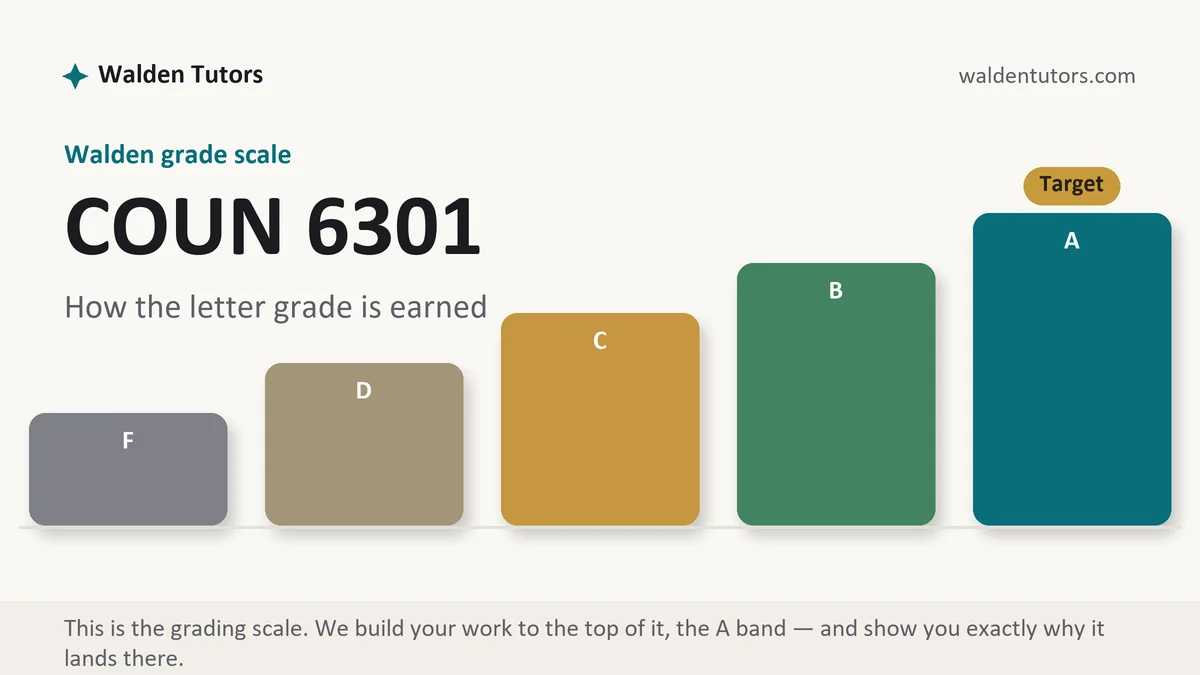
What COUN 6301 actually grades
Conceptualization. The deliverables tend to be theory papers, case applications, comparison assignments, and a personal orientation piece, and every one of them turns on a single question: can you take a model's account of how people get stuck and use it to explain a particular person. Techniques get scored too, but only as consequences of the model. An intervention lifted from one theory and pasted into a conceptualization built from another is the error the rows are designed to find.
How we help in this course
Tutoring reviews theory work from the inside out. The model's assumptions come first, the client is then explained through those assumptions, and goals and techniques should follow from the explanation rather than sit beside it. When the assignment compares frameworks, feedback checks whether your draft finds the real disagreement instead of running two summaries in parallel. You remain the author and decide every final revision.
Same terms as everything else here. Two days or less to delivery, targeting an A on the rows you provide, one scoring review plus a separate formatting and originality review, and free revisions until the target lands.
Weekly manuals for this course
COUN 6301 week manuals appear as individual deliverables are verified, never as a block guessed from another counseling course. Walden keeps its syllabi inside the classroom, which is exactly why nothing speculative goes on this page. Week not listed? Bring it to chat and it gets drafted anyway. Whether you sit in a quarter or a semester is set by your specific program, so read your due dates off the calendar in your student portal and nowhere else.
Working COUN 6301 now?
Paste the prompt, attach the rubric, name the theory. The opening sample is on us and lands inside 48 hours.
What a theories grader notices first
Instructors in this course can tell within a paragraph whether a student is thinking inside a model or standing outside describing it. The tell is the verb. Writing that a theory holds that behavior is learned puts you outside, looking at a textbook. Writing that this client keeps returning to the argument because the pattern was reinforced every time it ended the silence puts you inside, using the model to explain a person. That difference lands in the first thirty seconds of reading, and it colors how generously every later row is scored. Assignments close at 10:59 p.m. Central and 11:59 p.m. Eastern, and the letter that arrives afterwards is built row by row, so an opening that already thinks in the theory buys credit throughout.
What we need for a theory assignment
The prompt, the scoring guide, the case or vignette if one was supplied, and the name of the model if the week assigned one. Where the choice is yours, tell us which direction you lean and the draft is built there, because an orientation paper written in somebody else's voice is worthless to you later in the program. What returns is a conceptualization that holds one frame consistently, techniques drawn from that frame, evidence cited from library sources, and notes pairing each section to its row so you can see the mapping.
One conceptualization on the house
Spend the free sample on a case conceptualization, since that assignment reveals more about a writer than any other item in the course. It exposes whether the theory is genuinely driving the analysis, whether the interventions belong to the model, and whether the cultural discussion is more than a sentence of goodwill. Send the instructions and the rubric, judge what comes back against your own rows, and decide afterwards. The seasonal offer then reduces your first paid order.
How to actually write COUN 6301: where to begin
Read the scoring guide before the case, because the case is seductive and the rows are not. Rebuild every row as a heading in a fresh document and record its weight. In theory assignments the heaviest rows are almost always application and consistency, while the origins and key concepts row is comparatively light, and students reliably invert that ratio by spending two pages on the history of a model and half a page on the client. Write the history short and accurate, then give the client the space the rubric is paying for.
Learn each model by its answers to four questions rather than by its list of terms. What does this theory say a problem is. What does it say causes a problem to persist. What does it say produces change. What does the counselor do to bring that about. Cognitive behavioral work locates the trouble in learned patterns of thought and behavior and changes them through structured practice. Person-centered work locates it in a blocked capacity for growth and changes it through conditions the counselor provides rather than techniques the counselor applies. Solution-focused work steps around cause altogether and builds from exceptions. Psychodynamic work reads present difficulty against earlier relational patterns and changes it by making them visible. Four sentences per model, written in your own words, will serve you better in this course than any set of memorised definitions.
Then conceptualize instead of describing. A description of a client reports what is happening. A conceptualization explains why it persists, using that model's causal machinery, and predicts what would have to shift for the pattern to break. Write the explanation first without naming the theory, then check whether a reader could identify your frame from the reasoning alone. If they could not, the theory is a label on the paper rather than an engine in it. Keep goals downstream of the conceptualization and techniques downstream of the goals, so the whole document reads as one argument. Mixing an insight-oriented explanation with a homework-driven treatment plan is the incoherence a consistency row exists to catch.
Give evidence and cultural fit real paragraphs, not gestures. Every established model has an outcome literature and every model has boundaries, so state where the support is strong, where it thins, and which populations the founding work did not include. Most of these theories were developed in specific cultural settings with assumptions about individuality, disclosure, family authority, and the value of talking that do not travel evenly, and a paper that names one such assumption and adapts around it for a particular client is doing exactly what the multicultural row asks. Draw that support from the Walden Library databases instead of a general search, and take your mechanical rulings from the Writing Center rather than improvising them at midnight.
| Section | What goes in it | What earns full rubric points |
|---|---|---|
| Presenting concern | The client, the situation, and the specific pattern you intend to explain. | One pattern chosen and named, rather than every detail of the vignette repeated back. |
| Theoretical frame | Origins and core concepts of the model, written briefly and accurately. | Short, correct, and pitched entirely at the concepts you are about to use. |
| Case conceptualization | Why the pattern persists, told through the causal logic of that model. | A reader could name your theory from the explanation with every label removed. |
| Goals and interventions | Treatment goals that follow from the conceptualization and techniques that belong to the model. | Every technique is traceable back to the explanation, with nothing borrowed from a rival frame. |
| Evidence and limits | Outcome research supporting the approach and honest statement of where it is weaker. | Support and limitation both cited, with the populations studied made explicit. |
| Cultural fit and your position | Assumptions inside the model that may not suit this client, and where you personally stand. | One named assumption adapted for this client, and a position you can defend rather than a preference. |
Discussion posts in a theories course
Threads here usually put a short vignette in front of you and ask how a given model would read it. The post that scores does the reading rather than reporting on it: two or three sentences of conceptualization in the theory's own logic, one intervention that follows from it, one citation, and a line about what the model would miss. Skip the introductory summary of the framework. Everyone in the thread has the same chapter, and the row wants your application of it. Getting in early also gives the thread somewhere to go, which is the only way the exchange the rubric imagines can actually happen.
Replies work best when they test the fit rather than praise it. Ask which part of the conceptualization would change if the client's family read the situation differently. Point out that the technique proposed comes from another model than the one your classmate named. Offer the competing framework and say what it would predict instead. The policy sitting behind all of this is short. Contributions should be thoughtful, should keep arriving through the week instead of in one burst, and should be on time. Two to four posting days is the floor Walden names. What the university declines to fix is a single number, since it says openly that requirements differ between courses and between weeks of one course. Take the count and the deadline from your own classroom.
Sourcing a theory paper, and the APA that governs it
Theory writing invites two citation habits that cost points. The first is citing only the textbook, which flattens every model into one author's summary. The second is citing the founder for everything, which leaves your paper reading as though nothing has been tested since. Balance the two: an original source for a concept where you can reach it, a current empirical article for an outcome claim, and the course text for orientation. Anything you paraphrase closely still needs a citation, and secondary citation formatting matters when you are reporting one author's account of another.
Mechanically the expectations are the usual ones. APA 7 title page in the format Walden supplies, headings applied consistently at the right levels, in-text citations matching a reference list with no strays in either direction, and quotations kept rare because a theory paper should be argued in your own sentences. Search the Walden Library databases for the outcome literature, since the filters there let you match a study to the population you are writing about, and take formatting rules from the Writing Center rather than from memory.
The mistakes that cost points in COUN 6301
- A history of the theory that runs longer than the analysis of the client it was supposed to explain.
- Techniques imported from a rival model, so the treatment plan contradicts the conceptualization above it.
- A conceptualization that describes what the client does without ever explaining why the pattern holds.
- An orientation paper built on which theory feels comfortable, with no account of change to justify the choice.
- Cultural considerations added as a closing paragraph rather than applied to a specific assumption in the model.
- Outcome claims made with no research behind them, in a field where the outcome research is easy to find.
COUN 6301 questions students actually ask
How do I pick an orientation when several appeal to me?
Stop asking which theory you like and start asking which account of change you believe. Write one sentence saying what causes people to get stuck and one saying what frees them, then find the framework whose claims sit closest to yours. Liking a set of techniques is not an orientation, because techniques travel between models while explanations do not. Walden describes this course as supporting the development of a personal theoretical orientation, so the paper is allowed to be provisional. Saying that your position is where you currently stand and naming what would change your mind reads as maturity, not indecision.
What does case conceptualization actually mean?
It means explaining a client rather than describing one. A description lists what is happening. A conceptualization says why it keeps happening, using the causal machinery of one theory, and then predicts what would need to shift for the pattern to break. Two counselors using different models will conceptualize the same intake differently and both can be defensible, which is the point of the exercise. Test your draft by asking whether a reader could name your theory from the explanation alone with every label removed.
Do I have to agree with the theory I am assigned?
No, and disagreement handled well scores better than forced enthusiasm. What the rows require is that you represent the model accurately before you argue with it, because a critique of a theory you have misdescribed is not a critique. Set out its account of the problem and its method of change on the theory's own terms, apply it honestly to the case, then say where it thins out, who it fits poorly, and what evidence supports your reservation. Reasoned dissent is a professional skill and it is visible on the page.