DDBA 8101C is the mentoring seat on the consulting route through Walden's DBA. Its catalog title is Doctoral Study Mentoring, it is carried at one semester credit and taken again as your work continues, and the letter on the end matters: this line runs on to DDBA 9001C, which Walden lists as Doctoral Consulting Study Completion. The document the seat exists to get approved is the plan for that capstone.
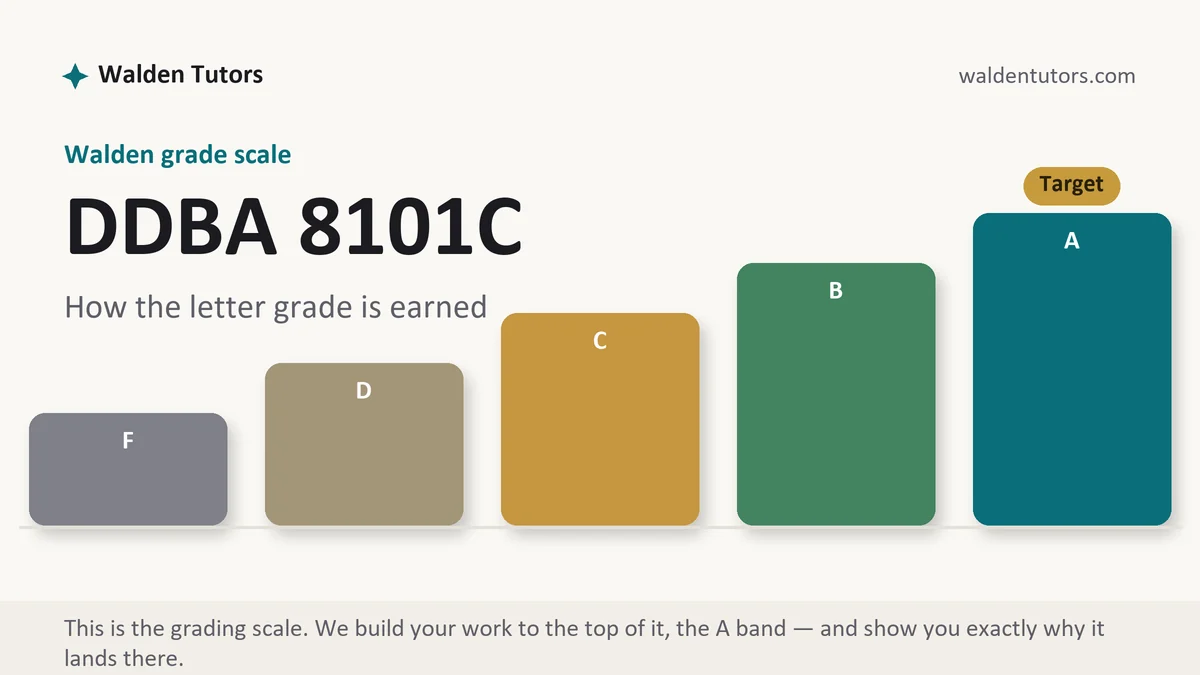
What DDBA 8101C actually grades
Movement, shown in writing. There is no reading list here and no final exam. Walden describes the mentoring course as a standing forum where you trade ideas and feedback with your peers and with the faculty member chairing your committee, and that chair is simultaneously the instructor of record for your section. The person recording your term is therefore the person whose signature every later gate depends on, which ought to change how much you are willing to put in front of them.
What counts as movement is narrow and specific. A business problem that is tighter this month than last. A question that has stopped being a subject heading. A method that now follows from the question rather than sitting beside it. On the quarter-calendar version of this doctorate, Walden's own course description says the mentoring seat carries students toward an initial project plan for the consulting research project, and the semester-coded course you are enrolled in serves that same purpose on a different clock.
One thing the seat is not measuring is your pace against the room. Sections deliberately mix candidates at several stages, so somebody in your forum is a year further along and somebody else opened the classroom yesterday. Neither of those facts says anything about whether you are behind.
How we help in this course
Bring the document and the feedback in the same message. A consulting capstone plan succeeds or fails on whether the client problem, the research question and the intended method are describing one piece of work, and chairs send these back for failures in the joints far more often than for anything a proofreader would catch.
Send the current draft, your chair's comments copied out exactly, and whichever edition of the program requirements your school is enforcing this year. You get the plan rebuilt with every comment answered in a paragraph of its own and a change log saying what moved and for what reason. Terms are the same across this site: turnaround of 24 to 48 hours, two separate quality reads before anything is released, revisions carried on until the document clears.
Weekly manuals for this course
Mentoring publishes no weekly deliverable list, and printing an invented one to make this page look complete would be dishonest. The calendar question underneath it does have a clean answer, though, and it is worth having before you plan around any date. Walden maintains this doctorate as two parallel builds, and the prefix on your transcript is the tell. Codes beginning DDBA sit in the semester version of the degree and are priced in semester credits, which is why the chip at the top of this page reads one semester credit. The quarter version of the same doctorate runs under DBAX codes and counts in quarter credits. You are on the semester side. What your portal still owns is the specific start and end dates, and those are worth checking rather than assuming, because the completion sequence waiting after mentoring is published as two eight-week terms sitting inside a semester rather than one unbroken run. Manuals for this seat go up as each milestone is verified against Walden's published material. Until yours appears, bring the paragraph you are stuck on into chat and we will start from the sentence causing the trouble.
In DDBA 8101C right now?
Send the plan, the program requirements you were given, and whatever your chair wrote back. Your first sample costs nothing and the turnaround is measured in hours rather than weeks.
The brief asks for one thing, the submission is another
Read enough returned mentoring documents and the same distance keeps appearing. The brief asks you to isolate a problem inside an organization that evidence could actually resolve. What lands on the chair's desk is an account of a company having difficulties, written fluently, referenced properly, and pointing at nothing anybody could study.
The consulting route makes that trap worse instead of easier, because you already know how to write the other document extremely well. Fifteen years of being paid for recommendations produces a recommendation without the writer noticing. The shape comes out as situation, then analysis, then proposed intervention, then expected benefit. For a client that is excellent work. For a chair it is the wrong genre entirely. A doctoral plan travels in reverse: here is what the evidence has not yet settled, here is why existing work cannot settle it, here is the study capable of settling it.
The second gap is quieter and costs just as much. You are asked what remains unknown, and what you hand in is a careful account of what is known. Twelve sources, each summarized accurately, no claim anywhere about the point where the evidence runs out. Your reader finishes better informed and still cannot say why your study has to exist.
What a term of this work looks like on our desk
Orders in this seat usually arrive mid-cycle rather than at a clean start. Something has come back for the second time, the comment attached to it runs three lines, and you cannot tell which of several possible readings it carries. The first job is diagnostic instead of editorial: which required elements genuinely exist, which are headings with nothing underneath them, and which single broken joint is causing the review to fail further down the document.
Two returns can look almost identical on the page and mean opposite things. One is telling you the scope has no edges. The other is telling you the claim has no evidence sitting under it. Repairing the wrong one costs an enrollment you have already paid for, so copy the comment out exactly as your chair typed it rather than summarizing it for us. The rebuild comes back within two days, annotated element by element, which lets your next meeting be about the research instead of about whether you listened.
If your route runs through a named client organization, say so in the order and say what access you hold in writing. A design that assumes interviews nobody has agreed to is a design that will be returned, and building around the access you have is far cheaper than rebuilding after somebody says no.
How to actually write the DDBA 8101C plan: where to begin
Do not begin in an empty file. Walden issues the current capstone requirements through the classroom and the research resources attached to it, and those requirements get revised between catalog years, which makes the copy a colleague forwarded you two years ago a liability rather than a shortcut. Ask your chair in writing which version governs you. Then build a skeleton: every required element as its own heading, in the published order, with the requirement itself sitting underneath in a color you strip out at the very end. Omission is the cheapest failure to prevent and the most expensive one to discover at review, and a skeleton makes it impossible.
Write the specific business problem next, ahead of the literature, ahead of the method, ahead of everything. One sentence, defensible across a table, bounded on three axes: who is affected, in what setting, with what consequence somebody could observe. Compare two attempts at the same idea. Regional logistics firms struggle to retain warehouse supervisors is a subject heading wearing a full stop. The version that works names a size band of firm, names the operational setting, and states the consequence in something a manager already counts, such as unfilled shifts or overtime spend. Everything downstream is generated out of this sentence, which is exactly why a loose one contaminates the whole document rather than staying where you put it.
Chain forward on purpose after that. Lift the nouns out of the problem sentence and refuse to swap them for synonyms anywhere later. Your purpose statement announces that you intend to study precisely that. Your research question puts the same thing in interrogative form. The method should then fall out of the question rather than being picked. If you are asking how managers make sense of something, the design was decided the moment the question was written, and it is qualitative. If you are asking whether one measured thing moves with another, the same logic runs in the other direction. Read the four in sequence out loud, and treat any noun appearing in the third that is absent from the first as a break, because reviewers spot that kind of break faster than anything else in the file.
Budget for two versions of the document rather than one. Walden's published description of the mentoring seat has candidates producing a draft and then a final version of the plan, with the capstone unable to open until the final one clears, and that two-step shape is an advantage if you use it the way it was built. The draft is the inexpensive place to be wrong. Send it while the problem sentence is still soft enough to move, and attach a short covering note naming the parts you are least confident about, because a chair who has been told where the soft ground is reads differently from one handed a document that presents itself as finished. Candidates who sand the draft down until it looks like a final version usually get a final-quality review of something that needed a structural one, and they spend an extra enrollment repairing what a blunt early read would have exposed in a single week.
The literature section in a plan is short and it is not a book report. Its only job is to prove that the gap you are claiming is real. That takes three moves: establish what current evidence does support, mark the point where it stops, and say who is affected by the stopping. Synthesis is how those moves get made. Put studies into argument with one another, name where two of them agree, name where a third contradicts them, then name the question none of the three answered. A paragraph opening with a researcher's surname has almost certainly summarized. A paragraph opening with a claim about the state of knowledge and then producing three studies that disagree about the mechanism has synthesized. Pull all of it through the Walden Library, and keep a source matrix that records, for every entry, the design used, the population studied and the finding you are relying on.
Your program document sets the required headings and it is the only authority on them. The table below is not that list. It is what a reviewer is actually testing underneath whichever headings you were handed.
| Working part | What it does | Where it fails |
|---|---|---|
| Client problem framing | Names a business problem inside a real organization and bounds it to people, place and a recorded outcome. | The organization gets described at length and the problem never separates itself from the description. |
| Feasibility and access | States what data you can obtain, from whom, and under whose permission. | A design resting on interviews, records or mailing lists nobody has agreed to release. |
| Question to method fit | Shows the design arriving as a consequence of the question rather than ahead of it. | A method the candidate already knows, retrofitted afterwards with a paragraph of justification. |
| Evidence base | Establishes that published research stops short of answering what you are asking. | A reading list where every source is summarized and no two are ever set against each other. |
| Contribution to practice | Says which practitioner does something differently once the answer exists. | Adding to the body of knowledge, with no human being named anywhere in the claim. |
| Feedback log | Tracks each chair comment beside the exact change that answered it. | Comments answered in spirit, which produces the identical return a term later. |
Using the forum instead of enduring it
Walden puts a forum at the center of its description of this course, which means the board is not a box you tick before the real work starts. The people posting alongside you are on the same road at different mile markers, and the ones ahead of you have already walked into the wall you are currently approaching. So post the problem rather than the progress. Saying that the same element has come back twice and you cannot see what the difference is supposed to look like will pull genuine help out of the room. Saying the term is going well will not.
The grading policy Walden publishes wants posts that carry substance and arrive on schedule, and it recommends spreading them across two to four days instead of dropping the lot in one sitting, which exists for the obvious reason that a conversation needs more than a single moment in which to happen. Walden is explicit that no single posting rule covers every course, or even every section of one, so read your own item rather than importing a habit from a previous classroom. The clock on Course-Based submissions runs on Central time, so 10:59 p.m. there equals 11:59 p.m. in the Eastern zone.
Citations and APA at plan level
APA 7 is read here as evidence of care, not as typography. A plan whose reference list will not reconcile against its citations plants a specific doubt in the reader: if this much slipped here, what slipped inside the method. Removing that doubt costs a great deal more than preventing the errors would have. Run reconciliation as its own pass, on paper or at reduced zoom, because reading for sense makes the eye skip over exactly these mistakes.
Recency is the other half of the judgment. Reviewers of doctoral plans generally want the weight of your evidence sitting in current peer-reviewed research, with anything older earning its place by being genuinely foundational and labeled that way. Your program document states the expectation that binds you, and that line rewards being read literally. Do the searching in the Walden Library instead of a general engine, since the databases behind that expectation are the ones your school subscribes to, and store what you find in a matrix you can answer questions from without reopening the file.
What quietly costs candidates a term here
- A plan written as a client recommendation, answering what should be done instead of what nobody yet knows.
- Access assumed rather than secured, so the whole design collapses the first time somebody has to grant permission.
- Vocabulary drift, where the problem, the purpose and the question stop naming the same study.
- A gap declared in one sentence and then never demonstrated with evidence anywhere in the section.
- Downtime treated as a break, so the weeks between chair replies produce nothing to reply with.
DDBA 8101C questions candidates actually ask
Is DDBA 8101C a different course from DDBA 8101?
Both carry the catalog title Doctoral Study Mentoring and both are priced at one semester credit, so on paper they look interchangeable. The suffix is what separates them. Walden's semester program of study runs the C-coded line through to DDBA 9001C, listed as Doctoral Consulting Study Completion, while the unsuffixed line finishes at DDBA 9001. Since the capstone waiting at the end differs, the work you should be doing right now differs too. Check your own program of study rather than borrowing an answer from somebody in your section.
How many terms of mentoring should I expect?
No honest number exists outside your committee. The seat carries one semester credit and is taken again, your published program of study sets what your route requires, and enrollment continues until the plan is approved and the completion sequence opens. Review cycles are the real unit of measure. Someone who walks in with a bounded problem sentence tends to need fewer cycles than someone who walks in with an interest. Read the program of study for the requirement, then ask your chair where you actually stand against it.
My employer will not release its data. Is the study finished?
The study is fine. The plan is not, and it needs rebuilding around what you can genuinely obtain. Access is a design constraint like sample size or timeframe, and there are usually several honest routes left: public filings, industry datasets, professional association surveys, or practitioners recruited from organizations other than your own. Raise it with your chair the week the refusal arrives, because reshaping a plan early costs one conversation while reshaping it after review costs an enrollment. What you must not do is submit a design that quietly assumes permission nobody has granted.