DDBA 8521 is Seminar in Change Management, listed by Walden at 3 semester credits inside the DBA. The workload in it is not flat. It stays gentle while you are still reading, then climbs steeply at the point where a research topic of your own has to appear in front of a peer work group with an implementation argument already attached to it. Scholars who go looking for their organizational problem in the opening days of the term arrive at that climb carrying material. Scholars who wait arrive carrying a search box.
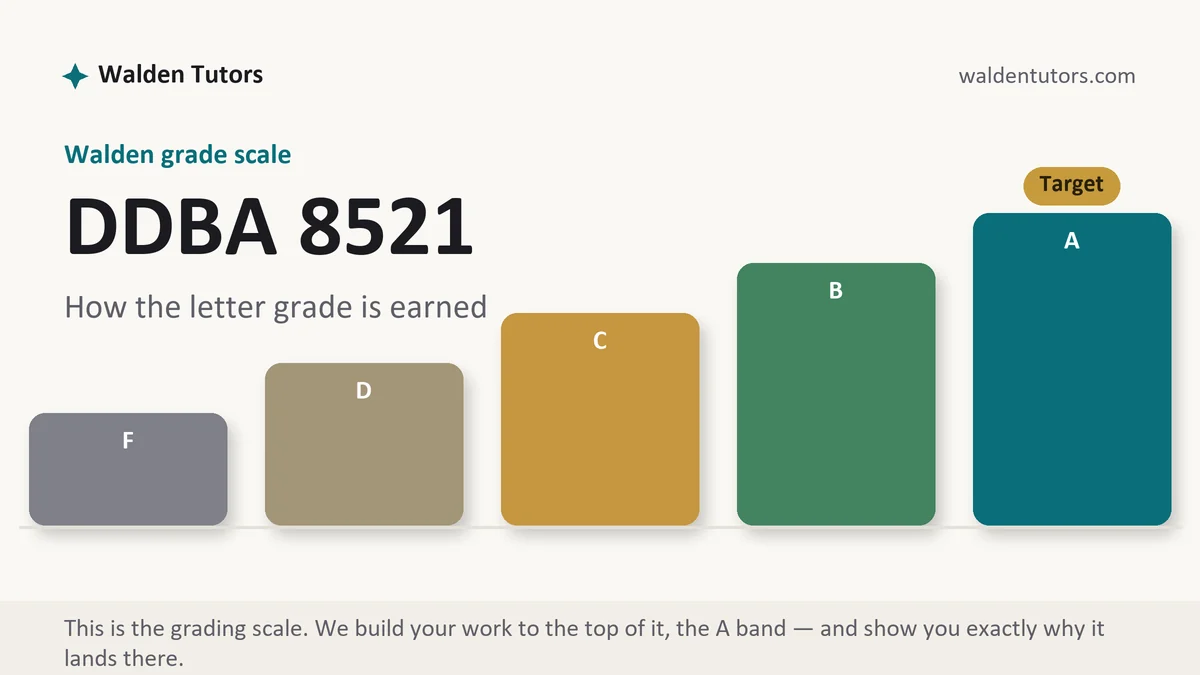
What DDBA 8521 actually grades
Three strands are scored together. The first is problem selection: can you name an organizational issue that genuinely requires a change initiative, rather than one a policy memo would settle by Friday. The second is alignment, which is the idea this seminar returns to more than any other. Walden's description asks you to line up the effort at organizational, process and employee levels, and the rows follow that instruction closely, so a plan that redraws the org chart while ignoring the people who have to work differently is an incomplete plan by definition. The third is how you handle the field's literature. Doctoral treatment means putting established models under pressure, not reciting them in the order a textbook lists them.
There is a fourth thing being graded that nobody writes on a rubric, and it is readiness. Original topics are formulated by each scholar and then presented to peer work groups, which means your thinking becomes public property partway through the term. A topic that still lives only in your own head on the day the group convenes is a topic nobody can help you sharpen, and you lose the one round of free consultancy the seminar hands out.
How we help in this course
Most 8521 work falls into four shapes: a paper defining and evidencing the change problem, a comparison of models against a setting, an implementation strategy with sequencing and measures, or preparation for a work-group session. Tutoring reviews your draft against the scoring guide and returns a row map showing where each criterion is answered or still needs work. You remain the author and decision-maker.
Terms are the same ones the rest of this site runs on. Turnaround sits at 24 to 48 hours, the target for course-based work is an A, two separate reviewers read every piece before it leaves us, and revisions stay free until the deliverable does its job. If your instructor or work group has already commented on an earlier draft, attach those comments with the order and we will write against what was actually said rather than against our guess at it.
Weekly manuals for this course
We publish a manual for a given week of 8521 once that week has been checked, and not one day earlier. Walden releases its syllabi to enrolled scholars inside the classroom, so any outside site printing a full deliverable schedule for this seminar is guessing, and we would rather leave a gap than fill it with fiction.
Term length is the one piece of admin this page can state flatly. Walden runs a quarter calendar and a semester calendar side by side, and the prefix on your registration says which of them you live under: DDBA is the semester build, DBAX is the quarter one. Treat the start and end dates in your student portal as the authority. Nightly cutoffs do not vary: 10:59 p.m. Central, 11:59 p.m. for anyone living on Eastern time. Where a week has no manual yet, bring it to chat and you will have scope and pricing the same day.
Sitting on an 8521 change problem that will not behave?
Send the prompt, the scoring guide and whatever you have written so far. First premium draft free, back inside two days.
How to actually write DDBA 8521: begin at the problem, not the model
Choose an organization you have watched from close range. Doctoral change writing collapses when the writer has only read about the setting, because the interesting detail in this field is always operational: who signs off, what the workaround is, which shift resents which policy. Pick a unit you know at that resolution, then narrow until you have one behavior that needs to be different and one gap you could describe to a stranger in thirty seconds. A stalled system rollout, a quality checklist staff skip when the queue builds, a merger that left two teams running incompatible schedules. Small and observable beats grand and vague every time in this seminar.
Now separate the symptom from the problem before you write a word of the paper. Turnover is a symptom. Missed deadlines are a symptom. The problem sits underneath, in the incentive that rewards the old behavior, the process step that makes the new behavior slower, or the manager who was never told the change was theirs to carry. State the problem in a sentence that contains a unit, a behavior and a gap, and put the evidence for the gap right beside it. Reviewers at this level accept almost any topic that is properly bounded and refuse almost every topic that is not.
When you reach the models, compare rather than catalog. A staged model such as Kotter's is a claim about sequence. A field-based model such as Lewin's is a claim about equilibrium and the forces holding it in place. An individual-level framework such as ADKAR is a claim about what has to happen inside one employee before adoption is possible, and a diagnostic model such as Burke-Litwin is a claim about which organizational variables move first. Say what each one makes visible and what it hides, then choose. Two paragraphs that put a model against your own case and report where the fit fails will out-score six pages of definition, because the fit failure is where original contribution actually begins.
Build the implementation strategy on the three levels the course names, and make each level concrete enough to argue with. At the organizational level, say what the sponsor commits to and what structure or policy has to give way. At the process level, redraw the actual sequence of work: what step disappears, what step is added, who now hands off to whom, and what the new cycle time is expected to be. At the employee level, name the group whose day changes most, say what capability they need, what they lose by adopting, and how that loss is compensated. Then close the loop with measures. A measure worth writing has a source, a baseline, a review point and a person, and if you cannot supply those four, you have written an aspiration rather than a metric.
Resistance deserves its own treatment, and the doctoral move is to stop treating it as an obstacle. The literature that matters here reads resistance as information: staff who push back are often reporting a real defect in the design, the training, or the timing. Write a paragraph that distinguishes the objection you intend to answer with communication from the objection you intend to answer by changing the plan. That distinction is rare in student drafts and graders notice it.
Synthesis is the habit that separates a doctoral literature section from a competent one. Organize by construct, not by author. Open a table with your themes down the side, readiness, sponsorship, sequencing, resistance, sustainment, and your sources across the top, then fill the cells. Every paragraph you write from that table should begin with a claim of your own, position two or three studies with respect to it, and say plainly where they disagree. If a paragraph starts with a surname it is almost always a summary. Pull the sources through the Walden Library rather than open search, since Business Source Complete, ABI/INFORM and the SAGE and Emerald collections hold the management journals your rubric assumes, and mix the seminal work with recent empirical studies so the section shows both roots and currency. Under APA 7 the author and year belong inside the sentence making the claim, heading levels have to stay consistent from first page to last, and nothing sits in the reference list without a citation pointing at it. The Writing Center owns the templates Walden grades against, and copying their formatting is quicker than defending your own.
| Section | What it does | Common failure |
|---|---|---|
| Change problem and setting | Names the unit, the behavior that must shift and the evidence that a gap exists. | A topic the size of a culture, with no unit and no way to tell whether anything moved. |
| Diagnosis | Traces the symptom back to the incentive, process step or ownership gap producing it. | Symptoms restated at length and mistaken for causes. |
| Model comparison | Weighs staged, field-based and individual-level frameworks against your setting and picks one. | A single model named early, then never allowed to shape the plan that follows. |
| Implementation at three levels | Sets out organizational commitments, redrawn process steps and the employee experience of the change. | All three levels asserted in one sentence each, with no sequencing and no owner. |
| Resistance and readiness | Separates objections answered by communication from objections that should change the design. | Resistance treated as a personality defect to be managed away. |
| Measures and sustainment | Attaches source, baseline, review point and owner to each indicator, and says what holds the gain. | Metrics with no baseline, and a plan that ends the day the rollout finishes. |
Posting when the thread is a work group
Threads in this seminar behave less like debates and more like consulting reviews, because the material under discussion is usually somebody's live topic. That changes what a strong initial post looks like. Bring the decision you made about your own change problem, show the reasoning, and name the piece you trust least. Confidence is cheap in a change management thread. A clearly stated doubt gives your colleagues something they can actually work on.
Walden asks for participation that is substantive, consistent and delivered on time, and its grading policy recommends spreading contributions across at least two to four separate days rather than dropping everything in one late evening. Walden also states openly that posting expectations differ between courses and even between weeks, so the brief inside your own classroom overrules any rhythm you carried in from an earlier term. When you reply, aim at the design rather than the prose. Ask who owns the change after the sponsor moves on, ask what the affected staff give up, ask what evidence would tell them by month three that it had failed. Those three questions have saved more implementation plans than any amount of agreement ever has.
The mistakes that cost points in DDBA 8521
- Choosing a topic so large that no before-and-after could ever be described, then defending its importance instead of its boundaries.
- Listing every model the module covered and committing to none of them, which reads as reading rather than reasoning.
- Writing an organizational plan that never says what a single employee does differently.
- Treating pushback as an attitude problem, so the design keeps whatever defect the pushback was reporting.
- Indicators announced with no baseline, no owner and no date, which cannot show movement in either direction.
- A literature section arranged author by author, where each paragraph opens with a surname and closes without a claim.
- Arriving at the work group with a topic that has not been written down, so the session produces sympathy instead of critique.
DDBA 8521 questions students actually ask
How do I pick a change problem a doctoral seminar will accept?
Pick something small enough to be described and painful enough that someone has already tried to fix it. A stalled software rollout in one division, a safety protocol that staff quietly work around, a merger of two scheduling systems that nobody uses the same way. Those give you a visible before, a visible attempt and a visible outcome, which is exactly the raw material an implementation argument needs. Enormous topics such as culture or morale sound doctoral and behave badly, because you cannot say what changed, for whom, or by when. Write your candidate problem as one sentence naming the unit, the behavior and the gap. If that sentence needs a colon and three clauses, the topic is still too big.
Do I have to use Kotter, or can I argue with him?
Arguing is the higher-scoring move, provided the argument is evidenced. A staged model is a claim about sequence, and sequence claims can be tested against your own case. If your organization built its coalition after piloting rather than before, say so, cite the studies that report the same reversal, and explain what the deviation cost or saved. What loses points is neither loyalty nor dissent but decoration: naming a model in the opening pages and then writing a plan that owes nothing to it. Whichever model you take, it has to be visible in the shape of your implementation strategy, not just in your reference list.
How much of the paper should be the implementation strategy?
Let the scoring rows decide, then check the balance against a simple test: could a reader hand your plan to a manager and have them know what happens first. Most drafts that come to us are back-heavy on diagnosis and thin on execution, with pages of context and a closing half page of recommendations. Diagnosis earns its space only when each finding is later picked up by an action. If a paragraph of background never reappears in the plan, it is not analysis, it is scenery, and cutting it buys room for the sequencing, the ownership and the measures that actually get scored.