DDBA 8523 is Seminar in Law and Compliance, carried by Walden at 3 semester credits in the DBA. The hard part of the term is not spread evenly. Early on you are reading about fraud, bankruptcy and the regulatory answers that followed the housing collapse, and that reading goes quickly. The load jumps the moment a general interest in regulation has to become one original research topic, defended in front of classmates who will critique it. Every day you spend early with a statute open and a candidate question written down is a day you will not spend later rebuilding one under time pressure.
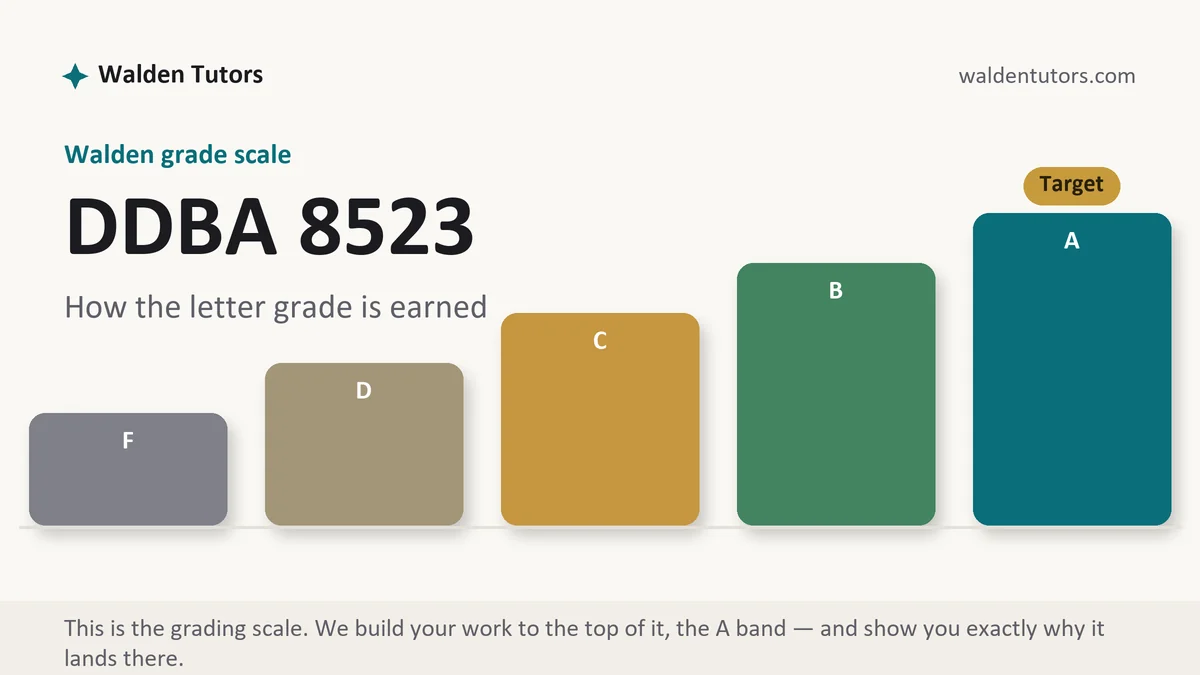
What DDBA 8523 actually grades
Accuracy about the rule comes first. The seminar sits on named regimes, Sarbanes-Oxley, Dodd-Frank and the Foreign Corrupt Practices Act among them, and a paper that paraphrases a requirement loosely has already lost the reader who knows it. You do not need to write like an attorney, but you do need to name the provision you are relying on and represent it correctly.
Then comes the move that separates strong papers from weak ones: converting a legal subject into a business research question. Whether conduct was lawful is a question for a court. Why a control failed, who was accountable when it did, what the incentive scheme quietly rewarded, and whether a remedy would survive a busy quarter are questions a doctoral business scholar can actually investigate. The rows reward that conversion.
Third, the seminar grades what your work would mean if it were true. You are asked to evaluate the potential impact of your findings on business law and compliance, so a paper that stops at description leaves points on the table. Finally there is critique, given and received. Peer review is part of the course, which means your topic has to be written down early enough to be attacked and improved.
How we help in this course
Work from 8523 arrives here in recognizable forms: the analysis of a regulatory regime against a real corporate failure, the compliance program evaluation, the topic paper that has to withstand peer critique, and the piece arguing what a finding would change for practice. Tutoring reviews your draft against the scoring guide, checks whether the law is described and cited accurately, and marks where each row is answered or still needs work. You choose and defend every final revision.
The commitments are unchanged from the rest of the site. Drafts return inside 24 to 48 hours, they aim at an A on a course-based rubric, two reviewers read every piece independently before it reaches you, and revision is free until the work does what it is meant to do. One thing we do not do is give legal advice, and you should not either: a doctoral seminar paper analyzes conduct and controls, it does not tell a company what is lawful.
Weekly manuals for this course
A manual for any single week of 8523 publishes after that week is verified, never on speculation. Walden distributes syllabi through the classroom to enrolled scholars, so no external page can list this seminar's deliverables honestly, and we would rather show an empty slot than a confident guess.
Term length works differently. Walden operates a quarter calendar and a semester calendar together, and the DDBA code you registered under is the semester one, its quarter counterpart carrying a DBAX number instead. The dates in your student portal are still the ones to trust. The nightly deadline is fixed regardless: 10:59 p.m. Central time, or 11:59 p.m. if you are on Eastern. When the week you are in has no manual published, raise it in chat and we will price and scope it the same day.
Turning an 8523 regulation into a research topic?
Send the prompt, the scoring guide and the regime you are working with. First premium draft free, back within two days.
How to actually write DDBA 8523: separate the rule from the question
Split your draft in two before you start writing it. One part describes the requirement, and it must be exact, sourced to the provision itself rather than to a summary of a summary. The other part is your argument, and it belongs to management research rather than to law. Keeping those apart on the page saves you from the drift that ruins most compliance papers, where a description of a statute slides into an assertion about what a company should have done, with no evidence in between and no citation to carry it.
Pick the failure before you pick the theory. Enforcement actions, settlements, bankruptcy filings and inspector reports are a rich seam of published material, and each one gives you a sequence: what the organization did, what the control was supposed to catch, where it did not, and what the authority concluded. Choose a matter that has been publicly resolved so the record exists, and note the sector and the size of the firm, because a control that works in a listed multinational may be unaffordable in a company of two hundred people. That contrast alone has carried many strong seminar papers.
When you write about the regime, be specific about which part of it you mean. Sarbanes-Oxley is not one rule; certification duties, internal control reporting and whistleblower protection do different work and fail in different ways. Dodd-Frank added an award-backed reporting channel that changed the incentives around speaking up, which is a behavioral fact you can research rather than merely describe. The Foreign Corrupt Practices Act carries both an anti-bribery prohibition and a books-and-records duty, and in practice the accounting side catches more firms than the bribery side, usually through an intermediary nobody diligenced. Name the provision, say what behavior it targets, and only then start arguing.
Now build the compliance analysis around elements rather than adjectives. A program is written standards, an accountable owner with genuine board access, training that reaches the people who face the risk, monitoring and testing, a reporting channel people trust, consistent discipline when something is found, and a response that fixes the cause rather than the incident. Walk your case through those elements one at a time, mark which held and which did not, and say what evidence tells you so. That structure will out-argue any amount of general commentary about a culture of integrity, because it produces findings a reader can check.
Do the impact section properly, since the seminar explicitly asks what your findings would mean for the field. Say who would act differently if you were right: the board committee, the line manager who signs off exceptions, the auditor, the regulator drafting guidance. Then say what it would cost them and what would make them resist. Impact claims that name no actor and no cost read as filler.
On sources, go to primary documents and use commentary as a map to them. Agency releases, enforcement orders and court filings are the record; a firm's client alert is a signpost, not authority. Check currency deliberately, because rules and thresholds in this area get amended, and a paper resting on a superseded version is describing something that no longer applies. The Walden Library carries the business journals and can point you to the legal databases your account reaches, and a librarian will find the right one faster than you will. For synthesis, sort your reading by question rather than by author: what predicts program effectiveness, why reporting channels go unused, how enforcement intensity changes firm behavior. Each paragraph should open with your claim and place two or three studies around it. On format, APA 7 defers to legal citation conventions for statutes, regulations and cases, so cite the provision in the form legal readers expect, keep heading levels consistent, and make sure every reference has a matching in-text citation. The Writing Center holds Walden's own templates and will settle formatting arguments before a grader has to.
| Section | What it does | Common failure |
|---|---|---|
| Statement of the requirement | Names the provision, the conduct it targets and the parties it binds. | A whole act cited where a specific section was needed, so the claim floats free of the rule. |
| The case or failure | Sets out a publicly resolved matter with dates, actors and the sequence of events. | A famous scandal retold from memory, with no filing or order behind any of it. |
| Research question | Converts the legal subject into something a business scholar can investigate. | A question only a court could answer, which leaves the paper with nothing to analyze. |
| Program element analysis | Tests standards, ownership, training, monitoring, reporting, discipline and remediation one by one. | Ethics discussed in general terms while no element is ever examined against evidence. |
| Impact evaluation | Says who would act differently, at what cost, and why they might resist. | An impact claim addressed to nobody in particular and costed at nothing. |
| Limits and currency | Records what the public record cannot show and confirms the rule is the version in force. | Analysis built on a threshold or provision that has since been amended. |
Posting about law when you are not a lawyer
Two habits sink threads in this seminar. One is moral commentary, where everybody condemns the misconduct and nobody analyzes the control. The other is amateur legal opinion, where a post announces what a provision means with no citation and no acknowledgement that reasonable readers disagree. Avoid both by anchoring your initial post to a document: quote or paraphrase a specific requirement, cite it, then ask a question about behavior that the document cannot answer on its own.
Walden asks for participation that is substantive, steady and punctual, and its grading policy recommends spreading posts across at least two to four separate days instead of firing them all off at once. Walden also says plainly that expectations vary between courses and within them, so your classroom brief beats any habit carried from another seminar. When you respond to a colleague, test the evidence rather than the sentiment. Ask which section they are relying on, ask whether the control they praise was actually operating at the time of the events, ask what the same program would cost a firm a tenth of the size. Those questions turn a thread of agreement into peer critique, which is what this seminar was built to run.
The mistakes that cost points in DDBA 8523
- Describing a statute in general terms when the argument depends on one particular section.
- Sliding from what the law requires into what the company should have done, with no evidence bridging the two.
- Building a paper on a rule as it was written years ago, unaware that the provision has since been amended.
- Retelling a well-known scandal from memory rather than from filings, orders and settlement documents.
- Praising a compliance program as strong without testing a single element against what actually happened.
- Writing an impact section that names no decision maker, no cost and no source of resistance.
- Using confidential material from your own workplace, which risks far more than a grade.
DDBA 8523 questions students actually ask
Do I need a law degree to write a good compliance paper?
No, and trying to write like a lawyer is the more common way to lose marks. Your seminar is a doctoral business course, so the paper it wants is management research about how firms behave under rules, not an opinion on what a rule means. Describe the requirement accurately and cite it precisely, then spend your pages on the questions a business scholar can answer: why the control failed, who was accountable, what the incentive rewarded, whether the fix would survive a busy quarter. Where genuine interpretation is disputed, report the dispute and cite the sources arguing each side rather than settling it yourself.
Can I write about a case my own employer is involved in?
Be careful, and default to public material. Anything you learned through your role may be confidential, privileged, or covered by an agreement you signed, and a doctoral paper is not the place to find out which. If the matter has been resolved publicly, work only from filings, settlements and press releases that anyone can obtain, and say in the paper that the account rests on public documents. If it has not been resolved publicly, pick a different organization. A comparable case in the same sector will give you the same analytical value with none of the exposure, and your seminar cares about the pattern rather than the name.
How do I cite a statute or a regulation in APA 7?
APA 7 hands legal material over to legal citation conventions, so a statute is cited by its name, its place in the code and its section, with the year, rather than being reshaped into an author and date entry. Give enough detail that a reader can find the exact provision you relied on, including the section or subsection, because a whole act is too coarse to support a specific claim. Agency releases, enforcement actions and guidance documents are cited to the issuing body as author with the year and the retrieval information. When you paraphrase a legal requirement in your own words, put the citation in the sentence making the claim so the reader can check the language you compressed.