One small habit does most of the work between a B paper and an A paper here: stop writing "the customer." Nothing in a business market corresponds to that phrase. There is an engineer who writes the specification, a purchasing lead who runs the negotiation, a finance director who signs, and an operations manager who has to live with the result. Put one of those people into the sentence and your analysis suddenly has a mechanism inside it. Seminar in B2B Marketing carries 3 semester credits and treats selling to organizations as a discipline with its own theory rather than as consumer marketing at a larger invoice value.
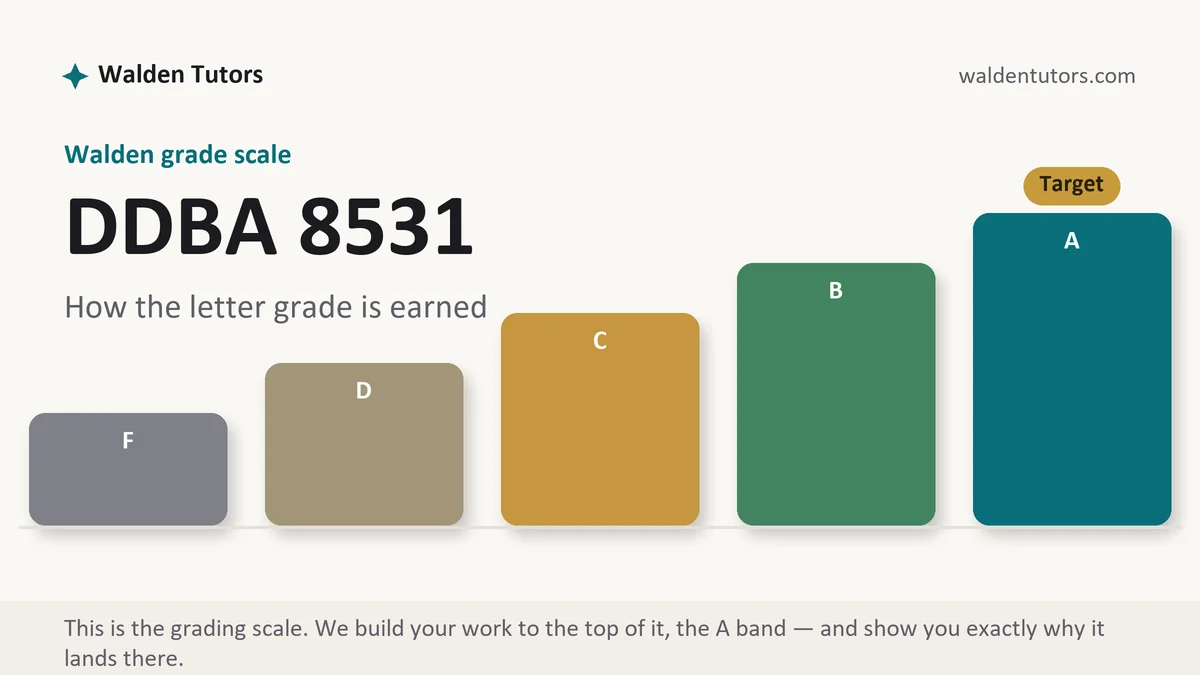
What DDBA 8531 actually grades
Walden's description of the seminar points at three things at once: how firms win business customers and hold onto them, the conceptual problems a marketing manager in this space is currently facing, and the practical territory of online promotion, digital communication and building out a channel. Around all of that sits a doctoral expectation the description states outright, namely that you formulate original research and defend it among peers using foundational literature and established models.
So the rows are split between argument and grounding. Grounding means the classic work is present and used correctly, not paraphrased from a textbook summary. Argument means you did something with it. A submission that explains a model accurately and then describes a company separately, with nothing joining the two halves, scores in the middle of every row it touches, which is a frustrating place to land after a long week of reading.
There is a specific hazard for the many DBA students who already sell for a living. Experience makes your writing confident and your claims unsourced. The seminar rewards the same instinct only after it has been attached to a named construct and a citation, so treat what you know as the hypothesis and the literature as the thing that tests it.
How we help in this course
Work in 8531 tends to include seminar papers on an acquisition or retention problem, discussion contributions that argue from published research, and a longer synthesis piece. Tutoring reviews your draft against the live scoring guide and returns a row map showing which paragraph addresses each criterion and which gaps still need revision. You remain the author and verify every source and claim.
Everything else matches the rest of the site. Delivery runs 24 to 48 hours, the writing aims at an A on a course-based scale, a second reviewer checks the work independently for rubric fit and for APA before it reaches you, and revisions cost nothing until the document is doing its job. Send the industry or account you want the argument built on and we will use it rather than inventing a generic manufacturer.
Weekly manuals for this course
Manuals covering individual weeks of 8531 appear only after that week has been confirmed by someone sitting in the classroom. Syllabi at Walden go to enrolled students, not to search engines, so a public page listing this seminar's deliverables week by week is inventing them, and inventing them is worse than leaving a gap.
Do not take a term length on trust either. Your DBA sequence follows the semester pattern, DDBA being the numbering Walden gives the semester build and DBAX the numbering it gives the quarter build, so open the student portal and read the dates that apply to your own enrollment. The submission clock is the one fixed thing: work is due by 10:59 p.m. Central, an hour later on the Eastern clock. If the week in front of you has no manual, bring it to chat and you will get a scope and a price today.
Stuck on an 8531 seminar paper?
Send the prompt, the scoring guide and the industry you want used. First premium draft free, returned in two days.
How to actually write DDBA 8531: put a job title in the subject slot
Read the assignment prompt twice, then read the scoring guide as though it were the prompt, because that is the document your grader fills in. Where the two point in different directions, follow the guide. Then choose a buying situation rather than a company. A company is a subject; a buying situation is a question. One manufacturer replacing a control system it has run for fifteen years, one distributor deciding whether to add a competing line, one software vendor moving from perpetual licenses to subscriptions across an installed base: each of those has parties, stakes, a sequence and an outcome you can argue about.
Map the buying center before anything else. Organizational buying theory hands you the roles ready made, the person who first raises the need, the people who will use the thing, the technical influencers who write the specification, the gatekeepers who control access, the buyer who negotiates and the decider who can say yes. Fill those roles with plausible job titles from your chosen setting and note what each one is actually optimizing for. Uptime, unit cost, audit risk and personal exposure are different objectives, and a marketing program that speaks only to unit cost fails in front of the person carrying the audit risk.
Then classify the purchase, because the classification changes everything downstream. A first-time buy runs long, drags in more participants and turns on information; a modified rebuy is a fight over one or two changed criteria; a straight rebuy is mostly inertia, and the interesting question is what could dislodge it. Naming which one you are dealing with, in a sentence, saves you three pages of hedging later and shows a reader you know why the sales cycle behaves the way it does.
Now the sentence habit itself. Go through your draft and find every clause where the subject is "the customer," "the client," "the account," "the market" or "the organization." Most of them can be repaired by substituting the role that actually acted. Not "the customer requires a long evaluation period" but "the plant engineer runs a six-month trial before releasing the specification, and procurement will not open a negotiation until that specification exists." The rewritten version states who, what and in what order, which is the raw material of analysis. The original version states a mood. Doctoral graders reward the first because it can be argued with, and a claim nobody can argue with earns nothing.
Handle the digital and channel material with the same discipline. Business buyers research quietly and at length before anyone in sales hears from them, so a plan that treats online activity as advertising misses what it is for. Distinguish the work that creates awareness in a category from the work that captures an enquiry already forming, and say which one your recommendation is buying. When you propose a channel move, name the conflict it will cause, because adding a direct route beside an existing distributor takes revenue from somebody who will notice. A channel recommendation that never mentions the incumbent is not finished.
Build the theory in as you go rather than in a block at the front. Introduce a construct at the point where you need it to explain a decision, cite the origin work rather than a summary of it, and then show the construct doing something. Where two sources disagree, say so and take a side; a paragraph that reports a disagreement without resolving it is exactly the reading log the seminar is trying to train out of you. Pull all of it through the Walden Library, since the marketing and management journals a DBA reader expects are inside the databases rather than on the open web.
Keep the formatting cheap. Under APA 7 the author and year go inside the clause carrying the claim, every heading level stays consistent across the whole document, and no entry sits in your reference list without a matching mention in the text. The Writing Center publishes the templates Walden marks against, and formatting rows are the least interesting marks in the course to lose.
| Section | What it does | Common failure |
|---|---|---|
| Buying situation | Fixes one firm, one purchase and one time window as the case being argued. | A company profile stretched across the paper, with no decision to analyze. |
| Buying center map | Names the roles involved and what each of them is trying to protect or achieve. | A single decision maker assumed, so the whole program speaks to one motive. |
| Purchase classification | Says whether this is a first-time buy, a modified rebuy or a routine reorder. | Sales cycle length treated as a mystery instead of a consequence of the buy class. |
| Theory in use | Brings each construct in where it explains behavior, citing the origin work. | A framework chapter at the front that never reappears once the case begins. |
| Program and channel design | Sets out the promotion, communication and route to market, with the trade-offs named. | Tactics listed with no account of channel conflict or what they displace. |
| Evidence and measurement | States what would show the recommendation working and by when. | Success described in adjectives, so nobody could tell whether the plan had worked. |
Seminar threads where everybody sells for a living
Discussion in this course has an unusual property: your classmates are practitioners, and several of them have run the exact program you are analyzing. That raises the floor and raises the risk. Anecdote flows easily, citation does not, and the rows are usually written to reward the second. Open your post with the claim, attach the source in the same paragraph, and only then bring in what you have seen at work, clearly marked as your own observation.
Walden asks for participation that is substantive, steady and delivered on time, and its grading policy recommends posting across two to four separate days rather than compressing the week into one late night. Walden also states that requirements shift between courses and between weeks, so the brief in your classroom outranks whatever pattern you learned last term. Replies land best when they push on a mechanism: ask which role in the buying center the classmate's program is aimed at, ask what happens to the incumbent distributor, ask what evidence would tell them within a quarter that it is not working.
The mistakes that cost points in DDBA 8531
- Consumer marketing reasoning transplanted whole, so brand preference does the work that a specification and a negotiation actually do.
- A single buyer assumed, which erases the committee that makes business purchasing behave differently in the first place.
- Frameworks summarized at length and then abandoned before the analysis starts.
- Textbook paraphrase cited where the seminar expects the original paper that introduced the idea.
- Channel recommendations written as though existing partners will not react to losing volume.
- Professional experience presented as evidence without ever being labeled as personal observation.
- Outcomes promised in adjectives, leaving no measure anyone could check next quarter.
DDBA 8531 questions students actually ask
Can I build the paper around my own employer?
Usually yes, and it often produces the sharpest work, provided you handle two risks. The first is disclosure: keep out anything confidential, and say in a line that identifying details have been generalized where required. The second is evidence. What you know from the inside is not citable, so every claim that carries weight in the argument needs either a published source or an explicit label saying it comes from your own observation. Written that way, insider knowledge becomes an advantage rather than a liability.
What counts as a seminal work in this field?
The papers everyone in the area still cites when they set up a problem, usually the ones that introduced the vocabulary you are using. Organizational buying behavior, the roles inside a buying center, the distinction between a first-time purchase and a routine reorder, relationship and exchange theory in industrial markets: each of those has an origin paper, and your doctoral reader expects the origin rather than a textbook paraphrase. Find them by tracing citation chains backward from a recent review article.
How much of the paper should be theory and how much should be the company?
Let the scoring guide decide, then check your draft against it with a highlighter. As a working default, theory earns its space only where it is doing something to the case, so a long framework section followed by a long company section is the shape to avoid. Interleave instead. Introduce a construct at the moment you need it to explain something the firm did, and you will find the theory section shrinks while the analysis rows fill up.